
Houseplant
Deer-Apples
Ibervillea tenuisecta
Also known as Slimlobe Globeberry, Ibervillea
How to grow deer-apples, Ibervillea tenuisecta, a desert caudiciform with a swollen water-storing root, thread-fine leaves and red berries.
At a glance
- Difficulty
- Moderate
- Water
- Sparingly in growth; keep dry when leafless and dormant
- Light
- Bright light to full sun
- Temperature
- Frost-tender; keep above about 5 deg C
- Hardiness
- USDA 9-11, RHS H2, hardy to 5 C
- Type
- Perennial with a swollen caudex and thin annual stems
- Height
- Stems to 2 m; the caudex a compact swollen base
- Native to
- The southwestern United States, Mexico
A desert perennial that stores water in a swollen root, or caudex, and sends up thin seasonal stems that die back in the dry season or cold. It survives hard drought but not frost, so in most climates it is grown as a potted plant kept frost-free and dry over winter. It needs heat, strong light and very sharp drainage, and rots quickly in cold, damp soil.
Hardiness zones describe winter cold alone. Summer heat, humidity, rainfall and the length of the growing season decide as much, so treat the range as the outer limit rather than as a recommendation.
Harmful if eaten
- Do not eat
- The berries
- Harm from
- Eating it
- Affects
- People, cats and dogs
Deer take the small red berries in the wild, which is where the name comes from, but the plant belongs to the cucumber family, whose wild members commonly carry bitter cucurbitacins, so the fruit is best treated as not for people or pets to eat. It is grown for its curious swollen root instead of for its fruit, and there is no reason to taste the berries. Handling the plant is harmless. If a child or pet eats the berries, expect a possible stomach upset and seek advice if symptoms are marked.
Sources: RHS potentially harmful garden plants, North Carolina Extension plant toxicity database
About
Deer-apples is not an apple. It is a caudiciform plant, meaning it forms a swollen, water-storing base called a caudex, and succulent and caudiciform collectors grow it in pots to display that fat, swollen root. From the caudex it sends up thin, wiry stems that climb by tendrils, then dies back to the base when the season turns dry or cold.
It is a desert member of the cucumber family from the American south-west and Mexico, quite unlike the leafy vines most people picture from that family. The leaves are cut into fine, thread-like segments, the epithet tenuisecta meaning finely divided.
The name comes from the small red berries, which deer eat in the wild. It is a plant for the specialist grower instead of the general garden, valued as a caudiciform that survives long droughts on the water held in its root.
Appearance and character
The caudex is a rounded, swollen root that sits at or just above soil level, pale and firm, enlarging slowly over years into the shape that collectors grow the plant to show off.
Stems are thin and wiry, rising from the caudex each growing season and climbing by tendrils over any support, then dying back when growth stops. They are seasonal, not permanent.
Leaves are cut into narrow, almost thread-like lobes, small and sparse, giving the plant a fine, airy look far removed from a broad-leaved gourd.
Flowers are small and yellowish, with male and female flowers on separate plants, so a single specimen may never set fruit without a partner.
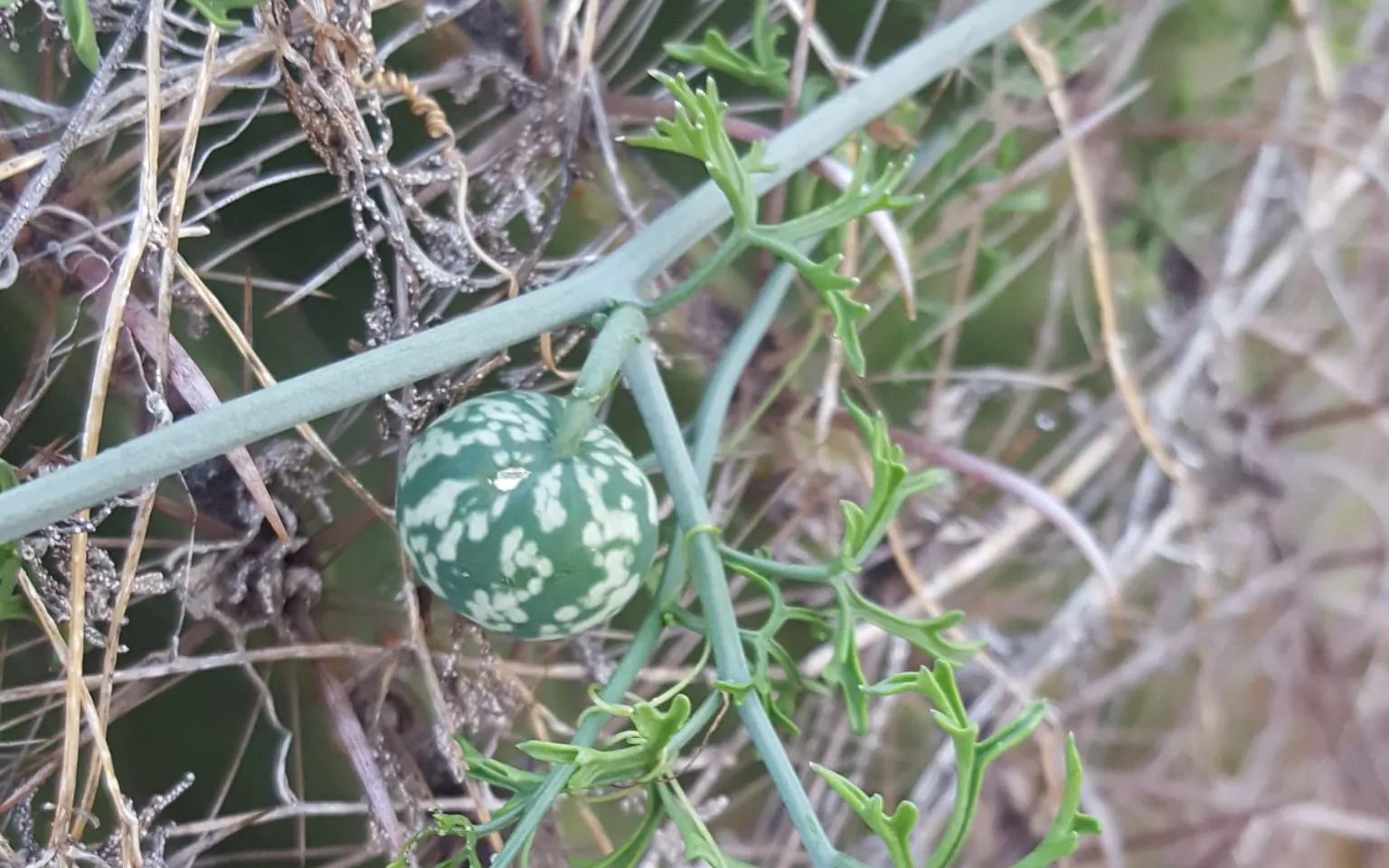
Berries, where they form, are small and ripen bright red, the deer-apples of the name. They are decorative on the plant but not for eating.
Where it is from
Ibervillea tenuisecta grows in the deserts and dry grasslands of the south-western United States and northern Mexico, rooted in gritty, sun-baked ground where rain is scarce and comes in short seasons.
It survives there by storing water in its caudex and growing only when conditions allow, sending up stems and leaves in the growing season and dying back to the root through drought and cold. Frost, not drought, is its limit, so it is grown under cover in cooler climates.
How it grows
Growth comes in a flush when warmth and moisture arrive, with the caudex producing thin stems that climb and leaf out and may flower. During this active period the plant uses the water and food stored in its root.
When the season turns dry or cold, the stems wither and the plant rests as a bare caudex, living on its reserves until the next growing period. This cycle of growth and dormancy is normal.
Grown in a pot, it needs a gritty, free-draining mix, careful watering only while in active growth, and a dry, frost-free rest when leafless. The caudex is displayed above the compost so its shape can be seen, as with other caudiciform plants.
Through the seasons
Spring usually ends dormancy, with the caudex sending up new stems as warmth returns. Begin watering sparingly as growth appears.
Summer is the active season of climbing stems, fine leaves and any flowers. Water lightly when the compost dries and give strong light.
Autumn the stems begin to die back as growth slows. Reduce watering as the plant moves towards dormancy.
Winter the plant rests as a bare caudex. Keep it dry and frost-free, watering little or not at all until spring.
Care difficulty
Moderate, and mostly a matter of restraint. The plant itself is tough, but the common ways to kill it are overwatering and cold, which rot the caudex, so the skill is in watering sparingly, keeping it warm and dry in dormancy, and giving very sharp drainage. Get the watering rhythm right and match it to the growth and rest cycle, and the plant can be long-lived and undemanding.
Watering
Water sparingly during active growth, letting the gritty compost dry out between waterings, since the caudex holds the plant’s own reserve and does not want a constantly wet root. Overwatering is the quickest way to rot it.
When the stems die back and the plant is dormant, keep it nearly dry, giving at most an occasional splash to stop the caudex shrivelling hard. The dry winter rest is part of how the plant stays healthy.
Warning signs, diseases and pests
Root rot is the main danger, brought on by too much water or cold, wet compost. A caudex that turns soft or discoloured is usually rotting, so cut back watering sharply, improve drainage, and keep the plant warm. Prevention through a gritty mix and careful watering matters far more than any cure.
Mealybugs can settle on the stems and in the crevices around the caudex, showing as white woolly tufts. Wipe them off or treat them promptly, since they hide easily on a knobbly root.
The berries should not be eaten, so keep them from children and pets. The plant is grown for its caudex, and the fruit is incidental.
Growing environment
Bright light to full sun suits it, matching its open desert habitat, and good light keeps the growth compact and the caudex firm. Poor light gives weak, drawn stems.
The compost must be very free-draining, gritty and low in organic matter, of the kind used for cacti and other caudiciforms. Ordinary rich, moisture-holding compost stays too wet and rots the root.
Keep it frost-free. In most climates that means a pot that can be brought into a frost-free greenhouse or a bright indoor spot for winter, kept dry and warm until growth resumes in spring.
Feeding
Feed lightly and rarely. A weak, balanced feed once or twice during active growth is enough for a slow desert plant, and heavy feeding forces soft growth and does nothing for the caudex. Through dormancy it needs no feeding at all.
Troubleshooting
The caudex has gone soft. Rot, almost always from overwatering or cold, wet compost. Stop watering, improve the drainage, keep the plant warm, and cut away any clearly rotten tissue. A firm caudex is a healthy one.
It has dropped all its stems. Usually normal dormancy, especially as the season turns dry or cool. Keep it dry and frost-free and wait; new stems should rise from the caudex when growth resumes. If the caudex stays firm, the plant is fine.
Why has it never fruited? It may be a single plant of one sex. Male and female flowers grow on separate plants, so berries need both a male and a female nearby. The plant is grown for its caudex in any case, not its fruit.
Can I eat the red berries? No. Treat them as not for eating. The plant is a wild member of the cucumber family grown for its root, and the berries are best enjoyed only as decoration on the plant.
How do I show off the swollen root? Pot it with the caudex sitting above the compost surface, as collectors do with caudiciforms, so its shape is visible. Keep the mix gritty and the watering careful to keep the root firm and healthy.
Deer-Apples problem guides
Not sure what is wrong? See the common vegetable pests guide.