
Houseplant
Turtle Vine
Callisia repens
Also known as Creeping Inch Plant, Bolivian Jew
How to grow Callisia repens, the turtle vine, a fast trailing mat of tiny round leaves for a hanging pot. It can irritate skin mildly.
At a glance
- Difficulty
- Easy
- Water
- When the top of the compost has dried
- Light
- Bright indirect light, with a little direct sun
- Temperature
- Warm; keep above 10 deg C
- Humidity
- Average to high
- Hardiness
- USDA 10-12, RHS H1b, hardy to 10 C
- Type
- Evergreen trailing perennial
- Height
- 30 to 60 cm of trailing growth
- Native to
- Tropical America
A tender, fast-growing trailing plant from tropical America, grown indoors and outdoors only where it is frost-free. It has no frost tolerance and needs warmth above about 10 deg C and bright light. It grows quickly in warmth and can become a weed in warm climates, so it is risky to plant outdoors where it is not native.
Hardiness zones describe winter cold alone. Summer heat, humidity, rainfall and the length of the growing season decide as much, so treat the range as the outer limit rather than as a recommendation.
Harmful if eaten
- Do not eat
- The sap, which can irritate skin
- Harm from
- Handling it and eating it
- Affects
- Cats, dogs and people
Like its relatives in the spiderwort family, turtle vine has a sap that can cause a mild skin rash or irritation in sensitive people and, more often, in pets that lie on or chew it, so the group is sometimes flagged for dermatitis in cats and dogs. Eaten, it may cause mild mouth or stomach upset. It is not a serious poison, but wash off the sap if it irritates your skin and discourage pets from chewing it.
Sources: ASPCA toxic and non-toxic plants, RHS potentially harmful garden plants
About
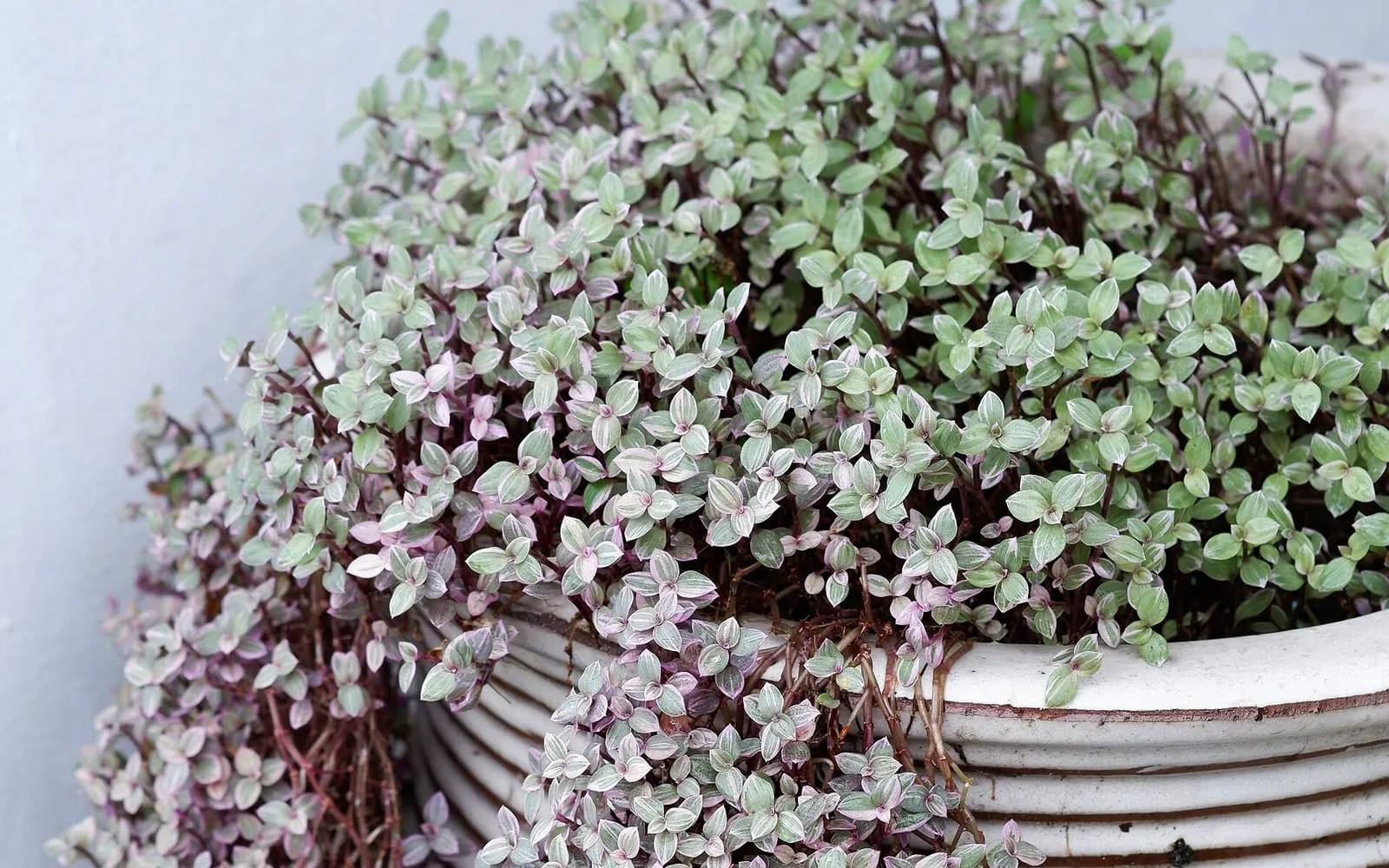
Turtle vine is a fast, trailing plant that spills from a pot in dense curtains of tiny, round, glossy leaves packed along fine, creeping stems. The leaves are small enough to give the plant a delicate, beaded look, and it grows quickly enough to fill a hanging pot in a single season.
It belongs to the spiderwort family, alongside the tradescantias and purple heart, and it shares their easy, vigorous, trailing nature. Some forms have pink-flushed or variegated leaves, and all root readily from any piece of stem.
It is one of the easiest of all houseplants, asking only for warmth, light and the odd trim, though its vigour means it can become a weed outdoors in warm climates.
Appearance and character
Leaves are tiny, round to oval, glossy and closely spaced along the stems, mid green and sometimes flushed pink or purple beneath, or variegated in cream and pink in the named forms.
Stems are fine and creeping, rooting where they touch compost and trailing over the pot edge into dense, cascading curtains up to half a metre or more.
Flowers are tiny and white, tucked among the leaves, and are incidental. The plant is grown for its trailing mat of foliage.
It roots at almost every node, so a broken piece laid on compost quickly becomes a new plant, which is how it fills a pot and how it spreads outdoors.
Where it is from
Callisia repens is native to tropical and subtropical America, where it creeps over the ground and rocks in warm, bright, humid conditions. It is a plant of warmth and quick growth.
That origin makes it easy and vigorous indoors, wanting warmth, bright light and moderate moisture. It has no frost tolerance, and in warm frost-free climates its fast, rooting growth lets it escape gardens and become a weed, so it is best contained.
How it grows
It grows fast in warmth and good light, trailing and rooting as it goes, and fills a hanging pot quickly. It slows in the lower light of winter but rarely stops entirely in a warm room.
Pot it in a free-draining houseplant compost in a hanging pot or on a shelf, and water when the top of the compost has dried. Pinch or trim it regularly to keep it full, and use the trimmings as cuttings.
Give it bright, indirect light with a little direct sun for the best colour, and keep it above about 10 deg C. In too little light it grows pale and leggy with widely spaced leaves.
Take cuttings whenever you like, since any piece roots readily in compost or water. This is the easiest way to refresh a leggy plant or make more.
Through the seasons
Spring starts fast growth again as the light lengthens. This is the time to cut it back hard, repot and start feeding, using the trimmings as cuttings.
Summer is its fastest season, when a pot can fill and spill over in weeks. Water when the surface dries, feed, and pinch the trailing ends to keep it dense.
Autumn growth eases as the light drops. Cut back on feed and water as the days shorten.
Winter the plant rests in lower light. Keep it warm and water less, and expect little new growth until spring.
Care difficulty
Easy, and one of the most forgiving trailing houseplants. It grows fast, roots readily and only needs warmth, light and the odd trim. The main faults are legginess in poor light, rot in cold, wet compost, and, outdoors in warm climates, its weedy vigour. In a pot indoors it is straightforward.
Watering
Water when the top of the compost has dried, soaking it enough to reach the roots and letting the surplus run off. Let more of the mix dry between drinks in winter, when cold, wet compost brings on rot in this plant.
The fine stems and tiny, slightly fleshy leaves cope with a short dry spell, going limp before plumping up again within hours of a drink. Because the leaves hold a little water of their own, err dry instead of wet. Tip out any saucer once it has drained.
Warning signs, diseases and pests
Aphids gather on the soft growing tips, distorting new growth and leaving sticky honeydew. Wash them off or treat early, and encourage the predators that clear them.
Root rot follows cold, wet compost, showing as collapsing, blackening stems. Reduce watering, improve the drainage, and keep the plant warm. Healthy cuttings will restart it if much is lost.
Bare, leggy stems with widely spaced leaves mean too little light. Move it somewhere brighter, and pinch it back hard, rooting the trimmings to thicken the plant.
Growing environment
Bright, indirect light with a little direct sun suits it, keeping the growth dense and the colour strong, especially in the pink and variegated forms. Too little light gives pale, leggy growth.
Warmth and moderate humidity suit it, above about 10 deg C, away from cold draughts. It tolerates ordinary room air and appreciates a little extra humidity.
Give it a free-draining compost and a hanging pot or shelf where it can trail, and keep it contained instead of planting it out in a warm climate, where it can spread.
Feeding
Feed monthly through spring and summer with a balanced liquid houseplant feed at half strength. Turtle vine grows so fast that a hungry plant pales and thins along its trailing ends, and a weak, regular dose keeps the little leaves packed and coloured better than an occasional strong one. Ease off in autumn and stop in winter.
Fresh compost carries enough for the first few weeks after repotting, and a plant resting in winter light needs nothing.
Troubleshooting
It has gone bare and leggy at the top. Too little light, or age. Move it somewhere brighter and pinch it back hard, rooting the trimmings on top of the compost to thicken it up.
The tips are sticky and distorted. Aphids. Wash them off or treat early, and clean up the honeydew.
Can it irritate my pets? It can. The spiderwort family, including turtle vine, is known to cause mild skin irritation in cats and dogs that lie on or chew it, so discourage that and wash off any sap that irritates your own skin.
The stems are collapsing and blackening. Rot from cold, wet compost. Reduce watering, improve the drainage, keep it warm, and restart from healthy cuttings if needed.
How do I make more plants? Take cuttings of any length and lay them on compost or stand them in water; they root within days. It is one of the easiest plants to propagate.
Turtle Vine problem guides
Not sure what is wrong? See the common houseplant pests guide.