
Houseplant
Inch Plant
Tradescantia zebrina
Also known as Silver inch plant, Zebrina, Tradescantia
How to grow Tradescantia zebrina. Keeping the purple and silver colour, pinching to stop it going bare, rooting cuttings in a week, and the name the trade is retiring.
At a glance
- Difficulty
- Easy
- Water
- When the top 2-3 cm dries. Less in winter
- Light
- Bright indirect light. Colour fades badly in shade
- Temperature
- 15-27 deg C. Damaged below 10
- Humidity
- Average room air is fine. Tolerates more
- Hardiness
- USDA 9-11, RHS H1c, hardy to 10 C
- Type
- Evergreen trailing perennial
- Height
- Trails 60-90 cm
- Native to
- Mexico, Central America
- Best month
- November in the Northern Hemisphere, May in the Southern Hemisphere
Southern Mexico and Central America. Easy to the point of being a problem: Tradescantia species smother native ground flora across New Zealand, eastern Australia and the south-eastern United States, and they root from any fragment. In USDA 9 and warmer keep it potted and bag the prunings rather than composting them.
Hardiness zones describe winter cold alone. Summer heat, humidity, rainfall and the length of the growing season decide as much, so treat the range as the outer limit rather than as a recommendation.
Every month named in this guide is for the temperate Northern Hemisphere. If you garden in the Southern Hemisphere, shift each one by six months, so November becomes May. Closer to the equator the wet and dry seasons matter more than the calendar, and the shift stops being a useful guide.
Harmful to pets if eaten
- Do not eat
- The sap in leaves and stems
- Harm from
- Handling it and eating it
- Affects
- Cats, dogs and horses
The ASPCA does not list Tradescantia zebrina itself. It lists the sibling species Tradescantia fluminensis as toxic to dogs, cats and horses, with dermatitis as the clinical sign, and the RHS places Tradescantia in category C as a skin allergen. The two species share the same sap, so the sibling listing is the right guide here rather than direct evidence about this plant. The effect is irritation rather than systemic poisoning. Contact with the sap causes redness and itching on skin, and animals that push through a trailing plant repeatedly can develop dermatitis on the muzzle, belly and paws, which is a documented problem for dogs in countries where Tradescantia has naturalised outdoors. Ingestion causes mouth irritation and an upset stomach. Wash your hands after taking cuttings, and hang the plant where a pet is not walking through it daily.
Sources: ASPCA (Inch plant, Tradescantia fluminensis), RHS potentially harmful garden plants
About
A note on the name before anything else. This plant was sold for decades under a name drawn from an antisemitic legend, and the RHS, the horticultural trade and most nurseries have moved to inch plant or silver inch plant. Those are the names used here.
Inch plant refers to the spacing of the leaves along the stem, and also to the speed at which it grows, which is roughly an inch a week in good conditions.
It is one of the fastest and easiest houseplants available. A cutting roots in a glass of water within a week, and a bare pot becomes a full trailing plant in a single summer. The trade-off is that it goes leggy just as fast, so this is a plant to keep replacing rather than to keep for years.
Appearance and character
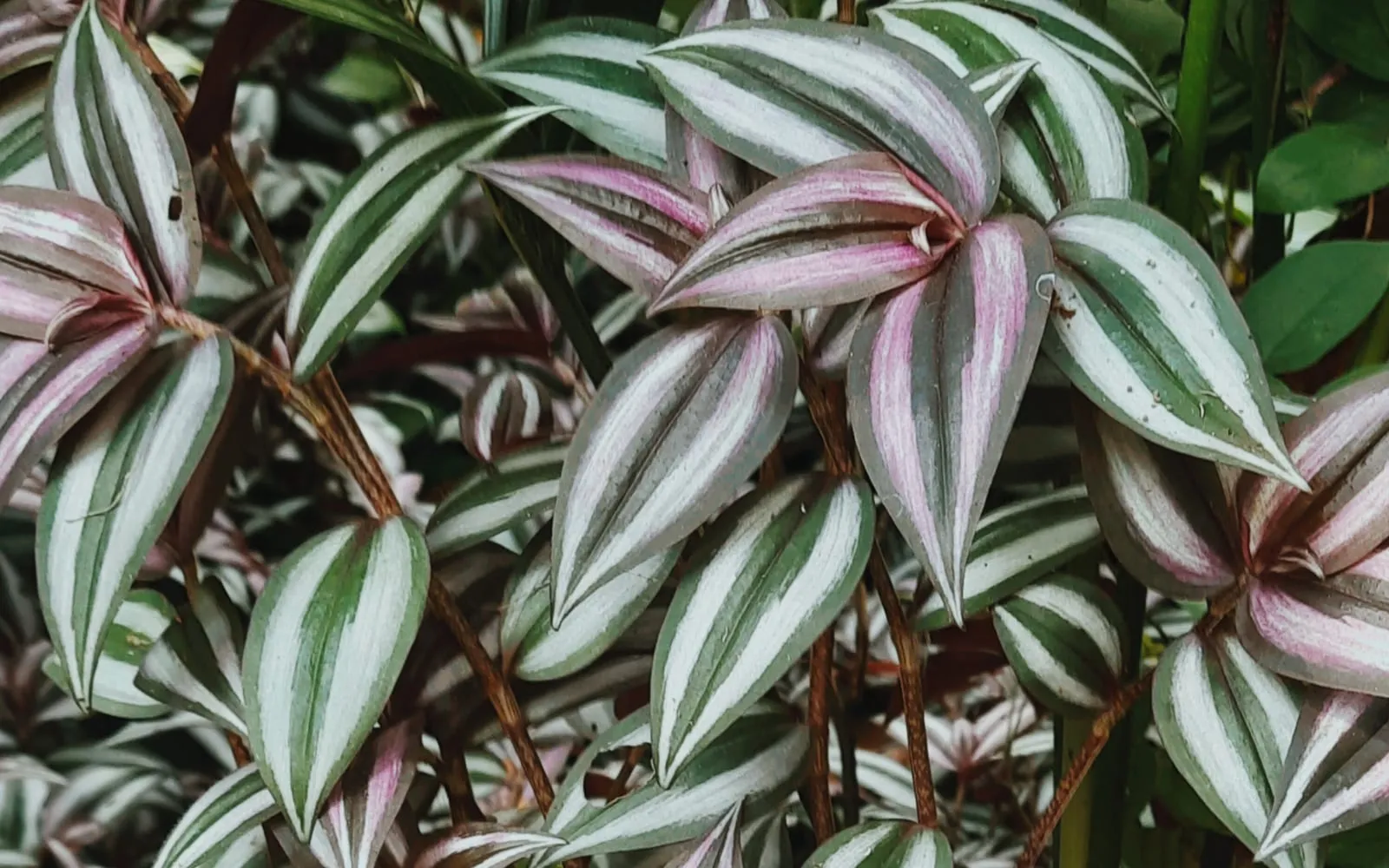
Pointed oval leaves in opposite pairs along fleshy trailing stems, and the colouring is the point. The upper surface carries two broad silver bands either side of a green or bronze centre, and the underside is a solid deep purple.
Stems are soft, slightly translucent and break easily, and they root at every node where they touch damp compost.
Flowers are small, three-petalled and pink to magenta, appearing sporadically through the year. They last a day each and are a pleasant extra rather than a reason to grow the plant.
Colour intensity tracks light closely. In bright indirect light the silver and purple are vivid. In a dim corner the leaves go plain green, the purple fades to a dull grey, and the plant loses the only thing it is grown for.
Several related species are sold under the same common name, including the all-purple Tradescantia pallida and the white-variegated Tradescantia fluminensis, and they need identical care.
Where it is from
Mexico and Central America, growing along forest floors and stream banks as a sprawling ground cover in warm humid conditions.
Ground cover in dappled forest light explains both the trailing habit and the tolerance for indirect light indoors.
It has naturalised widely in the tropics and subtropics and is a serious invasive weed in New Zealand, Australia and parts of the southern United States, forming mats that smother native seedlings. That vigour is exactly why it is so easy indoors.
The purple underside is thought to help capture light that has already passed through the leaf, which is a useful adaptation on a shaded forest floor.
How it grows
An evergreen trailing perennial that grows fast in spring and summer and slows in winter without going fully dormant.
Growth is from the tip of each stem, and stems left alone extend indefinitely while the older growth behind them loses its leaves. The result is a pot with long bare stems and a tuft of leaves at each end, which is what happens to almost every inch plant that is not pinched.
Pinching is the whole maintenance routine. Take the growing tip off each stem every few weeks, and the stem branches from the nodes behind the cut. Doing this regularly keeps the plant dense.
Propagation is close to instant. Cut a stem into 8 cm sections with at least two nodes each, put them in water, and roots appear within a week. Pot several together for a full plant. Cuttings also root directly in compost.
Plants decline after two or three years regardless of care. Rather than fighting it, take cuttings every year and let the young plants replace the old ones.
Through the seasons
Spring restarts strong growth. Cut back hard now, root the prunings, repot if needed, and start feeding in April.
Summer is the fast season. Water when the top few centimetres dry, feed monthly, pinch the tips every few weeks, and keep it in bright indirect light.
Autumn slows down. Stop feeding at the end of September, and take a batch of cuttings as insurance before winter.
Winter is the difficult season for colour, since winter light at high latitudes is too low to hold the silver and purple. Move the plant to the brightest position you have, water considerably less, and accept some fading and legginess. Cut it back in spring.
Care difficulty
Easy, and the plant is hard to kill outright.
Keeping it looking good is the actual work, and it has two parts. Pinch the tips regularly or it goes bare and stringy. Give it bright indirect light or it loses its colour.
Overwatering is the only real danger. The stems are soft and fleshy and rot at the base if the compost stays wet.
Accepting the lifespan is the third thing. This is a plant to renew from cuttings rather than to nurse into old age, and treating it that way removes most of the frustration.
Watering
Water when the top 2 to 3 cm of compost is dry. In summer that is roughly weekly, and in winter every two or three weeks.
Water the compost rather than the foliage. The soft leaves mark and rot where water sits on them.
Drench thoroughly and let it drain completely. Never leave the pot standing in water.
The plant wilts dramatically when dry and recovers within hours of watering, which makes it easy to read. Repeated severe wilting costs you the lower leaves.
Yellowing soft leaves with wet compost mean overwatering, and the stem base will be next.
Tap water is fine. This species has no fluoride sensitivity.
Warning signs, diseases and pests
Bare leggy stems with leaves only at the tips are the defining complaint, and the cause is a lack of pinching combined with insufficient light. Cut every stem back hard in spring, root the cuttings, and pinch the tips every few weeks from then on.
Colour fading to plain green means too little light. Move it brighter and prune away the faded growth.
Root and stem rot follows overwatering and shows as soft blackening stems at compost level. Take cuttings from healthy growth immediately, since the parent rarely recovers.
Aphids cluster on the soft growing tips. Rinse them off or pinch out the affected tips.
Spider mites turn up in hot dry rooms, stippling the leaves and webbing the leaf joints.
Brown crisp leaf edges usually mean the plant dried out completely, or the air is very dry.
Small leaves with long gaps between them indicate low light rather than a pest.
Growing environment
Bright indirect light. An east-facing window, or a metre back from a south-facing one, gives the strongest colour. A couple of hours of gentle direct morning sun intensifies the purple. Harsh afternoon sun scorches the soft leaves.
Warmth of 15 to 27 deg C. Damage starts below 10 deg C, so keep it off cold windowsills in winter.
Average room humidity is fine, and the plant appreciates more without demanding it.
Compost should be free-draining. A general peat-free houseplant compost with some perlite works.
Hanging baskets and high shelves suit the trailing habit and have the practical advantage of keeping the sap away from a dog that would otherwise push through it daily.
Several cuttings potted together give a fuller plant than a single rooted stem.
Feeding
A balanced liquid houseplant feed at half strength, monthly from April to September.
Stop from October to March.
This is a fast grower and it does use nutrients, though over-feeding produces soft floppy growth with weaker colour. Half strength is right.
Fresh compost after repotting supplies enough for the first couple of months.
Troubleshooting
Long bare stems with leaves only at the ends. Not pinched, and probably too dark. Cut everything back hard in spring, root the cuttings into the same pot, and pinch the tips regularly.
Leaves gone plain green with no silver or purple. Too little light. Move it brighter and prune out the faded growth.
Soft blackening stems at compost level. Rot from overwatering. Take cuttings now.
Brown crisp leaf edges. It dried out completely, or the air is very dry.
Plant looks tired after two years. Normal. This species is short-lived as a specimen. Take cuttings annually and let the young plants replace it.
Cuttings rotted in water. Change the water weekly, and keep the leaves above the waterline with only the nodes submerged.
Rash on the hands after pruning. The sap is a skin irritant. Wear gloves or wash your hands afterwards.
Sold to me under a different name. The older common name is being retired across the trade. Inch plant and silver inch plant are the current names.
Inch Plant problem guides
Not sure what is wrong? See the common houseplant pests guide.