
Outdoor plant
Common Juniper
Juniperus communis
Also known as Ground juniper, Dwarf juniper
How to grow common juniper, Juniperus communis. Why its berries take three years to ripen and flavour gin, and why almost no other woody plant grows across so much of the world.
At a glance
- Difficulty
- Easy
- Water
- Rarely once established; tolerates drought well
- Light
- Full sun for the densest growth; tolerates part shade
- Temperature
- Extremely cold-hardy, tolerating arctic and alpine winters
- Hardiness
- USDA 2-6, RHS H7, hardy to -40 C
- Type
- Hardy evergreen conifer
- Height
- Usually a low, spreading shrub 1-3 m across. Upright cultivated forms reach 5 m, and old trees in favourable, undisturbed sites occasionally exceed 10 m, a wider range of habit than almost any other conifer grown in gardens
- Native to
- Circumpolar across the Northern Hemisphere, from the Arctic Circle south through Europe, Asia and North America to mountain ranges in North Africa
Native from the Arctic Circle to mountain ranges in the Mediterranean and North Africa, so the zone number understates how broadly this species tolerates different summers as well as different winters. It thrives in poor, dry, exposed ground where richer soil and shelter would suit most other conifers better, and it is markedly more heat and drought tolerant than its extreme cold hardiness alone would suggest.
Hardiness zones describe winter cold alone. Summer heat, humidity, rainfall and the length of the growing season decide as much, so treat the range as the outer limit rather than as a recommendation.
Skin irritant
- Safe to eat
- Ripe female cones, commonly called berries, used sparingly in cooking and to flavour gin
- Do not eat
- Foliage, unripe berries and concentrated essential oil, if eaten in quantity
- Harm from
- Eating it and handling it
- Affects
- People, cats, dogs and horses
Common juniper occupies an unusual middle ground among the conifers in this list, since its ripe berries are a genuine, widely used food and flavouring, while the rest of the plant carries a real, if modest, toxicity risk if eaten in quantity. Historically, concentrated juniper oil was used as an abortifacient and to induce menstruation, a use now considered unsafe and associated with kidney irritation and, in pregnancy, miscarriage risk at the doses once used medicinally. Eating a handful of culinary berries, as used in cooking or infused into gin, is not a concern; eating the foliage, unripe berries or a concentrated oil in quantity can cause vomiting, diarrhoea and kidney irritation in people, cats, dogs and horses. As with the other Cupressaceae in this list, foliage contact can also mildly irritate skin during pruning.
Sources: RHS potentially harmful garden plants, ASPCA toxic and non-toxic plants
About
Common juniper holds a record no other woody plant matches: it grows naturally across more of the Northern Hemisphere than any other tree or shrub, from Arctic tundra south through the temperate forests of three continents to isolated mountain populations near the Mediterranean and in North Africa. Almost every ornamental conifer in a garden is a specialist, suited to one narrow band of climate. Common juniper is close to a generalist.
Its blue-black berries, technically fleshy female cones rather than true berries, are the flavouring behind gin, and the fruit takes a unusual three years to ripen fully on the plant, so a single juniper bush carries green, unripe fruit and dark ripe fruit from different years side by side at the same time.
Appearance and character
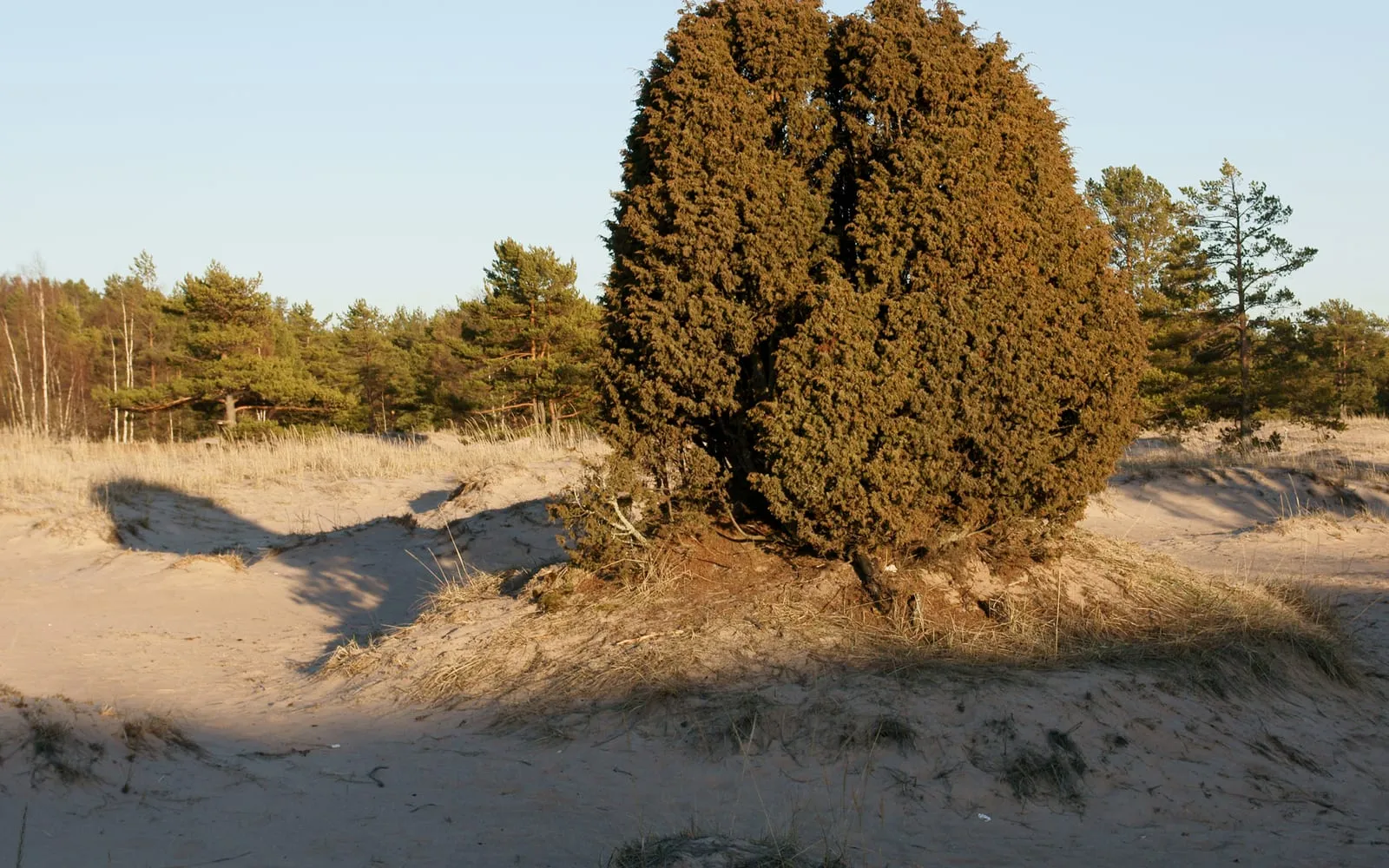
Growth habit is the least predictable feature of any species in this list. Wild plants range from mats a few centimetres tall creeping over exposed mountain rock to upright shrubs and, in sheltered, undisturbed sites, small trees several metres tall, and the many named garden cultivars capture only a fraction of that natural range, from the narrow, flame-shaped ‘Hibernica’ to ground-hugging spreading forms sold for banks and rockeries.
Foliage is needle-like rather than the flattened scales of Thuja or Chamaecyparis, sharp to the touch, blue-green above with a single bright white band along the upper surface, arranged in whorls of three around the stem. That sharpness is a useful identification feature, since it is one of the few common junipers with true needles rather than soft, adult scale foliage.
The plant is dioecious, meaning individual plants are either male or female, and only female plants carry the berries. Male plants release visible clouds of yellow pollen in spring, a detail worth knowing before planting a hedge or screen expecting fruit from every specimen.
Where it is from
Juniperus communis has the largest native range of any woody plant, a circumpolar distribution running from the Arctic Circle south through the boreal and temperate forests of Europe, Asia and North America, with outlying mountain populations reaching as far south as the Atlas Mountains of North Africa. Few other species tolerate both genuine Arctic winters and Mediterranean mountain summers within the same distribution.
That range spans an enormous variety of soils and exposures, from acidic heathland and poor sandy ground to chalk downland, which explains the species’ famous tolerance for difficult, low-nutrient soil in cultivation. It is frequently one of the first woody plants to colonise disturbed, grazed or recently cleared ground, since birds spread the seed widely and seedlings establish where little competing vegetation exists.
Its use flavouring gin dates back centuries, to Dutch genever and its juniper-flavoured predecessor in medieval Europe, and juniper smoke and berries have separately been used across the species’ huge range for purposes from preserving meat to ceremonial burning.
How it grows
Plant in spring or autumn into any well-drained soil, including poor, sandy, chalky or acidic ground; this is one of the least fussy conifers about soil type in cultivation, provided drainage is reasonable.
Choose a cultivar suited to the intended use rather than assuming any juniper behaves the same way, given how much the species varies in habit. A narrow upright form suits a vertical accent, a spreading prostrate form suits ground cover or a bank, and only a named female cultivar will produce the berries if fruit is wanted.
Established plants need almost no routine care. Little to no pruning is required beyond removing the occasional wayward shoot, and unlike some conifers in this list, juniper tolerates a harder cut back into older wood somewhat better, though it still regrows most reliably from green, needle-bearing growth rather than completely bare stems.
Avoid overwatering or planting in ground that stays wet, since this is where the species’ famous toughness runs out; root-rot in waterlogged soil is a far more common cause of death than cold, drought or pests combined.
Through the seasons
Spring brings pollen release from male plants, visible as a fine yellow dust shaken from the foliage in dry, breezy weather, and it is a reasonable time to plant, giving roots a full season to establish before the following winter.
Summer shows the species at its most drought-tolerant, needing little or no supplemental watering on most soils once established, and it is when that year’s berries, on female plants, begin to swell and change from green toward the blue-black of the ripe fruit from two summers earlier.
Autumn is when fully ripe, three-year-old berries are traditionally harvested for gin production and cooking, picked once they have turned deep blue-black and slightly soft.
Winter is untroubled by cold for this species almost anywhere it is planted, since it is native to some of the coldest inhabited winters on Earth. Heavy wet snow can occasionally splay a multi-stemmed upright cultivar, which shaking snow off promptly helps prevent.
Care difficulty
Easy, and among the least demanding conifers commonly planted. Common juniper tolerates poor soil, drought, exposure and severe cold without complaint, needs minimal feeding or pruning, and is troubled by few serious pests or diseases on a well-drained site. The one real vulnerability is wet, poorly drained ground, which causes root-rot in a plant otherwise built for some of the harshest conditions any garden conifer faces.
Watering
Water new plants through their first year while roots establish, then step back; this is one of the most drought-tolerant conifers commonly grown, reflecting its native range across dry mountain and exposed coastal sites as well as wetter lowland ground.
Established plants on well-drained soil rarely need supplemental watering outside a prolonged drought.
Avoid ground that holds water after rain. The plant’s tolerance for difficult conditions does not extend to waterlogging, and root-rot in wet soil is the leading cause of decline in an otherwise trouble-free species.
Warning signs, diseases and pests
Juniper webber moth caterpillars web foliage together and feed within the protected tent they create, causing patches of brown, dead growth, particularly on dense, upright cultivars. Removing and destroying webbed sections while caterpillars are present usually controls a light infestation.
Juniper scale appears as small, waxy discs on the foliage and stems, weakening growth over time in a heavy infestation; a horticultural oil applied at the right stage in the pest’s life cycle is the standard response.
Rust diseases affecting juniper alternate between two very different hosts across their life cycle, spending part of the year on juniper, where they cause bright orange, gelatinous growths on the stems in wet spring weather, and the other part on a rose-family host such as hawthorn or apple, where they cause leaf spotting. Planting junipers and susceptible rose-family trees at a distance from each other reduces the risk to both.
Root-rot follows waterlogged soil rather than any external pathogen in most cases, and it is the most likely cause of an established juniper’s sudden decline.
Browning from within the plant, rather than at the shoot tips, in an old, dense specimen is often simple natural shedding of inner foliage rather than disease, since junipers routinely lose older interior growth as the plant matures.
Growing environment
Full sun produces the densest, healthiest growth on almost every cultivar; shade thins the foliage and encourages a looser, less attractive habit.
Well-drained soil of almost any type suits it, including poor, sandy or chalky ground where richer soil would suit few other ornamental conifers as well. Waterlogging is the one soil condition to avoid.
Exposure to wind, salt spray and drought are all tolerated well, reflecting the species’ huge native range across some of the most exposed habitats available to a woody plant, from windswept coasts to open mountainsides.
Space to allow for the chosen cultivar’s mature spread, which varies more for this species than for almost any other conifer, from a low ground-cover mat to an upright form several metres tall.
Feeding
Little to no feeding is needed on most soils, reflecting the species’ adaptation to poor, low-nutrient ground across much of its native range.
A young plant establishing on poor soil can be given a light, balanced feed in spring, tapering off entirely once established.
Rich soil and heavy feeding are more likely to produce soft, disease-prone growth in this species than to improve it, which is the opposite of what many gardeners assume for a plant that looks this tough.
Troubleshooting
How long until the berries are ready to pick? Common juniper berries take up to three years to fully ripen, turning from green through several shades of blue before reaching the deep blue-black used in cooking and gin production. A single plant carries fruit from more than one year’s crop at once.
My juniper has never produced any berries. Check whether the plant is male or female; only female plants carry fruit, and a male specimen, identifiable by pollen release in spring rather than berries, will never produce them regardless of care.
There is orange, jelly-like growth on the stems in spring. This is juniper rust, part of a two-host fungal disease that alternates between juniper and a rose-family plant such as hawthorn or apple. It rarely seriously harms the juniper itself; removing affected shoots reduces spread to nearby susceptible trees.
The plant is browning from the inside rather than the tips. This is often normal shedding of older interior foliage on a maturing plant rather than disease, particularly if the outer, newer growth remains healthy and green.
Can I eat berries from any juniper species? No. Culinary and gin-flavour use is specific to Juniperus communis; several other ornamental juniper species carry a stronger concentration of irritant compounds and are not used as food, so confirm the species before eating fruit from an unidentified plant.
My upright juniper has splayed open under snow. Heavy wet snow can push a multi-stemmed upright cultivar apart. Shake snow off promptly during a heavy fall, and a loose tie around the crown before a snowy winter helps prevent it on a young plant.
The plant looks unhappy despite being in poor, dry soil, which I thought it liked. Check drainage rather than fertility. This species tolerates poor, dry ground extremely well but does badly in waterlogged soil, which is a far more common cause of decline than low nutrients.