
Edible
Sweet Cicely
Myrrhis odorata
Also known as Garden myrrh, British myrrh, Anise chervil
How to grow sweet cicely, Myrrhis odorata. The perennial that sweetens rhubarb, its green seeds eaten raw, and why the seed needs a winter outdoors before it germinates.
At a glance
- Difficulty
- Easy
- Water
- In dry spells only, once established
- Light
- Part shade, and it dislikes hot full sun
- Temperature
- Fully hardy, to -25 deg C. It is a plant of northern hills
- Hardiness
- USDA 3-7, RHS H7, hardy to -30 C
- Type
- Hardy herbaceous perennial, long-lived
- Height
- 60-120 cm
- Native to
- Europe
- Best month
- April and May in the Northern Hemisphere, October and November in the Southern Hemisphere
A plant of northern hills and damp upland pasture, so it takes hard cold and dislikes hot dry summers, fading away in a warm lowland garden. Seed needs a winter outdoors before it will germinate. Once established the taproot makes it near impossible to move.
Hardiness zones describe winter cold alone. Summer heat, humidity, rainfall and the length of the growing season decide as much, so treat the range as the outer limit rather than as a recommendation.
Every month named in this guide is for the temperate Northern Hemisphere. If you garden in the Southern Hemisphere, shift each one by six months, so April becomes October. Closer to the equator the wet and dry seasons matter more than the calendar, and the shift stops being a useful guide.
Not known to be toxic
- Safe to eat
- Leaves, unripe green seeds and roots
Non-toxic. Sweet cicely is a culinary herb eaten across northern Europe and it appears on neither the RHS list of potentially harmful garden plants nor the ASPCA list of plants toxic to cats, dogs and horses. Leaves, green seeds and roots are all eaten. The caution attached to it is entirely one of identification. Sweet cicely is an Apiaceae, and the family contains hemlock and hemlock water-dropwort, the two most poisonous plants in Britain, both of which have ferny leaves and flat white umbels. Sweet cicely can be told from them by its soft downy leaves, its strong aniseed scent when crushed and its long ridged black seeds, and the checks are set out in the hemlock and hemlock water-dropwort guides. Do not eat a wild umbellifer on a guess.
Sources: RHS potentially harmful garden plants, ASPCA toxic and non-toxic plants
About
Sweet cicely is the herb that lets you use less sugar. The leaves and the green seeds are sweet in themselves, and a handful cooked with rhubarb, gooseberries or blackcurrants takes the edge off the acidity so that the dish needs noticeably less sugar than it otherwise would.
The flavour is aniseed, soft and rounded rather than sharp. Green seeds picked straight off the plant in June are the best part, crunchy and sweet, and they are worth growing the plant for on their own.
It is a long-lived hardy perennial that grows in shade, which is a short list. It comes up in March, flowers in May, feeds a great many early insects and then seeds itself with enthusiasm, so plant it where a colony is welcome.
Appearance and character
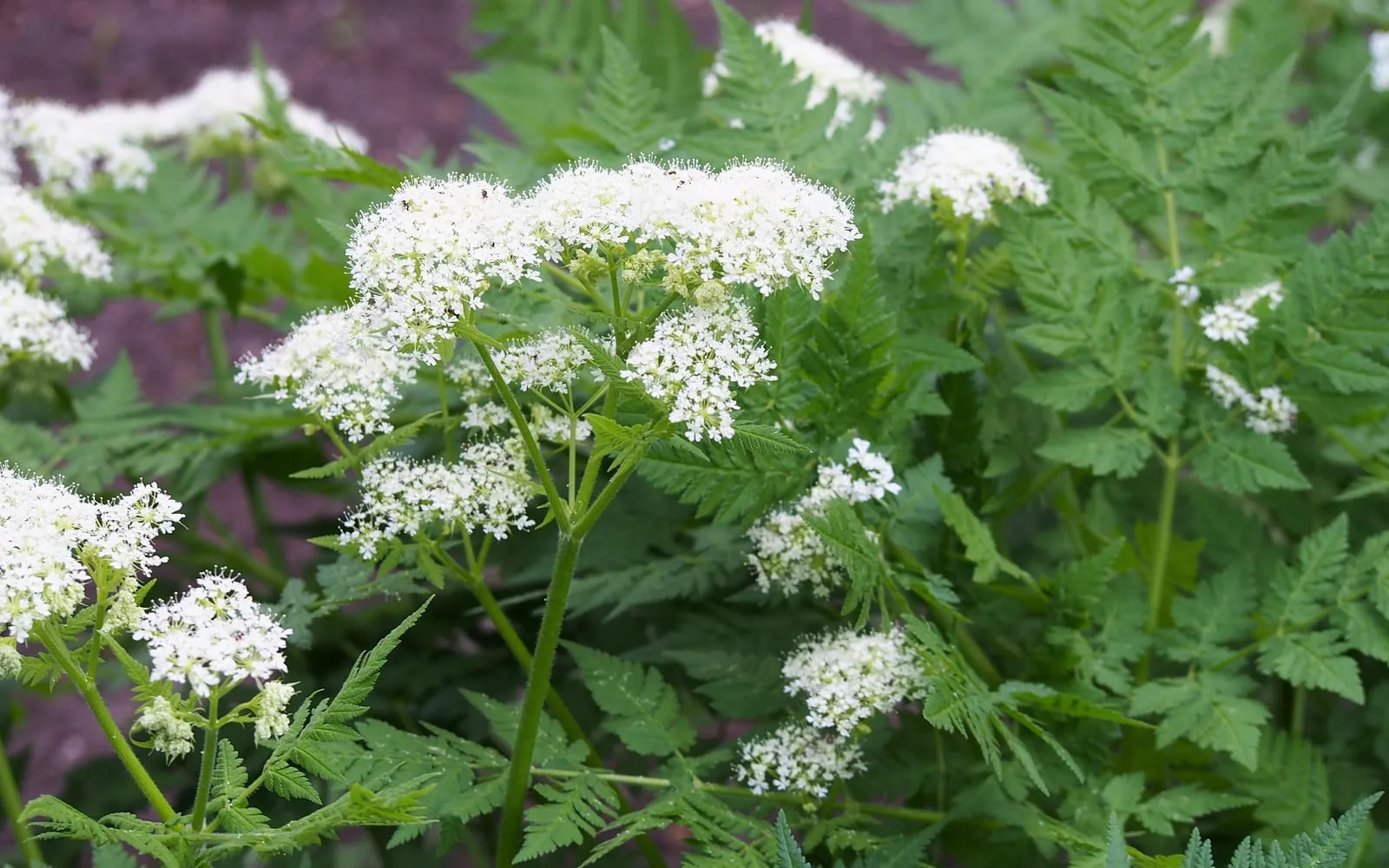
A soft ferny clump, 60 cm to 1.2 m tall and wider than it is high, with a downy texture to the whole plant.
Leaves are large, three times divided, fresh light green and covered in fine soft hairs, often flecked with pale patches that look like a marking rather than a disease. They come up in March, weeks before most perennials.
Flowers are small and white, in flat umbels 3 to 5 cm across, opening in May and early June.
Seeds are the recognition character. Long, narrow, strongly ridged and up to 2 cm, green and sweet when young, ripening to shining black.
The scent is aniseed, released by the lightest crush, and it is present in leaf, seed and root.
The taproot is thick and white and goes deep, which is what makes an established plant hard to move and a seedling hard to weed out.
Where it is from
Sweet cicely is native to the mountains of central and southern Europe, from the Pyrenees through the Alps to the Balkans, growing in damp grassland and open woodland.
In Britain it is an ancient introduction rather than a native, brought in as a herb and now thoroughly naturalised in the north. It is common along roadsides, riverbanks and hedges through northern England, Scotland and Wales, and scarce in the south.
Its distribution follows old cultivation. The plant is most abundant near settlements and monastic sites in the Pennines and southern Scotland, which is a map of where it was once grown rather than where it arrived.
The kitchen use is northern European and old. Sweetening sour fruit, flavouring drinks and eating the roots as a vegetable all appear in early herbals, and the roots were also boiled and dressed as a salad.
Chartreuse is said to include it, and its aniseed character has kept it in liqueur recipes across the Alps.
How it grows
Sow fresh seed in autumn, outdoors, and leave the pot in the open through the winter. The seed needs a long cold period before it will germinate, and a spring sowing in warmth produces nothing at all.
Expect germination the following spring, sometimes the spring after that. Patience is part of the method.
Alternatively buy a plant, or lift a self-sown seedling while it is small. An established plant cannot be moved because of the taproot.
Plant into part shade in moist, humus-rich soil, spacing at 60 cm.
Cut the plant back after flowering in June for a flush of fresh leaf, and cut the seed heads off at the same time unless you want seedlings.
Harvest leaves from March onwards. Pick green seeds in June while they are still soft and eat them raw or cook them with fruit.
Dig roots in autumn from a plant several years old if you want to use them, which ends that plant.
Divide in spring if you must, though the taproot makes it awkward and seedlings are easier.
Through the seasons
Winter is bare ground. The plant disappears completely and returns without warning.
Early spring is its best trick. Leaves come up in March, ahead of almost everything else, and the first picking is possible in April.
Late spring is flowering, in May, and the umbels bring in early hoverflies and solitary bees when little else is open.
Early summer brings the green seeds in June, which is the harvest worth planning for. Cut the plant back after picking them.
Late summer ripens the remaining seed to black. Collect it and sow it immediately outdoors, or cut the heads off before it scatters.
Autumn is when the foliage yellows and collapses. Clear it, mulch with leaf mould, and dig roots if you want them.
Care difficulty
Easy once established, and two things about it catch people out in advance.
The seed needs a winter outdoors before it germinates. Sowing it in warmth in spring wastes it, and gardeners conclude the seed was dead when it was merely waiting for cold.
The taproot means an established plant stays where it is. Choose the position carefully, because moving it later means digging a large hole and probably killing the plant anyway.
Self-seeding is generous, and the seedlings root deeply and quickly. Pull them in their first year or accept a colony.
Beyond that it needs no feeding, no staking, no watering in a normal year and no protection. It grows in shade, tolerates rough ground and lives for decades.
It has no serious pest or disease.
Watering
Water new plants weekly through their first summer while the taproot goes down.
An established plant rarely needs watering in a temperate climate, particularly in the shade it prefers.
Water in a long dry summer if the leaves start to brown at the edges, and give a thorough soak rather than a sprinkle.
Mulch each spring with leaf mould or compost, which holds moisture and suits a woodland-edge plant better than watering does.
A container is not a good home for it. The taproot wants depth and the plant resents drying out.
Water at the base if you water at all.
Warning signs, diseases and pests
Slugs graze the soft new growth in March and can set a young plant back. Established clumps outgrow them.
Aphids gather on the flower heads in May and rarely need action, since the hoverflies working the same flowers deal with them.
Powdery mildew whitens the leaves in a dry August. Cut the plant back and it regrows clean.
Pale flecking and mottling on the leaves is normal variegation for this species rather than a virus, which catches people out every year.
Brown crisp leaf margins mean drought or too much sun. Move it into shade or mulch it.
Seedlings across the bed mean the seed ripened. Cut the heads off in July.
An old clump that flowers less is usually crowded by whatever has grown up around it rather than exhausted.
Growing environment
Part shade. Sweet cicely is a plant of open woodland and damp hedge banks, and it browns and struggles in hot full sun.
Moisture-retentive soil with plenty of organic matter, well-drained rather than waterlogged.
pH from 5.5 to 7.5. It is unfussy and grows on limestone hills in the wild.
A woodland edge, the shady side of a hedge, a north-facing border or under deciduous shrubs all suit it well.
It is fully hardy and needs no protection. Its natural range is northern hills, and it performs better in a cool upland garden than in a hot lowland one.
The early flowers make it useful for pollinators, opening in May when many gardens are still short of nectar.
Feeding
Very little is needed. Sweet cicely finds what it wants in ordinary soil with organic matter in it.
Mulch each spring with leaf mould or garden compost, spread around the crown rather than over it.
Skip fertiliser. Rich feeding gives you a larger, softer plant with no more flavour.
Feed a container plant with a weak balanced feed monthly in summer if you are growing it in one, though the ground is a better home.
An established clump in decent soil will run for twenty years without any feeding at all.
Troubleshooting
The seed never came up. It needs a cold winter outdoors before germinating. Sow fresh seed in autumn in a pot left outside and expect seedlings the following spring, or the one after.
Pale patches on the leaves. Normal marking for this species, and a common reason for a gardener to reach for a fungicide. Leave it alone.
Seedlings everywhere. Cut the seed heads off in July before they ripen. The seedlings root deeply within a season, so pull them young.
Can I move it? Not easily. The taproot goes deep and an established plant usually dies. Move a first-year seedling instead.
How do I use the green seeds? Pick them in June while still soft and green, and eat them raw or cook them with rhubarb or gooseberries. They sweeten the fruit and reduce the sugar needed.
Is this hemlock? Sweet cicely has soft downy leaves, a strong aniseed scent when crushed and long ridged seeds. Hemlock has hairless leaves, a smooth purple-blotched stem and smells unpleasant. Read the hemlock guide and do not pick a wild umbellifer without certainty.
It went brown in August. Drought or too much sun. Cut it back, mulch it and it will return.