
Outdoor plant
Frogbit
Hydrocharis morsus-ranae
Also known as European frogbit, Frog-bit
How to grow frogbit, Hydrocharis morsus-ranae, a tiny floating native that dies back each autumn to overwintering buds on the pond bed.
At a glance
- Difficulty
- Easy
- Water
- Floats on still or slow-moving water
- Light
- Full sun to light shade
- Temperature
- Active from about 10 deg C, dormant as turions below that
- Hardiness
- USDA 4-9, RHS H5, hardy to -15 C
- Type
- Hardy free-floating annual-behaving perennial
- Height
- Rosettes 2-6 cm across, trailing roots 5-10 cm
- Native to
- Europe, Temperate Asia
Fully hardy as a species despite looking delicate, because the plant itself does not have to survive winter at all. It dies back completely each autumn and passes the cold season as dense, starch-filled buds resting on the pond floor below the ice, safely insulated from the same air temperatures that would kill the summer foliage outright.
Hardiness zones describe winter cold alone. Summer heat, humidity, rainfall and the length of the growing season decide as much, so treat the range as the outer limit rather than as a recommendation.
Not known to be toxic
Frogbit has no toxicity listing from the RHS and no history of causing harm to people, pets or wildfowl, several of which graze its leaves without ill effect. There is nothing in the plant that needs guarding against at a pond visited by children or animals.
Source: RHS
About
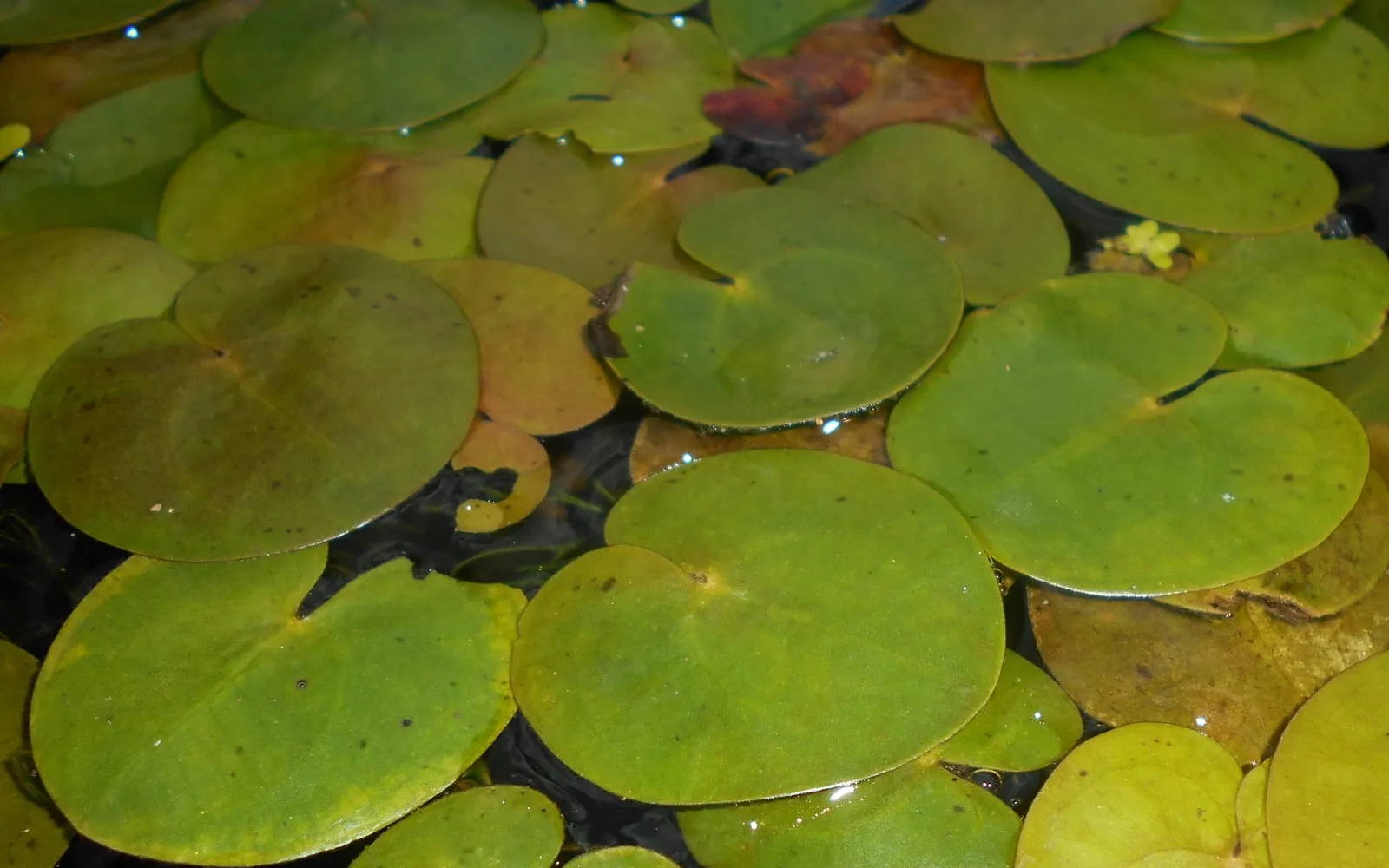
Frogbit forms small floating rosettes of rounded, glossy, heart-shaped leaves that look like a miniature water lily shrunk to a few centimetres across, spreading in loose colonies across the surface of still or slow water. Three-petalled white flowers with a yellow centre appear just above the leaves through summer, small and easy to miss individually but attractive in number across a well-established colony.
It is a native British plant, most often found today in the calcium-rich fens and dykes of East Anglia, and a popular choice for a small wildlife pond because of the shade and cover its floating leaves give fish and invertebrates without the vigorous spread of larger floating species. In parts of North America, where it was introduced deliberately as an ornamental in the 1930s, the same qualities have made it a damaging invasive weed, and it should never be released into open water outside its native range.
Appearance and character
Leaves are almost circular, glossy and leathery, with a shallow heart-shaped notch at the base and a spongy, air-filled underside that keeps each one afloat without the inflated stalks water hyacinth relies on for the same job. New leaves emerge tightly rolled from the centre of the rosette and unfurl flat on the surface, arranged in a loose rosette connected to its neighbours by short, trailing runners.
Flowers open singly a little above the leaves, three white petals around a cluster of yellow stamens, opening for a single day before closing for good. Roots hang free below each rosette rather than reaching for the bottom, fine and unbranched, giving the plant its whole water and nutrient supply directly rather than through any anchorage in mud.
Where it is from
Frogbit grows across still and slow-flowing fresh water in Europe and temperate Asia, favouring calcium-rich, unpolluted water in ditches, fens, canals and the sheltered margins of ponds and lakes. In Britain it has become scarce outside a handful of wetland strongholds as agricultural drainage and nutrient pollution have removed much of its preferred habitat.
Its native range sits entirely within regions with a distinct cold winter, and the plant’s whole life cycle, dying back completely each autumn rather than persisting as evergreen foliage, reflects that. It has no mechanism for surviving as standing growth through frost and relies instead on the overwintering buds described below.
How it grows
A frogbit colony spreads by short runners from each rosette, budding new plantlets that detach and drift apart, in a pattern similar to a spider plant’s offsets adapted to open water. Growth through summer is steady rather than explosive by the standards of other floating plants, and a colony rarely dominates a pond surface the way water hyacinth or duckweed can.
The distinctive part of its life cycle happens at the end of the season. As days shorten in autumn, the plant produces dense, starch-rich buds called turions at the tips of its runners. These detach, sink to the pond floor and lie dormant through winter, essentially discarding the whole summer’s leafy growth rather than trying to keep any of it alive through the cold months. In spring, turions float back to the surface and grow directly into new rosettes, restarting the colony from stored reserves rather than from anything that survived winter above water.
Through the seasons
Spring turions rise from the pond floor as water warms and daylight lengthens, usually through April and May, sprouting directly into new floating rosettes.
Summer is the main growing season, with rosettes multiplying steadily by runners and small white flowers appearing from June through August.
Autumn growth shifts entirely towards producing turions rather than more leaves, and the summer’s rosettes die back and disintegrate once the buds have been released.
Winter the plant exists only as turions resting on the pond bed, fully dormant and well protected from frost by the insulating depth of water above them, even where the surface freezes hard.
Care difficulty
Easy, and largely self-managing once a colony is established, since the plant’s own turion cycle handles overwintering without any input from the gardener. The only real task is making sure turions are not accidentally removed with autumn pond clean-up, since a heavy-handed netting session that clears every trace of dying foliage from the water can strip out next year’s colony along with it.
Watering
There is no watering as such, since frogbit floats freely and draws everything it needs from the water it sits on. It does best in still or only gently moving water; a strong current or a fountain’s spray tends to break rosettes apart and scatter them before they can build a settled colony. Any depth of standing water suits it, since the plant lives entirely at the surface regardless of how deep the pond is below.
Warning signs, diseases and pests
Frogbit is rarely troubled by disease and faces few serious pests. Snails occasionally graze small patches out of young leaves, visible as ragged holes rather than the clean edges disease would leave, and rarely cause lasting harm to an established colony.
Waterlily aphid can colonise the leaves in a warm, sheltered pond in the same way it colonises true water lilies, clustering on the leaf undersides and causing mild yellowing where numbers are heavy; a strong jet of water usually dislodges them without harming the fragile leaves.
A colony that fails to reappear in spring after a cold winter is more often a sign that turions were accidentally removed during fastidious autumn tidying than a sign the plant has failed outright; leaving some fallen leaf litter undisturbed on the pond floor over winter is worth doing for this reason alone.
Growing environment
Full sun to light shade both suit frogbit well, and it flowers more freely in brighter positions. Clean, unpolluted, calcium-rich water is closest to its natural habitat, though it tolerates a wider range of water chemistry in a garden pond than it does in the wild, where nutrient pollution has pushed it out of many former sites.
Shelter from strong wind and heavy wave action helps a young colony establish, since loose rosettes with no root anchorage are easily driven against the pond edge and stranded before they can multiply.
Feeding
None needed. An established pond with normal fish waste and decaying leaf litter supplies more than enough nutrient for frogbit’s modest growth rate, and there is no benefit to adding fertiliser intended for more demanding marginal or deep-water plants. A colony growing in nutrient-poor water may spread more slowly rather than needing supplementary feeding to correct it.
Troubleshooting
No frogbit reappeared this spring after a good display last year. Check whether turions were removed with autumn debris during pond clean-up. Leave some undisturbed silt and leaf litter on the pond floor over winter in future to avoid clearing them out by accident.
Leaves have ragged holes eaten out of them. Check for grazing snails, though damage is usually cosmetic and rarely serious enough to need more than occasional hand removal of the worst-affected leaves.
Small green or black insects are clustered on the leaf undersides. Waterlily aphid, most likely, especially in a sheltered, warm pond. A firm jet of water from a hose usually clears light infestations.
Rosettes have been pushed to one side of the pond and stranded. Frogbit has no root anchorage, so wind and current move it freely. Position new plantings in a sheltered bay if the pond is exposed, and nudge stranded rosettes back into open water by hand.
The colony has spread further than expected in a single season. Growth is steady rather than explosive in most ponds, but very nutrient-rich water can speed it up. Thin the colony by hand if it starts to cover more surface than suits fish and other plants below.
Flowers appear but seem to open for only a day. Correct and expected. Each flower opens once, lasts a single day, and is replaced by others in succession through the summer rather than staying open continuously.