
Outdoor plant
Osage Orange
Maclura pomifera
Also known as Hedge Apple, Bois d'Arc, Bodark
Practical guidance for growing osage orange, Maclura pomifera, including its rot-resistant wood, thorny hedge history, the huge inedible fruit, milky sap, and its drought tolerance on poor soil.
At a glance
- Difficulty
- Easy
- Water
- Regularly for the first two seasons, then rarely at all
- Light
- Full sun
- Temperature
- Very hardy; heat and drought tolerant once established
- Hardiness
- USDA 5-9, RHS H7, hardy to -25 C
- Type
- Deciduous tree, dioecious, extremely long-lived
- Height
- 12-15 m
- Native to
- the south-central United States
A tree of the continental interior, built for a hot, humid summer and a real winter cold snap rather than for a mild, wet maritime climate. It tolerates drought, poor soil and extremes of temperature in either direction better than almost anything else grown at this size, and the main limit is not cold but a climate too consistently damp underfoot, since it dislikes standing water far more than it dislikes frost.
Hardiness zones describe winter cold alone. Summer heat, humidity, rainfall and the length of the growing season decide as much, so treat the range as the outer limit rather than as a recommendation.
Skin irritant
- Do not eat
- Milky latex sap in the stems, leaves and unripe fruit
- Harm from
- Handling it and sap in the eyes
- Affects
- People
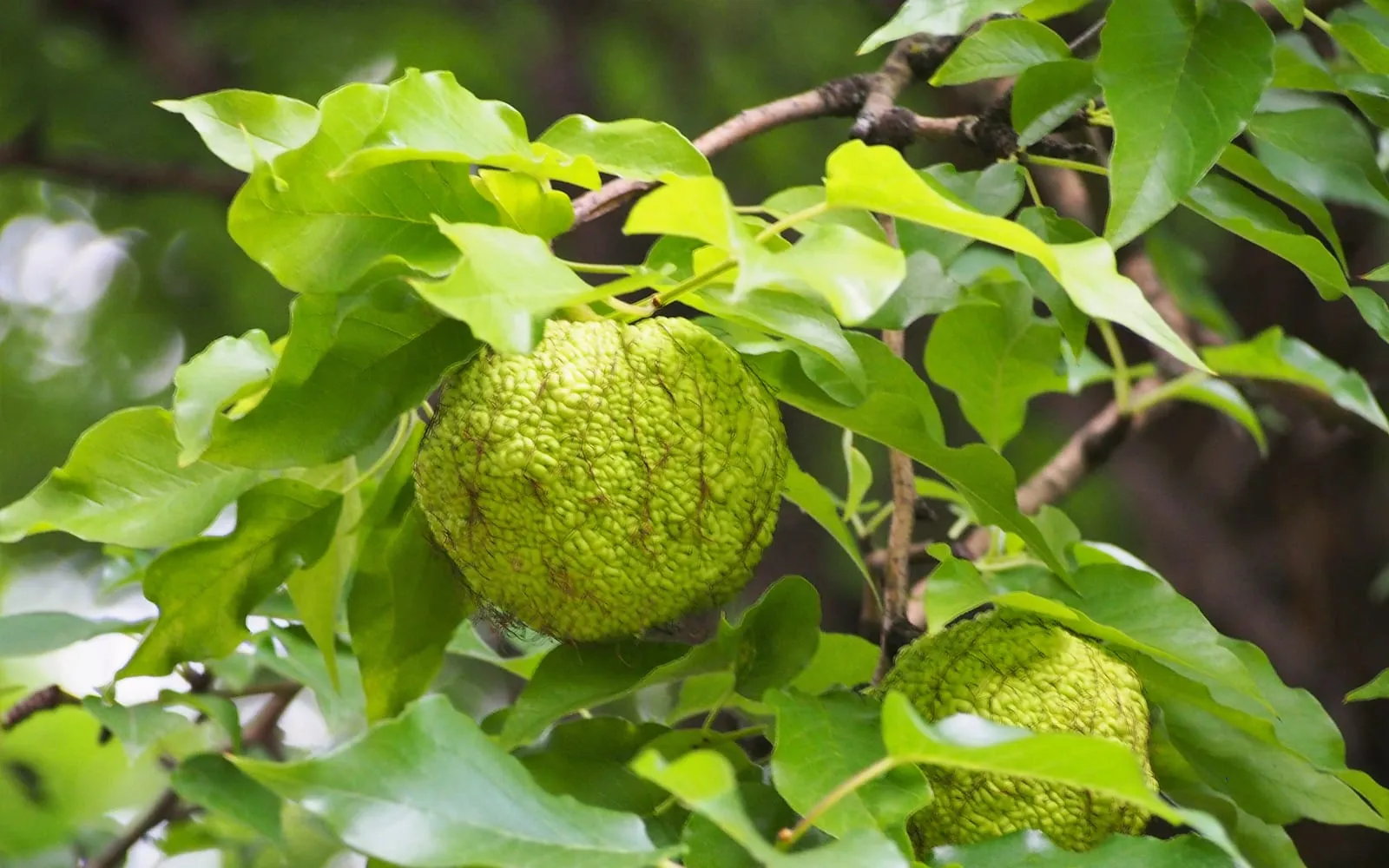
Osage orange is not listed by the ASPCA among plants toxic to cats, dogs or horses, and the RHS does not carry it on its list of potentially harmful garden plants, but it belongs to the fig and mulberry family, and like many of its relatives it produces a milky latex sap in the stems, leaves and fruit that can irritate skin and eyes on contact. Anyone pruning it or handling the large green fruit is better off wearing gloves. The fruit itself, a heavy, wrinkled ball the size of a grapefruit, is not documented as a poisoning risk when eaten, but it is not palatable and is not a food crop; whole fruit swallowed by livestock or a large dog has caused choking and gut obstruction on more than one occasion, a mechanical hazard from its size rather than a toxin. The tree's other well-known feature, stout thorns on younger wood, is another physical hazard. Keep it away from paths.
Sources: ASPCA toxic and non-toxic plants, RHS potentially harmful garden plants
About
Osage orange is a tough, thorny tree best known for two things that have nothing to do with fruit: wood so dense and rot-resistant that a fence post cut from it can outlast the fence it holds up, and a huge, wrinkled, lime-green fruit the size of a grapefruit that almost nothing alive today eats.
It was planted across the American Midwest by the million in the nineteenth century as a living fence, a dense, thorny hedge that stopped livestock before barbed wire existed, and later as a windbreak through the Dust Bowl years. Both uses grew from the same qualities: near-total drought tolerance, indifference to poor soil and a readiness to resprout from almost any cut.
Appearance and character
A rounded, often irregular tree with furrowed orange-brown bark and stout thorns on younger growth, particularly on wild or hedge-grown trees, less pronounced on the thornless cultivars sold for ornamental planting.
Leaves are glossy, dark green and pointed-oval, turning a clear yellow in autumn before dropping. Cut bark or a broken twig weeps a milky white sap within seconds, a family trait shared with fig and mulberry.
The tree is dioecious, with male and female flowers on separate plants. Only female trees bear the famous fruit, a heavy, warty, bright yellow-green ball up to 12 cm across that ripens in autumn and thuds to the ground in numbers, giving the tree its common name of hedge apple. Male trees flower but produce nothing that follows.
Where it is from
Maclura pomifera is native to a comparatively small area of the south-central United States, historically concentrated around the Red River valley of Texas, Oklahoma and Arkansas, well short of the huge range it now covers as a planted tree.
That native range is smaller than ecologists think it should be. The fruit is far too large and heavy for any small animal to disperse effectively, and almost nothing alive today eats it in any quantity, which has led to the idea that it evolved to be eaten and spread by large Pleistocene animals such as mammoths, giant ground sloths and horses that went extinct in North America around ten thousand years ago. Under that theory, the tree has spent the time since dispersing on its own, unassisted by anything large enough to do the job its fruit was shaped for, and its small natural range reflects that isolation rather than any narrow tolerance for climate or soil.
People solved the dispersal problem the mammoths left behind. Settlers and railroads carried it across the Midwest and beyond from the 1850s onward, planting it as hedging, and it is now naturalised well outside its original range across much of the eastern and central United States.
How it grows
Plant in full sun on almost any soil, including poor, dry, alkaline or compacted ground where few other trees at this size would establish at all. It is one of the most soil-tolerant trees commonly planted in North America.
Buy a named thornless, fruitless male cultivar such as ‘White Shield’ for an ornamental or shade planting, since a seed-grown tree may turn out thorny, fruit-bearing, or both, and there is no way to tell before it matures.
Space at least 10 to 12 m from buildings and paths if a fruiting female is planted, since the heavy fruit drop in autumn is a genuine hazard and a mess underfoot for weeks.
Water regularly through the first two growing seasons to establish a deep root system, then largely leave it alone. A young hedge planting is traditionally cut back hard after a couple of years to force dense, low, thorny growth from the base.
Prune in winter while dormant if shape needs correcting. The tree tolerates hard pruning and coppicing well, resprouting vigorously from cut stumps, which is exactly the trait that made it useful as a stock-proof hedge.
Through the seasons
Spring brings small, inconspicuous yellow-green flowers, easy to miss entirely, followed by the season’s new leaf growth.
Summer is steady growth in full heat, tolerated without irrigation once a tree is established on typical soil.
Autumn ripens the fruit on female trees, dropping heavily through several weeks, alongside a clear yellow leaf colour before leaf fall.
Winter is dormant and the best time for any pruning, cutting or hedge-laying, while the tree’s vigorous resprouting response is not yet needed to recover growth lost to summer heat stress.
Care difficulty
Easy, and among the most forgiving trees available for a difficult site. It needs no feeding, tolerates drought and poor soil that would kill many other species, and recovers well from hard pruning. The real decisions happen before planting: choosing a thornless, fruitless cultivar for anywhere near foot traffic, and giving a fruiting female enough distance from a path or driveway.
Watering
Water deeply through the first two growing seasons while the deep taproot that gives this tree its drought tolerance is still developing.
Once established, an osage orange rarely needs supplemental water even in a dry summer, drawing on a root system built for the hot, sometimes drought-prone continental interior it comes from. Overwatering established trees on heavy soil is more likely to cause problems than underwatering.
Warning signs, diseases and pests
Leaf spot appears occasionally in a wet season as small dark spots on the foliage, rarely serious enough to warrant treatment on a tree this vigorous.
Scale insects can build up on the bark of a stressed or weakened tree, sapping vigour, though a healthy specimen on suitable soil is rarely troubled.
Bacterial canker shows up now and then on bark damaged by mowers, frost cracks or pruning wounds, and avoiding unnecessary injury to the trunk is the best prevention.
Root rot follows waterlogged ground rather than any particular vulnerability in the tree itself. Osage orange tolerates drought far better than it tolerates standing water, and a site that floods after heavy rain is the one situation likely to kill an otherwise indestructible tree.
Growing environment
Full sun suits it best and produces the densest, thorniest growth if grown as a hedge.
Almost any soil works, from heavy clay to poor sand, and it tolerates alkaline ground that many trees dislike. Good drainage matters more than soil quality.
Wind, heat, drought and urban pollution are all tolerated with little visible stress, which is why it was chosen for shelterbelt plantings across the American plains and remains a reasonable choice for a difficult exposed site today.
Feeding
None is needed on typical soil. This is a tree adapted to poor, unimproved ground, and fertiliser is more likely to produce excessive, weakly attached growth than to improve its health.
A struggling young tree on very poor soil can be helped along with a light spring mulch of compost, but an established specimen needs nothing further.
Troubleshooting
The ground under a female tree is covered in huge green fruit every autumn. Normal, and unavoidable if a fruiting female was planted. Rake and dispose of fallen fruit regularly if it is a nuisance underfoot, or replace the tree with a thornless, fruitless male cultivar if the mess is not wanted long term.
My tree has thorns and I did not expect that. A seed-grown or unnamed nursery tree can turn out thorny even where a thornless form was wanted. There is no way to remove thorns from an existing tree; a thorny specimen either needs siting away from foot traffic or replacing with a named thornless cultivar.
Sap got on my skin while pruning and it is irritated. Wash the area with soap and water promptly. The milky latex sap common to this family of trees can cause mild irritation, so wear gloves for pruning or fruit handling.
Does anything eat the fruit? Very little today. Squirrels sometimes dig into it for the seeds, but the bulk of each fruit usually just rots where it falls, evidence for the idea that it evolved to be eaten by animals that no longer exist in North America.
Why is the wood valued so highly? It is exceptionally dense, strong and naturally rot-resistant, historically prized for fence posts, tool handles and bows, giving the tree its French-derived name bois d’arc, meaning bow wood.