
Outdoor plant
She-Oak
Casuarina equisetifolia
Also known as Australian Pine, Beach Sheoak, Horsetail Tree
How to grow she-oak, Casuarina equisetifolia. Why it is not a conifer despite looking like one, the shallow roots that can topple even a healthy tree in a storm, and why it is a listed invasive species in parts of the world it thrives in.
At a glance
- Difficulty
- Easy
- Water
- Regularly while young, then rarely once established
- Light
- Full sun
- Temperature
- Frost-tender; needs a near frost-free climate
- Hardiness
- USDA 10-11, RHS H2, hardy to -2 C
- Type
- Evergreen nitrogen-fixing tree, fast-growing
- Height
- 20-35 m in the tropics, less in cooler cultivation
- Native to
- coastal Southeast Asia to Australia
The zone range states the cold this tree cannot take and says nothing about the two facts that matter more in practice. Its shallow, wide root plate makes even a healthy mature tree prone to toppling in a severe storm, and in several of the warm, humid regions where it is hardiest it has also become a listed invasive species. A climate this tree can survive is not automatically one where planting it is a good idea.
Hardiness zones describe winter cold alone. Summer heat, humidity, rainfall and the length of the growing season decide as much, so treat the range as the outer limit rather than as a recommendation.
Not known to be toxic
Casuarina equisetifolia does not appear on the RHS potentially harmful plants index or the ASPCA toxic and non-toxic plants list, and no reputable poisoning database documents a toxic principle in any part of the tree. Its real hazards are physical rather than chemical: a fine litter of shed branchlets and hard, woody seed cones underfoot, and the risk of a mature tree coming down in a storm. Neither is a poisoning risk to a person, a pet, or a horse.
Sources: RHS potentially harmful garden plants, ASPCA toxic and non-toxic plants
About
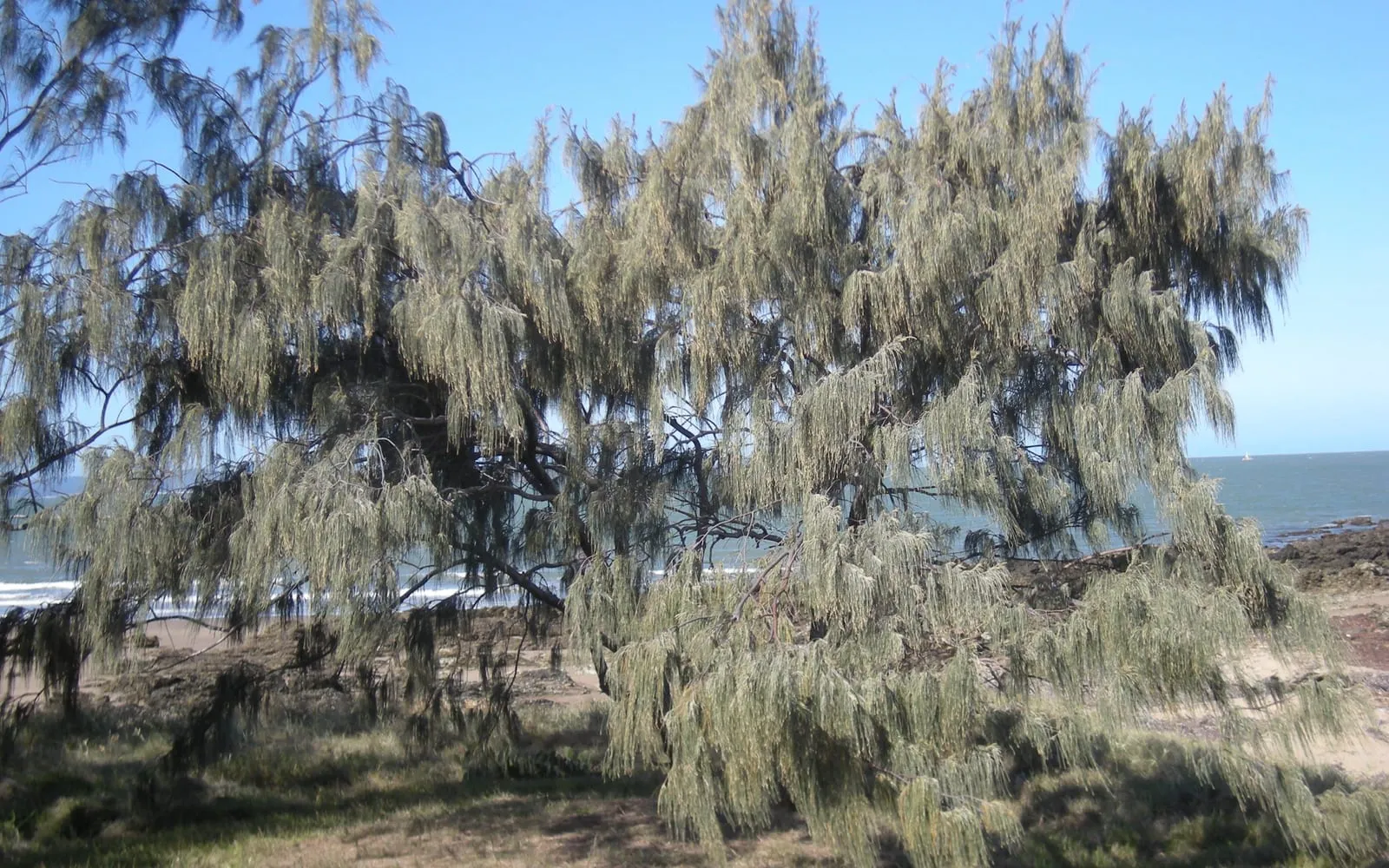
She-oak looks like a slender, weeping pine from a distance, but it belongs nowhere near the conifers. Casuarina equisetifolia is a flowering tree in the family Casuarinaceae, and the resemblance is a case of two unrelated lineages arriving at the same answer to a windy, sun-baked coastline: fine, needle-like green stems doing the work that leaves would otherwise do.
It grows fast on the poorest sand, thanks to root nodules that fix nitrogen from the air, and gardeners along tropical and subtropical coasts have long planted it as a quick windbreak or dune stabiliser. That same speed and tolerance have made it a serious invasive species in Florida, Hawaii and other warm, humid regions, where old plantings have spread into native beach and dune habitat. Check local rules before planting it outside its native range.
Appearance and character
The “needles” are not true leaves. Each thin, jointed green stem, called a cladode, carries the tree’s chlorophyll and does its photosynthesis; the actual leaves are reduced to a whorl of tiny brown teeth circling each joint, visible only up close. The overall effect from a distance is a soft, grey-green, drooping crown that moves constantly in the lightest breeze.
Flowers are inconspicuous. Male flowers cluster in small spikes at the branch tips and shed clouds of yellowish pollen; female flowers are tiny and reddish, clustered further back on the same tree. They develop into a small, woody, cone-like structure built from many tightly packed winged seeds, close enough to a conifer cone in size and shape to fool most people, though botanically the two share nothing.
Bark is grey-brown and shallowly fissured with age. The timber underneath is exceptionally dense, heavy enough that a dry log will barely float, and it splits and burns readily, which is why island communities have long used it for fuel and fence posts.
Where it is from
Casuarina equisetifolia grows wild along tropical coastlines from Southeast Asia through northern and eastern Australia and out across the western Pacific islands, typically rooted in pure beach sand within reach of salt spray. It is one of the first woody plants to colonise a bare, wind-scoured dune, ahead of almost anything else able to survive there.
That pioneering talent is what carried it around the world. Colonial and postwar planting schemes moved it to coastlines in Africa, the Caribbean, the southern United States and the Pacific as a fast windbreak and erosion control measure, long before anyone weighed the cost of a tree with no natural predators outside its original range. Florida and Hawaii both now list it as a serious invasive species.
How it grows
Root nodules housing the bacterium Frankia fix nitrogen straight from the air, which is why she-oak thrives in sand too poor to support most other trees and needs almost no feeding once established. The same roots spread wide and shallow rather than deep, tracking the water table just under the sand instead of anchoring against a strong gust, and that habit shapes almost every siting decision worth making.
Growth is fast by any standard, commonly a metre or more a year while young, slowing as the tree matures. Little pruning is needed beyond removing damaged wood, since the natural weeping habit needs no shaping. Choose a planting site well clear of buildings, driveways and parking, for reasons the Warning signs section below covers.
Through the seasons
Spring brings the main flush of new growth and the first flowering of the year in a warm, frost-free climate, with male flowers shedding visible pollen.
Summer is steady growth and, in many populations, a second flowering, since the tree has no true winter dormancy in the tropics.
Autumn sees the woody fruiting cones from earlier flowers ripening and splitting to release seed.
Winter needs no special care where frost never visits. Anywhere with even an occasional light frost, young growth is scorched and a harder freeze kills a young tree outright.
Care difficulty
Easy where the climate suits it and the site is chosen with care. Established trees need almost no feeding, cope with poor sandy soil that would starve most other species, and tolerate salt spray and constant wind that would scorch less tolerant planting.
Two real difficulties sit outside routine care. Storm-toppling is a structural risk that good husbandry cannot fully remove, since it comes from the tree’s shallow root habit rather than from neglect. Invasiveness is the other, so check local guidance before planting near any coastline with vulnerable native dune vegetation. A decision made at planting time is hard to reverse once seedlings have spread.
Watering
Water a newly planted tree regularly through its first year or two while roots establish, particularly in a dry season.
Once established, she-oak needs no supplemental watering in any climate with reasonable rainfall, drawing on the water table its shallow roots track. Avoid heavy, poorly drained soil that stays wet, which suits it far worse than dry sand ever does.
Warning signs, diseases and pests
Wind rock affects she-oak most while it is still establishing. A tree not yet firmly rooted rocks visibly at the base in strong wind, opening a funnel-shaped hollow around the trunk that collects water and damages the roots further. Firm the soil back around the base after a storm and stake a young tree in an exposed position until its roots have caught up.
Established trees face a related but more serious version of the same weakness. Even a fully rooted, healthy she-oak can come down wholesale in a severe storm, because the wide, shallow root plate this species relies on for nutrition was never adapted to resist hurricane-force wind. Siting a new tree well clear of buildings and roads is the only real precaution.
Scale insects sometimes colonise the stems and cladodes, sapping the plant and leaving a sticky residue behind. Sooty mould, a black fungal growth, follows on that residue and coats affected branches, more disfiguring than dangerous on an otherwise healthy tree.
Root rot can set in where a tree is planted in heavy soil that holds water, a poor match for a species adapted to free-draining sand. Improve drainage before planting rather than trying to treat a waterlogged, established tree afterwards.
Growing environment
Full sun and a warm, frost-free climate suit she-oak best. It performs poorly and stays stunted anywhere with regular cold snaps.
Poor, sandy, free-draining soil is not a limitation for this species so much as its natural habitat, and rich garden soil offers it little advantage. Salt spray and near-constant coastal wind, punishing to most trees, are conditions this one is adapted to handle.
Give it plenty of open space away from paths, parking and buildings, both for the width of its eventual crown and for the storm-toppling risk that comes with age. Check whether Casuarina equisetifolia is restricted or discouraged in your region before planting at all, since several places with a climate it loves have also listed it as invasive.
Feeding
Established trees need no routine feeding. The nitrogen-fixing partnership in the roots supplies most of what the tree needs even from bare sand, part of why it naturalises so readily where it is not wanted.
A young tree planted into poor or disturbed ground can be given a light, balanced feed for its first year or two to help it establish, but this is a head start rather than an ongoing requirement.
Troubleshooting
Is she-oak a type of pine or conifer? No. It only looks like one. The fine, needle-like green stems are photosynthetic branchlets called cladodes, and the tree is a flowering plant in its own family, Casuarinaceae, unrelated to any conifer.
My established tree fell over in a storm with no warning. That is the species’ known weakness rather than a sign of neglect. She-oak roots spread wide and shallow rather than deep, and a mature tree can topple in severe wind even when it looked entirely healthy beforehand. Siting new trees well clear of buildings and roads is the only real safeguard.
Can I grow it somewhere with occasional frost? Poorly, and not for long. It needs a near frost-free climate to thrive, young growth scorches at the first light frost, and a harder freeze kills a young tree outright.
Is she-oak invasive where I live? Possibly, and it check before planting. It is listed as a serious invasive species in Florida, Hawaii and other warm, humid regions, where old windbreak and amenity plantings have spread into native beach and dune habitat.
Why are the branchlets turning brown and dropping? Older cladodes shed naturally as the tree grows, which is normal and not a sign of trouble. Widespread browning across the whole crown check against drought stress in a young tree or waterlogging in heavy soil.