
Edible
Salsify
Tragopogon porrifolius
Also known as Oyster plant, Purple salsify, Vegetable oyster
How to grow salsify, Tragopogon porrifolius. The oyster plant explained, sowing fresh seed, lifting the brittle root, and eating the spring shoots.
At a glance
- Difficulty
- Moderate
- Water
- Weekly in dry spells
- Light
- Full sun
- Temperature
- Fully hardy. Roots stand hard frost in the ground
- Hardiness
- USDA 4-9, RHS H6, hardy to -20 C
- Type
- Biennial grown as an annual
- Height
- 60-120 cm when flowering
- Native to
- Southern Europe, North Africa
- Best month
- April in the Northern Hemisphere, October in the Southern Hemisphere
Roots stand hard frost in the ground and are lifted through winter, which is how the crop is normally taken. It needs deep stone-free soil and a long season to make a root worth pulling. Any plant left in place flowers in its second year and seeds itself about.
Hardiness zones describe winter cold alone. Summer heat, humidity, rainfall and the length of the growing season decide as much, so treat the range as the outer limit rather than as a recommendation.
Every month named in this guide is for the temperate Northern Hemisphere. If you garden in the Southern Hemisphere, shift each one by six months, so April becomes October. Closer to the equator the wet and dry seasons matter more than the calendar, and the shift stops being a useful guide.
Not known to be toxic
- Safe to eat
- The root, the spring shoots, the young leaves and the flower buds
Salsify is a food crop and carries no toxicity concern. The RHS does not list Tragopogon porrifolius as a potentially harmful garden plant and the ASPCA does not list it as toxic to cats and dogs. Cut roots and stems bleed a white latex that stains hands and washes off with soap, and it is a nuisance rather than an irritant. The plant is in the Asteraceae, and people with a strong contact allergy to that family may react to the sap, which is uncommon. Every above-ground part is edible. The young leaves go in salad, the shoots that appear in the second spring are cooked like asparagus, and the unopened flower buds are steamed. Goatsbeard, Tragopogon pratensis, is the yellow-flowered native relative found on British verges, and it is edible in the same way, though the root is thin and hardly worth lifting.
Sources: RHS potentially harmful garden plants, ASPCA toxic and non-toxic plants
About
Salsify and scorzonera are grown identically, cooked identically and sold under overlapping names, and they are not the same plant. Salsify has a pale buff-brown skin, a purple flower and a slimmer root. Scorzonera has black skin, a yellow flower and a fatter root, and it is a perennial where salsify is a biennial.
Both earned the name oyster plant from a faint shellfish note in the flavour. Salsify carries it more strongly of the two, which is why it got the name first.
The root is only half the reason to grow it. Leave a few plants through the winter and in April they throw up thick shoots that are cooked like asparagus and are excellent, arriving in the gap between the last stored roots and the first spring vegetables.
Appearance and character
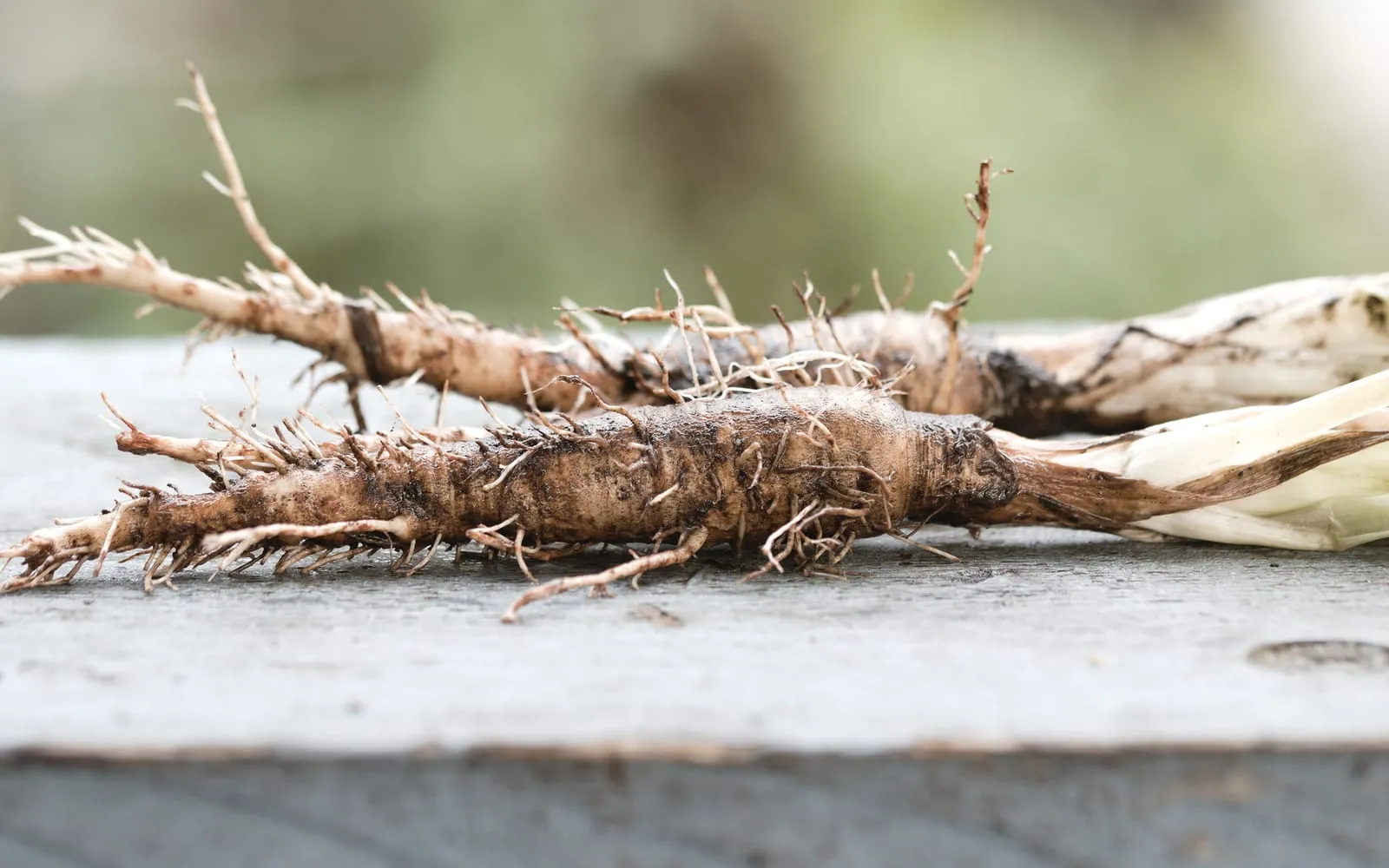
A long, slender, tapering taproot, 20 to 30 cm long and rarely more than 3 cm across, with buff to pale brown skin and a mass of fine side roots.
Flesh is creamy white, softer than scorzonera, bleeding white latex from any cut.
Leaves are narrow, keeled and grass-like, greyish-green with a waxy bloom, forming an upright rosette. A row of salfisy seedlings looks convincingly like a row of coarse grass, which makes early weeding a careful job.
The flower is the easiest identification. A large, solitary, dull purple daisy-like head on a long stem, opening in the morning and closing by midday, which gives the related species the country name Jack-go-to-bed-at-noon.
Seed heads are large parachute clocks, bigger than a dandelion’s, and the plant seeds itself freely.
Where it is from
Salsify is native to southern Europe and North Africa, growing on dry grassland and disturbed ground.
Italians and Greeks gathered the wild root long before anyone cultivated it, and selection into a garden vegetable happened in Italy and France in the sixteenth century.
It reached Britain by the seventeenth century and was widely grown in kitchen gardens through the eighteenth and nineteenth. American colonists took it across the Atlantic, and it has naturalised across much of North America.
Britain dropped it in the twentieth century, along with scorzonera and several other roots, when the vegetable trade narrowed to what stores and travels well. A brittle root that bleeds when cut does neither.
The wild yellow-flowered goatsbeard, Tragopogon pratensis, is a British native of verges and meadows and a close relative.
How it grows
Sow direct where it is to crop. The taproot forks if moved.
Use fresh seed. Salsify seed loses viability after a year, exactly as parsnip and scorzonera do.
Sow from March to April at 1 cm deep in rows 30 cm apart, then thin to 10 cm. Germination takes one to three weeks.
Roots are ready from October, about six months from sowing.
Lift by digging a trench alongside the row and easing the roots sideways into it. Levering from above snaps them.
Leave a few plants in the ground over winter for the spring shoots. Cut them at 15 cm in April, before the flower buds open, and cook them like asparagus.
Clear the bed by early summer of the second year, or the plants flower and seed themselves across the plot.
Through the seasons
Early spring is the sowing window, March into April, into a deep stone-free bed prepared the previous autumn without manure.
Late spring thins the seedlings to 10 cm and keeps the row weeded. Take care here, since the seedlings look like grass.
Summer is watering and weeding. Remove any first-year flower stems.
Autumn and winter are the root harvest. Lift from October by trenching alongside, and leave the rest in the ground to lift as needed to March.
The following spring brings the shoots on any plants left in place. Cut them in April at 15 cm, take two or three cuttings from each plant, then clear the bed before the flowers set seed.
Care difficulty
Moderate, and undemanding through the season.
Lifting is the skill. Trench alongside to the full depth of the root and lever sideways. Pulling or levering from above snaps a root that is thinner and more brittle than scorzonera.
Seed viability catches people out. Buy fresh each year.
Weeding the seedling row needs attention, because grass-like seedlings among grass weeds are easy to hoe off.
Bolting in the first year follows a cold spring or a dry summer and is more common in salsify than scorzonera. Cut the stem off and the root continues, though it will be smaller.
Self-seeding is the long-term nuisance. A plant allowed to flower puts hundreds of parachute seeds across the plot.
Watering
Water weekly in dry spells, around 12 litres per square metre as a single soak.
Even moisture gives smooth roots and interrupted moisture gives split or forked ones.
Keep the seedbed damp through germination.
Mulch between the rows after thinning, which steadies the moisture and suppresses the weeds that hide among the narrow leaves.
Splitting follows heavy rain onto dry ground.
Container growing needs a pot at least 40 cm deep and gives a shorter root than open ground.
Warning signs, diseases and pests
Roots snapping on lifting is the commonest complaint and is a technique fault rather than a problem with the plant.
Slugs graze the crown and the shoulders of the root. Earth up lightly and patrol on damp evenings.
White blister brings raised chalky pustules on the leaf undersides and distorted growth above. Remove affected leaves and space for airflow.
Bolting in the first year follows cold or drought. Cut the stem out.
Forked or stubby roots mean stones, compaction or fresh manure.
Splitting follows irregular watering.
The white latex stains hands and clothing. Wear gloves.
Nothing else troubles it much. Salsify is largely ignored by the pests that plague brassicas and umbellifers.
Growing environment
Full sun. Salsify tolerates less shade than scorzonera and gives thin roots in a shaded bed.
Deep, light, stone-free soil is the requirement. Dig to a spade and a half and remove stones.
Lime to pH 6.5 or 7.
Never sow into freshly manured ground, which forks the roots. Follow a crop that was manured the previous season.
Rake to a fine tilth before sowing.
Raised beds of sieved soil suit it where the ground is stony or heavy.
Rotate on three or four years. Salsify shares few problems with other crops, so it is easy to slot into a rotation.
Feeding
Salsify needs very little, and on soil in reasonable heart it needs nothing.
Avoid nitrogen, which gives leaf at the expense of root.
A dressing of sulphate of potash at 15 g per square metre before sowing helps on poor or sandy ground.
Never apply fresh manure.
Plants held over for spring shoots benefit from a light potash dressing in February.
Troubleshooting
The roots snapped as I lifted them. Trench alongside the row to the full depth of the root and lever sideways rather than upwards.
Forked or stubby roots. Stones, compaction or fresh manure. Dig a deep stone-free bed and follow a crop manured last year.
Nothing germinated. Old seed. Buy fresh each year.
A flower stem in the first summer. Bolting after a cold spring or a dry spell. Cut it off and the root carries on, smaller.
I hoed off my seedlings by mistake. The narrow grey-green leaves look like grass. Mark the row when sowing, or sow a few radishes in the same drill.
White sap all over my hands. Latex from the cut root. Harmless and it washes off with soap.
Salsify seedlings coming up all over the plot. A plant was allowed to flower and seed. Clear the bed before the clocks form.
What is the difference from scorzonera? Salsify has pale brown skin, a purple flower and a slimmer root, and it is a biennial. Scorzonera has black skin, a yellow flower and a fatter root, and it is a perennial that can be left a second year to fatten.
How do I cook the spring shoots? Cut them at 15 cm before the buds open, steam or boil briefly, and dress them as you would asparagus.
Salsify problem guides
Not sure what is wrong? See the common vegetable pests guide.