
Outdoor plant
Pot Marigold
Calendula officinalis
Also known as Calendula, English marigold
How to grow pot marigold from seed. Its edible orange petals, long history in the kitchen and dye pot, and why deadheading keeps it flowering into autumn.
At a glance
- Difficulty
- Easy
- Water
- Regular watering while establishing, drought-tolerant once mature
- Light
- Full sun to light shade
- Hardiness
- USDA 2-11, RHS H3, hardy to -5 C
- Type
- Hardy annual
- Height
- 30-60 cm
- Native to
- Southern Europe, Mediterranean
Grown as a hardy annual across almost every temperate climate, tolerating a light frost as a young plant and often self-seeding reliably enough to reappear without deliberate resowing in a mild climate. It flowers over a very long season, from early summer through to the first hard frost, given full sun and regular deadheading.
Hardiness zones describe winter cold alone. Summer heat, humidity, rainfall and the length of the growing season decide as much, so treat the range as the outer limit rather than as a recommendation.
Not known to be toxic
- Safe to eat
- The petals, used fresh in salads or dried as a saffron substitute and colouring agent, a use with a very long culinary history
Pot marigold has no toxicity listing from the RHS or the ASPCA and is widely grown as an edible and medicinal herb, with a long history of culinary and traditional herbal use. It is considered safe around pets and children, and the petals are properly edible rather than merely non-toxic.
Source: RHS
About
Pot marigold is one of the oldest cottage garden flowers still widely grown, valued for its cheerful orange to yellow daisy-like flowers, its long flowering season, and a useful history in the kitchen that few purely ornamental annuals can match. Its petals have been used fresh in salads and dried as a colouring agent and saffron substitute for centuries, and the plant’s common name reflects that practical, everyday use rather than any connection to the unrelated French and African marigolds of the Tagetes genus.
It self-seeds readily in a mild climate, often reappearing reliably year after year from a single original sowing, and its long flowering season combined with real usefulness in the kitchen has kept it a consistently popular choice in cottage and kitchen gardens for generations.
In the vegetable garden it doubles as a companion plant, its open flowers drawing hoverflies and bees whose larvae go on to clear aphids from nearby crops.
Appearance and character
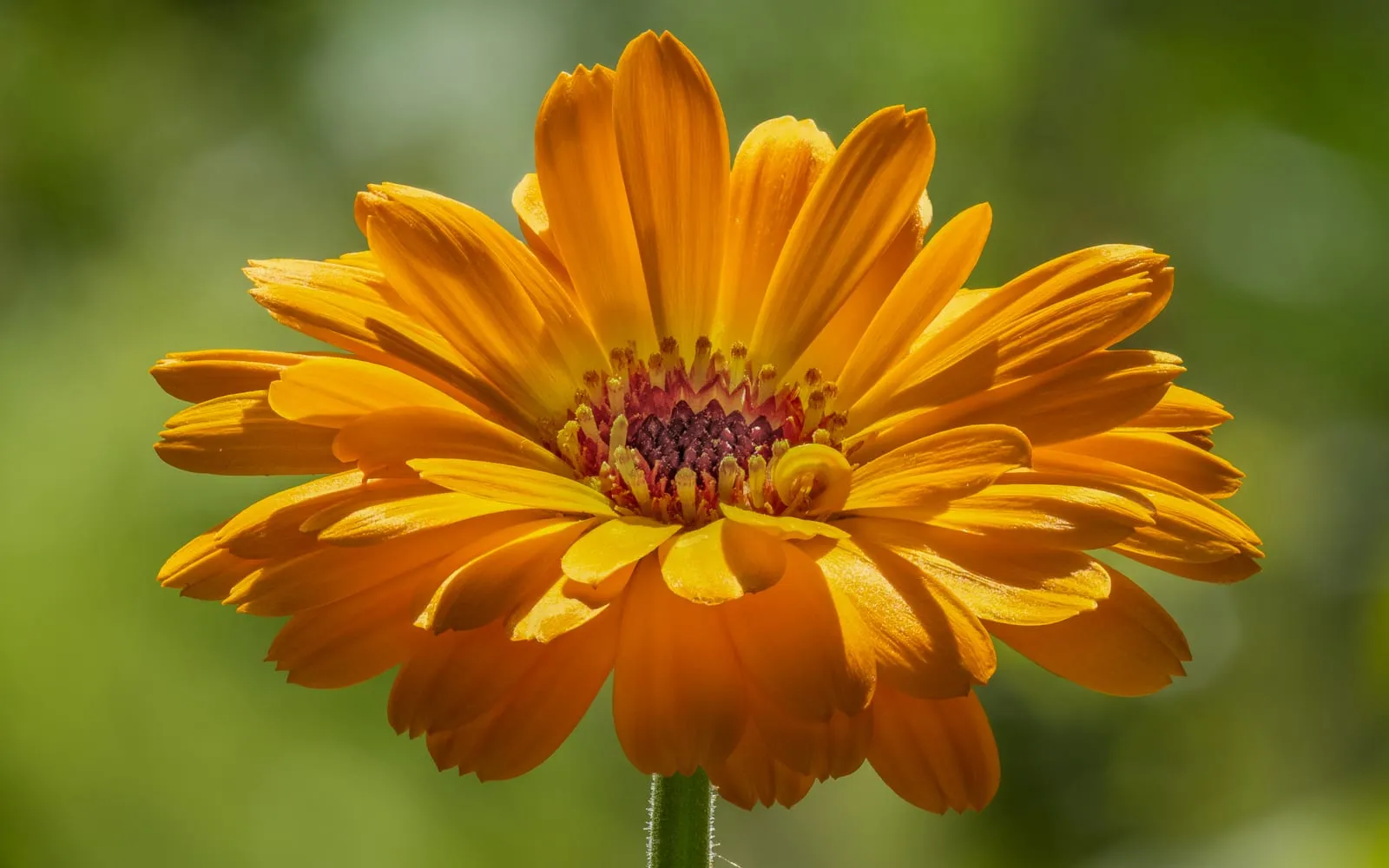
Slightly hairy, aromatic, oblong leaves clothe bushy, branching stems that build into a rounded clump over the growing season. Open, daisy-like flowers, typically a warm orange or yellow, sometimes with darker centres in some varieties, open continuously from early summer given regular deadheading, each bloom lasting several days before fading and being replaced by fresh buds.
Flowers close at dusk and in dull weather, reopening as the sun returns, a habit that has earned the plant folk names referencing the sun in several languages, and seed pods that follow are distinctive curved, crescent-shaped structures that readily self-seed if left on the plant.
Where it is from
Open, sunny ground across southern Europe and the Mediterranean, in a climate with warm, dry summers, though the species has been cultivated and naturalised so widely and for so long that its precise original wild range is somewhat uncertain.
That Mediterranean origin explains the plant’s love of full sun and its general tolerance of poor, dry soil, and its very long history of cultivation across Europe and beyond has produced numerous garden varieties selected for flower colour, size and form.
How it grows
A fast-growing hardy annual, germinating readily from seed sown directly outdoors and reaching flowering size within a matter of weeks given reasonable warmth. Growth is bushy and self-supporting, rarely needing staking even at full height, and the plant continues producing new buds throughout summer given regular deadheading.
Because seed forms and disperses so readily, this species self-seeds freely in a favourable spot, and gardeners who want to keep a consistent colour or form from year to year sometimes need to remove volunteer seedlings that have crossed with other varieties nearby rather than relying on self-seeding alone.
Through the seasons
Spring sow seed directly outdoors from mid-spring, or earlier under cover for an earlier display; germination is generally fast and reliable.
Summer is the main flowering season, continuing over many weeks given regular deadheading.
Autumn flowering often continues until the first hard frost, particularly if deadheaded consistently through the season.
Winter the plant dies with hard frost, having completed its annual cycle, though self-sown seedlings from the current season may already be present as small plants ready to grow on the following spring in a mild climate.
Care difficulty
Easy. This is one of the most forgiving hardy annuals available, tolerating poor soil, some neglect and a range of conditions while still flowering reliably over a long season with minimal intervention.
Watering
Regular watering supports strong establishment while young. Once established, this species tolerates real drought reasonably well, needing supplemental watering mainly during an extended dry spell.
Warning signs, diseases and pests
Aphids occasionally colonise soft new growth and flower buds, and are dislodged easily with a jet of water. Powdery mildew can develop later in the season, particularly in dry conditions with poor air circulation, showing as a pale, dusty coating on leaves; thinning overcrowded plants and watering at the base rather than over the foliage both help reduce its likelihood.
Reduced flowering as summer progresses most often reflects a lack of deadheading rather than disease, since a plant left to set seed redirects its energy away from producing further blooms.
Growing environment
Full sun to light shade both suit it, and this species tolerates poor, free-draining soil much better than very rich, heavily improved ground, which tends to encourage leafy growth at the expense of flowers.
Feeding
None to minimal. Rich soil or heavy feeding produces excess foliage and fewer flowers than the lean conditions this species naturally performs best in.
Troubleshooting
Flowering has slowed as the season progresses. Deadhead spent flowers promptly and consistently, since this is the single most effective way to keep new buds forming throughout summer.
A pale, dusty coating has appeared on the leaves later in the season. This is powdery mildew, more likely in dry conditions with poor air circulation. Water at the base rather than over the foliage and thin overcrowded plants.
Self-sown seedlings have appeared but do not match the parent plant’s colour. This can happen where multiple varieties have cross-pollinated nearby. Remove unwanted volunteer seedlings and resow fresh seed of the desired variety if a consistent colour matters.
You want to harvest petals for culinary use. Pick fresh flowers in the morning once fully open, and either use the petals fresh in salads or spread them out to dry thoroughly before storing, away from direct sun, for use later as a colouring agent.
You want to keep a particular flower colour true from year to year. Isolate a preferred variety from other Calendula plantings nearby, since cross-pollination between different colour forms can produce inconsistent self-sown seedlings, and save seed deliberately from your best plants if a specific shade matters to you.
You are growing this species as a companion plant among vegetables. Its long flowering season and appeal to hoverflies, whose larvae prey on aphids, make it a popular choice dotted through a vegetable bed, and its own undemanding needs mean it rarely competes seriously with nearby crops for water or nutrients, even when planted quite close alongside them.