
Houseplant
Ruffled Fan Palm
Licuala grandis
Also known as Licuala grandis, Vanuatu Fan Palm
How to grow Licuala grandis, the ruffled fan palm, a striking tropical palm with whole, circular pleated leaves that needs warmth and humidity.
At a glance
- Difficulty
- Moderate
- Water
- Keep evenly moist; never dry out or waterlog
- Light
- Bright indirect light
- Temperature
- Warm; keep above about 16 deg C
- Humidity
- High
- Hardiness
- USDA 10-12, RHS H1b, hardy to 13 C
- Type
- Evergreen single-stemmed fan palm
- Height
- Up to 3 m; slow indoors
- Native to
- Vanuatu and the Santa Cruz Islands
A tender tropical fan palm from the humid rainforests of Vanuatu and the western Pacific, growing in warm, shaded, wet understorey. It needs steady warmth, high humidity and bright but filtered light, and cannot take frost, chill or dry air. It is safest above about 13 deg C, and its big leaves brown fast in dry rooms or cold draughts.
Hardiness zones describe winter cold alone. Summer heat, humidity, rainfall and the length of the growing season decide as much, so treat the range as the outer limit rather than as a recommendation.
Not known to be toxic
A safe plant to keep around pets and children. The ruffled fan palm is not listed as toxic by the ASPCA or the RHS, and no harmful compound is recorded in it, so it is one of the safer statement plants for a home with animals. Its leaf stalks carry small teeth that can scratch, so handle the fronds with a little care, but there is no chemical hazard.
Sources: ASPCA toxic and non-toxic plants, RHS potentially harmful garden plants
About
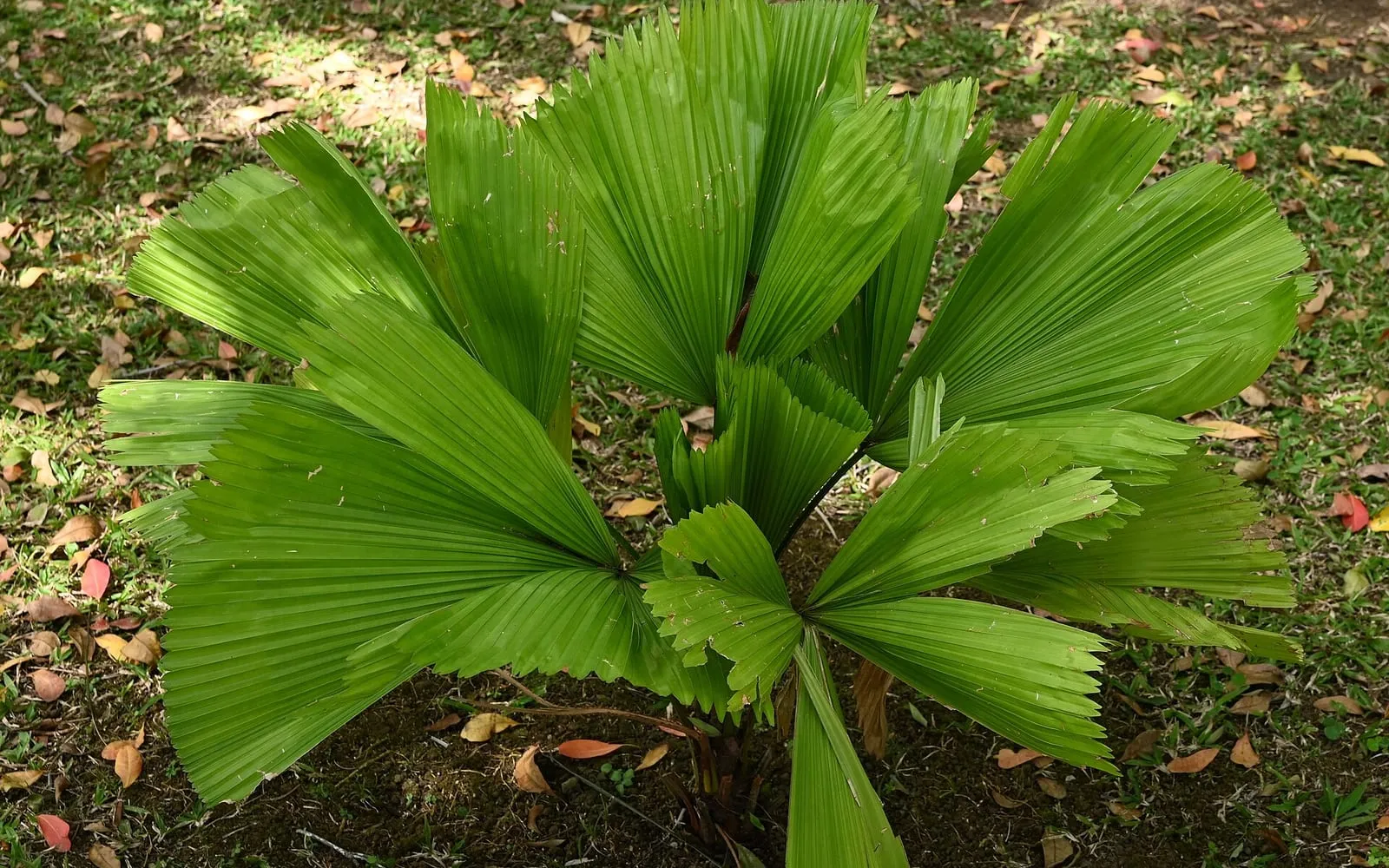
Licuala grandis has one of the most striking leaves of any palm kept indoors. Each leaf is a single almost undivided glossy disc, deeply pleated and frilled with teeth around its outer rim, like a large round scallop of green. Where its clustering relatives split their fans into narrow segments, this one keeps the blade nearly whole, so a mature crown of these ruffled plates on a slender trunk is hard to miss. It comes from the humid island rainforests of Vanuatu and the western Pacific, growing in warm, shaded, wet understorey. That makes it a thirsty, tender plant that needs warmth, damp air and soft light, and it is grown almost entirely as an indoor specimen where those conditions can be maintained.
Appearance and character
The main feature is a broad, circular blade, glossy and rich green, corrugated into deep pleats that radiate from the stalk and edged with a ruffled, toothed margin, undivided or split only shallowly. Each sits on a long, slim stalk whose edges bear small teeth, so handle the fronds with a little care. The trunk is slender and, in a pot, very slow to build, so a young plant is a low rosette of discs close to the compost for years before any stem shows. Flowers and small bright red fruit appear only on large, mature specimens and are rarely seen indoors. The pleated discs are the main reason to grow it.
Where it is from
The palm grows wild on Vanuatu and nearby islands of the western Pacific, on the warm, wet, shaded floor of tropical rainforest where humidity stays high all year and the canopy filters the light. Rain is frequent, temperatures barely shift, and the air stays moist. Those conditions explain its needs indoors. It needs steady warmth, high humidity, filtered instead of direct light, and a rootball that never dries out. It has none of the toughness of a sun-baked coastal palm, so dry air, chill and drought mark the big leaves quickly. Give it a warm, damp, softly lit position and it grows well.
How it grows
The palm unfurls only a few of its ruffled discs in a year, growing slowly from a single tip, and needs warmth and moisture around the clock to keep those leaves in good condition. Cool, dry or draughty air browns them fast. Grow it in a rich compost that stays moist yet drains, in a pot matched to its roots, and water with rain or filtered water so the mix is never dry and never sodden. Repot only every few years, since the roots dislike disturbance. Fresh seed is the only way to raise more, because this solitary palm makes no suckers to separate and will not root from a cutting.
Through the seasons
Lengthening spring days and rising warmth restart growth and make this the best time to repot if needed and to begin feeding again. Summer is the main growing spell: keep the compost evenly moist, the surrounding air humid, and feed regularly while shielding the leaves from direct sun. As autumn light weakens, reduce feeding but keep warmth and humidity high, countering the drying effect of central heating. Winter is a rest, though never a cold one; keep the palm warm, the air moist and the compost just damp, and place it well away from radiators, cold glass and draughts that quickly crisp its broad blades.
Care difficulty
This is a demanding houseplant, mostly because it needs warmth and humidity. Given steady heat, moist air and gentle light it is a slow, spectacular plant, but a dry living room browns the big leaves at their frilled edges and thins the crown. Cold and draughts are equally damaging, and a rootball left either bone dry or waterlogged brings trouble fast. It is hard work to keep the leaves perfect.
Watering
Hold the compost evenly moist right through the year, topping up as the surface begins to dry instead of waiting for it to parch, and use rainwater, filtered or distilled water throughout. The broad blades lose water fast and their frilled edges brown quickly if the rootball dries or the water is hard and limey. Equally, never let the pot stand in water, because the roots rot in a sodden, airless mix and the crown can soften. Ease back only a little in winter, keeping the compost just moist to match slower growth, and always empty whatever water gathers in the saucer beneath.
Warning signs, diseases and pests
Brown, crisping edges on the discs are the commonest complaint and nearly always mean dry air, hard water or a dried-out rootball; raise the humidity, switch to soft water and keep the compost evenly moist. Warm, dry air also encourages spider mites, which stipple the blades and web their undersides, so lift the humidity, wash the leaves and act early. Scale insects settle as brown bumps on the stalks and midribs and can be wiped off and dabbed with horticultural oil. The single growing tip must never be cut, since removing it kills the palm, and the small teeth on the stalks warrant careful handling.
Growing environment
Filtered light suits it, matching the shaded rainforest floor it comes from; strong direct sun scorches the big blades while deep shade slows an already slow plant, so aim for a bright spot screened from the sun’s full force. Warmth and humidity are central to its care: keep it comfortably warm and raise the moisture in the air with a humidifier, pebble tray or a group of plants. Set it well away from radiators and cold draughts. Grow it in a rich, moisture-holding yet free-draining compost, in a warm, steamy, brightly but indirectly lit place such as a conservatory or a bathroom.
Feeding
Feed through the growing season, roughly monthly, with a diluted palm or balanced fertiliser, always keeping the strength low since palms dislike being overfed. A feed that includes magnesium and potassium helps hold the deep green of the blades and reduces the interveinal yellowing that fan palms show when those nutrients run short. Reduce feeding through autumn and stop over winter while growth pauses. For the first couple of months after repotting, withhold feed and let the fresh compost support the plant, resuming only once it is clearly growing again and the roots have settled into the new mix.
Troubleshooting
The edges of the discs are browning and crisp. Dry air, hard water or a dried rootball. Raise the humidity, water with rain or filtered water, keep the compost evenly moist, and trim only the dead brown margin.
Why is my leaf a whole circle and not a split fan? That undivided, pleated, ruffled disc is the species’ hallmark and the reason it is grown, setting it apart from the segmented fans of most palms.
Can I cut it back to keep it compact? No. A palm grows from one tip and will not branch or reshape, and cutting that tip kills it. It stays small by being slow.
The leaves look dull and speckled. Spider mites from warm, dry air. Raise humidity, wash the blades top and bottom, and treat without delay.
Is it safe around pets? Yes, chemically, since no toxin is recorded for it. The only caution is the small teeth along the leaf stalks, which can scratch.
Ruffled Fan Palm problem guides
Not sure what is wrong? See the common houseplant pests guide.