
Outdoor plant
Marram Grass
Ammophila arenaria
Also known as European beachgrass
How to grow marram grass to stabilise a sand dune or coastal garden. Its deep spreading rhizomes, salt tolerance, and why it needs to be half-buried to thrive.
At a glance
- Difficulty
- Easy
- Water
- Naturally rain-fed; no supplemental watering in a dune setting
- Light
- Full sun
- Hardiness
- USDA 4-9, RHS H7, hardy to -30 C
- Type
- Hardy evergreen perennial grass
- Height
- 60-120 cm
- Native to
- Coastal Europe, North Africa
Extremely hardy to cold and thoroughly adapted to salt spray, strong coastal wind and shifting sand, tolerating conditions that would kill most other grasses outright. It is not adapted to ordinary garden soil or a sheltered inland position, and performs poorly, becoming weak and disease-prone, anywhere it is not being regularly buried by fresh sand.
Hardiness zones describe winter cold alone. Summer heat, humidity, rainfall and the length of the growing season decide as much, so treat the range as the outer limit rather than as a recommendation.
Not known to be toxic
Marram grass has no toxicity listing from the RHS or the ASPCA and is considered safe around pets and children. Its sharply pointed, tightly rolled leaf blades can scratch skin on contact, which is a physical rather than a chemical hazard.
Source: RHS
About
Marram grass is the plant most responsible for building and holding together sand dunes along Europe’s coastlines, its deep, far-reaching rhizome network binding loose sand into a stable structure that countless other coastal plants and animals depend on. It is planted deliberately in coastal defence and dune restoration schemes worldwide for this stabilising ability, and it is one of the few plants that needs to be buried by fresh, moving sand to stay healthy, an almost complete reversal of how most garden plants behave.
Outside its native range it has become a serious problem in places like the Pacific coast of North America, where introduced marram outcompetes native dune vegetation and changes the shape of dune systems altogether, so it is worth checking local guidance before planting it anywhere outside coastal Europe or North Africa.
Appearance and character
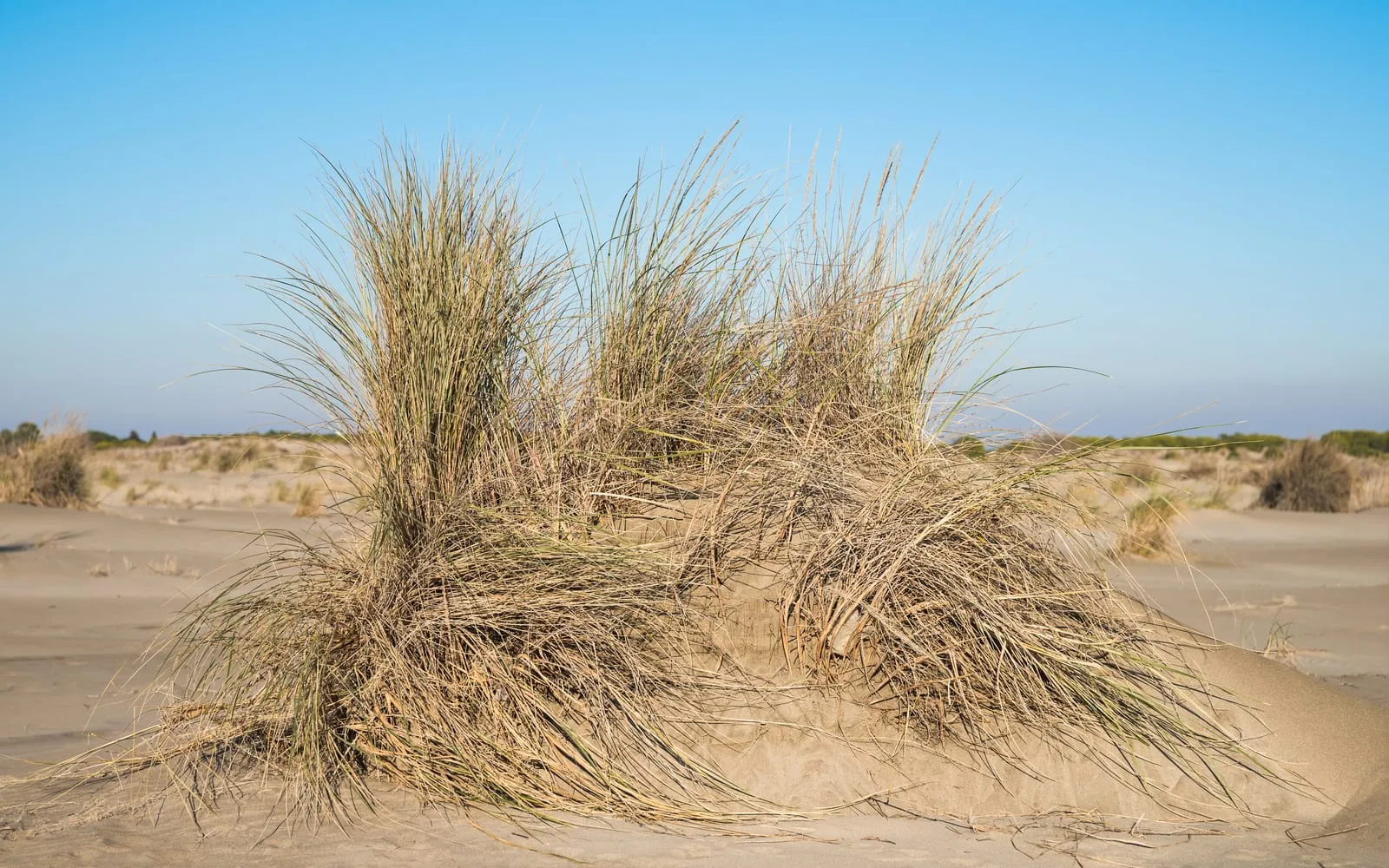
Stiff, narrow blades roll tightly along their length, an adaptation that reduces water loss in the exposed, salty, often desiccating coastal wind this grass grows in, giving the foliage a distinctive spiky, blue-green appearance quite different from a typical lawn or border grass. Flower spikes rise well above the foliage in summer, narrow and cylindrical, turning a pale straw colour as they mature.
The visible foliage is only part of the plant. Below ground, a vast, interconnected rhizome system extends far beyond what the surface growth suggests, sending up new shoots at intervals and binding sand together as it spreads, which is the real mechanism behind the plant’s dune- building reputation.
Where it is from
Coastal sand dunes across Europe and North Africa, growing in an environment defined by constant sand movement, salt spray, strong wind and very little in the way of stable nutrients or moisture retention.
That extreme, ever-shifting habitat is unlike almost anywhere else a garden grass is expected to grow, and it explains both the plant’s remarkable toughness in the right setting and its poor performance anywhere that setting is not replicated, since ordinary garden conditions offer none of the sand burial this species relies on to stay vigorous.
How it grows
An extensive rhizome system spreads horizontally through loose sand, sending up new shoots as it goes and responding to being partially buried by fresh sand with renewed, vigorous growth rather than any sign of stress. This is the key to the plant’s role in dune building. As sand accumulates around existing shoots, the plant grows upward and outward to keep pace, trapping yet more sand in the process.
Where sand movement stops, whether from coastal development, a stabilised path or an inland garden setting, marram grass tends to weaken over time, becoming more prone to disease and gradually losing the vigour that defines it in its natural dune habitat.
Through the seasons
Spring new shoots emerge vigorously from the rhizome, particularly where recent sand movement has provided fresh burial.
Summer is the main growing season, with flower spikes rising above the foliage.
Autumn growth continues at a steady pace in a suitable coastal setting, with little seasonal change compared with many other grasses.
Winter the plant remains evergreen and largely unaffected by coastal winter storms and salt spray, which it is fully adapted to withstand.
Care difficulty
Easy in its intended setting, a sandy, coastal, full-sun position, and difficult to keep looking right anywhere else. This is a species defined entirely by matching it to the right site rather than by any ongoing maintenance routine once it is there.
Watering
No supplemental watering is appropriate or necessary in a real dune or coastal sand setting, where the plant relies on natural rainfall and its own deep root system. It is not suited to a border or bed watered on a typical garden schedule, which does not replicate the conditions it needs to thrive.
Warning signs, diseases and pests
Rust disease can develop on marram grass that has stopped receiving fresh sand burial, showing as orange-brown pustules on the leaf blades, and is as much a symptom of the underlying site problem as a disease to treat directly; restoring natural sand movement, where feasible, does more for the plant’s health than any fungicide.
A weak, thinning stand in an established dune area can indicate reduced sand supply, often from coastal development or stabilisation nearby interrupting the natural movement of sand the plant depends on, and addressing that underlying cause is the relevant fix rather than treating the grass itself as the problem.
Growing environment
Full sun and loose, free-draining sand are both essential, and this species performs best where fresh sand periodically buries the base of the plant, encouraging vigorous new growth. It has no place in ordinary garden soil, however well drained, and is suited specifically to coastal dune or sand garden settings.
Feeding
None at all. This species is adapted to naturally poor, low-nutrient sand, and richer soil tends to favour more vigorous competing plants over marram grass itself, working against rather than for its establishment.
Troubleshooting
A dune planting looks weak and thin after some years. Consider whether natural sand movement in the area has been reduced or stopped, since this species depends on periodic burial to stay vigorous, and restoring that movement where practical is more effective than any direct treatment.
Orange-brown pustules have appeared on the leaves. This is rust disease, often linked to reduced sand burial and general site stress rather than an isolated pathogen problem. Address the underlying sand supply where possible.
You are considering planting this species outside coastal Europe or North Africa. Check local invasive species guidance first, since introduced marram grass has caused significant ecological problems on dune systems in parts of North America and elsewhere.
Skin has been scratched by the sharp leaf blades. This is a mechanical rather than toxic hazard. Wear gloves and long sleeves when handling or planting this species closely.
You are planting marram grass deliberately to stabilise a dune or bank. Plant into loose, freely draining sand at a reasonable density across the area, ideally timed for the cooler, damper part of the year to help roots establish before the driest summer weather arrives, and avoid foot traffic across a young planting while its rhizome network knits the sand together.