
Outdoor plant
Swamp Cypress
Taxodium distichum
Also known as Bald cypress, Southern cypress
How to grow swamp cypress, Taxodium distichum. A deciduous conifer that thrives in standing water and produces knobbly knees whose exact purpose is still debated.
At a glance
- Difficulty
- Easy
- Water
- Flexible; tolerates both permanently wet ground and, once established, ordinary garden watering
- Light
- Full sun to light shade
- Temperature
- Fully hardy in cold winters; also tolerates hot, humid summers well
- Hardiness
- USDA 4-9, RHS H5-H6, hardy to -29 C
- Type
- Hardy deciduous conifer
- Height
- 30-40 m at maturity, with a broad, buttressed base where grown in permanently wet ground. Growth to that size takes many decades, and several compact or narrow cultivars are sold for smaller gardens
- Native to
- Wetlands and river floodplains of the southeastern United States, from the lower Mississippi Valley and Gulf Coast north along the Atlantic coastal plain
Unusually broad for a wetland species, since its native range spans cold winters in the upper Mississippi Valley to hot, humid, near-subtropical conditions on the Gulf Coast. It tolerates both drought and permanent standing water once established, which is a wider spread of moisture tolerance than almost any other conifer offers, and heat and humidity are tolerated well, unlike several of the cooler-climate species elsewhere in this list.
Hardiness zones describe winter cold alone. Summer heat, humidity, rainfall and the length of the growing season decide as much, so treat the range as the outer limit rather than as a recommendation.
Not known to be toxic
Swamp cypress carries no established toxicity to people or common pets. Neither the RHS nor the ASPCA lists the species among plants of concern, and there is no documented case of poisoning from its foliage, bark or the small woody cones it produces. It is a tree regularly planted at pond and lake edges specifically because it tolerates standing water so well, and its needles decomposing in water present no known hazard to fish, waterfowl or anything else sharing that habitat, which is a reasonable safety record for a species so often planted directly beside water that pets and children have easy access to.
Sources: RHS potentially harmful garden plants, ASPCA toxic and non-toxic plants
About
Swamp cypress can grow standing in permanent water, with its roots submerged for months or years at a time, while still sending up a straight, tapering trunk. In wet ground it often produces knobbly woody growths called knees that break the surface around the base of an old tree. The species is equally at home in an ordinary well-drained garden border, which makes it one of the most adaptable large trees available, not just a specialist for a bog garden or pond edge.
Despite the conifer’s needle-like foliage, it drops that foliage completely every autumn, turning a warm russet-orange first, which is where the older common name bald cypress comes from, describing a tree that stands cold through winter in the way few other conifers in cultivation does.
Appearance and character
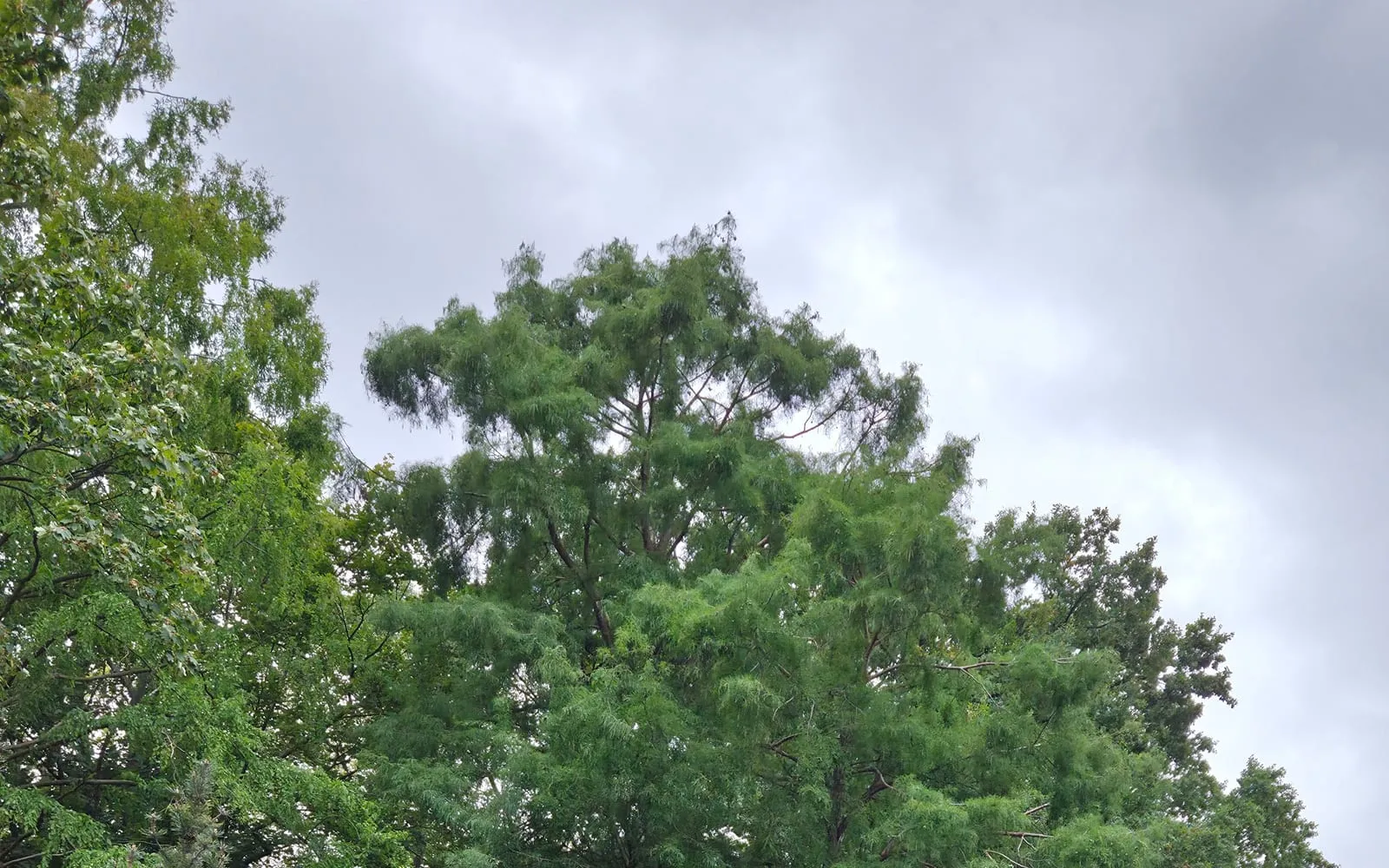
Foliage is soft, flat and feathery, arranged along slender side shoots that drop as a unit each autumn, a texture close to European larch and dawn redwood among the deciduous conifers in this list, though slightly more delicate in appearance. Fresh spring growth is a bright yellow-green, maturing to a soft mid-green through summer.
The trunk of a mature tree, particularly one grown in wet ground, develops a distinctive fluted, buttressed base that flares outward before narrowing into the straighter upper trunk, an adaptation to anchoring the tree in soft, waterlogged soil that a tree on ordinary dry ground develops far less strongly.
Cypress knees, technically pneumatophores, are woody projections that rise from the shallow, spreading roots, most pronounced and numerous on a tree growing in or very near standing water and largely or entirely absent on a tree in ordinary dry garden soil. Their exact function remains unresolved among botanists; the long-standing explanation that they help the submerged root system take up oxygen in waterlogged, low-oxygen soil is plausible and widely repeated, but structural support in soft ground and carbohydrate storage have both also been proposed, and no single explanation has been conclusively confirmed.
Bark is grey-brown and fibrous, peeling in long strips similar in texture to its relatives dawn redwood and coast redwood.
Where it is from
Taxodium distichum is native to wetlands, river floodplains and swamps across the southeastern United States, from the lower Mississippi Valley and the Gulf Coast north along the Atlantic coastal plain into parts of Delaware and Maryland. It forms the dominant tree of the classic American cypress swamp, often growing directly in standing water for extended periods and reaching considerable age; several individual trees in North Carolina have been documented by tree-ring dating at well over a thousand years old, among the oldest known trees in eastern North America.
Its wide native range, spanning cooler winters in the northern part of its distribution to hot, humid, near-subtropical conditions on the Gulf Coast, explains the species’ unusual tolerance for both cold and heat in cultivation, a broader climate range than almost any other conifer commonly planted ornamentally.
The wood is naturally resistant to rot and long used regionally for construction in wet conditions, boat building and shingles, valued in the same way European larch’s rot-resistant timber was valued in the Alps, though for a wholly different, wetland climate.
How it grows
Plant in spring or autumn into almost any soil, from a pond or stream margin with permanent shallow standing water to an ordinary well-drained garden border, since this is one of the few large trees suited to both extremes without any special soil preparation.
Choose the planting site based on the effect wanted, not soil constraint. A tree grown at a pond or lake edge in standing water develops the buttressed trunk and prominent knees the species is best known for; the same tree grown in ordinary dry garden soil grows just as well but develops fewer or no knees and a less flared trunk base.
Give it space to reach a substantial eventual size in most cases, though several narrower or more compact cultivars, bred specifically for smaller gardens, are available where the straight species would be too large.
Little pruning is needed beyond removing any damaged or crossing branches while the tree is young to establish a single leading shoot; the species develops a good natural shape without much intervention.
Through the seasons
Spring brings a flush of soft, bright yellow-green new growth from bare winter branches, a noticeable change after the tree has stood bare through winter.
Summer is steady growth through warm, often humid conditions that this species tolerates well, unlike several other conifers here that struggle in heat and humidity together; watering needs are minimal on most soil once established.
Autumn brings the tree’s other major seasonal display, needles turning a warm russet-orange before dropping completely over a few weeks, leaving the tree bare and giving rise to the older common name bald cypress.
Winter shows the tree entirely without foliage, its buttressed trunk and, on a tree in wet ground, its ring of exposed knees fully visible. Established trees tolerate cold well across a wide part of their range, and standing water around the roots, instead of being a winter risk as it would be for almost any other conifer, is the condition this species is built for.
Care difficulty
Easy, and unusually forgiving of a wide range of sites for a tree with such a strong wetland reputation. Swamp cypress grows well in permanently waterlogged ground, in ordinary garden soil, in hot humid summers and in cold winters, without needing the particular combination of conditions several other conifers in this list demand. The main practical consideration is planning for its eventual size and, where planted in a lawn near standing water, deciding whether the knees that develop there are wanted, since mowing around an established ring of knees becomes impractical.
Watering
No special watering regime is needed on ordinary, reasonably moist garden soil once the tree is established, and this species tolerates a wide range of moisture conditions better than almost any other tree of comparable size.
Planted at a pond or stream margin, it tolerates permanent shallow standing water indefinitely, a condition that would kill most other trees within a season or two.
Planted on ordinary dry garden soil, it also tolerates moderate drought reasonably well once established, an unusual combination of wet and dry tolerance in the same species that few other trees, conifer or otherwise, can match.
Warning signs, diseases and pests
Spider mites appear in hot, dry conditions, more likely on a tree grown in ordinary dry soil than one at a pond margin with reliably moist air and ground, showing as fine speckling on the foliage.
Twig blight causes localised dieback of individual shoots, usually following a wound or a period of stress, and pruning out affected growth generally contains it on an otherwise healthy tree.
Gall-forming insects produce small, rounded swellings on twigs and foliage, mostly cosmetic and rarely a threat to an established tree’s health.
Chlorosis, a yellowing of the foliage caused by iron deficiency, sometimes develops on strongly alkaline soil, since this species is naturally adapted to the more acidic soils of its native southeastern wetlands; a chelated iron treatment corrects it where alkaline soil cannot easily be avoided.
Knees appearing unexpectedly in a lawn near a pond or stream are not a disease at all, the tree’s normal response to consistently wet ground nearby, and mowing around them or accepting a slightly different lawn texture near the water is the only practical response.
Growing environment
Full sun to light shade both suit it, with the strongest autumn colour generally in full sun.
Almost any soil moisture level is tolerated, from permanent shallow standing water to ordinary well-drained garden ground, which is unusual among trees of this size and makes it a strong choice for a difficult, seasonally wet corner that few other large trees would tolerate.
Space for its considerable eventual size matters, along with a decision about how close to open water it is planted, since proximity to standing water directly determines how prominent the trunk buttressing and knees become.
Heat and humidity are tolerated well, reflecting the Gulf Coast portion of its native range, in contrast to several other conifers in this list that perform noticeably better in a cooler, drier summer.
Feeding
Established trees on reasonable soil need very little supplemental feeding, reflecting how adaptable the species already is to a wide range of soil conditions without help.
A young tree can be given a light, balanced feed once in spring during its first few seasons to support establishment, particularly on poor soil.
Chlorosis on alkaline soil is better addressed with a chelated iron treatment targeted at the specific deficiency than with general fertiliser, since the underlying issue is poor nutrient availability caused by soil pH.
Troubleshooting
What are the knobbly growths appearing around the base of my tree? These are cypress knees, woody projections from the shallow root system that develop most prominently on a tree growing in or near standing water. Their exact purpose is still debated among botanists, with oxygen exchange in waterlogged soil the most commonly cited explanation alongside structural support, and neither has been conclusively proven over the other.
My tree has lost all its needles. Is it dead? No, if it is autumn or winter. Swamp cypress is a deciduous conifer, alongside European larch and dawn redwood elsewhere in this list, and it drops its needles completely every year after turning a warm russet colour, with new growth returning reliably each spring.
Can I really plant this tree in standing water? Yes, more reliably than most trees. It is regularly planted at pond and lake margins specifically because it tolerates permanent shallow water for its entire life, developing a flared, buttressed trunk base and prominent knees in response.
Will it grow just as well on ordinary dry garden soil? Yes. Despite its wetland reputation, the species performs well on ordinary well-drained garden soil too, developing fewer or no knees and a less pronounced trunk base than a tree grown at a water’s edge.
The foliage is yellowing despite regular watering. On alkaline or chalky soil, this is often chlorosis, an iron deficiency caused by soil pH instead of a lack of water, since this species is naturally adapted to the more acidic soils of its native wetlands. A chelated iron treatment usually corrects it.
Knees are appearing in my lawn near the pond and getting in the way of mowing. This is a normal response to consistently wet ground nearby not a problem with the tree. Mowing around established knees, or accepting a different, less manicured texture in that part of the lawn, is the practical response, since removing knees is difficult and can damage the shallow root system they belong to.
Does it tolerate hot, humid summers as well as cold winters? Yes, and unusually well for a conifer. Its native range spans both, from cold winters in the upper Mississippi Valley to hot, humid Gulf Coast summers, giving it a broader comfortable climate range than most of the other species in this list.