
Houseplant
Red Dragon Flower
Huernia schneideriana
Also known as Huernia schneideriana, Little Dragon
How to grow Huernia schneideriana, the red dragon flower, a small carrion-flower relative with deep-red bell flowers and clustering toothed stems.
At a glance
- Difficulty
- Moderate
- Water
- Once the mix has dried right through
- Light
- Bright light with some direct sun
- Temperature
- Warm; keep above about 10 deg C
- Humidity
- Low
- Hardiness
- USDA 10-11, RHS H1c, hardy to 10 C
- Type
- Evergreen clump-forming succulent
- Height
- 10 to 20 cm
- Native to
- Eastern Africa
A small clustering stem succulent from the dry uplands of eastern Africa, storing water in ridged, toothed stems. It needs bright light, sharp drainage and warmth, has no frost tolerance and rots below about 10 deg C in the damp. It thrives on heat and drought and dies in a cold, wet pot.
Hardiness zones describe winter cold alone. Summer heat, humidity, rainfall and the length of the growing season decide as much, so treat the range as the outer limit rather than as a recommendation.
Not known to be toxic
The red dragon flower is not listed as toxic by the ASPCA or the RHS. A pet or child biting a stem would find it bitter and fleshy and might have a mild stomach upset. Its flowers give off a faint carrion scent to draw flies, far milder than its larger stapeliad cousins, so the main nuisance is the smell rather than toxicity.
Sources: ASPCA toxic and non-toxic plants, RHS potentially harmful garden plants
About
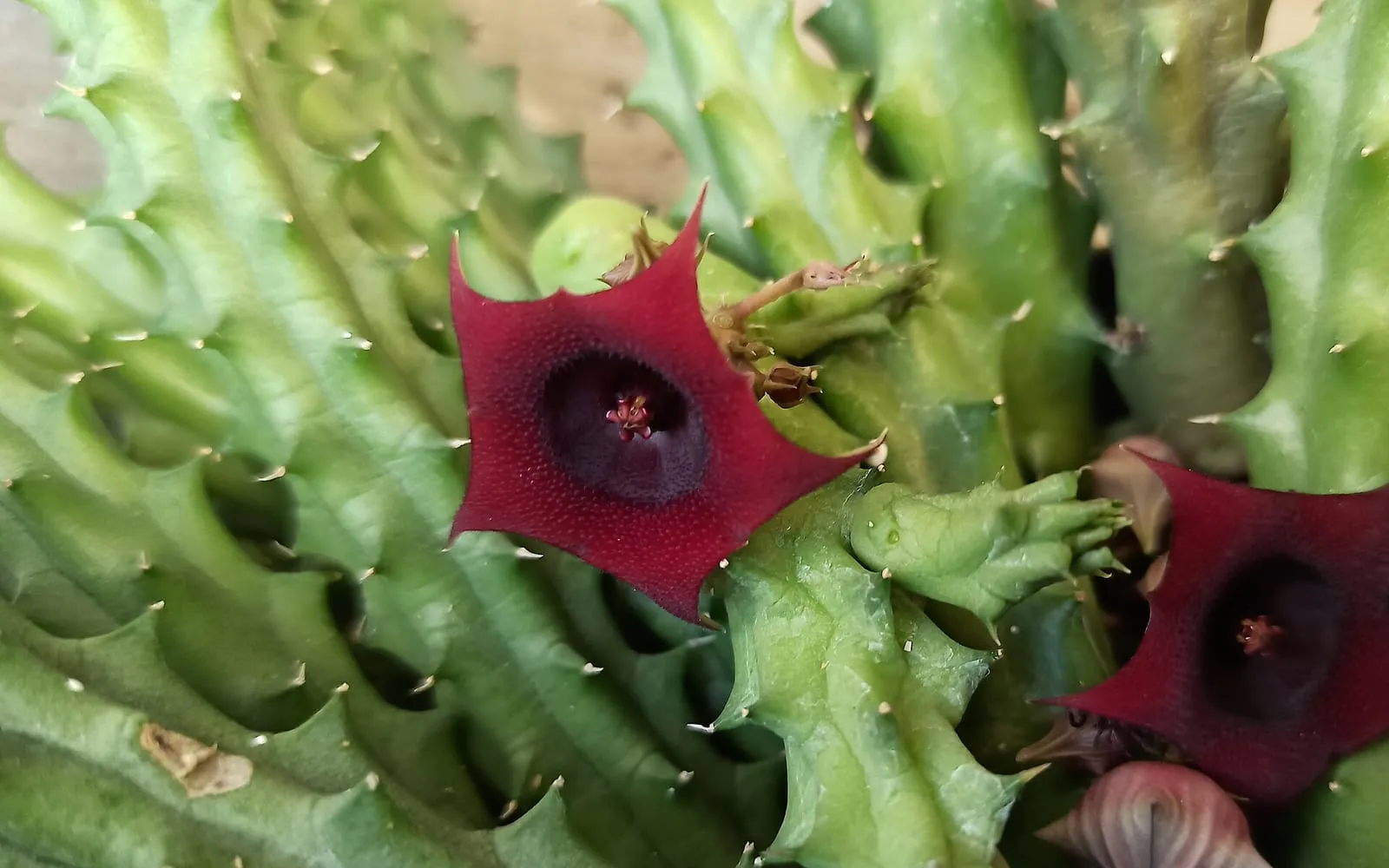
Red dragon flower is a small clustering succulent that flowers heavily for its size. The short, finger-thick stems are ribbed and rimmed with soft teeth, mounding into a low cushion, and from low on those stems come tidy, waxy bells of dark maroon-red, velvety within, in a run that lasts from early summer well into autumn. Because it blooms while still young and keeps at it, it has become a staple of collections of small unusual succulents.
It sits in the stapeliad group, the carrion flowers, next to the much bigger and far ranker carrion flower. Where that cousin reeks, the dragon flower gives off only a light scent to bring in its pollinating flies, mild enough that it makes an easy houseplant.
Native to the dry highlands of east Africa, it needs similar conditions in a pot. Give it strong light, a gritty root run and a proper drying-out between drinks, keep it warm, and it responds to you with a generous, long-running show of little dark bells.
Appearance and character
Each stem is short, plump and ribbed, carrying four to six angles lined with small, soft teeth, and coloured a bright green that takes on a red cast in strong light. The stems branch from the base into a low, spreading cushion that spills a little over the pot edge.
No true leaves appear on the plant. The ribbed green stems hold the water and carry out the photosynthesis, so between flowering spells it looks like a neat cluster of small toothed fingers.
The bells are what set it apart, small and waxy, cut into five points, a deep velvety maroon-red inside, following one another up the young stems through the warm half of the year and coming freely once the plant has settled.
Sniff a flower and the scent is slight, a soft lure for the small flies that carry its pollen, nothing like the reek of a full-sized Stapelia. That mildness makes it comfortable to keep on an indoor shelf.
Where it is from
The species belongs to the dry highlands of eastern Africa, where it tucks itself among rocks and under the light cover of low shrubs, drawing on the water banked in its stems to ride out dry seasons of warm days and chilly nights.
Everything it needs comes from that setting. Strong light and a fast-draining root run keep it firm, drought and heat suit it, and a cold pot left wet can kill it. Its small, faintly scented bell is modest compared with the large, foul flowers of bigger stapeliads.
How it grows
Through the warm, bright half of the year it puts out fresh stems from the base and produces one waxy bell after another, then settles into a quiet winter. Heat and light drive that growth, while a cold, damp spell will halt it and set rot into the soft stems.
Set it in a gritty, sharply draining cactus compost, and choose a broad, shallow container that suits the low, creeping habit better than a deep one. Let the compost dry out fully before you water, then give it a good soak and tip away all that drains through. Watering it while the weather is cool is the most likely way to lose it.
Stand it in bright light with a little direct sun, hold the room above about 10 deg C, and keep the air on the dry, moving side. Once it has decent light and a summer’s growing spell behind it, the flowers come without much effort.
Few plants are simpler to increase. Snap off a stem, leave the wound to callus over a few days, and settle it into gritty compost, where it takes hold within weeks.
Through the seasons
Spring starts it back into growth on the returning light and warmth. Begin watering again, split a congested cushion if it needs it, and root a few spare stems.
Summer is its working season for both stems and flowers. Water once the compost has dried out, give a weak feed, and watch the dark bells open in succession.
Autumn keeps the flowers coming as the weather cools, and is the point to begin cutting back on water.
Winter is close to bone-dry, held above about 10 deg C. Water almost never, because a cold, sodden pot now causes rot.
Care difficulty
Moderate. In the right spot it is easy and generous with its flowers, and it roots from any broken stem, but the soft, water-swollen stems rot at once if they are watered cool or left standing wet. Keep it bright, warm and on the dry side and it ranks among the most rewarding of the small succulents, coming into bloom young and often. Overwatering is the most reliable way to kill it.
Watering
Hold off until the gritty compost has gone dry all the way through, then drench it and let every drop run out of the base. With so much water banked in the stems, the plant tolerates a long dry spell far more readily than it does any lingering damp.
In winter it needs next to nothing, since a cold, wet pot rots the stems at that season. A stem that has gone slightly wrinkled is short of water and fills out again after a drink, while one that turns soft, sallow or blackened has begun to rot and should be cut away, the sound pieces kept to root.
Warning signs, diseases and pests
Stems that soften, blacken and slump at the base are rotting from cold, wet compost, and this is the usual way the plant is lost. Cut everything back to firm, healthy tissue, let the good pieces dry off, and start them again in fresh gritty compost, watering far more warily from then on.
Mealybugs slip in among the packed stems and down at the roots, showing as white fluff. Touch them out with a cotton bud dipped in dilute alcohol, and give the roots a look whenever you repot, since the crowded stems shelter them well.
Wrinkled, sunken stems are usually just thirsty and recover after a soak. Buds that shrivel and fall before they open point to the plant having gone too dry or too cold while they were forming.
Growing environment
It needs bright light with a spell of direct sun each day, both to keep the stems firm and red-flushed and to bring on the flowering it is grown for. Starved of light, the stems turn thin and pale and the bells stop coming.
Warmth over about 10 deg C and a dry, well-aired position suit it best. It prefers low humidity and does badly with still, damp air, so a place where the air stirs a little keeps it sound.
Grow it in a broad, shallow pot of gritty, sharply drained compost on a bright sill, where the low cushion can creep and the bells can open at the rim in easy view.
Feeding
A weak, low-nitrogen cactus feed once or twice across the summer is enough. Too rich a diet only softens the stems and leaves them open to rot.
Feed it nothing over winter. After repotting, the fresh gritty compost keeps it going for the first few weeks unaided.
Troubleshooting
The stems have gone soft and black. Rot, brought on by cold, wet compost. Trim back to firm tissue, dry the healthy pieces, and root them in fresh gritty compost, and water far more sparingly, above all when the weather is cool.
The stems have shrivelled. Thirst, after too long without water. A thorough soak fills them out. If they stay thin and washed-out, the plant needs more light.
How is it different from the carrion flower? It is a good deal smaller, with little dark bells and no more than a faint scent, whereas the carrion flower throws huge, foul star flowers. Both are stapeliads and both want the same bright, dry treatment.
Is it safe around pets? No toxicity is recorded, and its scent is slight. Keep it away from pets that chew, since any plant can still cause a mild stomach upset.
It has stopped flowering. The cause is nearly always too little light, or the lack of a proper summer growing spell. Move it into brighter light with some direct sun and keep it warm, and the bells return.
Red Dragon Flower problem guides
Not sure what is wrong? See the common houseplant pests guide.