
Outdoor plant
Pyramidal Orchid
Anacamptis pyramidalis
How to grow pyramidal orchid, Anacamptis pyramidalis. Its flowers clamp pollen onto a moth's tongue to guarantee cross-pollination, it colonises disturbed chalk ground faster than most wild orchids, and a bought plant rarely establishes in a border.
At a glance
- Difficulty
- Difficult
- Water
- Rainfall alone is normally sufficient; do not irrigate through summer dormancy
- Light
- Full sun
- Temperature
- Needs a cool winter and a dry summer rest; poorly suited to a mild, damp, year-round climate
- Humidity
- Dry at the surface once flowering finishes
- Hardiness
- USDA 6-9, RHS H5, hardy to -15 C
- Type
- Herbaceous perennial orchid growing from a pair of underground tubers
- Height
- 20-60 cm in flower
- Native to
- Europe, the Mediterranean
Ranges from southern England through France and the Mediterranean into North Africa, a spread too wide to explain by winter cold on its own. Every established population sits on calcium-rich, low-nutrient, fast-draining ground with a dry spell after flowering. That combination matters more than the zone number when judging whether the species can grow in a given spot.
Hardiness zones describe winter cold alone. Summer heat, humidity, rainfall and the length of the growing season decide as much, so treat the range as the outer limit rather than as a recommendation.
Not known to be toxic
Anacamptis pyramidalis carries no recorded toxic compounds and does not appear on the RHS list of harmful garden plants or any equivalent European reference. It is not grown as a cut flower or kept indoors, so the practical question of pet or child safety rarely comes up, and there is no documented reason for particular caution beyond the general legal restrictions on picking or uprooting a wild orchid.
About
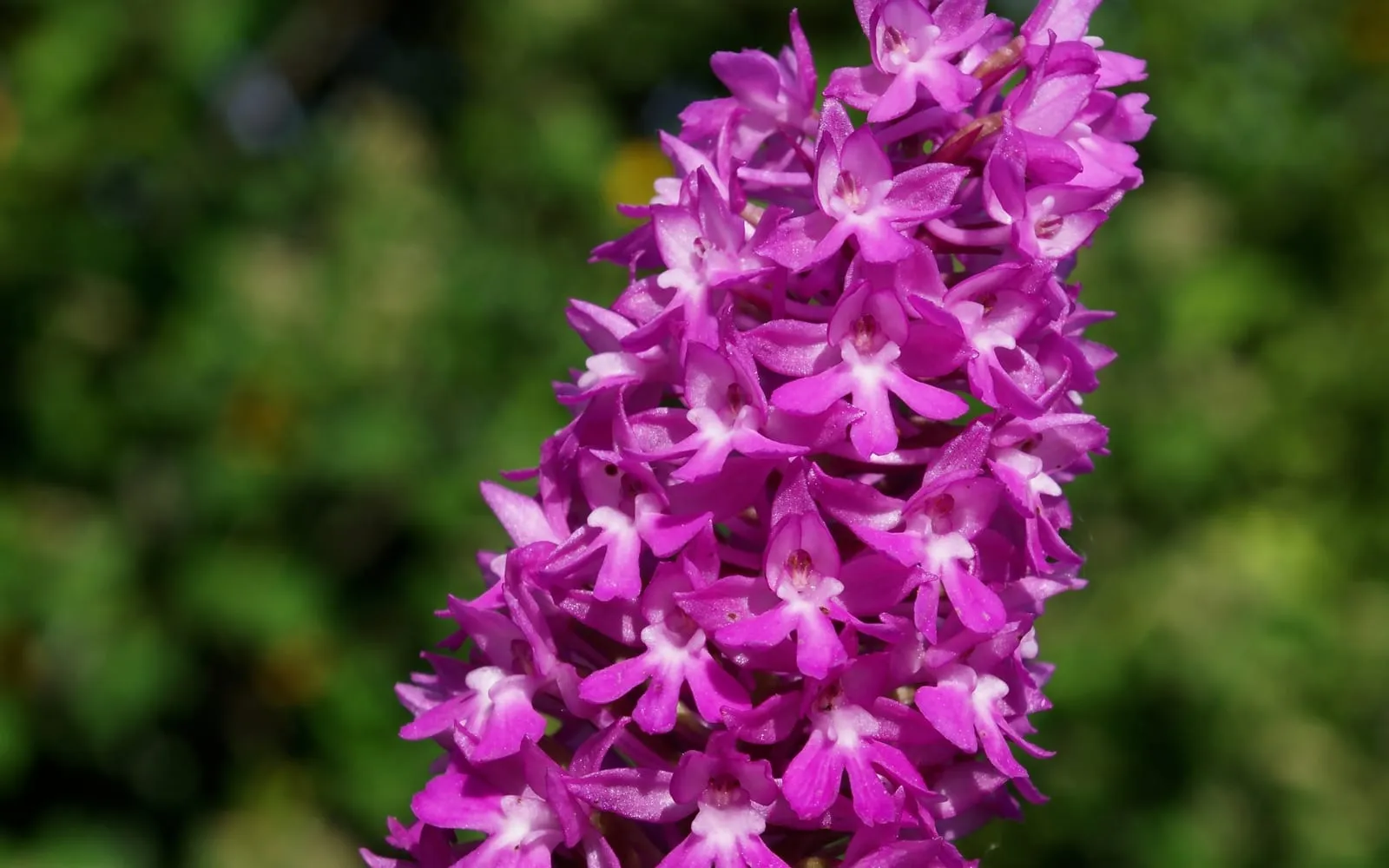
Pyramidal orchid carries a dense, tightly packed cone of bright pink-magenta flowers at the top of a slender stem, the shape that gives the species its name. It is one of the more successful wild orchids at colonising disturbed or newly created chalk grassland, turning up on motorway verges, old quarries and restored downland within a few years of suitable ground becoming available.
That readiness to spread on its own is not the same as being easy to plant deliberately. A live plant or tuber almost never establishes when bought and set into an ordinary garden bed, because germination and early growth depend on a soil fungus that most cultivated ground does not contain. Where this species appears in gardens, it has typically arrived as windblown seed onto ground already suited to it, not been planted there.
Appearance and character
The flower spike opens as a tight, conical cluster, widening slightly at the base as more flowers open below the still-closed tip, and can carry fifty or more individual blooms on a strong plant. Each flower is small but intensely coloured, usually a vivid pink though occasionally pale or white, with a three-lobed lip and a long, thin nectar spur curving back behind it.
Two raised ridges on the lip guide a visiting moth’s tongue directly towards that spur, and as the moth probes for nectar the flower’s pollen sacs clamp onto its proboscis in a saddle shape found in few other orchids, ensuring they are carried intact to the next flower the moth visits. Long-tongued day-flying and night-flying moths do most of the pollinating, which is part of why the species can set seed prolifically in a site with a healthy moth population nearby.
The narrow, grey-green leaves form a low rosette that appears in autumn or early spring and dies back once the plant has flowered and set seed for the year.
Where it is from
Anacamptis pyramidalis grows across western and southern Europe and round the Mediterranean basin into North Africa, on chalk downland, limestone grassland, coastal dunes and other calcium-rich ground with thin, free-draining, nutrient-poor soil. It tolerates more disturbance than many wild orchids, which is why it is often among the first orchid species to appear on a newly cut road verge or a quarry face left to recolonise naturally.
The mycorrhizal fungus the seed needs to germinate is present in a wide range of undisturbed and recently disturbed calcareous ground across that range, more so than for some rarer orchids, which helps explain why this species spreads faster and further than most. It is still absent from ordinary garden soil in the great majority of cases, since garden beds are built from imported topsoil and compost rather than exposed chalk or limestone.
How it grows
Buying a plant or tuber is rarely worthwhile. Genuine nursery-propagated stock is uncommon, since raising this species from seed requires the same fungal partner the wild plant depends on, and wild-collected material is illegal to sell or plant in most of its range regardless of how it is marketed.
The realistic path for a gardener is to create or preserve the right conditions and let seed find its own way there. An area of chalk or limestone lawn, low in nutrients and left unmown from spring through midsummer, gives windblown seed a chance to germinate if the right fungus happens to be present. Removing the grass cuttings after an annual late- summer cut, rather than leaving them to rot down and enrich the soil, helps keep fertility low enough for the orchid to compete.
If plants appear, leave them undisturbed. This species tolerates ground disturbance around it, such as an adjacent path being cut or verge management continuing nearby, better than many orchids, but a tuber dug up or moved still loses the fungal connection that let it establish in the first place and rarely survives the move.
Through the seasons
Autumn and winter see the leaf rosette present at ground level in mild climates, growing slowly through the cold months.
Spring brings faster leaf growth and the emergence of the flower spike.
Early to midsummer is flowering time across most of the range, typically June and July in Britain, when the dense pink cone opens fully and draws in moths.
Late summer onward is dormancy. The plant sets seed, the leaves die back, and nothing shows above ground until growth resumes the following season.
Care difficulty
Difficult to establish deliberately, though somewhat more forgiving once a colony exists than many wild orchids, since this species tolerates a degree of soil disturbance and management change that would eliminate a more sensitive relative. The core problem does not go away with attentive care: a garden bed built from ordinary topsoil lacks the fungus the plant needs, and no amount of watering, feeding or mulching creates that partnership from scratch. Success mostly comes down to whether suitable calcareous ground already exists nearby for seed to reach, which is outside a gardener’s control.
Watering
None beyond natural rainfall in a suitable site. The plant is adapted to dry summer ground after flowering, and irrigating a chalk lawn or bank where it has appeared works against that dormancy and risks rotting the tubers.
Through autumn, winter and spring, ordinary rainfall on free-draining calcareous soil is enough; standing water at any point in the year threatens the tubers directly.
Warning signs, diseases and pests
Slugs and snails feed on the leaf rosette and young flower spike, particularly in a wet spring, and can remove a season’s flowering from an individual plant. General slug management in the surrounding area is the practical response, since chemical treatment near a wildflower colony is best avoided.
Vine weevil larvae feed on the paired tubers below ground, with damage usually only obvious when a plant fails to reappear the following year. There is little that can be done for an established wild colony beyond maintaining healthy, well-drained soil.
Root rot follows ground that holds water rather than draining sharply away, and is one of the more preventable problems here, since a site can be chosen or improved for drainage before hoping for a colony to establish.
Moles tunnelling through turf can sever tubers or heave them to the surface, and there is no targeted way to protect an orchid colony from mole activity without disturbing the ground around it just as much.
Growing environment
Full sun is essential; this species does not tolerate the shade some other wild orchids manage, and a site with tree or shrub canopy overhead is unlikely to support it regardless of the soil beneath.
Alkaline, chalk or limestone soil, low in nutrients and sharply free-draining, is the non-negotiable condition. A pH test of a candidate site takes minutes and rules the species in or out faster than any other single check.
Minimal disturbance during the growing season, paired with an annual late cut after seed has set, keeps the sward open enough for seedlings to establish without letting coarser grass and scrub take over the ground.
Feeding
None. Adding fertiliser to ground where this species grows or might grow raises fertility in a way that favours vigorous grasses over the orchid, and can eliminate an established colony within a handful of growing seasons.
Troubleshooting
Can I buy a pyramidal orchid to plant in a border? Rarely with any real chance of success. Legitimate nursery-propagated stock is uncommon, wild-collected material is illegal to sell or plant across most of its range, and an ordinary flower bed lacks the soil fungus the species needs to establish.
Plants have appeared on a verge or bank I manage. What should I do? Leave them in place, delay mowing that area until after flowering and seed set in late summer, and remove the cuttings afterwards rather than letting them enrich the soil.
Why does this orchid seem to spread faster than other wild orchids I have read about? It tolerates disturbed and newly available calcareous ground better than many species, and its fungal partner is relatively widespread on that kind of soil, both of which let it colonise a site faster than rarer, more specialised orchids manage.
I mowed the area before I realised what was growing there. Will it come back? Possibly, if the tubers themselves were not dug up or damaged, since mowing after the leaves have died back does not necessarily harm the dormant plant below ground. A cut taken before seed has set will reduce or remove that year’s contribution to the colony, though established tubers can still flower again the following year.
Is it worth trying to introduce seed to a suitable-looking chalk lawn? It rarely works as a direct sowing exercise, since germination depends on the fungus already being present in that exact patch of soil. Managing the ground correctly and leaving it open for seed to arrive naturally, from nearby colonies or on the wind, is a more realistic approach than attempting to sow it yourself.