
Outdoor plant
Chinese Dodder
Cuscuta chinensis
Also known as Tu Si Zi, Chinese Dodder Vine
What Chinese dodder is, Cuscuta chinensis, a leafless parasitic vine of yellow threads that cannot be grown normally, and how to deal with it.
At a glance
- Difficulty
- Difficult
- Water
- Not applicable; it takes water from its hosts
- Light
- Full sun to partial shade, on its hosts
- Temperature
- Frost-tender; dies back each year and returns from seed
- Hardiness
- USDA 8-11, RHS H2, hardy to 2 C
- Type
- Parasitic annual, twining on host plants
- Height
- Sprawling over hosts, 1 to 3 m across
- Native to
- Eastern Asia
A warm-climate annual parasite that grows through the warm season, sets a great deal of seed, and dies at the first frost, carrying on only through that seed. The seed is long-lived in the soil and germinates when warmth returns, so the plant persists in warm regions and on agricultural land far more through its seed than through any single plant surviving the winter.
Hardiness zones describe winter cold alone. Summer heat, humidity, rainfall and the length of the growing season decide as much, so treat the range as the outer limit rather than as a recommendation.
Not known to be toxic
Chinese dodder is not recorded as poisonous to people or pets, and its seed, known as tu si zi, is used in traditional Chinese medicine. The harm it does is physical: it is a parasite that draws water and food from the host it twines around, weakening or killing it. Treat it as a plant pest to be removed instead of as a toxic hazard, and as a matter to take seriously where it threatens crops.
Sources: RHS potentially harmful garden plants, North Carolina Extension plant toxicity database
About
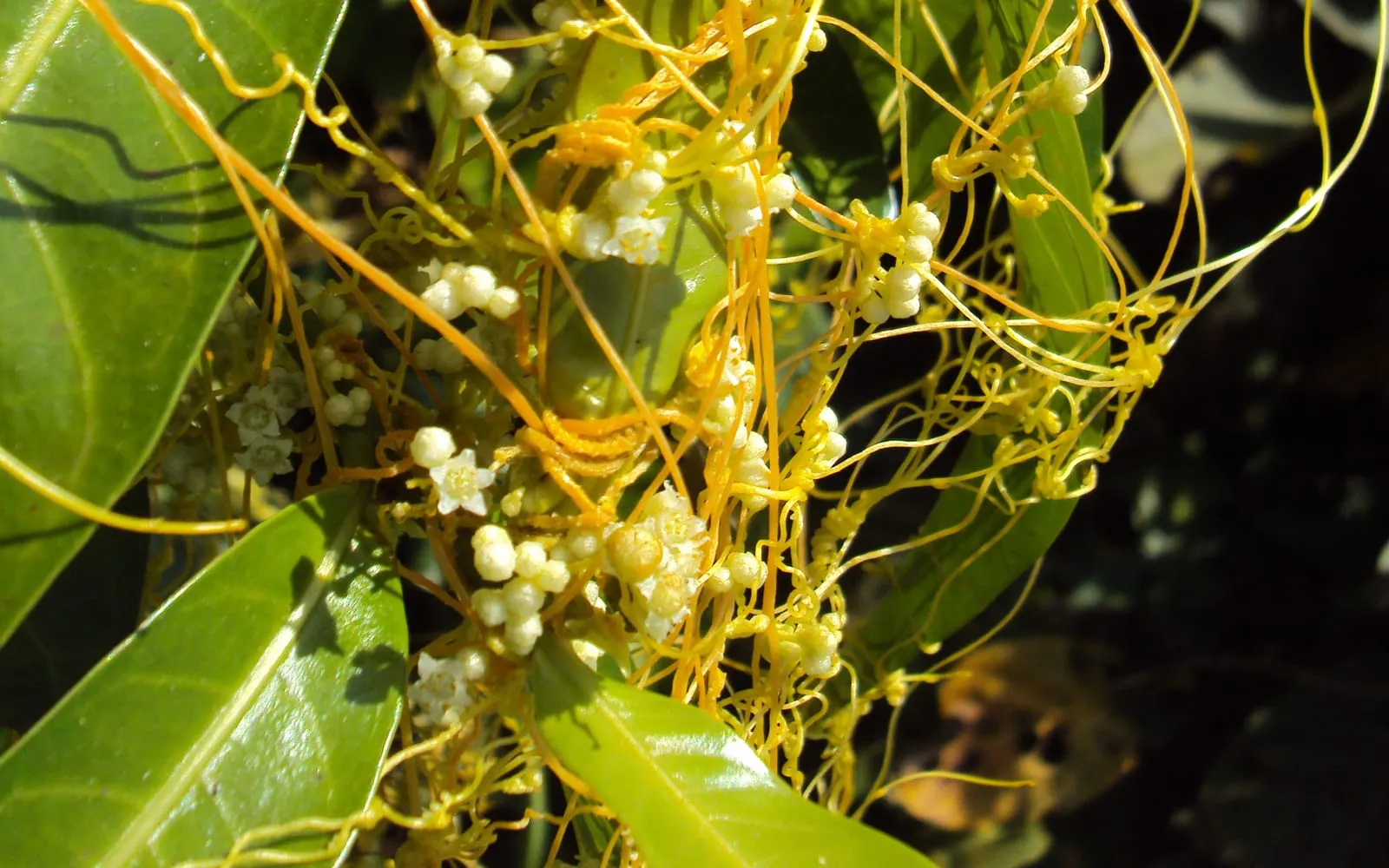
Chinese dodder is a parasitic plant. This guide explains what it is and how to deal with it, rather than how to grow it, because it is not a plant to cultivate as an ornamental. It appears as a tangle of thin, leafless, yellow or orange threads draped over other plants, with no green leaves and, once it has latched on, no roots in the soil.
It lives from its host. The threads twine around a host plant and push tiny suckers, called haustoria, into its stems to draw out water and food, so the dodder needs no leaves of its own and does almost no photosynthesis. A heavy infestation smothers and weakens the host and can kill it.
Its one recognised use is the seed, called tu si zi, which is collected for traditional Chinese medicine. As a living plant, though, it is treated as a weed and a crop pest, and in many countries it is regulated and its seed is a prohibited contaminant, so this guide takes the practical approach: how to recognise and control it.
Appearance and character
The stems are the whole visible plant, thin wiry twining threads in yellow to orange, leafless or with only tiny scale-like remnants, sprawling in tangled mats over whatever they grow on.
There are no functional leaves and almost no green colour, because the plant draws its living from its host instead of making its own food, so it can be so pale.
Flowers are small, cream or white, and clustered along the threads in tight little knots, appearing through the warm season and setting a great deal of seed.
The attachment to the host is through haustoria, minute suckers that the thread presses into the host’s stem to tap its sap. These make the plant a parasite and what make it damaging.
Roots exist only at the very start. A germinating seedling has a brief root and a thread that searches for a host, and once it attaches, the root withers and the plant lives entirely off the host.
Where it is from
Cuscuta chinensis is native to eastern Asia, where it grows through warm-season crops and wild vegetation, twining over a wide range of host plants in open, sunny and lightly shaded ground. It has spread with agriculture to other warm regions.
It behaves as a warm-season annual, germinating from long-lived seed as the weather warms, finding and attaching to hosts, flowering and seeding heavily, and dying at the first frost. Its persistence comes from that abundant, durable seed instead of from any one plant lasting.
How it grows
A seed germinates in warm soil and sends up a thin, thread-like seedling that moves in slow circles until it touches a suitable host. On contact it coils on, pushes in its suckers, and abandons its root, from then on living entirely off the host plant.
It then grows fast, spreading its threads from plant to plant, flowering and setting seed through the warm season. Broken fragments of stem can also start new infestations if they reach a host, so it spreads by pieces as well as by seed.
You do not grow it. The practical task is to prevent and control it. Pull off and destroy the threads before they seed, remove and bin infested host growth, and avoid spreading fragments. Because the seed is long-lived, control often means staying on top of it for more than one season.
Take it seriously where crops are concerned. It parasitises many crop plants, and as a regulated weed in many places it should be reported where required and kept out of seed and produce.
Through the seasons
Spring to early summer is when the seed germinates in warm soil and the seedlings reach for and attach to hosts. Catching it now, before it is established, is the easiest control.
Summer brings rapid spread over the hosts, flowering and the start of heavy seed set. Remove infested growth before the seed ripens.
Autumn is when the plant sets the last of its abundant seed and then dies with the first frost, leaving the seed behind in the soil.
Winter leaves only the seed, which waits in the soil for the warmth of the following year.
Care difficulty
There is no cultivation to rate, since this is a weed to control, not a plant to grow. The real difficulty is control, and it is considerable. The plant spreads by both seed and fragments, its seed is long-lived in the soil, and it grows fast once attached. Clearing it reliably takes vigilance over more than one season and care not to spread it further.
Watering
Watering does not apply, because the plant takes its water from the host it lives on instead of from the soil. Nothing about managing it involves watering it; the aim is to remove it, not to keep it alive.
Warning signs, diseases and pests
The plant itself is the pest. Tangled yellow or orange threads over your plants, with no leaves and no roots in the ground, are the sign of dodder, and the host beneath is being weakened as its sap is drawn off.
A heavy infestation smothers and can kill the host, and it spreads quickly to neighbouring plants, so early removal matters. Pull off the threads, remove infested host growth, and destroy it instead of composting it.
The plant is not a toxic hazard to people or pets, and its seed is used in herbal medicine, so the concern is its effect on other plants and its status as a regulated weed instead of any poisoning risk.
Growing environment
It grows wherever its host plants grow, in full sun to partial shade, since it depends on them instead of on soil or light of its own. Warm, open, cultivated and weedy ground suits it because it can spread from one host plant to another.
It has no soil requirements of its own, taking everything from its hosts, so the way to deny it a home is to deny it hosts and to clear it before it seeds.
The setting to keep in mind is an agricultural or garden one where it can spread from plant to plant. Keep susceptible plants clear of it, and keep its seed out of the ground where possible.
Feeding
Feeding does not apply and would be counterproductive, since anything that feeds the host also feeds the parasite. There is no reason to feed dodder and every reason to remove it.
Troubleshooting
What are the orange threads all over my plant? Almost certainly dodder, a parasitic plant. It has no leaves and no roots in the soil, living off the host it twines around. Remove and destroy it before it seeds.
How do I get rid of it? Pull off all the threads by hand and remove any heavily infested host growth, destroying instead of composting it. Because the seed is long-lived and fragments can re-root on a host, check repeatedly over the season and into the next.
Can I grow it for the seed? It is not a plant to cultivate. It is a parasite and, in many places, a regulated weed and crop pest, so growing it is both impractical and, where regulated, not allowed. The medicinal seed is a matter for licensed suppliers.
Is it dangerous to my children or pets? Not as a poison. It is not recorded as toxic to people or animals. Its danger is to other plants, which it parasitises and can kill.
Why does it keep coming back? Its seed is long-lived in the soil and germinates over several years, and stem fragments can start new plants on a host. Persistent removal before it seeds, over more than one season, is what clears it.