
Outdoor plant
Male Fern
Dryopteris filix-mas
How to grow male fern, Dryopteris filix-mas. It tolerates dry shade under trees where most ferns fail, the rhizome's history as a vermifuge carries a poisoning margin too narrow to risk, and the name has nothing to do with sex.
At a glance
- Difficulty
- Easy
- Water
- Regularly while a new plant establishes; drought-tolerant in shade once settled
- Light
- Full to deep shade; tolerates more sun where the soil stays consistently moist
- Temperature
- Fully hardy across almost its entire natural range
- Hardiness
- USDA 4-8, RHS H7, hardy to -30 C
- Type
- Deciduous to semi-evergreen perennial fern, evergreen in the mildest climates
- Height
- 60-150 cm
- Native to
- Europe, temperate Asia, North America
Native across the northern hemisphere from Britain to Scandinavia, temperate Asia and North America, so severe cold is rarely what limits where this fern grows. Its more useful trait for a gardener is drought tolerance once established, since it is one of a small number of ferns that copes with dry shade under trees, a condition most ferns fail in regardless of how hardy they are against cold.
Hardiness zones describe winter cold alone. Summer heat, humidity, rainfall and the length of the growing season decide as much, so treat the range as the outer limit rather than as a recommendation.
Toxic if eaten
- Do not eat
- The rhizome (rootstock) most of all, and the young fronds to a lesser degree
- Harm from
- Eating it
- Affects
- People
The rhizome of Dryopteris filix-mas was used historically as a vermifuge to expel intestinal worms, and that history is itself the warning: the dose separating an effective treatment from a poisoning was narrow, and recorded cases of overdose caused vomiting, abdominal pain, and in severe instances lasting vision damage or death. Nobody should eat any part of this plant, treat it as a home remedy, or let children mistake the emerging fiddleheads for an edible fern; several other Dryopteris species and unrelated ferns are eaten as fiddleheads in different cuisines, and this is not one of them. Toxicity to cats, dogs and horses is not well documented for this specific species, though the same caution is sensible given the known human risk.
About
Male fern is one of the most widely grown hardy ferns, valued for forming a reliable, upright shuttlecock of fronds in shade where few other plants perform well, and for tolerating drier soil than most ferns manage once it has settled in.
It needs very little: shade or part shade, soil that has some organic matter worked into it, and a season or two to establish before it starts tolerating the dry spells that would trouble it as a young plant. The name has nothing to do with sex; older herbalists distinguished it from the more delicate lady fern by its coarser, more robust appearance.
Appearance and character
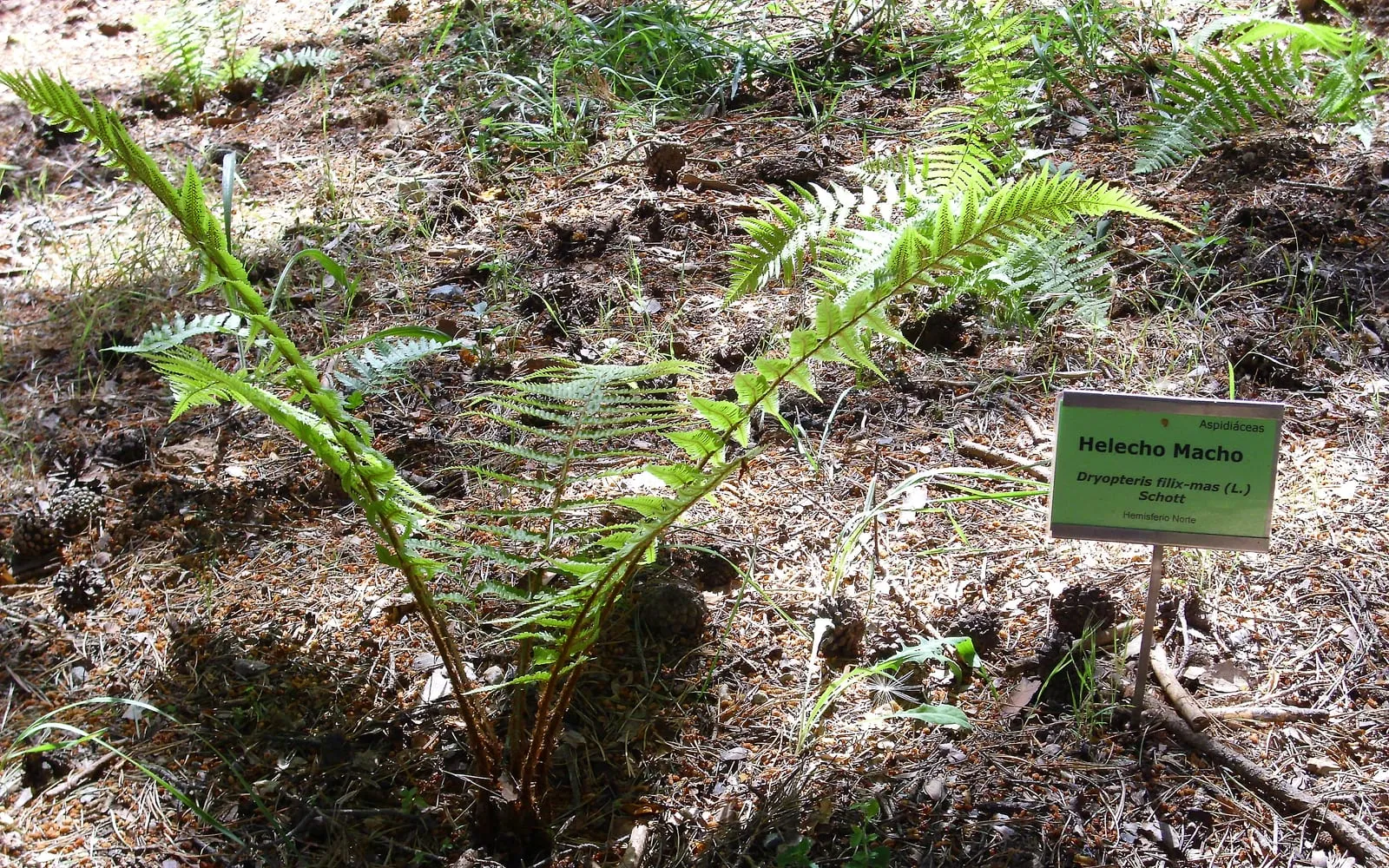
Fronds emerge from the crown of a stout, upright rhizome as tightly coiled fiddleheads covered in pale brown, papery scales, unfurling over several weeks into arching, pinnate fronds that form a symmetrical, vase-shaped rosette. A well-grown clump can reach 1 to 1.5 m across at its widest, with individual fronds a similar length.
The foliage is mid to deep green, finely divided but noticeably coarser in texture than many woodland ferns, giving the plant a robust, architectural presence rather than a delicate one. In a mild climate the older fronds persist through winter in a semi-evergreen state; in a colder one they die back completely and fresh fiddleheads appear again each spring.
Older plants develop a short, thick, upright rhizome rather than spreading by runners, so a clump increases in girth slowly over years rather than colonising ground the way some ferns do.
Where it is from
Dryopteris filix-mas has one of the widest natural ranges of any fern, found across Europe, temperate Asia and North America, typically in woodland, on shaded banks and in hedgerows, wherever some soil moisture and shelter from the harshest sun are available. It reaches from lowland Britain north into Scandinavia and high into mountain woodland further south, a spread that reflects real tolerance of cold rather than a narrow climatic niche.
That breadth of range is why it performs reliably in gardens across such a wide span of climates. A fern with a narrower native range often struggles outside conditions close to where it evolved; this one has already proved itself across most of the temperate world before it ever reaches a garden.
How it grows
Plant it in humus-rich soil in shade or part shade, working in leaf mould or garden compost at planting time to help retain moisture while the roots establish. It tolerates a wide range of soil types, including clay and chalk, better than most ferns.
Water regularly through the first year while the root system develops, then reduce watering as the plant settles in; an established clump tolerates real dry spells in shade, one of the few ferns that manages this reliably, which is why it turns up so often under trees and against shaded walls where other ferns fail from drought.
Divide an established clump in spring if a larger area needs covering or if the centre of an old plant has become congested, though division is optional rather than necessary for the plant’s health, since a single clump is long-lived and increases in size on its own without splitting.
Remove old, dead or badly damaged fronds at the base in late winter or early spring, just before new fiddleheads emerge, to keep the crown tidy and let light reach the new growth.
Through the seasons
Spring brings new fiddleheads unfurling from the crown, the plant’s most attractive stage. Remove any tattered fronds left from the previous year.
Summer is steady growth in shade, needing only occasional watering in an extended dry spell once the plant is established.
Autumn is a good time to plant a new specimen and to apply the annual mulch of leaf mould or compost around the base.
Winter sees fronds either persisting in a mild climate or dying back completely in a cold one, with the crown itself fully hardy either way.
Care difficulty
Easy. Once established in a reasonably shaded spot with some organic matter in the soil, male fern needs very little beyond an annual tidy of old fronds and a yearly mulch. It tolerates poor light, a wide range of soil types and, unusually for a fern, real drought once its roots have had a season or two to settle. The main way to go wrong with it is planting in full, exposed sun or letting a young plant dry out completely before its roots have established, both of which it tolerates far better once mature than while newly planted.
Watering
Water regularly through the first growing season after planting, keeping the soil consistently moist while the root system develops, since a newly planted fern has none of the drought tolerance an established one shows.
Once settled, water only during an extended dry spell, particularly in a more open position; a mature plant in reasonable shade often needs no supplemental watering at all through an average summer.
Warning signs, diseases and pests
Slugs and snails target the soft, unfurling fiddleheads in spring, and can disfigure or destroy new growth on an otherwise healthy plant. Torch- lit checks on damp evenings and a barrier around vulnerable young plants help most.
Vine weevil larvae feed on the roots and the base of the rhizome, usually noticed only once a plant looks unaccountably weak or fails to put on new growth. A biological nematode drench in late summer is the standard treatment where the pest is confirmed.
Root rot follows soil that stays waterlogged rather than moist, uncommon in this species compared with most ferns given its tolerance for drier conditions, but still a risk in heavy, poorly drained ground. Improve drainage before replanting if a clump has declined this way.
Leaf scorch shows as browning, crisping fronds on a plant exposed to strong sun or drying wind, more a sign of the wrong position than of disease. Moving a young plant to better shade, or providing temporary wind shelter, resolves it; established fronds already scorched will not recover and are best cut away.
Growing environment
Shade to part shade suits it best, and it is one of the more reliable ferns for a position under deciduous trees, where light and moisture both increase in spring before the canopy fills in.
A wide range of soil is tolerated, from clay to chalky ground, provided some organic matter has been worked in and drainage is reasonable rather than waterlogged.
Shelter from strong wind and harsh, direct sun protects the fronds from scorching, though this species tolerates more exposure than many ferns once it is established.
Feeding
An annual mulch of leaf mould or well-rotted garden compost around the base, applied in autumn or spring, supplies most of the fertility this fern needs and helps the soil retain moisture through summer.
Additional fertiliser is rarely necessary. A plant growing in reasonable soil with an annual mulch performs as well as one on a more intensive feeding regime, and heavy feeding offers little visible benefit.
Troubleshooting
The fronds have gone crispy and brown at the tips. Usually too much sun, wind, or drought stress on a young plant before it has established. Move a container-grown fern to better shade, or improve watering for a newly planted one through its first summer.
Is it safe to have this fern near where children play? Only with the usual sensible caution around any plant with a toxic part. The rhizome is the concerning part, and it sits below ground, but the safest approach with young children is to discourage eating any part of any plant in the garden rather than relying on a fern’s roots staying out of reach.
My clump has a bare, woody centre with fronds only around the edge. This happens on old, congested clumps. Lift and divide it in spring, discarding the oldest, least productive part of the rhizome and replanting the more vigorous outer sections.
Can it grow in full sun? Only where the soil stays reliably moist through summer; in dry soil, full sun scorches the fronds badly. Shade or part shade is the safer choice in most gardens, particularly if watering cannot be kept up through a hot spell.
Why has it not grown much in its first year? New plants put energy into establishing roots before top growth accelerates, so a modest first season is normal rather than a sign of a problem. Growth typically picks up noticeably from the second year onward, once the root system has filled out.