
Outdoor plant
Engelmann's Prickly Pear
Opuntia engelmannii
Also known as Cactus apple, Desert prickly pear
How to grow Engelmann's prickly pear outdoors. Its cold-hardy flattened pads, edible fruit, and how to handle the fine glochid spines safely.
At a glance
- Difficulty
- Easy
- Water
- Occasional deep watering in summer, almost none in winter
- Light
- Full sun
- Temperature
- Tolerates hard frost once established
- Hardiness
- USDA 7-11, RHS H4, hardy to -12 C
- Type
- Evergreen perennial cactus
- Height
- 0.5-1.5 m, spreading 1-3 m wide
- Native to
- Southwestern United States, Northern Mexico
One of the more cold-hardy prickly pears in general cultivation, tolerating real winter frost provided the soil drains sharply, since wet, cold roots are a far greater threat to this species than cold air. It needs a hot, dry summer to flower and fruit well, and performs less reliably in a consistently cool, damp temperate climate even where winter frost is not severe enough to damage it.
Hardiness zones describe winter cold alone. Summer heat, humidity, rainfall and the length of the growing season decide as much, so treat the range as the outer limit rather than as a recommendation.
Not known to be toxic
- Safe to eat
- Ripe fruit (tunas) and, once the spines are removed, young pads (nopales), both widely eaten across their native range
Engelmann's prickly pear has no toxicity listing from the RHS or the ASPCA, and both its fruit and pads are traditional foods across the southwestern United States and Mexico. The real hazard is mechanical rather than chemical: alongside the large, visible spines, the pads and fruit carry tufts of tiny, barbed hairs called glochids that detach at the lightest touch and embed in skin, causing persistent irritation that is awkward rather than dangerous to remove.
Source: RHS
About
Engelmann’s prickly pear is one of the most widespread and cold-hardy of the flat-padded prickly pear cacti, forming sprawling, sculptural clumps of rounded, blue-green pads across a large stretch of the American southwest and northern Mexico. It is grown both as an ornamental for its striking form and bright yellow summer flowers, and, in its native range, as a real food crop, with both the pads and the sweet, deep red fruit long used in Mexican and southwestern cuisine.
Its remarkable range, from low desert to surprisingly cold high plains and mountain foothills, has made it one of the more reliably hardy prickly pears for gardeners in a temperate climate willing to give it the sharp drainage it needs.
Appearance and character
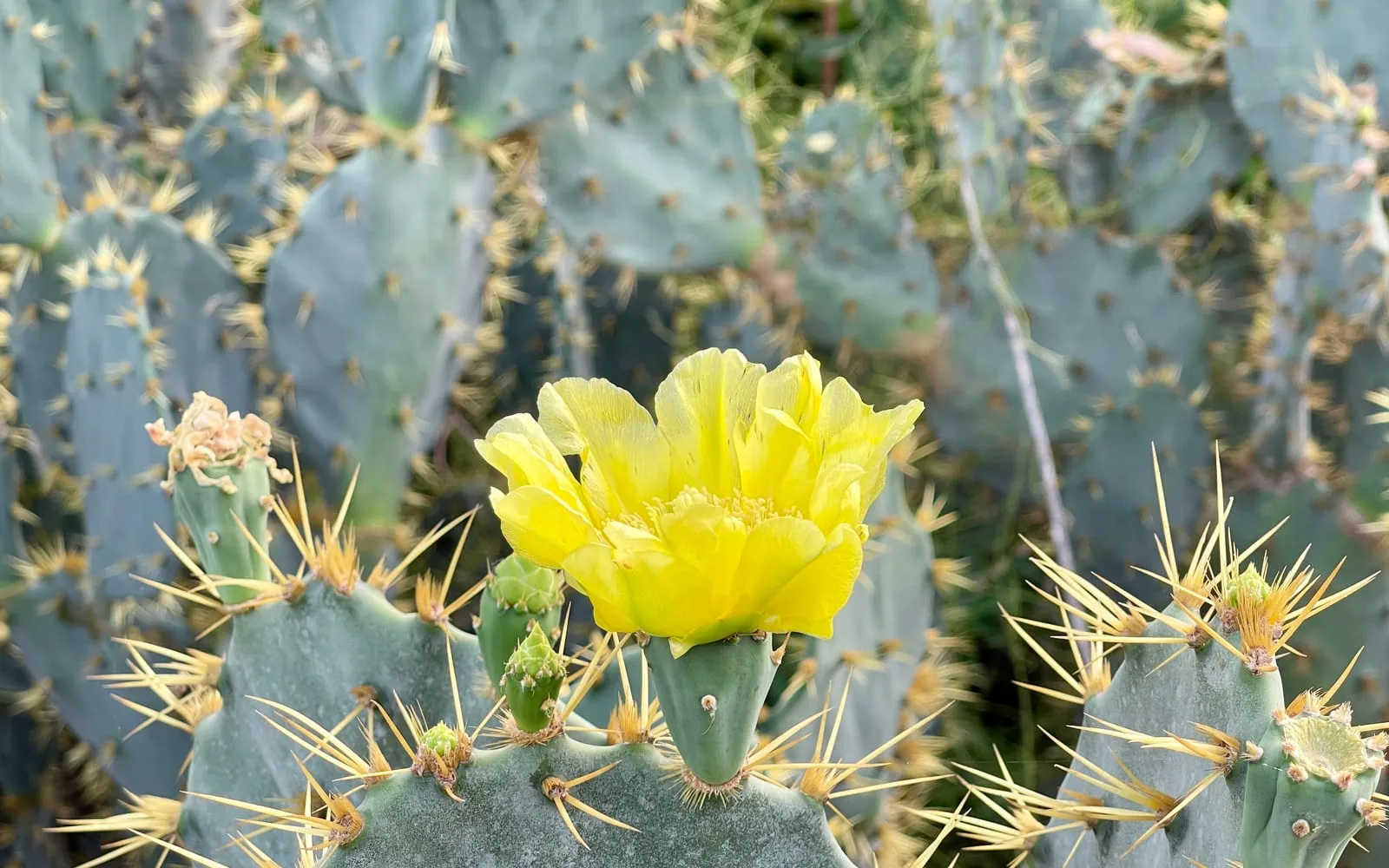
Flattened, oval to rounded pads, blue-green and often faintly waxy in appearance, join end to end to form sprawling, irregular clumps, each pad armed with clusters of long, sharp spines and, more subtly, dense tufts of tiny barbed glochids that are the more troublesome hazard in practice.
Large, bright yellow flowers, sometimes flushed orange or red at the centre, open along the pad edges in early summer, each lasting only a day or two, followed by egg-shaped fruit that ripen to a deep red or purple through summer and into autumn, edible once peeled of their own fine spines.
Where it is from
Deserts, grasslands and rocky slopes across the southwestern United States and northern Mexico, in a range spanning low, hot desert basins to much higher, colder plains and foothills, always in sharply free-draining, often poor or rocky soil.
That wide range across such different temperature zones is why this species tolerates cold better than many other prickly pears, though the common thread across its entire range is fast-draining soil; wherever it is found, water never sits around its roots for long.
How it grows
An evergreen cactus that grows by producing new pads from the edges of existing ones, gradually building a sprawling, multi-branched clump over years. Growth is fastest in hot, dry summer weather and slows or stops entirely once temperatures drop or the plant enters its winter rest.
Individual pads root readily if they break off and make contact with soil, which is both how the plant spreads naturally in the wild and the standard way to propagate it deliberately from a healthy, mature pad.
Through the seasons
Spring growth resumes as temperatures rise, with new pads emerging from the edges of existing growth.
Summer is the main growing and flowering season, with bright yellow flowers opening along pad margins, followed by developing fruit. Water occasionally during unusually hot, dry spells.
Autumn fruit ripens to deep red, and growth slows as temperatures drop.
Winter established plants tolerate hard frost provided the soil stays dry; withhold watering almost entirely through this period.
Care difficulty
Easy, provided the one non-negotiable condition, sharp drainage, is met from the start. On free-draining, gritty soil this cactus needs very little attention and tolerates real neglect; on heavy, poorly drained soil it is prone to rot regardless of how hardy it is to cold.
Watering
Occasional deep watering during hot, dry summer weather supports strong growth and better flowering, though established plants survive with very little supplemental water at all once their roots are well developed. Withhold water almost entirely through winter, since cold, wet soil is the most common cause of rot in this otherwise tough species.
Warning signs, diseases and pests
Scale insects and mealybug occasionally colonise the pads, appearing as small waxy or cottony clusters, and respond to careful manual removal or a horticultural oil treatment for heavier infestations. Cochineal insects, related to scale, can also appear as conspicuous white, waxy patches on the pad surface, historically harvested elsewhere for the red dye they produce.
Soft, discoloured, collapsing pads, particularly at the base of the plant, almost always indicate rot from waterlogged soil rather than a pest or infectious disease, and the fix is improving drainage and reducing watering rather than treating for disease directly. Remove any affected pads promptly to stop rot spreading to healthy growth.
Growing environment
Full sun is essential for compact growth and reliable flowering; in shade the pads grow etiolated and thin, and flowering drops off sharply. Gritty, sharply free-draining soil is the one condition this species will not compromise on, and amending heavy garden soil generously with grit or coarse sand before planting is worthwhile wherever natural drainage is poor.
Feeding
A low-nitrogen cactus fertiliser, applied once or twice during the growing season, supports steady growth and flowering without encouraging the soft, weak growth that excess nitrogen can cause in cacti generally. Many established plants in reasonably fertile garden soil need no supplemental feeding at all.
Troubleshooting
Pads are soft, discoloured and collapsing. Suspect rot from waterlogged soil. Improve drainage, reduce watering, and remove affected pads promptly to protect the rest of the plant.
The plant has grown tall and etiolated with few flowers. Usually insufficient sun. Move it to the sunniest position available, or consider that the situation has become shadier over time as nearby plants have grown.
Skin has been irritated after brushing against the plant. Fine glochid hairs, easy to overlook next to the larger spines, are the more common cause of persistent irritation. Remove them with tweezers or adhesive tape pressed against the skin, and avoid rubbing the area, which can drive them in deeper.
You want to propagate a new plant from an existing pad. Remove a healthy, mature pad, let the cut end callus over for several days in a dry, shaded spot, then plant it upright in gritty compost, keeping it mostly dry until roots establish over the following weeks.
You are deciding where to plant a clump relative to paths or seating. A mature clump spreads far beyond its height and has both large spines and fine glochids, so give it generous clearance from anywhere people or pets regularly walk. Fallen or detached pads can root wherever they land, extending the clump beyond the original planting spot over time.