
Outdoor plant
Japanese Blood Grass
Imperata cylindrica
Also known as Cogon grass, Blood grass
How to grow Japanese blood grass safely. Only the sterile red-leaved cultivar Red Baron, since the wild green species Imperata cylindrica is a banned invasive weed.
At a glance
- Difficulty
- Moderate
- Water
- Regular watering; performs poorly if the soil dries out for long
- Light
- Full sun to light shade for the strongest red colour
- Hardiness
- USDA 5-9, RHS H6, hardy to -20 C
- Type
- Hardy deciduous perennial grass, spreading by rhizome
- Height
- 30-45 cm
- Native to
- Southeast Asia, East Asia
Fully hardy through an ordinary temperate winter as the cultivar 'Red Baron' is usually sold and grown. The number that matters for this species has nothing to do with cold: it is the legal status of the wild green form in your region, which several US states restrict or ban outright regardless of hardiness, because the plant's tolerance for heat, drought and disturbed ground is what makes it one of the world's most damaging grass weeds where it has escaped cultivation.
Hardiness zones describe winter cold alone. Summer heat, humidity, rainfall and the length of the growing season decide as much, so treat the range as the outer limit rather than as a recommendation.
Not known to be toxic
Japanese blood grass carries no toxic compounds and has no listing from the RHS or the ASPCA as harmful to eat. Its root, known as cogon or alang-alang root, has a long history of use in traditional Chinese and other East Asian medicine. The practical hazard with this species is mechanical rather than chemical: like several related grasses, its leaf margins carry fine, silica-edged serrations that can cut skin on contact, particularly when a blade is pulled through a closed hand, so gloves are worth wearing when cutting back or dividing a clump.
Sources: RHS potentially harmful garden plants, ASPCA toxic and non-toxic plants
About
Read this section before buying the plant. Japanese blood grass sold in garden centres is almost always the cultivar ‘Red Baron’, prized for leaf blades that stay green at the base and deepen to a brilliant, translucent red toward the tip, glowing when backlit by low sun. The species behind it, Imperata cylindrica, is something else entirely: one of the world’s worst agricultural and ecological weeds, listed on the United States Federal Noxious Weed List, banned outright in several states including Alabama and, per at least one university researcher, effectively illegal in South Carolina in every form including the red cultivar. Only ever plant the named cultivar ‘Red Baron’, never the plain green species, and check your own state or country’s rules before planting even that.
The complication does not stop at naming the right cultivar. ‘Red Baron’ was long sold on the understanding that it was sterile and therefore safe, but research has since found it can produce viable seed and, more seriously, that plants can revert to the aggressive, fully green, invasive form of the species even where they were planted as the red cultivar. Several US states restrict interstate movement of ‘Red Baron’ specifically because of this reversion risk, and it is not a plant to treat as risk-free because the label says a named cultivar rather than the species.
Appearance and character
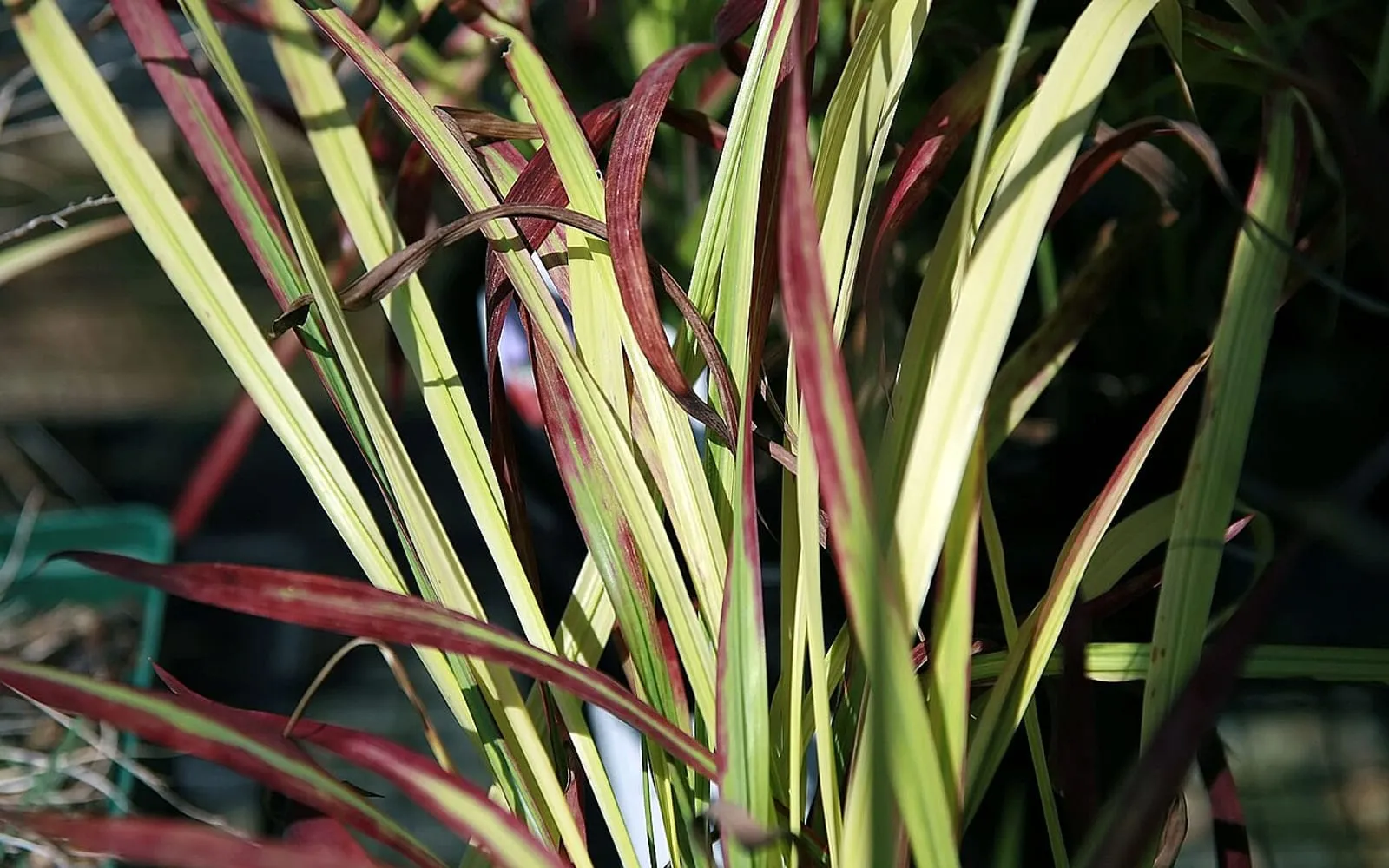
Narrow, upright blades emerge green at the base through spring, with red colouring developing from the tip downward as the season progresses, strongest in full sun and fading in shade to a duller, more uniformly green plant with far less of the display the cultivar is grown for. By late summer a well-grown clump can look almost entirely red when lit from behind, one of the most striking colour effects available from any hardy grass.
Flower spikes occasionally appear on a mature clump, silvery-white and fluffy, though flowering is less reliable in ‘Red Baron’ than in the wild green species, part of what was originally taken as evidence of reduced fertility in the cultivar. Foliage dies back for winter in a cold climate, leaving bare ground until fresh red-tipped shoots return in spring.
Where it is from
Imperata cylindrica is native across a huge range spanning Southeast Asia, East Asia, the Indian subcontinent and parts of Africa and southern Europe, growing on disturbed, open, often fire-prone ground. That tolerance for disturbance, poor soil, drought and fire is precisely what has made the wild green form so destructive outside its native range: introduced accidentally to the southeastern United States in 1911 and later spread intentionally for forage and erosion control, it now forms dense, fire-promoting monocultures across parts of the southeastern US, crowding out native vegetation and altering fire regimes wherever it establishes.
‘Red Baron’ arose as a selected red-leaved form grown for ornamental use rather than from a separate, safer species, which is the root of the reversion problem: it carries the same underlying genetics as the invasive wild type, expressed differently rather than removed.
How it grows
Plant ‘Red Baron’ in spring into moist, moderately fertile soil in full sun for the strongest colour, or light shade where summer heat is intense. It spreads slowly by short rhizomes, thickening a clump over several seasons rather than running aggressively, though gardeners in a region where the wild species is established should still watch for any shoots reverting to plain green and remove them promptly, since a reverted patch behaves like the invasive wild type rather than like the tame cultivar originally planted.
Divide an established clump every few years if it becomes congested or starts to die out in the centre, lifting and splitting it in spring as new growth begins. Cut the whole clump back close to the ground in late winter, before new shoots emerge, to remove the previous year’s faded growth and encourage a strong, evenly coloured new season.
Through the seasons
Spring brings the cutback of old foliage, followed by fresh shoots emerging green at the base with red colouring developing as the season warms.
Summer is the peak display, with the red colouring intensifying toward the tip of each blade and the whole clump glowing when backlit by low sun.
Autumn growth slows and the display begins to fade as temperatures drop, though colour often persists later into the season than many other ornamental grasses.
Winter foliage dies back completely in a cold climate, leaving bare ground until the following spring’s fresh growth, unlike several other ornamental grasses that hold structure through winter.
Care difficulty
Moderate, and most of the real difficulty is legal and horticultural rather than a matter of watering or feeding. Buying and planting only the correctly identified, permitted cultivar, watching for reversion to green growth, and removing any reverted shoots promptly all matter more to responsible cultivation of this species than any ordinary care task.
Watering
Keep the soil consistently moist through the growing season, since this species performs poorly and colours less strongly if allowed to dry out for extended periods. It is more demanding of regular moisture than many other ornamental grasses covered in this collection, closer in its watering needs to a border perennial than to a drought-tolerant prairie grass.
Warning signs, diseases and pests
Rust occasionally appears as small orange pustules on the leaf blades, usually in a humid season, and rarely does serious harm to an established clump.
Watch for any shoot reverting to plain, uniform green rather than showing the expected red colouring. That is a genetic risk rather than a pest or disease. Remove reverted growth immediately and dispose of it responsibly rather than composting it, since a reverted patch can behave like the invasive wild-type species rather than like the tame cultivar.
Growing environment
Full sun brings out the strongest red colouring, though light shade is tolerated, particularly in a hot climate, at some cost to colour intensity. Moist, moderately fertile soil suits it best, and unlike most of the ornamental grasses in this collection it does not thrive on poor, dry ground, needing more consistent moisture and fertility to perform well.
Feeding
A light application of balanced fertiliser in spring supports strong colour and growth, particularly on soil that is not naturally fertile. This is one of the few ornamental grasses in this collection that benefits from modest feeding rather than performing best when left entirely unfed.
Troubleshooting
Is Japanese blood grass legal to grow where I live? Check before buying. The wild green species is a US federal noxious weed and is banned outright in some states even in its red cultivated form; other regions restrict its sale or movement. A local check is essential and this guide cannot substitute for it.
Some of the foliage has reverted to plain green instead of showing red colour. This is a documented risk with the ‘Red Baron’ cultivar rather than a growing mistake. Remove and responsibly dispose of any reverted green growth promptly, since it can behave like the invasive wild species.
The plant is not showing much red colour at all. Check sun exposure first, since colour intensity depends heavily on full sun, and also rule out reversion, since fully reverted green growth will never develop the red tint regardless of light.
Can I compost the clippings when I cut this plant back? No. Dispose of clippings and any removed material through green waste collection or another method that avoids returning viable rhizome fragments or seed to open ground, given the species’ documented ability to spread and to revert.
I have seen this plant sold as “Imperata cylindrica” without a cultivar name. Do not plant it without confirming it is the ‘Red Baron’ selection. The plain species name refers to the invasive wild-type plant and should not be planted deliberately anywhere it is not already established and being managed.
Is the wild green form the same plant, just uncultivated? Yes. ‘Red Baron’ is a selected form of the same species, Imperata cylindrica, not a separate, inherently safer plant, which is why reversion is a genuine risk rather than a remote theoretical one.