
Houseplant
Violet Phalaenopsis
Phalaenopsis violacea
Also known as Violet moth orchid
How to grow the violet Phalaenopsis orchid as a houseplant. Its fragrant purple flowers, mottled leaves, and why it needs less water than most moth orchids.
At a glance
- Difficulty
- Easy
- Water
- Water when the roots turn silvery-grey, roughly weekly
- Light
- Bright indirect light, no direct midday sun
- Temperature
- 18-30 deg C, avoid below 15 deg C
- Humidity
- High, 60 percent or more
- Hardiness
- USDA 11-12, RHS H1b, hardy to 15 C
- Type
- Evergreen epiphytic perennial orchid
- Height
- 20-30 cm
- Native to
- Sumatra, Borneo, Malay Peninsula
A lowland tropical species with no tolerance for cold at all, grown as a houseplant everywhere outside a reliably equatorial climate. It needs warmth, high humidity and reliable shade from a rainforest canopy replicated as closely as an indoor spot allows, and it suffers below 15 deg C even briefly, well short of anything a temperate winter would call cold.
Hardiness zones describe winter cold alone. Summer heat, humidity, rainfall and the length of the growing season decide as much, so treat the range as the outer limit rather than as a recommendation.
Not known to be toxic
Violet Phalaenopsis has no toxicity listing from the RHS or the ASPCA and Phalaenopsis orchids generally are considered safe around pets and children. There is no documented history of poisoning associated with this species.
Source: ASPCA
About
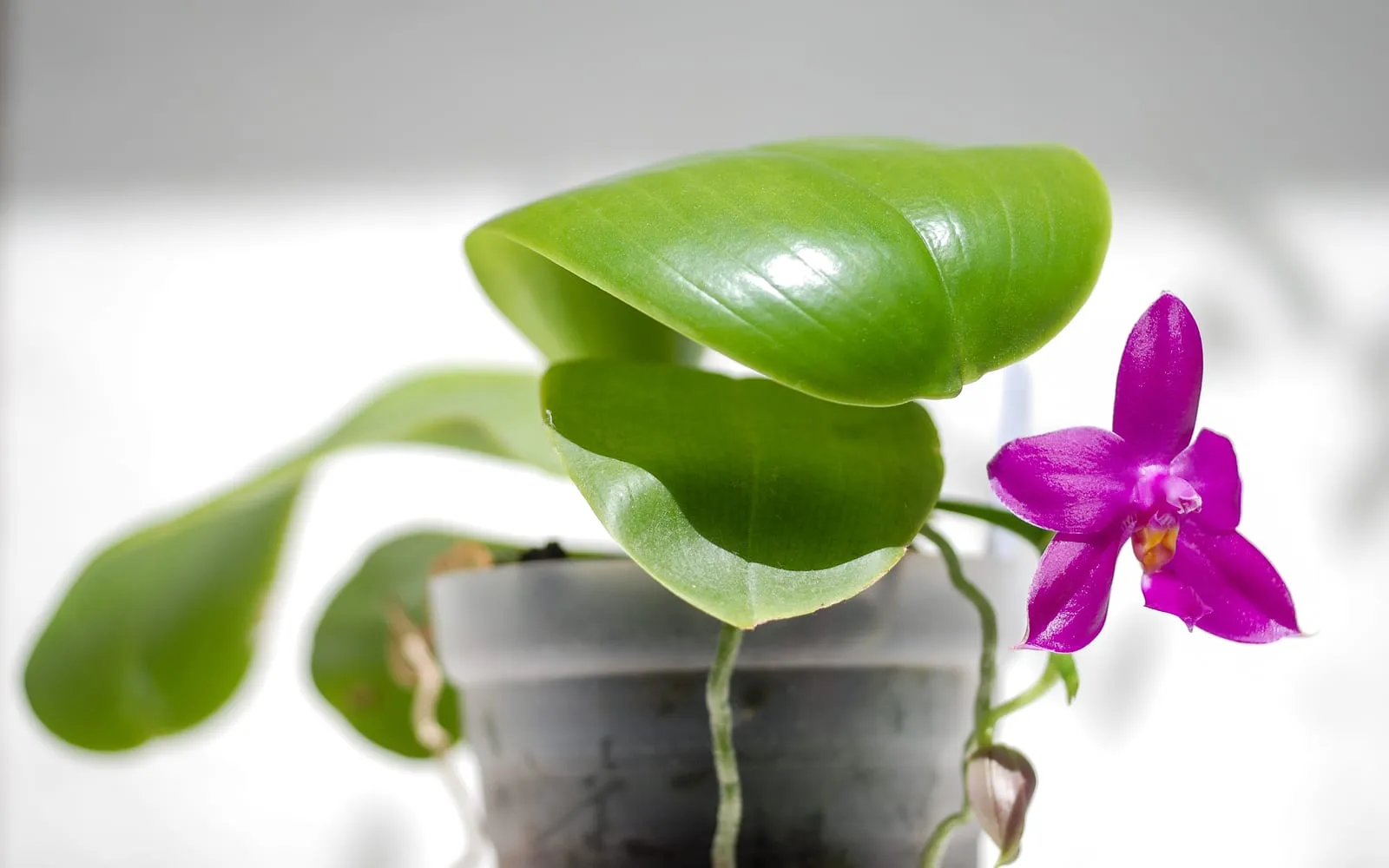
The violet Phalaenopsis is grown for a quality most moth orchids lack entirely: a strong, sweet fragrance, released most noticeably in the warm part of the day, alongside waxy purple-violet flowers with a distinctive star-shaped pattern that shifts from deep magenta at the centre to green or white toward the tips. It sits close to the wild end of the Phalaenopsis family tree that has produced most of the hybrid moth orchids sold in supermarkets, and it keeps a bushier, lower growth habit and a real scent that most of those hybrids have bred away.
Because it comes from lowland rainforest rather than the somewhat cooler mountain slopes some other orchid species favour, it is markedly less tolerant of cool conditions than many other orchids commonly grown indoors, and it does best in a warm, humid spot.
Appearance and character
Broad, fleshy, dark green leaves, sometimes marbled with lighter mottling, fan out from a short stem close to the compost surface. Unlike the tall, arching flower spikes of many hybrid moth orchids, this species produces shorter, often near-horizontal spikes holding just a few, but especially large and long-lasting, flowers at a time.
Each flower can remain open for several weeks, and a healthy, mature plant often produces a slow, near-continuous succession of blooms across a spike rather than one single flush, extending its flowering season well beyond that of many other orchids.
Where it is from
The lowland rainforest understorey of Sumatra, Borneo and the Malay Peninsula, growing as an epiphyte on tree trunks and branches in constant warmth, high humidity and dappled, filtered light beneath a dense canopy.
That equatorial lowland origin, with no cool season at all, is the reason this species tolerates far less cold than orchids from higher, cooler parts of the tropics, and it is also why it particularly resents cold water splashed directly onto its leaves or crown, which can cause lasting damage in a way a hardier species might shrug off.
How it grows
As an epiphyte, its thick, silvery-green roots grow both into the compost and out into open air, absorbing moisture and nutrients from humid air as much as from the growing medium itself, which is why chunky, open orchid bark rather than dense potting compost is essential for healthy root function. New leaves emerge from the centre of the fan, with older, lower leaves eventually yellowing and dropping as the stem slowly gains height.
Flower spikes typically arise from between the lower leaves rather than from the very top of the plant, and because flowers persist so long, a single well-grown spike can remain a feature of the plant for a significant part of the year.
Through the seasons
Spring growth typically strengthens as light levels rise, with new leaves and, on a mature plant, fresh flower spikes often beginning to show.
Summer is usually the strongest growing period, with warmth and humidity both easiest to provide. Water and feed on a regular weekly rhythm.
Autumn growth may slow slightly as light drops indoors, though this species has no true dormant season given consistent indoor warmth.
Winter keep the plant well away from cold draughts and cold windowsills, since this is when accidental chilling is most likely to occur and this species tolerates it particularly poorly.
Care difficulty
Easy, provided its two central needs, warmth and humidity, are met more consistently than a standard hybrid moth orchid demands. It is less forgiving of cold, dry indoor air over winter than many of the hybrids sold widely in supermarkets, but otherwise follows familiar Phalaenopsis care.
Watering
Water when the roots have turned a silvery-grey rather than on a fixed calendar, typically around once a week in a warm home, soaking the compost thoroughly and letting every drop of excess water drain away. This species is especially more sensitive to overwatering and to cold water than many hybrid moth orchids, so use room-temperature water and never let the pot sit in a saucer of water afterward.
Warning signs, diseases and pests
Scale insects and mealybug both occasionally colonise the leaves or the base of the plant, appearing as small stationary bumps or cottony clusters, and are treated with careful manual removal or a horticultural soap for persistent infestations. Spider mites can appear in warm, dry air, showing as fine speckling on the leaves.
Soft, translucent patches on the leaves, sometimes with a faint smell, are a common sign of crown rot from water sitting in the centre of the plant, a particular risk for this low-growing, fan-shaped species; always tip water out of the crown after watering rather than letting it pool there.
Wrinkled, limp leaves despite regular watering can indicate a root system damaged by rot, and lifting the plant to inspect the roots directly is worthwhile if this occurs.
Growing environment
Bright, indirect light suits it well, with protection from any direct midday sun, which can scorch the fleshy leaves. Humidity matters more for this species than for many hybrid moth orchids, and a pebble tray, a bathroom location or a humidifier all help replicate the constantly humid rainforest air it comes from.
Feeding
A balanced orchid fertiliser at quarter strength, applied with most waterings during active growth, supports steady leaf and flower production without the risk of fertiliser burn that a stronger, less frequent feeding schedule can cause on this species’ sensitive roots.
Troubleshooting
Leaves have gone soft and translucent, particularly near the centre of the plant. Suspect crown rot from water sitting in the growing point. Always tip the plant to drain the crown fully after watering, and remove any clearly rotten tissue promptly.
No fragrance is noticeable even though the plant is flowering. Scent is often strongest in warmth and during the middle of the day; check at different times before assuming the plant is not producing any.
Roots look shrivelled rather than plump and silvery-green. The plant is underwatered relative to its needs. Increase watering frequency slightly, always allowing full drainage afterward.
Leaves have developed sunken, discoloured patches. Check for cold damage first with this cold-sensitive species, particularly if the plant has been near a window during a cold spell, before considering pests.
Violet Phalaenopsis problem guides
Not sure what is wrong? See the common houseplant pests guide.