
Houseplant
Amaryllis
Hippeastrum vittatum
Also known as Hippeastrum, Knight's star lily
How to grow amaryllis, Hippeastrum vittatum. Planting the bulb half exposed, getting it to flower a second year, and the dormancy that most people skip.
At a glance
- Difficulty
- Moderate
- Water
- Sparingly until the bud shows, then regularly, then not at all in dormancy
- Light
- Bright light, with direct sun once the leaves are growing
- Temperature
- 18 to 22 deg C in growth, and around 10 deg C during dormancy
- Hardiness
- USDA 9-11, RHS H1c, hardy to 10 C
- Type
- Bulbous perennial, long lived with an annual dormancy
- Height
- 45-75 cm
- Native to
- The Andes of Peru and Bolivia, and the wider genus across South America
- Best month
- December in the Northern Hemisphere, June in the Southern Hemisphere
Grassland and scrub in South America, on a wet and dry cycle. The bulb flowers off stored reserves, so what decides next year is the feeding and light it gets after flowering rather than anything done at the time. A dry rest of eight to ten weeks resets it. Outdoors year round in USDA 9 and warmer.
Hardiness zones describe winter cold alone. Summer heat, humidity, rainfall and the length of the growing season decide as much, so treat the range as the outer limit rather than as a recommendation.
Every month named in this guide is for the temperate Northern Hemisphere. If you garden in the Southern Hemisphere, shift each one by six months, so December becomes June. Closer to the equator the wet and dry seasons matter more than the calendar, and the shift stops being a useful guide.
Toxic if eaten
- Do not eat
- The bulb above all, and the leaves and stems to a lesser degree
- Harm from
- Eating it and handling it
- Affects
- People, cats and dogs
Hippeastrum contains lycorine and related alkaloids, concentrated in the bulb, which is the same class of compound found in daffodil bulbs. Eating the bulb causes salivation, vomiting, abdominal pain, diarrhoea and in larger amounts lethargy, tremors and a drop in blood pressure. The ASPCA lists Amaryllis and Hippeastrum as toxic to cats and dogs, and the risk in a house is a dog chewing a bulb that has been left on a windowsill or a potting bench, since it looks like something worth investigating. The RHS lists it as harmful if eaten and as a skin irritant. Handling the bulbs causes contact dermatitis in some people, so wear gloves when potting them. For a person, eating a piece of bulb causes an unpleasant stomach upset rather than anything worse, and a child who has bitten one is worth a call to a doctor. This plant is not the true Amaryllis, which is Amaryllis belladonna from South Africa, and both genera carry the same alkaloids so the confusion does not change the advice.
Sources: RHS potentially harmful garden plants, ASPCA toxic and non-toxic plants
About
An amaryllis bulb bought in November flowers gloriously in January and then sits in a corner as a bundle of leaves that nobody knows what to do with.
Most are thrown away. Getting one to flower a second year takes three things, none of them difficult, and skipping any of them is why it fails.
Keep the leaves after flowering and feed them. The leaves are building next year’s flower inside the bulb, and cutting them off because they look untidy is the commonest mistake.
Give it a summer outside in a sunny spot, in the pot, from June to September.
Give it a proper dormancy. Stop watering in early autumn, let the leaves yellow and die, and keep the bulb dry and cool at around 10 deg C for eight to ten weeks. Then start it again and it flowers.
The plant is not an amaryllis. True Amaryllis is Amaryllis belladonna, the South African belladonna lily that flowers outdoors in autumn on bare stems. What is sold at Christmas is Hippeastrum, from South America, and the trade name has stuck for two centuries.
Appearance and character
A bulbous perennial with a large bulb 8 to 12 cm across and flower stems reaching 45 to 75 cm.
The bulb is the plant. It is round, brown-skinned, and larger bulbs produce more stems and more flowers, which is why size matters at the point of purchase.
Flower stems are thick, hollow and leafless, and they usually appear before the foliage. A good bulb throws two stems and sometimes three in succession.
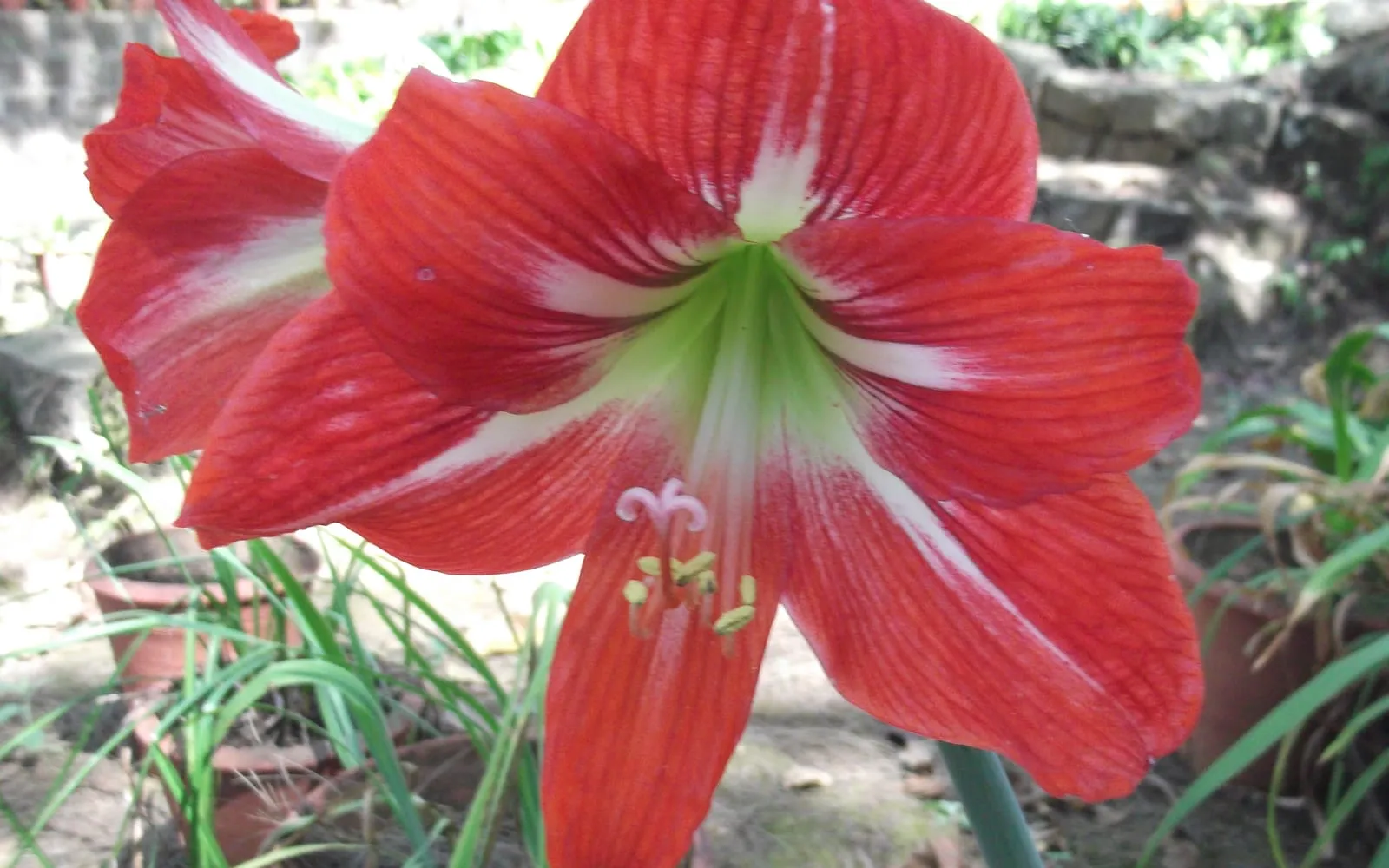
Flowers open four to a stem, held in a whorl at the top, each 15 to 20 cm across, trumpet shaped with six broad segments.
Colours run through scarlet, crimson, deep red, salmon, pink, white, and combinations striped or picoteed with contrasting edges.
Leaves are strap-shaped, 40 to 60 cm long, bright green and slightly fleshy, appearing during or after flowering and lasting through the summer.
The species Hippeastrum vittatum is white with red stripes down each segment, and it is one of the parents of the modern hybrids.
Flowering takes six to ten weeks from the start of watering, which is worth counting back from if you want it out at Christmas.
Where it is from
The Andes of Peru and Bolivia for Hippeastrum vittatum, with the wider genus spread across South America from Argentina north to Mexico and the Caribbean.
It grows on rocky slopes and in seasonally dry habitats, which is where the dormancy comes from. The plant grows and flowers in the wet season and rests through the dry one, and reproducing that cycle indoors is the whole of growing it well.
Hippeastrum vittatum reached Britain in 1769 and was one of the first of the genus in cultivation.
The naming confusion is old and was settled formally in 1987, when a botanical congress ruled that Amaryllis applies to the South African belladonna lily and Hippeastrum to the South American genus. The horticultural trade has continued to sell the latter as amaryllis.
Dutch and South African growers produce most of the bulbs sold worldwide, and they are grown on for two or three years before sale, which is why a large bulb costs what it does.
The name Hippeastrum means knight’s star, from Greek, describing the flower shape.
How it grows
Buy the largest bulb you can find and one that is firm with no soft patches or mould.
Pot it into a container only 3 to 4 cm wider than the bulb itself, using a loam-based compost with added grit. Amaryllis flowers better when the roots are confined.
Plant it with the top third to half of the bulb above the compost. Burying it completely is the standard cause of rot.
Water once thoroughly after potting and then very sparingly until the flower bud is clearly showing, since a bulb sitting in wet compost with no roots rots.
Put it somewhere warm at 18 to 22 deg C in bright light.
Water regularly once the bud is growing and turn the pot every few days, because the stem leans towards the light and a leaning amaryllis is hard to correct.
Support the stem with a cane if it is tall, since the flower head is heavy.
Move it somewhere cooler once the flowers open, which extends the display considerably.
Cut the flower stem off at the base once flowering finishes, and keep the leaves.
Feed with a high-potash liquid feed every two weeks from then until the leaves die back.
Put the pot outside in a sunny sheltered spot from June to September, keeping it watered and fed.
Start the dormancy in early September. Bring the pot in, stop watering and feeding, let the leaves yellow and pull them off when they come away easily, and keep the dry bulb in its pot at around 10 to 13 deg C for eight to ten weeks.
Restart it in November or December by removing the top few centimetres of compost, replacing it with fresh, and watering once. It flowers six to ten weeks later.
Repot fully every three or four years, and remove offsets at the same time to grow on separately.
Through the seasons
Winter is the flowering season, running from December to March depending on when the bulb was started.
Spring is the leaf-growing period, and this is when the feeding matters.
Summer is spent outdoors in a sunny spot, watered and fed, building the bulb.
Autumn is dormancy. Stop watering in early September, let the leaves die, and rest the bulb dry and cool for eight to ten weeks.
Care difficulty
Moderate. Flowering it the first year is close to automatic, since the bulb arrives with the flower already formed inside it.
Flowering it the second year is where most people fail, and the reasons are always the same. The leaves were cut off, the bulb was never fed, or the dormancy was skipped.
None of those is difficult and all of them require remembering something in a different season from the one where the reward appears.
Rot from planting too deep or watering too early is the other common loss.
Watering
Water once thoroughly when the bulb is potted and then very sparingly until the bud is clearly growing. A bulb with no roots in wet compost rots.
Water regularly once the stem is growing, keeping the compost just damp.
Continue watering and feeding right through the leaf period from flowering until early September.
Stop watering completely at the start of the dormancy and keep the bulb dry for eight to ten weeks.
Never let it stand in a saucer of water at any stage.
Warning signs, diseases and pests
The bulb going soft and smelling unpleasant is rot, caused by planting too deep or watering before the roots have formed. There is no recovery once it reaches the base plate.
Red or purple streaks and blotches on the bulb, the leaves and the flower stems, with stems bending or collapsing, is red blotch caused by Stagonospora curtisii. Remove affected leaves, dust the bulb with a fungicide if you have one, avoid wetting the foliage, and discard a badly infected bulb.
Leaves but no flowers in the second year is the standard failure, and it means the bulb was not fed, the leaves were removed, or the dormancy was skipped.
A stem leaning heavily is phototropism. Turn the pot every few days from the moment the bud appears.
Mealybug in the leaf bases shows as white fluffy patches. Wipe them off with a cotton bud dipped in alcohol.
Narcissus bulb fly larvae hollowing the bulb is uncommon indoors and possible on a bulb summered outside. Check for a single large grub if a bulb fails to grow.
Flowering with very short stems is usually too little light or too much warmth during the early growth.
Scorched leaf tips after going outside is sunburn from moving it straight into full sun. Harden it off over a week.
Growing environment
Bright light indoors, and full sun outdoors during the summer once hardened off.
A loam-based compost with grit added for drainage, in a pot only slightly larger than the bulb.
18 to 22 deg C during growth and flowering, and around 10 to 13 deg C during the autumn dormancy. A cool spare room, an unheated porch or a frost-free garage all work for the rest period.
It is a houseplant outside USDA 9 rather than a garden plant, and the bulb is not hardy outdoors.
Keep it away from a dog that chews things, since the bulb is the most toxic part and looks interesting.
Group three or five pots together for a better display, and stagger the starting dates by a fortnight to spread the flowering.
Grow it alongside other winter-flowering bulbs indoors, such as paperwhite narcissus and hyacinth, which want similar treatment and flower at the same time.
Feeding
Feed with a high-potash liquid feed such as tomato food every two weeks from the end of flowering until the leaves die back in September.
That period is when next year’s flower is formed, and skipping it is why a second-year bulb produces leaves and nothing else.
Do not feed during dormancy.
Do not feed heavily while the flower stem is growing, since the flower is already made and the feeding that matters comes afterwards.
Replace the top few centimetres of compost each year and repot fully every three or four years.
Troubleshooting
It flowered beautifully the first year and only made leaves the second. The three things that cause this are cutting the leaves off, not feeding through the summer, and skipping the autumn dormancy. Keep the leaves, feed fortnightly until September, then rest the dry bulb cool for eight to ten weeks.
How deep should I plant the bulb? With the top third to half sitting above the compost. Burying it completely causes rot.
How long from planting to flowering? Six to ten weeks. Count back from when you want the flowers.
The stem is leaning badly. It grows towards the light. Turn the pot every few days from the moment the bud appears, and support a tall stem with a cane.
Should I cut the leaves off after flowering? No. Cut the flower stem off at the base and keep every leaf. The leaves build next year’s flower.
When do I start the dormancy? Early September. Stop watering and feeding, let the leaves yellow and pull them away, and keep the pot dry at around 10 to 13 deg C for eight to ten weeks.
The bulb has gone soft and smells. Rot, from planting too deep or watering before the roots formed. There is no recovery once the base plate is affected.
There are red streaks on the bulb and the stem is bending. Red blotch, a fungal disease. Remove affected leaves, avoid wetting the foliage, and discard a badly infected bulb.
Is it poisonous to pets? The ASPCA lists it as toxic to cats and dogs. The bulb carries the most alkaloid and is the part a dog is most likely to chew, so keep spare bulbs out of reach.
Is this the same as the amaryllis that flowers outdoors in autumn? No. That is Amaryllis belladonna from South Africa. This is Hippeastrum from South America, sold under the wrong name for two hundred years.
Amaryllis problem guides
Not sure what is wrong? See the common houseplant pests guide.