
Outdoor plant
Montbretia
Crocosmia x crocosmiiflora
Also known as Crocosmia, Coppertips, Falling stars
How to grow crocosmia, Crocosmia x crocosmiiflora. Arching sprays of orange in late summer, dividing congested corms, and why montbretia escapes into the countryside.
At a glance
- Difficulty
- Easy
- Water
- In dry spells during the growing season
- Light
- Full sun to partial shade
- Temperature
- Hardy to about -15 deg C, and corms rot in wet cold clay
- Hardiness
- USDA 5-9, RHS H5, hardy to -15 C
- Type
- Cormous perennial, long lived and spreading into dense clumps
- Height
- 60-90 cm
- Native to
- A garden hybrid raised in France in 1880 from two South African species
- Best month
- September in the Northern Hemisphere, March in the Southern Hemisphere
Corms rot in cold wet clay long before frost reaches them, so drainage buys more hardiness than a mulch does. Mild wet summers suit it and it multiplies fast in them, which is exactly why it has become a problem. The common montbretia is listed under Schedule 9 in Britain, banned from sale in New Zealand under the National Pest Plant Accord, and naturalised through Ireland, Australia, Hawaii and the American Pacific north-west.
Hardiness zones describe winter cold alone. Summer heat, humidity, rainfall and the length of the growing season decide as much, so treat the range as the outer limit rather than as a recommendation.
Every month named in this guide is for the temperate Northern Hemisphere. If you garden in the Southern Hemisphere, shift each one by six months, so September becomes March. Closer to the equator the wet and dry seasons matter more than the calendar, and the shift stops being a useful guide.
Not known to be toxic
Crocosmia is not listed by the RHS as a potentially harmful garden plant and is not recorded by the ASPCA as toxic to cats, dogs or horses. No part of it is a recognised poisoning hazard, and it is a sound choice for a garden used by children and pets. The dried flowers of the parent species Crocosmia aurea smell of saffron when steeped in water, which is where the genus name comes from, and they have been used as a saffron substitute. Where a plant is unlisted by both sources rather than positively assessed, the correct reading is that no hazard has been recorded rather than that one has been ruled out, so there is no reason to encourage anybody to eat it. The concern attached to crocosmia in Britain is ecological rather than medical. It has naturalised extensively in the west of Britain and Ireland, forming dense stands on road verges, hedge banks, coastal cliffs and dune systems where it displaces native flora, and it is regarded as an invasive non-native. Check the current Schedule 9 listing under the Wildlife and Countryside Act 1981 before planting it where it can escape into the countryside, since that schedule is amended from time to time and governs what may be planted in the wild.
Sources: RHS potentially harmful garden plants, ASPCA toxic and non-toxic plants
About
Crocosmia does the thing a late summer border needs, which is bright colour on an arching stem above upright foliage, from July into September.
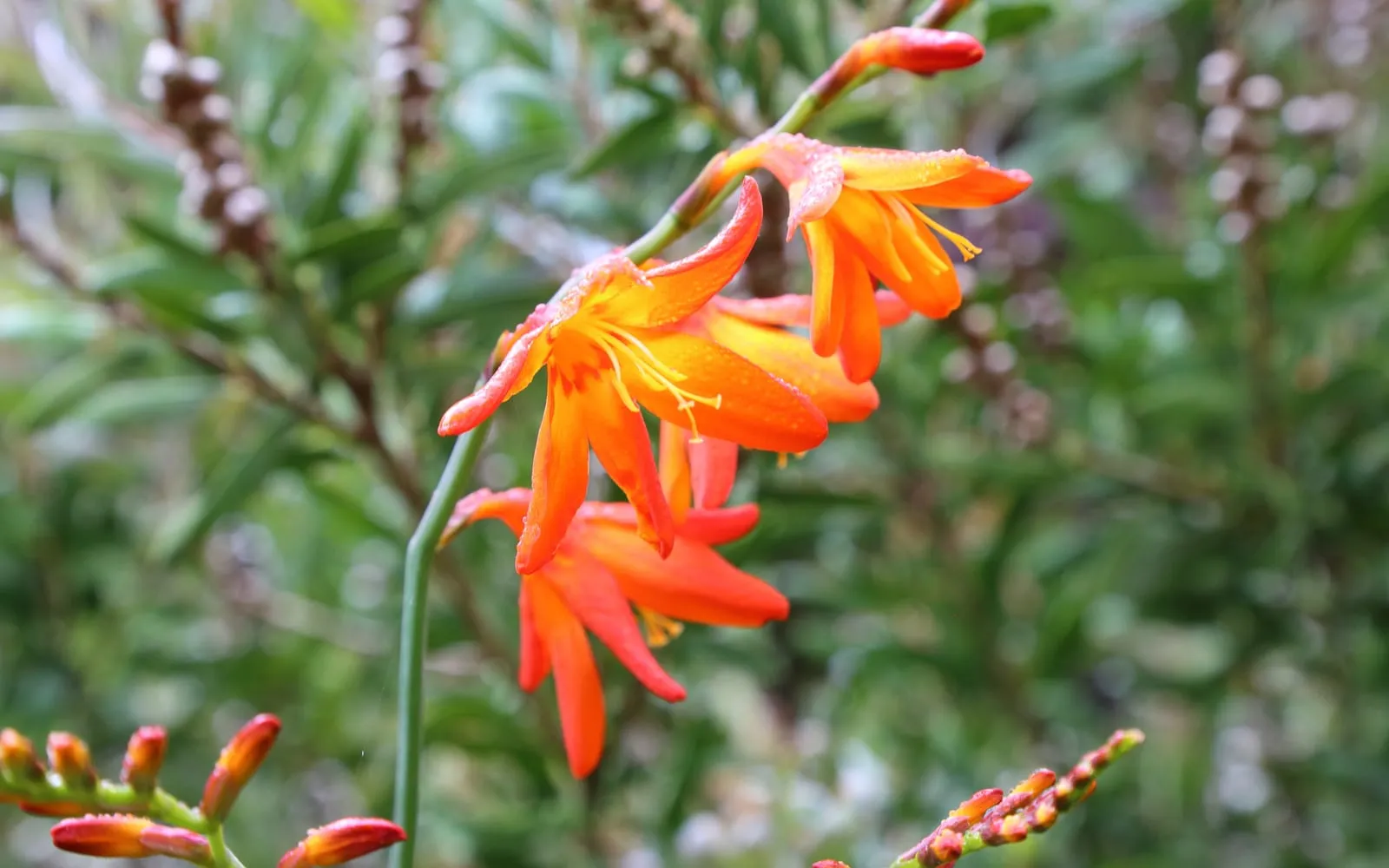
The flowers are small funnels held alternately along a wiry stem that curves over, so a clump reads as a series of sprays rather than a block. The colour runs from soft apricot through orange to the scarlet of ‘Lucifer’, which is the cultivar most people know and which reaches 1.2 m.
Below them the leaves are sword-shaped and pleated, standing upright in fans, and they give vertical structure from May onwards.
It grows from corms that stack on top of each other, each year’s corm sitting above the last, and over five or six years a clump becomes a dense congested mat that produces plenty of leaves and few flowers. Dividing it is the one regular job.
The common montbretia has escaped from gardens across the west of Britain and Ireland and forms dense stands on hedge banks, cliffs and road verges, particularly in Cornwall, Devon, west Wales, western Scotland and Ireland. It does the same through New Zealand, where sale is banned, and in Australia, Hawaii and the American Pacific north-west. It is an attractive plant in a garden and a problem in a hedgerow, and where you garden near open country that is worth thinking about before planting it.
Appearance and character
A cormous perennial reaching 60 to 90 cm in the common montbretia, and up to 1.2 m in ‘Lucifer’.
Leaves are sword-shaped and pleated lengthwise, 40 to 60 cm long, bright green, standing in flat upright fans like a small iris.
Flower stems rise above the foliage from July, branched and wiry, and arch over at the tip.
Flowers are held alternately in two ranks along the arching stem, each a funnel 3 to 5 cm long opening to six pointed segments, and they open progressively from the base of the spray outwards.
Colours run through orange, apricot, tangerine, gold and scarlet. The common montbretia is orange, ‘Lucifer’ is pure scarlet, ‘Solfatare’ is soft apricot with bronze foliage, and ‘Emily McKenzie’ is orange with a deep mahogany throat.
Seed capsules follow and split to show bright orange seeds, which stand well into autumn.
Corms are small, round, flattened and fibrous-coated, and they form stacked chains with the newest at the top.
The whole plant dies back to the corms in winter and reappears in spring.
Where it is from
A garden hybrid rather than a wild plant, raised in 1880 by Victor Lemoine at Nancy in France by crossing Crocosmia aurea and Crocosmia pottsii, both from South Africa.
The parents grow in damp grassland and on stream banks in South Africa, which explains a plant that wants moisture in summer and free drainage in winter.
The hybrid reached Britain almost immediately and was planted widely in Victorian gardens.
Its escape into the British countryside began in the early twentieth century and it is now naturalised across the west of Britain and Ireland, thriving in the mild wet climate of the Atlantic fringe and forming dense stands that exclude other plants.
The genus name comes from Greek for saffron and smell, since dried flowers of the parent species give a saffron scent in water.
Montbretia is the older name and honours Antoine Coquebert de Montbret, a French botanist on Napoleon’s Egyptian expedition.
‘Lucifer’ was raised by Alan Bloom at Bressingham in 1966 and is a hybrid involving Crocosmia masoniorum, which is a different cross from the common montbretia.
How it grows
Plant corms in spring, 8 to 10 cm deep and 15 cm apart, in sun or partial shade.
Free-draining soil that stays moist through summer suits it best. It grows on most soils and rots in cold wet clay.
Improve heavy ground with grit, or plant on a slight ridge.
Water through dry spells in the first summer and afterwards in a drought.
Mulch in spring with compost, keeping it clear of the emerging shoots.
Leave the foliage and seed heads standing over winter, which protects the corms and looks good, and cut them down in late February or March.
Divide every three or four years. Lift the clump in spring as growth starts, pull the stacked corm chains apart, discard the old shrivelled corms at the bottom, and replant the plump new ones at the top. This is what keeps it flowering.
Expect a congested undivided clump to produce foliage and very few flowers, which is the standard complaint.
Give it winter protection in a cold garden by mulching over the corms with bark or straw, particularly for ‘Lucifer’ and the larger-flowered hybrids.
Lift and store the corms over winter in a very cold or wet garden, keeping them dry and frost-free.
Do not tip surplus corms into a hedge, a lane or any wild place. This is how the plant spreads into the countryside, and a single discarded corm establishes a colony. Compost them, bin them or give them away.
Propagate by dividing the corm chains, which is easy and produces plenty.
Through the seasons
Winter is dormant, with the dead foliage left standing to protect the corms.
Spring brings the leaf fans up in April, and this is the time to cut down the old growth, divide congested clumps and mulch.
Summer flowers from July, with the arching sprays opening progressively through August.
Autumn carries the flowering into September and leaves seed capsules that split to show orange seed.
Care difficulty
Easy. Crocosmia is among the most trouble-free late summer perennials.
It needs no staking, no deadheading, no feeding and no watering once established, and it has almost no pests or diseases.
The one job is dividing every three or four years, and skipping it is why so many clumps produce leaves and nothing else.
Corm rot in cold wet clay is the other failure and it is a drainage problem.
The ecological question is worth taking seriously in a rural or coastal garden, and it is a siting and disposal issue rather than a cultivation one.
Watering
Water in dry spells through the first summer after planting.
Established clumps manage on rainfall in a temperate climate and benefit from water in a long drought, since the parents come from damp grassland.
Water at the base rather than over the foliage.
Free drainage in winter matters more than summer water. Corms sitting in cold wet clay rot.
Mulch in spring, which holds summer moisture and does more than watering.
Warning signs, diseases and pests
Plenty of leaves and very few flowers is a congested clump, which is the standard crocosmia problem. Lift and divide in spring, discarding the old corms at the bottom of each stack.
Corms failing to appear in spring is rot from cold wet soil, or frost damage in a hard winter on a shallow planting. Improve drainage, plant deeper, and mulch over the corms in a cold garden.
Silvery streaks and mottling on the leaves with distorted flowers is gladiolus thrips. They are worst in hot dry summers. Remove the worst affected foliage and water well.
Brown spots and blotches on the leaves in a wet summer is a fungal leaf spot and is cosmetic.
The clump spreading further than intended is normal in good soil, and the corms multiply readily.
Seedlings and stray plants appearing around the garden is the plant naturalising. Remove them, and never dispose of the material in the countryside.
Flowering poorly in deep shade is a light problem. It wants sun or light shade.
Slugs and snails occasionally graze the young shoots and rarely do lasting harm.
Growing environment
Full sun to partial shade, with better flowering in sun.
Moist but free-draining, reasonably fertile soil. Improve heavy clay with grit.
Hardy in most temperate climates. The larger hybrids are slightly less hardy than the common montbretia and benefit from a winter mulch in a cold garden.
Allow 30 to 45 cm per clump and plant in groups for the mass effect that suits it.
It suits a herbaceous border, a mixed border, a gravel garden, a coastal garden or a prairie-style planting.
Think about the site if you garden in the countryside, particularly in the west of Britain or in Ireland, and never dispose of surplus corms anywhere they can escape.
Grow it with the plants that flower at the same time. Rudbeckia, helenium, achillea, kniphofia, sedum and ornamental grasses all overlap with it, and the hot colours work together.
Its wildlife value is fair. Bees work the flowers, and hummingbird hawkmoths visit them in warm summers.
Choose ‘Lucifer’ for scarlet at 1.2 m, ‘Emily McKenzie’ for orange with a dark throat, and ‘Solfatare’ for soft apricot with bronze foliage.
Feeding
None needed on reasonable soil.
Mulch in spring with compost, keeping it clear of the shoots.
Feed a clump in poor soil with a balanced general fertiliser in spring.
Avoid high-nitrogen feeds, which give leaf at the expense of flower and make the standard problem worse.
A clump with plenty of leaves and no flowers needs dividing rather than feeding.
Troubleshooting
Lots of leaves and hardly any flowers. The clump is congested. Lift it in spring, pull the stacked corm chains apart, discard the old shrivelled corms at the bottom and replant the plump new ones. Do this every three or four years.
When do I divide it? In spring as growth starts, every three or four years.
Is it invasive? Seriously so in New Zealand, where sale is banned, and in the wild in the west of Britain and Ireland. It forms dense stands on hedge banks, cliffs and verges that exclude native plants. Check the current Schedule 9 listing under the Wildlife and Countryside Act 1981 before planting it where it can escape, and never tip surplus corms into a hedge or a lane.
It did not come back after the winter. Corm rot from cold wet soil, or frost on a shallow planting. Improve drainage, plant 8 to 10 cm deep, and mulch over the corms in a cold garden.
Should I cut the foliage down in autumn? No. Leave it standing over winter, since it protects the corms and looks well. Cut it down in late February or March.
The leaves have silvery streaks. Gladiolus thrips, which are worst in a hot dry summer. Remove the worst foliage and water well.
Which one should I grow? ‘Lucifer’ for scarlet at 1.2 m, ‘Emily McKenzie’ for orange with a mahogany throat, and ‘Solfatare’ for apricot flowers over bronze leaves.
Can I grow it in a pot? Yes, in a large container with free-draining compost, and it needs dividing more often and protecting from a hard frost.
Is it safe for children and pets? Yes. It is not listed as harmful by the RHS and not recorded as toxic by the ASPCA.