
Edible
Wild Parsnip
Pastinaca sativa
Also known as Parsnip, Garden parsnip
How to grow parsnips, Pastinaca sativa. Fresh seed and slow germination, why frost sweetens the root, avoiding canker, and the sap burn nobody warns you about.
At a glance
- Difficulty
- Moderate
- Water
- Weekly in dry spells, and steadily rather than heavily
- Light
- Full sun to light shade
- Temperature
- Fully hardy to about -15 deg C. Frost improves the flavour
- Hardiness
- USDA 2-9, RHS H6, hardy to -20 C
- Type
- Biennial grown as an annual
- Height
- 60-150 cm when flowering in its second year
- Native to
- Europe, Western Asia
- Best month
- March in the Northern Hemisphere, September in the Southern Hemisphere
Frost is an ingredient here rather than a hazard, since cold converts the root starch to sugar and an unfrosted parsnip tastes thin. That puts the crop out of reach of frost-free climates. Seed is short-lived and germinates slowly in cold soil, so use fresh seed every year and sow when the ground has warmed.
Hardiness zones describe winter cold alone. Summer heat, humidity, rainfall and the length of the growing season decide as much, so treat the range as the outer limit rather than as a recommendation.
Every month named in this guide is for the temperate Northern Hemisphere. If you garden in the Southern Hemisphere, shift each one by six months, so March becomes September. Closer to the equator the wet and dry seasons matter more than the calendar, and the shift stops being a useful guide.
Skin irritant
- Safe to eat
- The root, cooked or raw
- Harm from
- Handling it
- Affects
- People
The parsnip root is a food crop and entirely safe to eat. The hazard is the foliage, and it is more serious than most gardeners expect. Parsnip leaves and stems contain furanocoumarins, chiefly psoralen and bergapten, which react with ultraviolet light on skin to cause phytophotodermatitis. Sap on skin in sunlight produces redness after a day, then blisters, then brown staining that can last for months. Strimming a stand of parsnip in flower on a sunny day is the classic way to get a bad case, and children who handle the hollow stems are frequently affected. It is the same mechanism as giant hogweed, milder in degree and identical in kind, and severe cases scar. Wash the skin with soap and water at once if sap contacts it, keep the area out of sunlight for 48 hours, and see a doctor about blistering. Wear gloves and long sleeves when clearing parsnip foliage in summer. Wild parsnip is the same species growing on roadsides and rough ground across Britain, and it causes most of the recorded cases. Grazing animals eating large quantities of the foliage can develop the same photosensitisation. The RHS lists Pastinaca sativa among plants harmful on skin contact.
Sources: RHS potentially harmful garden plants, ASPCA toxic and non-toxic plants
About
Parsnips reward patience and punish haste. The seed germinates slowly and erratically, the root takes most of the year to fill, and the flavour only arrives after the first hard frost converts stored starch into sugar. A parsnip lifted in September tastes of not very much. The same root lifted in December is one of the best things in the garden.
Two facts decide whether you get a crop at all. Parsnip seed loses viability faster than almost any other vegetable, so seed more than a year old mostly does not come up. And the seedbed has to stay damp through three or four weeks of germination, which is longer than most gardeners are prepared to keep watering an apparently empty row.
The third thing to know is not about growing. The foliage burns skin in sunlight, and the burn is a real one.
Appearance and character
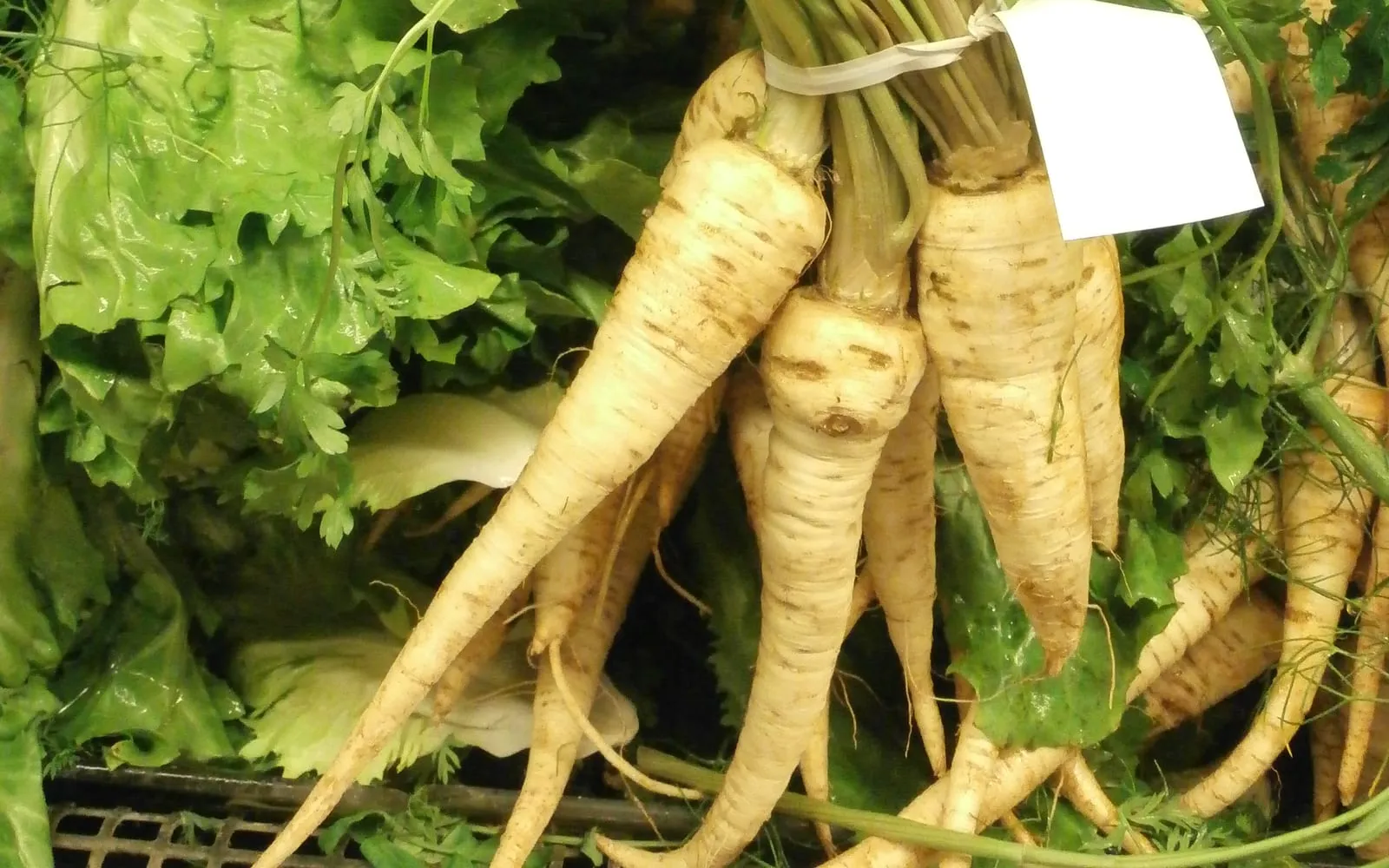
A long, tapering, creamy-white taproot with a broad shoulder and a fine tip, 20 to 30 cm in most garden varieties and considerably longer in the exhibition types.
Flesh is white to pale cream, sweet and aromatic after frost, and it goes brown at a cut surface.
Leaves are divided into broad toothed leaflets, coarser and flatter than carrot foliage, in a fresh mid-green, forming a rosette 40 cm across.
In its second year the plant sends up a hollow grooved flowering stem to a metre and a half, topped with flat umbels of small yellow flowers. The yellow flower separates it from almost every other white-flowered umbellifer in Britain, and several of those are lethal.
Seeds are flat, papery and winged, which is how the plant spreads itself along verges.
Where it is from
Parsnip is native to Europe and western Asia, and it grows wild across Britain on chalk grassland, roadsides and rough ground. The wild plant has a thin, tough, aromatic root.
Romans grew it and valued it, and the classical sources confuse it with carrot often enough that some claims about Roman parsnips probably describe carrots.
It was the main starchy root of northern Europe until the potato arrived, and it carried much of the sweetening load in medieval cooking before sugar was affordable.
Britain kept the taste for it when much of Europe did not, which is why parsnips are a supermarket staple here and a curiosity in parts of the continent.
The plant is a biennial. It builds a food store in year one and spends it on flowering in year two, and the crop is that store lifted before the plant can use it.
How it grows
Sow direct in the ground it is to crop in. Parsnips have a taproot and any transplanting forks it.
Buy fresh seed every year. This is the single most useful piece of advice about the crop. Parsnip seed is viable for about a year and germination collapses after that.
Sow from March to early May into soil that has warmed to at least 7 deg C. Sowing into cold wet soil in February gives nothing.
Sow at 1 cm deep in rows 30 cm apart, three seeds every 15 cm, and thin to the strongest seedling. Sowing a fast-germinating radish in the same drill marks the row while you wait.
Germination takes three to four weeks and the seedbed must stay damp throughout. Cover with fleece to slow the drying.
Thin to 15 cm apart. Roots need that space to fill.
Lift from October onwards, after the first frost, and leave the rest in the ground to lift as needed until February.
Through the seasons
Early spring is the sowing window, from March once the soil has warmed. Prepare the bed the previous autumn and do not manure it.
Late spring keeps the seedbed damp through germination and thins the seedlings once they are through. Cover the row against carrot fly.
Summer is weeding and watering. Keep the rows weed-free early, since parsnip seedlings are slow and easily smothered. Handle the foliage with gloves and long sleeves in bright weather.
Autumn brings the first lifts, from October and better after a frost. The foliage dies back and the roots stay sound in the ground.
Winter is the harvest proper. Lift as needed through to February. Clear the bed before the plants start into growth again, since a second-year parsnip is woody and its flowering stem is the part that burns skin.
Care difficulty
Moderate, and almost all of the difficulty is at the start.
Germination is the first hurdle. Fresh seed, warm soil, a fine tilth and three weeks of damp. Most failed parsnip rows failed here.
Stone-free ground is the second. A root that meets a stone forks around it, and fresh manure causes the same problem, so follow a crop that was manured the previous year.
Canker is the disease that spoils otherwise good roots, rotting the shoulders brown or orange. Resistant varieties such as ‘Gladiator’, ‘Avonresister’ and ‘Albion’ handle it, and good drainage and undamaged shoulders help.
Carrot fly attacks parsnips as readily as carrots and is prevented the same way.
The sap burn is the hazard rather than the difficulty, and it is easy to avoid once you know about it.
Watering
Water steadily rather than heavily. Even moisture gives a smooth root and interrupted moisture gives a split one.
Keep the seedbed damp for the whole germination period, which is three to four weeks. This is the one time parsnips need daily attention.
After that, a thorough soak weekly in dry weather is enough. Around 12 litres per square metre.
Mulch between rows once the plants are thinned, which steadies the moisture and suppresses the weeds that smother slow seedlings.
Splitting follows heavy rain onto dry ground. Even watering is the prevention.
Container growing needs a pot at least 45 cm deep. It works, and it is easier to grow a short-rooted variety such as ‘White Gem’ if the ground is stony.
Warning signs, diseases and pests
Parsnip canker is the main disease, showing as orange-brown or black rot spreading from the shoulder down. Wet soil, damaged shoulders and high nitrogen all encourage it. Grow a resistant variety, improve drainage, earth up the shoulders lightly in autumn, and avoid nicking the roots when weeding.
Carrot fly larvae tunnel rusty channels just under the skin. Cover the row with fine insect mesh from sowing, or fit a 60 cm vertical barrier around the bed. The flies fly low.
Celery leaf miner tunnels white blotches through the foliage and rarely affects the crop. Squeeze the tunnels to crush the larvae.
Slugs graze the shoulders of the root where it sits proud of the soil. Earth up lightly.
Forked roots mean stones, compaction or fresh manure.
Poor germination means old seed, cold soil, or a seedbed that dried out.
Splitting follows irregular watering.
Growing environment
Full sun to light shade.
Deep, light, stone-free soil is the requirement, and it is the same specification a carrot wants. Dig to a spade and a half, remove stones and break up any pan.
Never manure the bed before parsnips. Fresh organic matter causes forking and hairy roots and encourages canker. Follow a crop that was manured the previous year.
Lime to pH 6.5 or 7. Acid soil encourages canker.
Rake to a fine tilth before sowing. The seed is flat and papery and needs contact with fine soil.
Raised beds of sieved soil and sand grow good parsnips on stony or heavy ground.
Rotate with the other umbellifers, counting carrot, celery, celeriac, parsley and fennel as one crop.
Feeding
Parsnips need very little, and overfeeding causes the two problems that spoil the crop.
Avoid nitrogen. It gives a large leafy top over a small forked root and softens the shoulders against canker.
A dressing of sulphate of potash at 15 g per square metre before sowing helps on poor or sandy ground, and potash encourages straight clean roots.
Never apply fresh manure. Where organic matter is needed, add well-rotted compost a full season ahead.
Nothing further is needed through the season on ground in reasonable heart.
Troubleshooting
Nothing came up. Old seed, cold soil, or a seedbed that dried out. Buy fresh seed each year, sow from mid-March into warmed soil, and keep the row damp for four weeks.
Forked and stubby roots. Stones, compaction or fresh manure. Dig deeply, remove stones, and follow a crop that was manured last year.
Orange-brown rot spreading from the shoulders. Parsnip canker. Grow a resistant variety, improve drainage, earth up the shoulders, and avoid damaging the roots when weeding.
Rusty tunnels under the skin. Carrot fly. Cover with fine mesh from sowing or fit a 60 cm barrier around the bed.
The roots taste of nothing. Lifted too early. Wait for the first hard frost, which converts starch to sugar.
Splitting. Heavy rain after a dry spell. Water evenly through summer.
Blistering rash on my forearms. Phytophotodermatitis from the sap in sunlight. Wash immediately, keep the area out of the sun for two days, and see a doctor about blistering. Wear gloves and long sleeves when handling the foliage.
Can I leave them in the ground all winter? Yes, and you should. Lift as needed to February, then clear the bed before growth restarts.