
Outdoor plant
Foxtail Lily
Eremurus robustus
Also known as Desert candle, King's spear
How to grow foxtail lily, Eremurus robustus. Planting the starfish-shaped root crown on a mound of sand, staking a 2-3 m spike, and why the roots must never be bent.
At a glance
- Difficulty
- Moderate
- Water
- Occasional in spring growth, none at all once the foliage yellows
- Light
- Full sun
- Temperature
- Fully hardy once dormant, but the emerging spring shoot is frost tender
- Hardiness
- USDA 5-8, RHS H5, hardy to -20 C
- Type
- Hardy perennial grown from a fleshy root crown
- Height
- 2-3 m
- Native to
- The Tien Shan and Pamir-Alai mountains of Central Asia
The zone covers winter cold well enough, since the root crown sits below frost depth and tolerates a hard freeze while dormant. What it leaves out is drainage and a dry summer rest. A Central Asian steppe holds moisture for a few weeks in spring and then bakes dry for months, and a root crown left sitting in wet ground over winter rots long before any frost gets near it.
Hardiness zones describe winter cold alone. Summer heat, humidity, rainfall and the length of the growing season decide as much, so treat the range as the outer limit rather than as a recommendation.
Skin irritant
- Do not eat
- Sap from cut or damaged foliage and stems
- Harm from
- Handling it
- Affects
- People
Eremurus is not listed by the ASPCA or the RHS as a toxic garden plant, and there is no record of serious poisoning from any part of it. The genus sits in Asphodelaceae, the same family as aloe and red hot poker, and several of its relatives produce a sap that irritates skin on contact without being dangerous to eat. Handling cut foliage or a damaged stem has caused mild contact irritation in some gardeners, so wearing gloves when cutting back the spent spike is sensible rather than a strict necessity. There is no report of it causing illness in cats, dogs or horses, and the root crown is bitter enough that grazing animals generally leave it alone.
Sources: RHS potentially harmful garden plants, ASPCA toxic and non-toxic plants
About
A foxtail lily spike rises quickly in June and can stand taller than the gardener who planted it. Hundreds of small starry flowers open from the base upwards over several weeks. Few temperate border plants reach that height on a single unbranched stem.
What sits underground bears no resemblance to a bulb. A young hyacinth or tulip stores reserves in a tidy layered ball; a foxtail lily stores them in a crown of thick, brittle, radiating roots that spread flat like the arms of a starfish, with a single growing point at the centre. That shape determines how the plant has to be planted. Getting it wrong is the most common reason a newly bought crown never sends up a shoot at all.
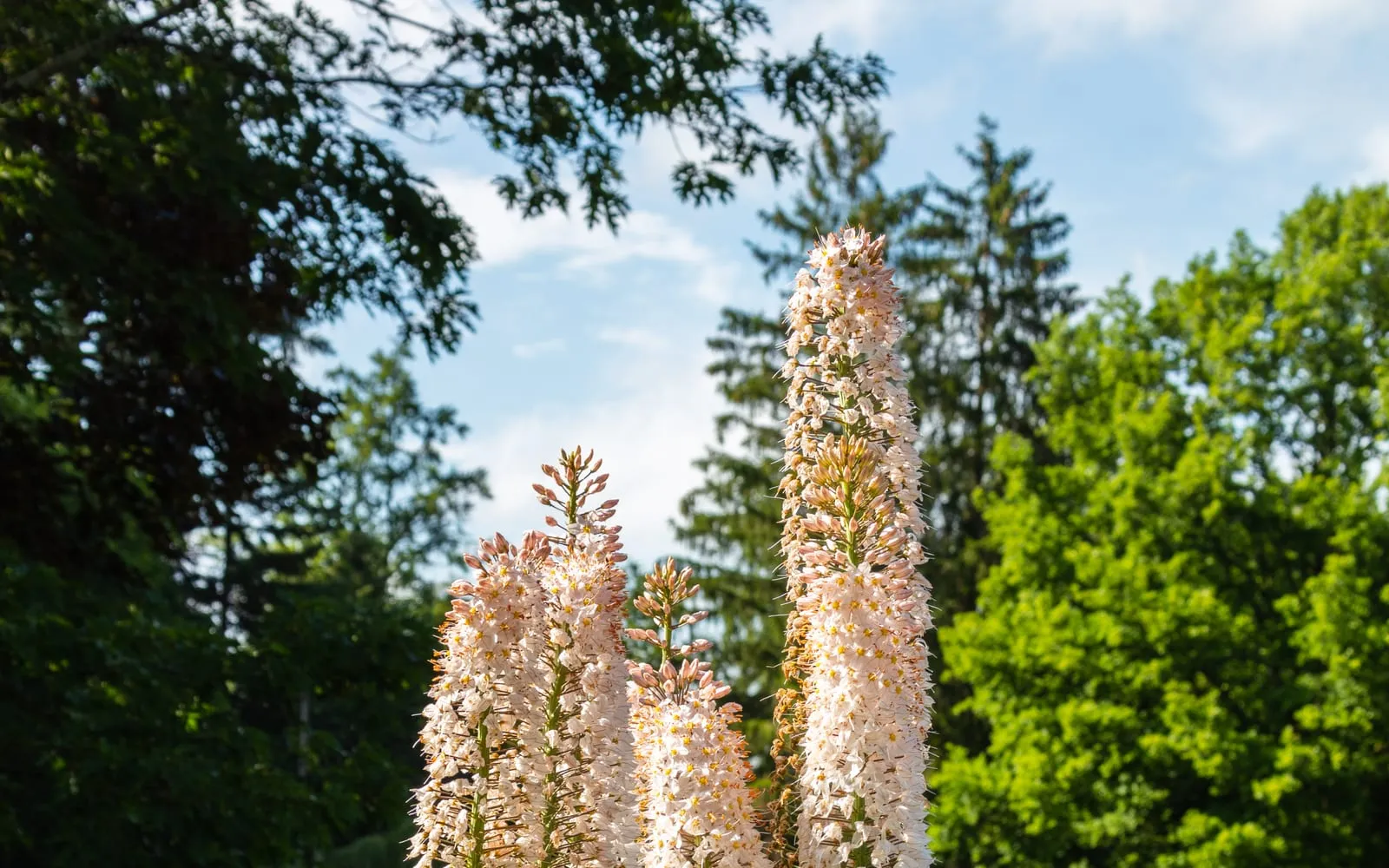
Eremurus robustus is the largest species in the genus and the one most widely sold for the back of a border, with spikes of soft pink flowers that can pass 2.5 m in good ground.
Appearance and character
A rosette of grey-green, strap-shaped leaves lies close to the ground in spring, dying back well before the flower opens. The flower stem rises clear of the foliage on a bare stalk, carrying its spike of blooms 60 to 120 cm above the leaves.
The spike itself is densely packed with hundreds of individual six-petalled flowers, pale pink with a darker central stripe on each segment, opening from the bottom of the spike towards the top over three to four weeks. A spent flower leaves behind a papery seed capsule, and a mature spike left uncut turns into a striking dried seed head that some gardeners keep for winter interest instead of removing.
The root crown is the plant’s defining feature and the reason it belongs in its own category instead of with bulbs or corms. Dozens of fleshy, finger- thick roots radiate from a central bud, brittle enough to snap if bent sharply and slow enough to regrow that a broken root can cost a season’s flowering.
Where it is from
The mountains of Central Asia, principally the Tien Shan and Pamir-Alai ranges spanning modern Kazakhstan, Kyrgyzstan, Uzbekistan and Tajikistan, where the genus grows on rocky and semi-desert slopes between about 600 and 2000 m.
That is a place with short, intense springs and long, baking summers. Snow melts in April, the ground holds moisture for a matter of weeks, and the plant completes its above-ground growth, flowering and setting seed, before the summer drought sets in. By July the foliage has died back completely and the crown sits dry and dormant in baked, cracked soil until the following spring.
Reproducing that dry dormancy is the key to growing Eremurus outside its native range. It explains why a plant that tolerates -20 deg C without difficulty still fails regularly in mild but wet British and Pacific Northwest gardens, where summer drainage instead of winter cold is the limiting factor.
How it grows
Plant the crown in autumn, as soon as it is available, since the brittle roots dry out and weaken the longer they sit out of the ground.
Dig a hole 20 to 25 cm deep and wide, and build a mound of coarse sand or grit in the centre rising to within about 10 cm of the surface. Sit the crown on top of the mound with the growing point uppermost and drape the roots down the sides of the mound in every direction, the way the plant grows in the wild. This is the step that most often gets skipped, and roots left bunched in a hole instead of spread out rot at the point where they touch each other.
Cover with soil so the crown sits about 8 to 10 cm deep, firm gently, and do not water at planting time in anything but dry autumn weather. A newly planted crown has no roots doing active work yet, and wet soil around a dormant crown is the most common single cause of failure.
The first shoot appears in early to mid spring as a tight cluster of leaves, followed some weeks later by the flower stem pushing up through the centre of the rosette. Growth from shoot to full flower spike takes eight to ten weeks, and the whole visible plant is finished and dying back within about twelve weeks of first appearing.
Never move an established crown once it has settled. Lifting disturbs and frequently snaps roots that took years to build, and a disturbed crown can skip flowering for two or three seasons before recovering.
Through the seasons
Spring is the entire growing season compressed into ten weeks. The leaf rosette appears in March or April, the flower stem follows in May, and the spike is in full bloom by June.
Summer brings dormancy almost as soon as flowering finishes. The foliage yellows and collapses by July, and the crown then should be left completely dry and undisturbed until autumn.
Autumn is planting season for a new crown, and for an established plant it is the season to leave alone. A light mulch of grit or gravel around the crown after the first hard frost protects the dormant bud without holding damp against it.
Winter passes with nothing visible above ground. The crown is fully hardy to about -20 deg C in this state, and the cold does the crown no harm at all provided the ground around it drains.
Care difficulty
Moderate, and the difficulty is mostly in two decisions made at planting. Choose a spot with sharp drainage, adding grit or planting on a raised mound if the native soil holds water, and handle the root crown only once, planting it correctly the first time.
Staking matters for anything over about 1.5 m in an open or windy site. A single stout cane driven in at planting time, before the roots fill the hole, avoids stabbing through the crown later.
Slugs are worth watching for in the few weeks the young rosette is at ground level and tender, since a rosette stripped before the flower stem forms means no flower that year.
Watering
Water once, lightly, if autumn planting happens during a dry spell, and otherwise leave a newly planted crown alone until growth is visibly underway in spring.
Once the leaf rosette is up and the flower stem is forming, a deep soak every couple of weeks in dry spring weather supports the spike, particularly in a light or sandy soil that drains fast.
Stop entirely the moment the foliage begins to yellow, usually by early July. From that point the crown needs to be bone dry until the following spring. Irrigating a nearby border through summer is the commonest way to lose an Eremurus that has flowered well for several years.
Warning signs, diseases and pests
A crown that produces leaves but never sends up a flower stem is usually either too young, still building reserves after being divided, or was planted with the roots bunched instead of spread flat, which stresses the plant in its first year or two.
Soft, blackened patches on the crown, with no shoot appearing at all in spring, mean rot from standing in wet soil, most often winter rain pooling around a crown planted without adequate drainage. There is no treatment once rot reaches the growing point; lift what remains, discard the rotten tissue, and replant a healthy piece on a proper sand mound in better drained ground, or in a raised bed if the garden soil cannot be improved.
Slugs graze the emerging rosette leaves in a wet spring, leaving ragged holes, and can strip a young shoot badly enough to prevent flowering. Beer traps, torchlit removal on damp evenings, or a barrier of grit around the crown all reduce the damage.
A late frost after the shoot has emerged can blacken and kill the growing tip. There is no way to protect a 2 m spike in the open, so a very late spring frost in an exposed site is a risk that comes with growing the species, and most established clumps recover the following year even after a bad one.
Wind is the other main hazard once the spike is up. An unstaked stem in an open, exposed border snaps at the point where it emerges from the rosette, and once broken it cannot be repaired.
Growing environment
Full sun is essential. A shaded Eremurus produces a weak, leaning spike and flowers poorly, if it flowers at all.
Drainage matters more than fertility. The species tolerates thin, sandy, even quite poor soil far better than it tolerates a rich but heavy one that holds winter wet. On clay, raise the planting position by 15 to 20 cm above the surrounding ground, or grow it in a dedicated raised bed with grit worked through the top 30 cm.
Shelter from the worst of the wind helps considerably, since the flower spike acts as a sail once it reaches full height. A position against a wall or hedge that still gets full sun for most of the day is close to ideal.
Give each crown enough room. A mature clump needs 60 to 90 cm of clear space in every direction, both for the root system to spread and so neighbouring plants do not shade the spring rosette.
Feeding
Feed sparingly. A rich, high-nitrogen soil produces soft, lush leaf growth at the expense of the crown and flower, and the wild plant thrives on poor mountain ground.
A single application of a low-nitrogen, high-potash feed such as tomato food as the shoot emerges in spring, and a second as the flower stem lengthens, is enough for most soils. Skip feeding altogether in reasonable garden ground.
Do not feed at all once the foliage begins to yellow. The plant is shutting down for its long summer dormancy by that point, and feed applied after flowering is not taken up in dry soil.
Troubleshooting
Planted a crown last autumn and nothing came up. Dig carefully to check whether it survived. A crown planted with roots bunched instead of spread over a sand mound, or one that sat in wet soil over winter, is the most common reason nothing appears in the first spring.
The roots snapped while I was planting it. A snapped root will not regrow that season, but a crown with several roots intact usually still flowers, just less strongly than an undamaged plant. Handle the crown by the central bud instead of by the roots themselves next time.
How deep should the crown go? About 8 to 10 cm to the growing point, sitting on top of a mound of sand or grit built up inside a hole 20 to 25 cm deep, with the roots draped down and outwards.
The spike snapped in the wind. Stake next year’s spike early, with the cane in the ground before growth starts, so it does not have to be driven through an established root system later.
Leaves came up but no flower spike. Most likely a young or recently divided crown that has not yet built enough reserve, or too much shade. Established clumps in full sun in their second or third year are far more reliable flowerers.
Can I move it once it is established? Only if you have to, and expect a setback. The brittle roots rarely survive lifting undamaged, and a moved crown often skips flowering for a season or two while it recovers.
Is it safe near pets? There is no record of it poisoning cats, dogs or horses, and the sap causes no more than mild skin irritation in sensitive people. It is one of the least risky plants in this collection.