
Houseplant
Bulbophyllum
Bulbophyllum lobbii
Also known as Lobb's Bulbophyllum
How to grow Bulbophyllum, Bulbophyllum lobbii, including its single round pseudobulbs on a creeping rhizome, star-shaped flowers, and the largest genus in the orchid family.
At a glance
- Difficulty
- Moderate
- Water
- Water regularly, allowing the surface to approach dryness between soakings
- Light
- Bright indirect light, some gentle morning sun
- Temperature
- 15-28 deg C
- Humidity
- 60-80 percent
- Hardiness
- USDA 10-12, RHS H1b, hardy to 12 C
- Type
- Evergreen epiphytic perennial orchid
- Height
- 15-25 cm
- Native to
- Borneo, Java, Sumatra, Thailand
Native to lowland and lower-montane forest across the western Malay archipelago, warm and humid year round with only a mild seasonal change in rainfall. This species has almost no tolerance for cold, and the zone figure alone does not capture the wide, shallow growing space its creeping rhizome habit demands, which is a bigger practical hurdle for most growers than temperature.
Hardiness zones describe winter cold alone. Summer heat, humidity, rainfall and the length of the growing season decide as much, so treat the range as the outer limit rather than as a recommendation.
Not known to be toxic
Bulbophyllum has no toxicity listing from the RHS or the ASPCA, and orchids of this kind carry an unusually clean safety record among houseplants generally. No part of this species is documented as harmful to cats, dogs or people if chewed, and there is no recorded history of poisoning associated with it.
Source: ASPCA
About
Bulbophyllum is the largest genus in the entire orchid family, with more than two thousand described species ranging from flowers smaller than a grain of rice to some of the largest blooms in the whole family, and Bulbophyllum lobbii sits comfortably in the showier half of that range. Many species in the genus produce flowers that smell of carrion to lure fly pollinators, but this one is a pleasant exception, carrying a light, sweet fragrance rather than anything unpleasant.
Its growth habit sets it apart from most other orchids grown as houseplants. Rather than pseudobulbs packed tightly together in a clump, this species spaces each one out along a creeping rhizome, sometimes several centimetres apart, so the plant spreads sideways across a pot or mount rather than building upward and inward.
Appearance and character
Each growth consists of a single, large, rounded pseudobulb, glossy and somewhat flattened, topped with one broad, leathery leaf. New pseudobulbs form at intervals along the advancing rhizome rather than clustering against the last one, so a mature plant looks more like a chain of beads spreading across the surface of its container than the dense clump a Cattleya or Cymbidium builds.
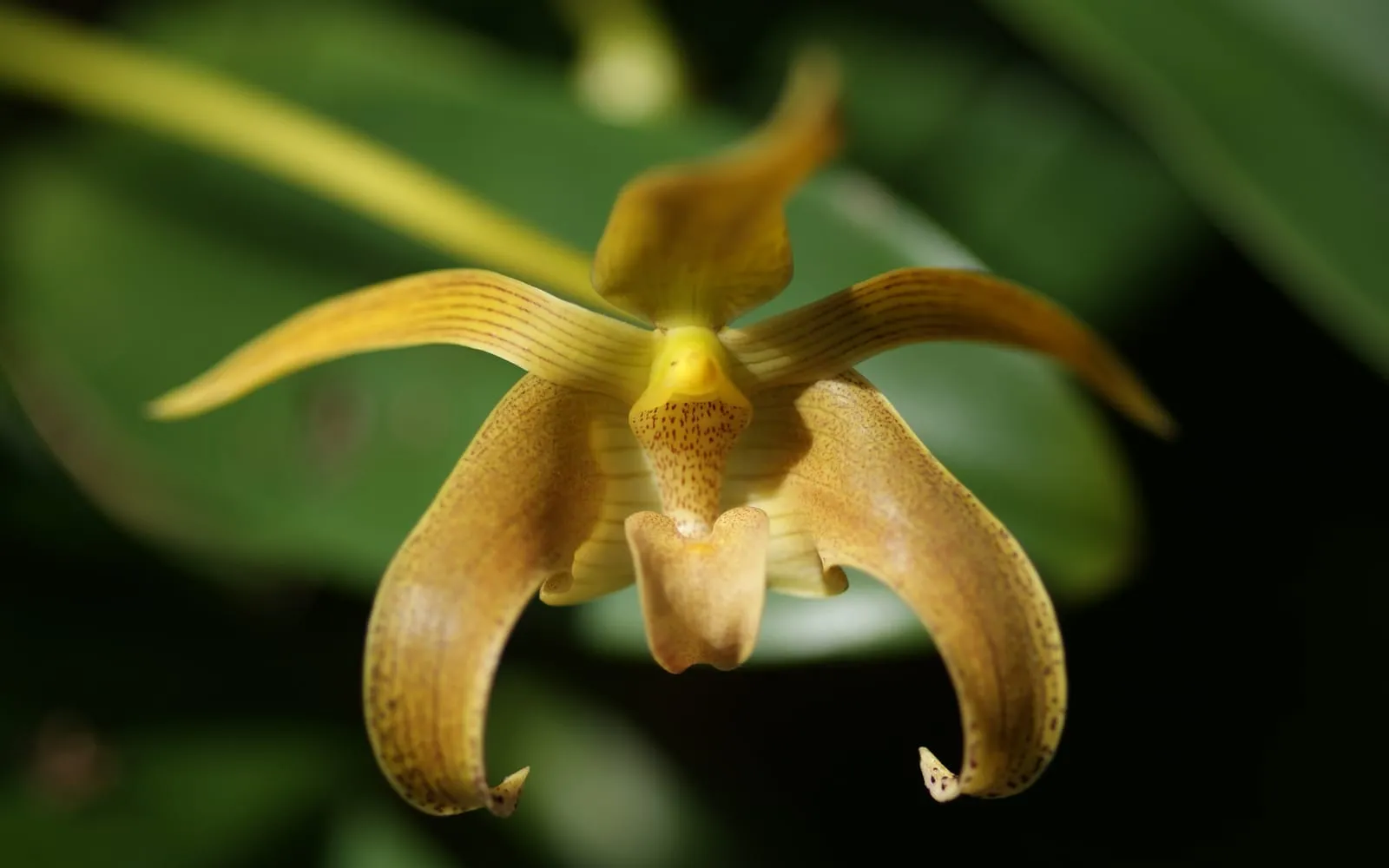
Flowers rise on a short stem from the base of a mature pseudobulb, usually one to a stem, star-shaped and often 8 to 10 cm across, in shades of cream, pale yellow or soft orange, marked with fine reddish-brown spotting and stripes. The petals and sepals taper to long, pointed tips, giving the whole flower a striking, angular outline unlike the rounder blooms of many other orchids.
Where it is from
This species grows across the western part of the Malay archipelago, including Borneo, Java, Sumatra and parts of Thailand, typically in lowland and lower-montane forest where warmth and humidity stay high throughout the year with only a modest seasonal shift in rainfall. Growth in the wild is usually on mossy tree branches with good air movement, rather than deep in still, shaded understorey.
The genus as a whole is remarkably diverse in habitat, spanning everything from hot lowland swamp forest to cool cloud forest at high elevation, which is part of why Bulbophyllum has become the largest genus of orchids: a single ancestral form has diversified into thousands of species suited to almost every forest niche across the tropics and subtropics. This particular species stays firmly in the warmer, lowland half of that range.
How it grows
Pot it in an open bark mix inside a wide, shallow container, or mount it on a raft or slab of bark, both chosen to give the creeping rhizome room to spread rather than confining it the way a deep pot suits a clumping orchid. A standard deep pot, sized for a Cattleya, quickly runs out of room sideways long before the plant has filled it vertically.
New growths appear at intervals along the advancing rhizome tip through the warmer months, each one maturing into a rounded pseudobulb over several weeks before producing its own leaf. Because growths are spaced out rather than clustered, the plant benefits from being allowed to spread across a proportionally larger surface than its actual root mass might suggest, well before it looks crowded.
Repot, or remount, once the rhizome has reached the edge of its current container, moving it to a larger flat container or a bigger mount rather than a deeper one, which keeps faith with the plant’s naturally spreading habit.
Through the seasons
Spring brings new growths along the advancing rhizome as the plant enters its main growing period. Water regularly as new pseudobulbs form.
Summer is the peak growing season, with warmth and humidity supporting steady pseudobulb development. Feed every second watering through this period.
Autumn growth slows gradually as conditions cool. Continue watering at a similar frequency, since this species has no pronounced dry season in most of its native range.
Winter brings flowering for many mature pseudobulbs, along with a quieter growth period overall. Keep the plant warm, since this species has very little cold tolerance at any time of year.
Care difficulty
Moderate. The main challenge is less about routine watering, which this species tolerates reasonably well within a normal range, and more about giving the creeping rhizome the lateral space it needs, since a plant confined to too small or too deep a container struggles to grow well regardless of how carefully it is watered.
Watering
Water regularly, allowing the surface of the mix to approach dryness between soakings rather than keeping it constantly wet. A thorough soak with full drainage afterward suits the single, fairly substantial pseudobulbs this species produces, which hold a useful water reserve without needing the constant dampness a leafier, pseudobulb-free orchid would require.
Because this species has essentially no cold tolerance, avoid watering late in the day during any cooler spell, since water sitting on the foliage or crown overnight in cool conditions increases the risk of rot.
Warning signs, diseases and pests
Scale insects and mealybugs can settle on the pseudobulbs and along leaf undersides, appearing as small brown bumps or cottony white tufts. Because growths sit spaced apart rather than tightly clustered, they are somewhat easier to spot early here than on a densely packed orchid, and regular checks catch most infestations before they spread far.
Spider mites occasionally appear in warm, dry indoor air, showing as fine speckling on the leaves. Snails are drawn to soft new pseudobulb growth and can rasp visible damage into it overnight, more of a risk for a plant kept outdoors or on a humid, shaded patio through summer.
Shrivelled pseudobulbs point to underwatering, while soft, discoloured ones point to rot, usually following a mix that stayed wet too long or a spell of overnight moisture in cool conditions. Cut away any affected tissue with a clean blade and adjust watering and warmth accordingly.
Growing environment
Bright indirect light suits this species, with some gentle morning sun tolerated well; deep shade produces healthy leaves but few flowers, while harsh midday sun can mark the foliage. An east-facing window or a lightly shaded spot near a bright window usually works well.
High humidity, in the 60 to 80 percent range, matches the plant’s lowland forest origins, and good air movement around the widely spaced pseudobulbs helps prevent the fungal problems that still air can bring on in humid conditions. Keep the plant reliably warm, since it has very little tolerance for cold at any point in the year.
Feeding
A balanced orchid fertiliser at quarter strength, applied every second watering through the main growing season, supports steady pseudobulb production along the advancing rhizome.
Reduce feeding through the cooler, quieter months, when growth slows, resuming the fuller routine as new growths begin appearing again along the rhizome in spring.
Troubleshooting
The plant is spreading sideways rather than filling in densely. This is normal for the species. Unlike a clumping orchid, Bulbophyllum lobbii spaces its pseudobulbs out along a creeping rhizome, so give it room to spread across a wide, shallow container rather than confining it to a deep pot.
A pseudobulb has shrivelled. Usually underwatering, though check the overall watering pattern rather than reacting to a single growth, since an older pseudobulb naturally shrivels somewhat as it ages and is replaced by newer growth further along the rhizome.
The plant has outgrown its pot faster than expected. Because growths spread laterally rather than clustering, this species can reach the edge of a container sooner than its root mass alone would suggest. Move it to a wider container or a larger mount rather than a deeper one.
Does the flower really smell unpleasant, like other Bulbophyllum species I have read about? No, not this one. Many species in this very large genus produce a carrion scent to attract fly pollinators, but Bulbophyllum lobbii carries a light, sweet fragrance instead, which is part of its appeal as a houseplant.
The plant is not flowering despite healthy pseudobulb growth. Usually too little light. Move it to a brighter spot, including some gentle direct morning sun if the current position is fully shaded, and expect improved flowering from the next mature pseudobulb.
Some older, leafless pseudobulbs remain along the rhizome. Leave them in place. They continue to support the rest of the plant as a water and nutrient reserve, and can be removed only once they are clearly shrivelled and spent.
Bulbophyllum problem guides
Not sure what is wrong? See the common houseplant pests guide.