
Edible
New Zealand Spinach
Tetragonia tetragonioides
Also known as Warrigal greens, Kokihi, Botany Bay greens
How to grow New Zealand spinach, Tetragonia tetragonioides. The heat-proof spinach substitute, chipping and soaking the seed, and blanching it before eating.
At a glance
- Difficulty
- Easy
- Water
- Weekly in dry weather
- Light
- Full sun to light shade
- Temperature
- 15-28 deg C. Killed by the first frost
- Hardiness
- USDA 9-11, RHS H2, hardy to 0 C
- Type
- Tender perennial grown as an annual
- Height
- 30-40 cm tall, spreading 1-2 m
- Native to
- New Zealand, Australia, Japan and South America
- Best month
- June in the Northern Hemisphere, December in the Southern Hemisphere
It crops right through the heat that makes true spinach bolt, which is the entire reason to grow it, and the first frost ends it. Seed is slow and benefits from soaking overnight. It has naturalised on coasts across Europe, the Americas and Japan, so keep it off a wild shoreline.
Hardiness zones describe winter cold alone. Summer heat, humidity, rainfall and the length of the growing season decide as much, so treat the range as the outer limit rather than as a recommendation.
Every month named in this guide is for the temperate Northern Hemisphere. If you garden in the Southern Hemisphere, shift each one by six months, so June becomes December. Closer to the equator the wet and dry seasons matter more than the calendar, and the shift stops being a useful guide.
Edible, with limits
- Safe to eat
- The young shoot tips and leaves, blanched or cooked
- Harm from
- Eating it
- Affects
- People
New Zealand spinach is a food crop with a long history of use by Maori and Aboriginal Australian communities, and it is eaten across Japan and South America. Neither the RHS nor the ASPCA lists Tetragonia tetragonioides. The caution is oxalic acid, which it contains in quantity comparable to spinach and above chard, and it is the reason every reliable source says to blanch it before eating. Blanching for a minute in plenty of boiling water and discarding that water removes a substantial part of the oxalate along with a slight bitterness, and it is the standard preparation in Australia and New Zealand. Oxalate binds calcium and contributes to kidney stones in people prone to them, so anybody with that history or on a low-oxalate diet should treat this plant as they treat spinach and sorrel. Eating it raw in quantity is the practice to avoid. Cooked in ordinary portions it is safe and nutritious.
Sources: RHS potentially harmful garden plants, ASPCA toxic and non-toxic plants
About
New Zealand spinach solves the problem every temperate gardener has with real spinach, which is that spinach bolts in midsummer. This plant does the opposite. It gets going as the weather warms, crops through the hottest weeks, and keeps producing until the first frost kills it.
It is unrelated to spinach, being in the Aizoaceae with the mesembryanthemums rather than in the Amaranthaceae, and the resemblance is entirely in how it cooks.
Two things surprise people. The seed is a hard woody cluster that needs chipping or soaking before it will germinate reliably. And the leaves want blanching in plenty of water before use, both to remove the oxalate and to take the edge off a slight bitterness.
Appearance and character
A low sprawling mat, 30 to 40 cm tall and spreading a metre or two, with thick brittle stems that root where they touch soil.
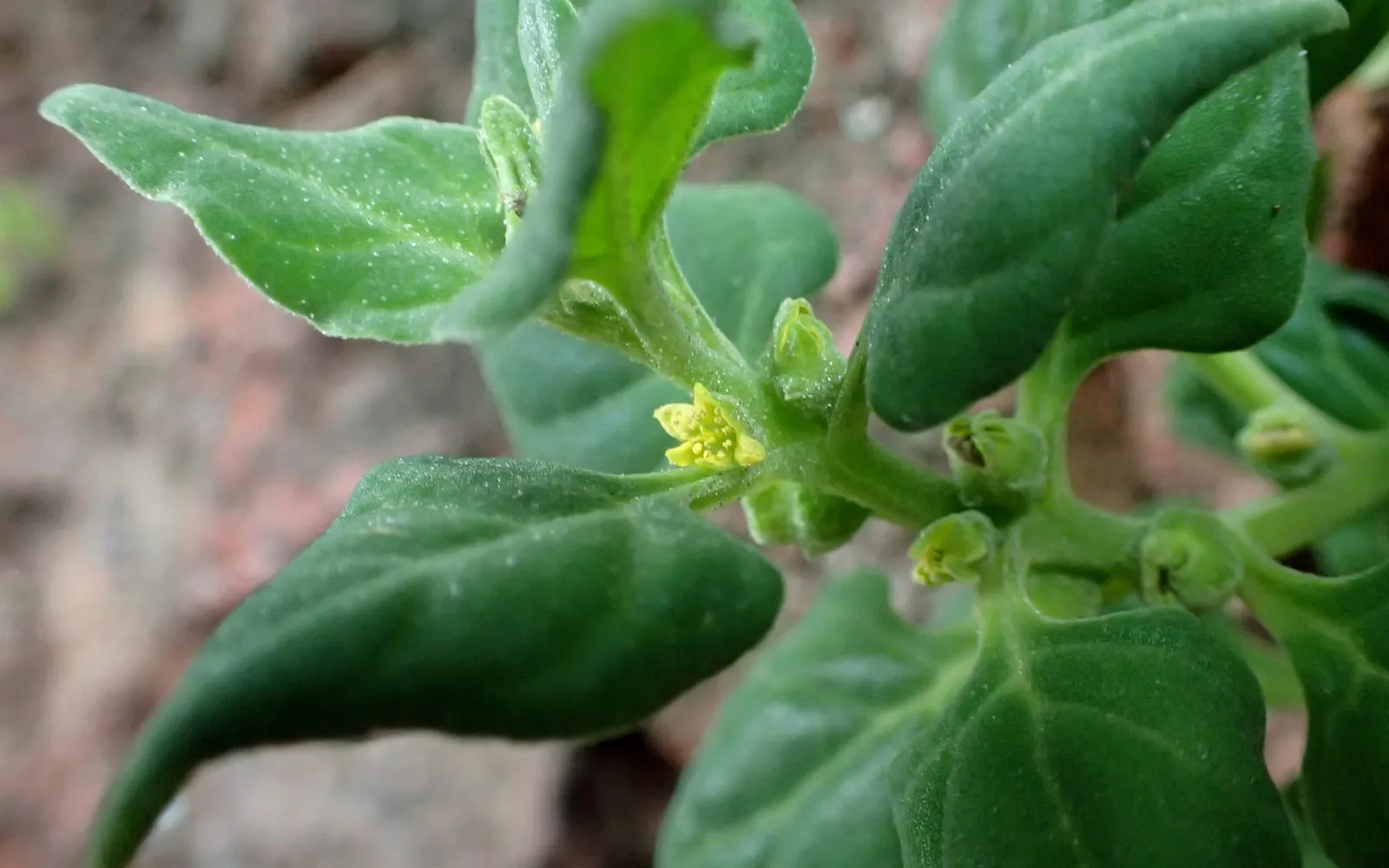
Leaves are triangular to diamond-shaped, thick, fleshy and slightly succulent, in a dull mid-green, with a surface covered in tiny glistening bladder cells that catch the light.
The whole plant has a slightly frosted appearance from those cells, which are salt-excreting structures and part of why it tolerates coastal conditions.
Flowers are tiny, yellow-green and inconspicuous, tucked into the leaf axils.
Seed is a hard woody four-horned capsule containing several seeds, which is where the name tetragonioides comes from.
Flavour cooked is close to spinach, slightly saltier and denser, and it holds its texture better in a pan.
Where it is from
New Zealand spinach grows wild on coastal sand and cliffs in New Zealand, Australia, Japan, Chile and Argentina, which is an unusual natural distribution around the Pacific rim.
Maori knew it as kokihi and Aboriginal Australians as warrigal greens, and both ate it long before European contact.
Joseph Banks collected it at Queen Charlotte Sound during Cook’s first voyage in 1770, and Cook had it cooked for the crew as an antiscorbutic. That is how it reached Kew in 1772 and European gardens shortly afterwards.
Britain grew it widely in Victorian kitchen gardens as the summer spinach substitute, then largely dropped it when reliable bolt-resistant spinach varieties arrived.
Australian restaurant cooking has revived it since the 1990s as a native ingredient, and warrigal greens now appear on menus there.
How it grows
Prepare the seed. Either soak the woody capsules in water for 24 hours or nick them with a file, and preferably do both. Untreated seed germinates slowly and patchily.
Sow direct in late May or June once the soil has warmed, at 2 cm deep and 60 cm apart in rows 90 cm apart. The plant needs far more room than its seedling suggests.
Alternatively start in modules under cover in April and plant out after the frosts.
Germination takes ten to twenty days even after treatment.
Pick from eight weeks, taking the top 10 cm of each shoot. This is the crop, and regular picking keeps the plant branching and productive.
Keep picking. An unpicked plant sprawls and coarsens, and a plant picked weekly produces tender tips until the frosts.
Let one plant set seed and it will self-sow, and the seedlings are easily recognised and easily pulled.
Through the seasons
Spring is for starting seed under cover in April, after soaking or chipping it. Outdoor sowing before late May is wasted.
Early summer is for sowing or planting out, from late May once the soil is warm and the frosts have finished.
Summer is the season and the reason to grow it. The plant crops right through the heat that ends spinach. Pick the shoot tips weekly.
Autumn carries on until the first frost, which kills the plant outright. Pick until then.
Winter is nothing. Clear the bed and follow with garlic or a green manure.
Care difficulty
Easy once the seed has germinated, and the seed is the only difficulty.
Chipping and soaking is the step that decides whether the crop happens. Untreated seed can take a month or fail entirely.
Space is the practical requirement. A single plant covers a square metre or more, so two plants feed a household and six overwhelm a bed.
Picking regularly is what keeps the plant producing tender tips rather than coarse sprawling growth.
Slugs take the seedlings and lose interest afterwards.
Cold wet ground rots it, and the plant is otherwise untroubled by anything.
Watering
Water weekly in dry weather, around 12 litres per square metre.
The plant is drought-tolerant thanks to its succulence and produces tougher leaves when it is dry.
Water at the base rather than over the foliage.
Mulch after planting to hold moisture, though the plant’s own sprawl shades the ground effectively within weeks.
Avoid waterlogging, which rots the stems at the base.
Container growing works in a large pot of 40 litres, and the plant will trail over the sides and needs picking to keep it in bounds.
Warning signs, diseases and pests
Poor germination is the commonest complaint and comes from an untreated hard seed coat. Soak for 24 hours and nick the capsule with a file.
Slugs graze seedlings off at ground level in early summer. Raise plants in modules and plant out at a decent size.
Root and stem rot follow cold wet ground, particularly early in the season. Sow late into warm soil.
Aphids cluster on the growing tips and are dealt with by predators.
Coarse tough growth means the plant is not being picked often enough. Take the top 10 cm of each shoot weekly.
Frost kills the plant outright and is the end of the season rather than a problem.
Nothing else troubles it. The plant travelled without most of its pests.
Growing environment
Full sun to light shade.
Free-draining soil is what it wants, and it tolerates poor, sandy and saline ground better than any other leaf crop here. A coastal garden suits it perfectly.
Neutral soil, pH 6.5 to 7.5, and it takes a wide range.
Warm soil at sowing is the requirement. Wait for late May.
Space at 60 cm in rows 90 cm apart, or one plant per square metre.
Rotate loosely. It shares almost no diseases with anything else in the vegetable garden.
Feeding
Work garden compost into the bed before sowing and leave it at that.
The plant is undemanding and crops on poor ground, which is one of its advantages.
Avoid heavy nitrogen, which gives soft sprawling growth and raises the oxalate and nitrate content of the leaves.
Never use fresh manure.
A container plant benefits from a balanced liquid feed monthly through summer.
Troubleshooting
Almost nothing germinated. The seed capsule is hard and woody. Soak it for 24 hours and nick it with a file before sowing, and sow into warm soil.
It has taken over the bed. Normal. One plant covers a square metre or more. Space at 60 cm and pick hard to keep it in bounds.
The leaves are tough and coarse. The plant is not being picked often enough. Take the top 10 cm of each shoot weekly.
It collapsed at the base. Cold wet ground. Sow later into warm soil and improve drainage.
Do I have to blanch it? Yes, for the same reason spinach and sorrel want care. Blanch for a minute in plenty of boiling water and discard the water, which removes much of the oxalic acid and a slight bitterness.
Can I eat it raw? Sparingly at most. The oxalate content makes it a cooked vegetable rather than a salad leaf.
Is it related to spinach? No. It is in the Aizoaceae, with the mesembryanthemums. The resemblance is in the cooking rather than the botany.
Will it come back next year? Not as a plant, since frost kills it. It often self-sows, and the seedlings are easy to recognise.
New Zealand Spinach problem guides
Not sure what is wrong? See the common vegetable pests guide.