
Houseplant
Air plant
Tillandsia xerographica
Also known as Tillandsia, King of air plants, Xerographica
How to care for Tillandsia xerographica. Soaking, drying the rosette upside down, mounting without glue and propagating after flowering.
At a glance
- Difficulty
- Moderate
- Water
- Soak for 20-30 minutes every one to two weeks
- Light
- Bright indirect light, with some direct morning sun
- Temperature
- 15-30 deg C. Never below 10 deg C
- Humidity
- Moderate. Good air movement matters more than damp air
- Hardiness
- USDA 10-11, RHS H1b, hardy to 10 C
- Type
- Evergreen epiphyte, flowering once and then producing offsets
- Height
- 20-40 cm across
- Native to
- Southern Mexico, Guatemala, El Salvador and Honduras
- Best month
- December in the Northern Hemisphere, June in the Southern Hemisphere
Dry forest in Guatemala, Mexico and El Salvador, growing on branches and taking water through the leaves rather than roots. Wild collection pushed it onto CITES Appendix II, so buy nursery-propagated plants. Outdoors year round in USDA 10 and 11.
Hardiness zones describe winter cold alone. Summer heat, humidity, rainfall and the length of the growing season decide as much, so treat the range as the outer limit rather than as a recommendation.
Every month named in this guide is for the temperate Northern Hemisphere. If you garden in the Southern Hemisphere, shift each one by six months, so December becomes June. Closer to the equator the wet and dry seasons matter more than the calendar, and the shift stops being a useful guide.
Not known to be toxic
Non-toxic. The ASPCA lists Tillandsia among plants that are not harmful to cats, dogs or horses, and the RHS does not include air plants in its list of potentially harmful garden plants. Bromeliads as a family are among the safest houseplants available, and the pineapple is the best-known edible member. Nothing in an air plant will poison a cat, a dog or a child. Two practical points are worth making instead. The leaves of Tillandsia xerographica are stiff and taper to a fine point, and a plant at eye level on a shelf is a minor hazard to a small child in the way any pointed object is. Secondly, air plants are frequently sold glued into shells, driftwood or ornaments, and the adhesive is the real problem. Hot glue and superglue both kill the tissue they touch and block the base of the plant, which is where it takes up water and where new offsets form. If you buy a glued plant, ease it off carefully and tie or wire it in place instead. That is a horticultural issue rather than a toxicity one, and it kills more air plants than anything except overwatering.
Sources: ASPCA (Air Plant, Tillandsia), RHS potentially harmful garden plants
About
An air plant has no use for a pot. It takes water and nutrients through its leaves, using microscopic scales called trichomes that open when wet and seal when dry, and its roots exist only to grip a branch. Plant one in compost and the base rots within weeks.
Everything else about the care follows from it. Watering means submerging the whole plant in a bowl and then turning it upside down to drain, rather than pouring anything onto soil. Feeding goes into the soak water. Mounting means tying it to something rather than potting it.
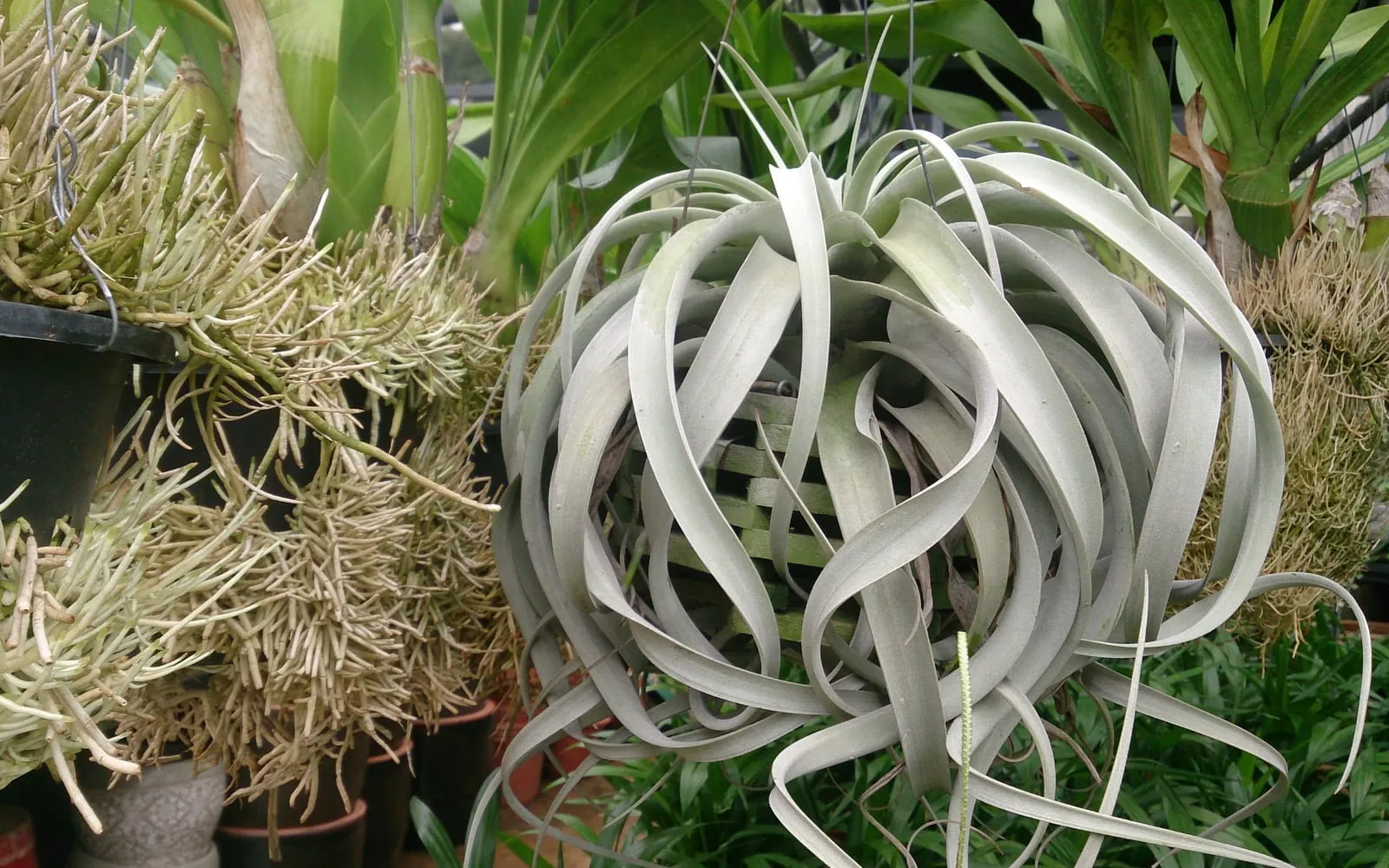
Tillandsia xerographica is the largest and most striking of the commonly sold species, a silver rosette of broad ribbon leaves that curl back on themselves into a loose ball, and it is slower and more forgiving than the small green ones.
Appearance and character
An evergreen epiphyte forming a rosette 20 to 40 cm across, with no functional root system.
Leaves are broad at the base and taper to a fine point, 30 cm or more long, and they curl and twist back on themselves, which is what gives the plant its sculptural ball shape.
The colour is a soft silver-grey rather than green, and that silver is the trichomes themselves. A drier-growing tillandsia is a more silver one, and green species need more water.
Trichomes are the whole mechanism. Tiny scales across the leaf surface that absorb water and nutrients when wet and reflect light and reduce water loss when dry.
Flowers come once in the plant’s life, from a thick branched spike carrying red or yellow bracts and tubular purple flowers, and the display lasts several weeks.
The plant is monocarpic. After flowering the parent slowly declines over a year or two while producing offsets around its base, called pups, which replace it.
Growth is very slow. A xerographica takes many years to reach full size, which is why large specimens are expensive.
Where it is from
Southern Mexico, Guatemala, El Salvador and Honduras, where it grows on the branches of trees in dry deciduous forest and thorn scrub.
The name comes from the Greek for dry writing, which describes the habitat rather than the plant.
It grows in the tops of trees in bright light with strong air movement, and it takes its water from rain, mist and dew rather than from any root system.
The dry forest habitat explains the broad curling silver leaves. Curling reduces the exposed surface area, and the dense trichome covering both catches moisture and reflects sunlight.
Wild collection was heavy enough that the species is listed on CITES Appendix II, and it is now widely propagated from seed and from offsets. Buy nursery-grown plants.
Bromeliads as a family are almost entirely American, and the pineapple and Spanish moss are relatives.
How it grows
Never plant it in compost. This is the first and most important rule, and burying the base kills the plant.
Display it loose in a bowl, in a wire holder, in a glass globe with an opening, or tied to a piece of driftwood, cork bark or a branch.
Mount it with fishing line, florist’s wire or a nylon tie rather than glue. Hot glue and superglue kill the tissue they touch and block the base where offsets form.
Soak it rather than watering it. Submerge the whole plant in a bowl of tepid water for twenty to thirty minutes every one to two weeks, or weekly in a heated room in winter.
Dry it upside down. After soaking, shake the plant firmly and stand or hang it upside down somewhere with moving air until it is dry, which should take no more than four hours. Water left sitting in the centre of the rosette rots the base, and this is the commonest way a xerographica dies.
Use rainwater or filtered water where possible. Air plants take everything through their leaves and are sensitive to the salts and chlorine in hard tap water.
Position it in bright indirect light with an hour or two of direct morning sun.
Give it moving air. Air plants need ventilation more than they need humidity, and a sealed jar or a closed terrarium will kill one.
Feed once a month in the growing season by adding a dilute bromeliad or air plant fertiliser to the soak water at a quarter of the stated strength.
Remove offsets once they reach about a third of the parent’s size, twisting them away gently, or leave them to form a clump.
Through the seasons
Winter is when the heating dries the air. Soak weekly rather than fortnightly, keep the plant away from radiators, and make sure it dries properly afterwards.
Spring is the start of growth. Resume feeding in the soak water, and remove any offsets that have reached a third of the parent’s size.
Summer is the growing season. Soak every one to two weeks, feed monthly, and give it plenty of light and moving air.
Autumn is when a mature plant may flower, sending up its branched spike. Reduce feeding and keep the routine steady.
Care difficulty
Moderate, and the difficulty is entirely in unlearning ordinary houseplant habits.
Rot from water left in the rosette kills more xerographica than anything else, and drying upside down prevents it completely.
Drying out is the opposite failure and shows as excessive curling and browning tips, usually in a heated room in winter.
Planting it in compost, or gluing it to an ornament, both kill it and both are things shops do before selling it.
Once the soak-and-dry routine is established the plant needs very little and lives for many years.
Watering
Soak the whole plant in tepid water for twenty to thirty minutes every one to two weeks, and weekly in a dry heated room.
Use rainwater or filtered water where the tap water is hard, since the leaves absorb everything in it.
Shake the plant firmly after soaking and dry it upside down in moving air. It should be dry within four hours.
Misting is not enough on its own for a xerographica. The broad leaves need a full soak to rehydrate properly.
Signs of thirst are exaggerated curling of the leaves and dry brown tips. A well-hydrated plant relaxes and opens out slightly after a soak.
Signs of rot are a dark soft base and leaves that pull away from the centre with no resistance, which is usually fatal by the time it is visible.
Warning signs, diseases and pests
A soft dark base with leaves falling away from the centre is rot, caused by water sitting in the rosette after soaking. It is usually fatal. Prevent it by shaking the plant and drying it upside down every time.
Brown crispy leaf tips and tightly curled leaves mean the plant is too dry. Soak weekly rather than fortnightly through the heating season.
A plant that has been planted in compost or gravel will rot at the base. Lift it out, let it dry, and display it loose or mounted instead.
Glue at the base kills the tissue and blocks the point where offsets form. Ease a glued plant off its ornament carefully and tie it in place instead.
Bleached or scorched patches mean direct midday sun, particularly through glass.
Mealybug and scale hide between the leaf bases where they are hard to see. Check after soaking, when they show up against the wet leaves.
A plant declining slowly after flowering is doing what it is supposed to do. Look for offsets around the base.
Growing environment
Bright indirect light with an hour or two of direct morning sun. An east-facing window is ideal, and a very shaded spot will not sustain it.
Warmth of 15 to 30 deg C, and never below 10 deg C.
Moving air, which matters more than humidity. Air plants need ventilation, and a sealed jar or closed terrarium kills them.
No compost, no gravel and no glue.
Good display options include a shallow bowl, a wire or ceramic holder, an open glass globe, a piece of driftwood or cork bark, or resting on a shelf.
Away from radiators, which dry it out faster than anything else.
A bathroom with a window suits it well, since the ambient humidity reduces how often it needs soaking, provided the air moves.
Feeding
Feed once a month from spring to autumn by adding a dilute bromeliad or air plant fertiliser to the soak water at about a quarter of the stated strength.
Ordinary houseplant fertiliser is too strong and too high in urea nitrogen, which air plants cannot process. Use a bromeliad or tillandsia formulation.
Stop feeding in winter.
Feeding encourages flowering and offset production and is worth doing on a mature plant.
Never apply fertiliser dry or to the base, since everything is taken up through the leaves.
Troubleshooting
How do I water it? Soak the whole plant in tepid water for twenty to thirty minutes every one to two weeks, then shake it and dry it upside down in moving air within four hours.
Why upside down? Water left sitting in the centre of the rosette rots the base, and that is the commonest way these plants die.
The base has gone soft and dark. Rot, from water trapped in the centre. It is usually fatal. Dry the plant upside down after every soak in future.
Can I plant it in soil? No. It has no functional root system and takes everything through its leaves. Compost around the base will rot it.
It came glued to a shell. Ease it off carefully. Glue kills the tissue it touches and blocks the point where new offsets form. Tie or wire it instead.
The leaves are curling tightly with brown tips. It is too dry. Soak weekly rather than fortnightly, particularly through the heating season.
It flowered and now looks tired. That is normal. Tillandsia flower once, then decline slowly over a year or two while producing offsets at the base to replace themselves.
Can I keep it in a closed jar? No. Air plants need moving air more than they need humidity, and a sealed container kills them.
Air plant problem guides
Not sure what is wrong? See the common houseplant pests guide.