
Outdoor plant
Dawn Redwood
Metasequoia glyptostroboides
Also known as Metasequoia
How to grow dawn redwood, Metasequoia glyptostroboides. A conifer known only from fossils until living trees turned up in a Chinese valley in 1944, and one of the fastest to grow.
At a glance
- Difficulty
- Easy
- Water
- Regular watering while establishing; consistent moisture strongly preferred afterwards
- Light
- Full sun to light shade
- Temperature
- Fully hardy in cold winters; tolerates a wide range of summer conditions given consistent moisture
- Hardiness
- USDA 4-8, RHS H6-H7, hardy to -29 C
- Type
- Hardy deciduous conifer
- Height
- 20-30 m within 40-50 years of planting, among the fastest-growing conifers in cultivation, capable of 1-1.5 m of growth a year while young. Because every cultivated tree descends from stock distributed after the 1940s, none has yet reached anything like the size its fossil relatives once did
- Native to
- Small native population in the Sichuan and Hubei border region of central China; now planted worldwide from that single source
Adaptable across a wide band of temperate climates, and the more useful limit is moisture rather than cold: this species wants consistently damp, rich soil and grows noticeably faster and healthier near a stream, pond or seasonally wet ground than on soil that dries out in summer. Drought tolerance is modest compared with most other conifers in this list, a legacy of a native site that itself sits near streams in a damp mountain valley.
Hardiness zones describe winter cold alone. Summer heat, humidity, rainfall and the length of the growing season decide as much, so treat the range as the outer limit rather than as a recommendation.
Not known to be toxic
Dawn redwood carries no established toxicity to people or common pets. Neither the RHS nor the ASPCA lists the species among plants of concern, and there is no documented case of poisoning from its foliage or bark. The tree's soft, feathery deciduous needles are shed harmlessly onto lawns and beds each autumn in large quantities, more a matter of raking than of any hazard, and the only practical caution around the species is the same one that applies to any large tree: its eventual size and surface-spreading roots near water are worth planning a planting site around.
Sources: RHS potentially harmful garden plants, ASPCA toxic and non-toxic plants
About
Every dawn redwood growing anywhere in the world today, from a botanical garden in England to a street planting in Tokyo, descends from a single population found in a remote Chinese valley in 1944, decades after botanists had concluded from fossil evidence that the genus Metasequoia had been extinct for millions of years. A Chinese forester came across an unusually large tree venerated by a local village and sent specimens for identification, and the resulting international seed-collecting expedition distributed the first seed worldwide within a few years, making this one of the very few tree species whose entire modern cultivated population can be traced to a single documented rediscovery.
It is also, remarkably for a conifer with such an ancient pedigree, one of the fastest-growing trees available to an ordinary garden, capable of adding well over a metre of height in a single good year while young.
Appearance and character
Foliage is soft, flat and feathery, arranged in opposite pairs along slender side shoots that themselves drop as a unit in autumn, a deciduous conifer alongside European larch and swamp cypress elsewhere in this list. Fresh spring growth is a bright, almost translucent green, darkening slightly through summer before turning a warm rust-orange to copper in autumn, a colour distinct from the clear gold of larch or the russet of swamp cypress.
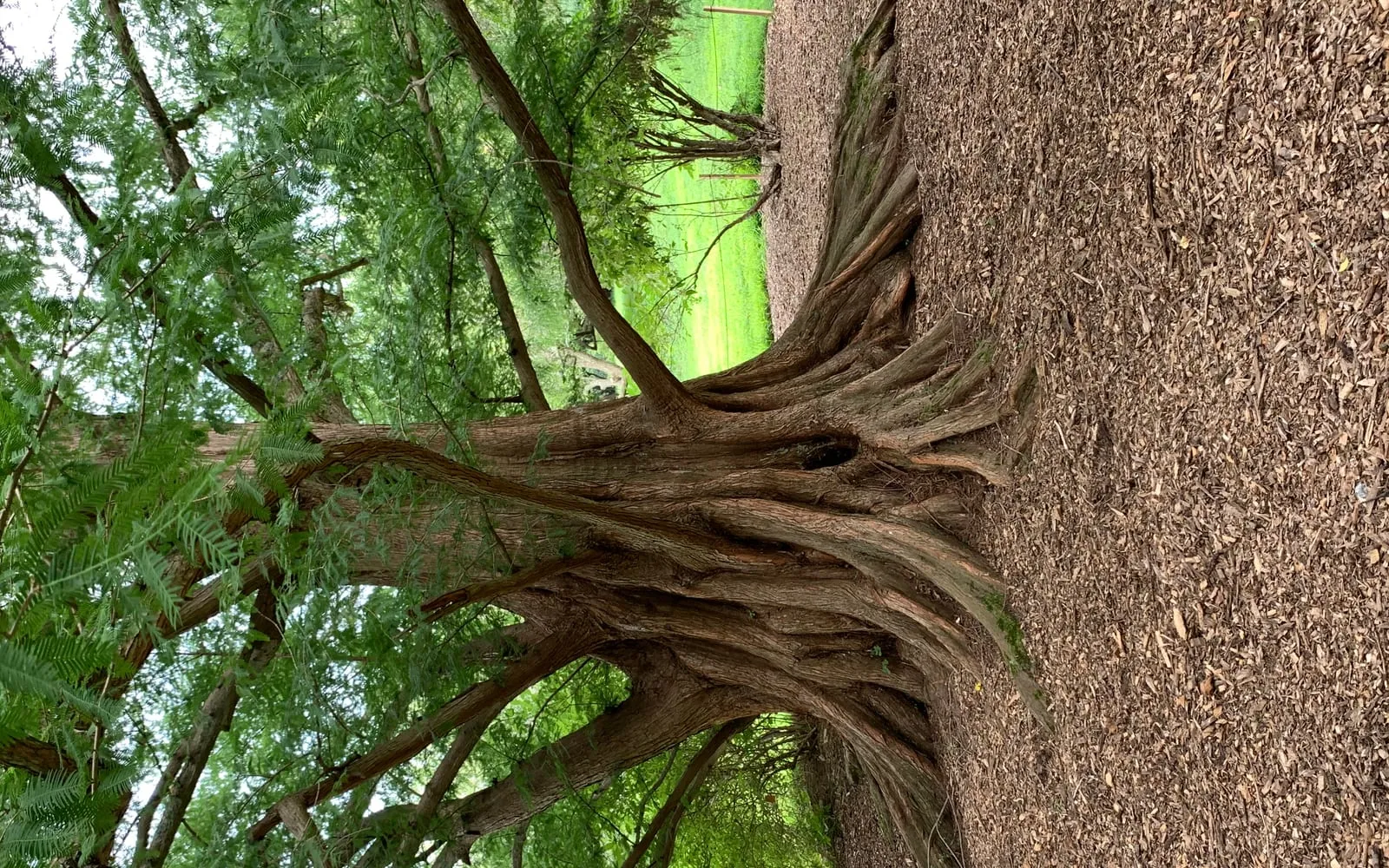
The trunk is notably straight and buttressed at the base on an older tree, often fluted with distinctive vertical ridges running up from broad, flaring roots, a feature that makes even a young specimen recognisable at a glance to anyone familiar with the species.
Bark is reddish-brown, fibrous and peels in long vertical strips, similar in texture to its relative the coast redwood, though the tree itself is unrelated to true cypress despite superficially similar foliage to swamp cypress.
The crown is broadly conical when young, narrowing and becoming more irregular with age, and the branches are arranged in opposite pairs along the trunk rather than the spiralling pattern typical of most conifers, a detail visible on close inspection and one more clue to the species’ distinctive, ancient lineage.
Where it is from
Metasequoia glyptostroboides survives as a native tree only in a small, scattered population along the border of Sichuan and Hubei provinces in central China, growing in damp valley bottoms and along streams at moderate elevation, often in ground that floods seasonally. Fossil Metasequoia, by contrast, has been found across a huge span of the Northern Hemisphere, including the Arctic, in rock tens of millions of years old, evidence of a genus that was once vastly more widespread before climate change and, eventually, human land use reduced it to the single valley where it was rediscovered.
The 1944 discovery and the seed-collecting expedition organised by Harvard University’s Arnold Arboretum in the years immediately following turned a population that may have numbered only a few hundred wild trees into one of the most widely planted ornamental conifers on Earth within a couple of generations, an unusually rapid and well-documented conservation story for a tree species.
Wild trees remain rare and are listed as endangered in their native range, even as the species thrives in cultivation on every inhabited continent.
How it grows
Plant in autumn or spring into deep, moist, fertile soil, ideally with reliable moisture through the growing season; this species performs noticeably better near a stream, pond or naturally damp low spot than on ground that dries out in summer.
Give it plenty of room from the outset. Its rapid growth rate means a small nursery tree reaches a substantial size within a decade or two, faster than almost any other conifer in this list, and a site chosen for a modest sapling can feel crowded within a surprisingly short time.
Little formal pruning is needed; the tree naturally develops a good, single leading shoot and a well-balanced crown without intervention, and cutting into old wood is best avoided in favour of removing only damaged or crossing growth while young.
Protect young trees from late spring frost where possible, since the soft, early foliage is more vulnerable to a late cold snap than the mature growth of summer.
Through the seasons
Spring brings rapid, soft, bright green new growth, among the earliest and fastest of any conifer in this list, and it is a vulnerable period if a late frost catches the tender new foliage.
Summer is the tree’s main growing season, with the fastest height gain of the year given adequate moisture, and consistent watering through a dry summer matters more here than for most other conifers, given this species’ comparatively modest drought tolerance.
Autumn brings a warm rust-orange to copper colour change across the whole crown, one of the more striking autumn conifer displays available, before the needles and the small side shoots bearing them drop together over a few weeks.
Winter leaves the tree entirely bare, its straight, fluted, reddish trunk and buttressed base fully visible against the sky, and cold is well tolerated by an established tree across most of its hardiness range.
Care difficulty
Easy. Given moist, fertile soil and reasonable space to grow into, dawn redwood asks little beyond routine watering while young and needs almost no pruning or intervention as it matures. Its main demand, consistent moisture, is straightforward to provide on most garden soil and is easily met by siting the tree away from the driest part of a garden. The species’ remarkable growth rate is itself the main planning consideration, since a site suited to a young tree can be outgrown faster than for almost any other conifer here.
Watering
Water regularly through the first several growing seasons while the tree establishes, and expect it to want more consistent moisture than most other conifers in this list even once established, reflecting its native site along streams in a damp valley.
A position near a pond, stream or naturally moist low spot suits it particularly well, and the species tolerates occasional waterlogging considerably better than most conifers, closer in this respect to its distant relative swamp cypress than to most upland species.
Drought stress shows relatively quickly compared with the more drought- tolerant conifers in this list, as wilting or premature leaf drop during a dry summer, and consistent watering resolves it faster than most conifer problems.
Warning signs, diseases and pests
Canker occasionally affects stressed or wounded trees, showing as sunken, discoloured bark and localised dieback; a generally healthy, well-watered tree resists it far better than one under drought stress.
Root-rot follows waterlogged, oxygen-starved soil rather than merely damp ground, since this species tolerates far more moisture than most conifers before drainage becomes a problem in its own right.
Japanese beetle feeds on the foliage of many garden trees, including this one, in parts of North America where the beetle is established, causing skeletonised leaves in a bad summer without usually threatening an established tree’s survival.
Late frost damage to the soft, early spring growth shows as blackened or collapsed new shoots, cosmetic in most cases on an established tree, which typically produces a second flush of growth to replace what was lost.
Yellowing foliage through the growing season, distinct from the tree’s normal autumn colour change, more often indicates waterlogged, oxygen-poor soil or, less commonly, a nutrient deficiency on very poor ground than any specific disease.
Growing environment
Full sun to light shade both suit it, with the fastest, densest growth in full sun given adequate moisture.
Moist, deep, fertile soil is the target, and this species is more forgiving of occasional waterlogging than almost any other conifer in this list, making it a strong choice for a damp corner, a streamside planting or ground that floods periodically.
Space for rapid, substantial growth needs to be planned in from the start, since this is one of the fastest-growing trees commonly available and a site sized for a young sapling is quickly outgrown.
Shelter from the most exposed, drying wind benefits a young tree, though an established specimen tolerates a fairly wide range of conditions once its root system is established.
Feeding
A balanced, slow-release fertiliser applied once or twice yearly supports a young tree’s rapid growth through its establishment years, particularly on soil of only moderate fertility.
Established trees on good, moist soil generally need little supplemental feeding, since the naturally fertile, damp valley conditions the species evolved in already supply most of what it needs given a reasonable garden soil.
A tree growing more slowly than its reputation suggests is more often short of consistent moisture than of nutrients, and correcting watering first is the more effective response in most cases.
Troubleshooting
Is it true this tree was thought extinct? Yes. Metasequoia was known to botanists only from fossils, some tens of millions of years old, until a small living population was found in a remote valley on the border of Sichuan and Hubei provinces in China in 1944. Seed distributed worldwide from that discovery within a few years is the ancestor of every cultivated tree grown today.
My tree lost all its needles in autumn. Is that normal? Yes, dawn redwood is one of the few deciduous conifers, alongside European larch and swamp cypress. Expect a warm rust-orange colour change followed by complete leaf drop each autumn, with fresh growth returning reliably in spring.
How fast will it grow, and is that a problem? Very fast by conifer standards, potentially over a metre a year while young. Plan the planting site with that rate in mind rather than for the size of the small nursery tree first bought, since it can outgrow a tight spot within a decade or two.
Late frost has blackened the new spring growth. This is common on the soft, early foliage and is usually cosmetic on an established tree, which typically pushes a second flush of growth to replace what was damaged.
Can I plant it somewhere that gets occasionally waterlogged? Yes, more readily than almost any other conifer in this list. This species tolerates periodic wet ground well, reflecting its native site along streams in a damp Chinese valley, though it still prefers moist rather than permanently stagnant soil.
The foliage is yellowing during the growing season, not in autumn. This more often points to waterlogged, oxygen-poor soil or, on very poor ground, a nutrient shortfall than to disease. Check drainage and soil fertility before assuming a pest or pathogen is responsible.
Is this the same tree as coast redwood or swamp cypress? Related to both but a distinct genus. It shares deciduous, feathery foliage with swamp cypress and a similar fibrous, peeling bark with coast redwood, but Metasequoia is its own genus, notable chiefly for having been rediscovered alive after being known only from fossils.