
Outdoor plant
Scaly Male Fern
Dryopteris affinis
Also known as Golden-scaled male fern
How to grow scaly male fern, Dryopteris affinis, in shade. Its russet-scaled croziers, tolerance of dry shade, and near-evergreen habit.
At a glance
- Difficulty
- Moderate
- Water
- Regular watering while establishing; more drought-tolerant once mature
- Light
- Partial to full shade
- Hardiness
- USDA 5-8, RHS H6, hardy to -20 C
- Type
- Semi-evergreen perennial fern
- Height
- 60-120 cm
- Native to
- Europe, Macaronesia
Fully hardy through ordinary temperate winters, keeping much of its foliage through all but the coldest spells rather than dying back completely like a fully deciduous fern. It manages much drier shaded ground than most ferns tolerate once its root system is established, though a young plant still needs consistent moisture in its first year or two.
Hardiness zones describe winter cold alone. Summer heat, humidity, rainfall and the length of the growing season decide as much, so treat the range as the outer limit rather than as a recommendation.
Not known to be toxic
Scaly male fern has no toxicity listing from the RHS or the ASPCA. Ferns in general are rarely grazed, and this species has no documented history of poisoning in people or pets, unlike the true male fern, Dryopteris filix-mas, whose rhizome was historically used as a vermifuge and has a mild toxicity warning of its own on some references. The two are closely related but distinct species.
Source: RHS
About
Scaly male fern is one of the most reliable structural ferns for a shaded garden, forming a neat, upright shuttlecock of dark green fronds that stay attractive through most of the year rather than collapsing completely at the first frost. Its common name comes from the dense covering of pale golden-brown scales along the frond stalks, most striking as new croziers unfurl in spring, when the whole developing frond can look almost bronze.
It shares the “male fern” name with several related Dryopteris species, an old distinction based on the coarser, more upright appearance of these ferns compared with the finer, more delicate “lady ferns,” rather than on any actual difference in sex, since ferns of this kind do not have separate male and female plants in the way the old naming implies.
Appearance and character
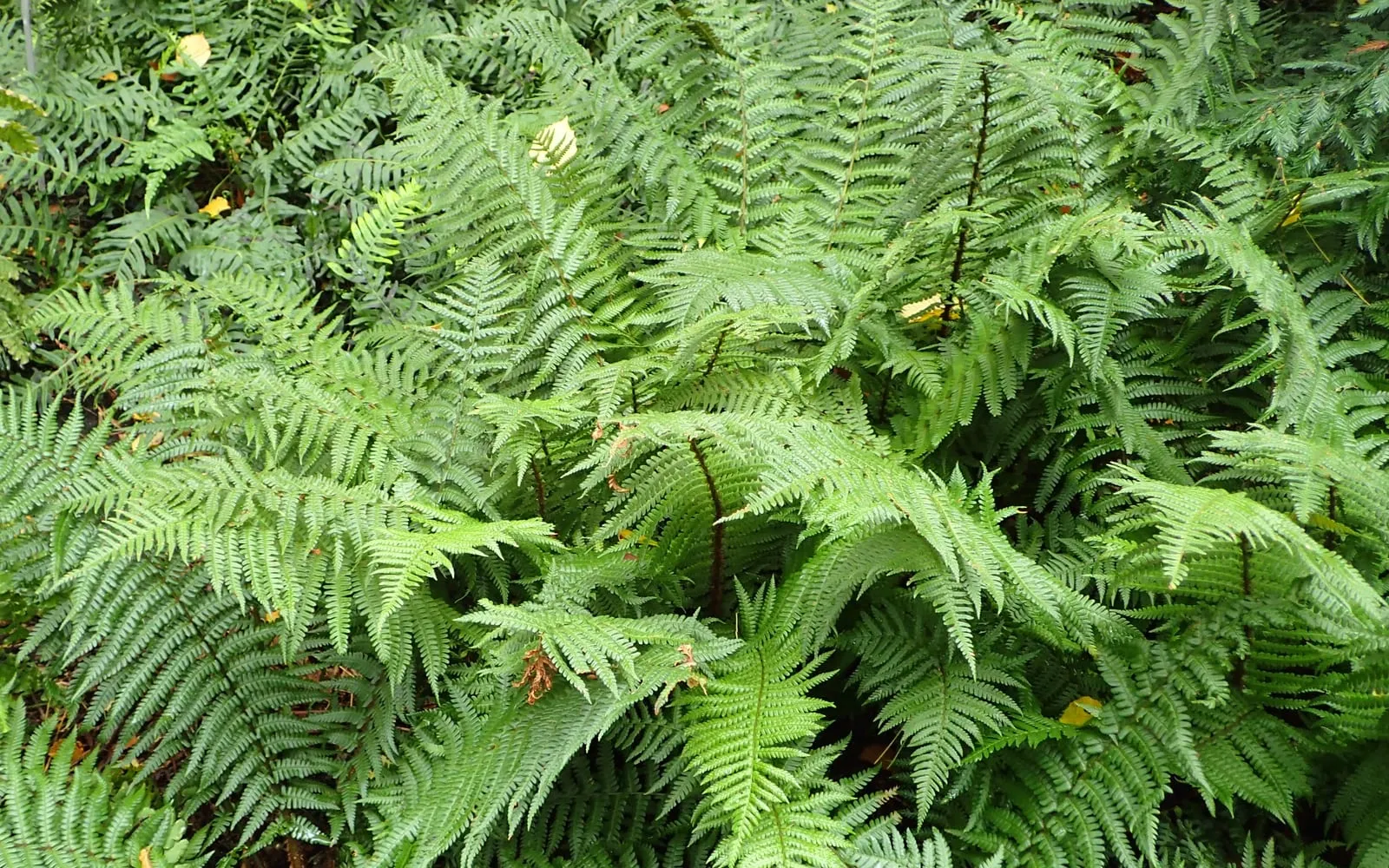
Broad, twice-divided, dark green fronds arch outward from a stout, upright crown in a dense, symmetrical shuttlecock, typically reaching 60 cm to just over a metre depending on growing conditions. The stalks and midribs are thickly covered in pale golden-brown papery scales, particularly dense on newly unfurling croziers, giving spring growth a distinctive warm colour before the mature green develops.
Unlike many deciduous ferns, a good number of the previous year’s fronds persist through a mild winter, especially in sheltered gardens, giving the plant a semi-evergreen presence that keeps a shaded border from looking bare in the colder months.
Where it is from
Woodland and hedge banks across Europe and the Macaronesian islands, typically in shaded, humus-rich ground beneath trees or along hedgerows, where fallen leaves build up a loose, moisture-retentive litter layer.
That woodland origin explains both its shade tolerance and its comparatively good performance in dry shade once established, since a mature woodland floor, while rarely wet, seldom dries out completely thanks to the shelter and leaf litter above and around it.
How it grows
A perennial forming an increasingly substantial crown over years, from which fronds arise in an annual flush each spring. Growth is moderate and steady rather than fast, and old, well-established crowns can persist for decades with minimal intervention beyond an annual tidy of the previous year’s tired fronds.
It does not spread by runners, staying instead as a single expanding crown, which makes it a predictable, well-behaved choice for a shaded border where a spreading fern might become a nuisance.
Through the seasons
Spring is the most visually striking season, with new croziers unfurling densely covered in golden-brown scales before opening into full dark green fronds.
Summer fronds are at their fullest, providing dense, structural ground cover in shade.
Autumn older fronds gradually decline, though many persist into winter rather than collapsing all at once.
Winter the crown remains largely intact in a sheltered spot, with some fronds surviving through to be cut back only once new growth begins the following spring.
Care difficulty
Moderate while establishing, easy once settled. A newly planted specimen needs reasonably consistent moisture through its first couple of seasons to build a strong root system, after which it copes with much drier shaded conditions than most other hardy ferns, making it one of the better choices for the difficult dry shade beneath established trees.
Watering
Regular watering during the first one to two years after planting helps the root system establish fully. Once mature, it tolerates real dryness between waterings far better than most ferns, though it still performs best with occasional deep watering during extended dry spells rather than being left entirely to fend for itself.
Warning signs, diseases and pests
This is an unusually trouble-free fern. Slugs occasionally graze the soft, newly emerging croziers in spring, leaving small notches, but established fronds are tough enough to be left alone by most garden pests.
Fronds that brown and collapse in a normally sheltered spot can indicate an unusually harsh, exposed winter rather than disease, and new growth typically returns reliably from the crown the following spring regardless.
A crown that produces noticeably fewer or smaller fronds than in previous years, without other symptoms, is often responding to a dry spell from the previous summer, and usually recovers with a season of more consistent watering.
Fronds are also relatively long-lived on this species, and the crown will generally carry a mix of ages at once. A few older, tattier fronds among otherwise healthy new growth are a sign of normal turnover rather than a sign that anything has gone wrong.
Growing environment
Partial to full shade suits it best, and it is one of relatively few ferns that copes reasonably well with the dry shade found beneath large trees or close to a wall, conditions that defeat many other shade-loving plants entirely. Humus-rich soil improves performance, but this species is more forgiving of ordinary garden soil than most ferns.
Feeding
An annual mulch of leaf mould or garden compost around the crown each spring is generally all this fern needs, both feeding it lightly and helping retain the soil moisture it benefits from. It does not require regular liquid feeding through the season.
Troubleshooting
Fronds are small or sparse compared with previous years. Usually a lingering effect of dry conditions the previous summer. Increase watering during dry spells and mulch generously; recovery typically takes a full season.
Croziers are notched or partly eaten in spring. Check for slugs on the soft new growth, and protect vulnerable young croziers if damage is severe.
The plant looks bare over winter. Some frond loss in cold or exposed conditions is normal for this semi-evergreen species. Cut back any completely collapsed fronds in late winter, just before new growth begins.
Growth has stalled since planting. Check that the plant has not dried out, particularly if planted within the last one to two years, since this is the establishment period when consistent moisture matters most.
Old fronds look tatty next to fresh new growth. This is normal turnover on a semi-evergreen fern that has more than one year’s fronds at once rather than a sign of ill health. Cut away only the fronds that have collapsed completely, and leave anything still green in place, since it is still contributing to the plant’s overall growth.