
Outdoor plant
Stag's-Horn Clubmoss
Lycopodium clavatum
Also known as Common clubmoss, Running clubmoss, Wolf's-foot clubmoss
How to grow stag's-horn clubmoss, Lycopodium clavatum. An ancient lycophyte, not a fern or moss, whose spores were once used as flash powder and pill coating.
At a glance
- Difficulty
- Difficult
- Water
- Keep lightly and constantly damp. Never let it dry out or flood
- Light
- Full sun to light shade, as on open heath or moorland
- Temperature
- Fully hardy against cold. Fails from soil and fungal mismatch, not frost
- Hardiness
- USDA 3-8, RHS H6, hardy to -20 C
- Type
- Hardy evergreen lycophyte, spreading by long creeping stems
- Height
- 5-20 cm tall, with stems creeping over a metre
- Native to
- Circumboreal, across the temperate and subarctic Northern Hemisphere, and high tropical mountains further south
Comfortably hardy against cold across almost its whole range. Cold is never what kills a cultivated plant of this species. It needs acidic, low-nutrient, undisturbed soil and a fungal partner already present in that ground, and no amount of shelter or feeding substitutes for either, which is why it is rare in gardens regardless of climate.
Hardiness zones describe winter cold alone. Summer heat, humidity, rainfall and the length of the growing season decide as much, so treat the range as the outer limit rather than as a recommendation.
Harmful if eaten
- Do not eat
- The whole plant, and especially the aerial stems
- Harm from
- Eating it
- Affects
- People
The plant contains a group of alkaloids, including lycopodine, reported in pharmacological literature to affect blood pressure and gut motility if eaten in quantity, so it is not something to sample. It is not grown as a food and has no culinary use. It is not listed by the RHS among potentially harmful garden plants, and it is not usually eaten by accident given how rarely it survives in cultivation at all. Historically the spores, sold as lycopodium powder, were used to coat pills and surgical gloves and as a flash powder in early photography, applications involving handling the dry spore rather than eating the plant. Long-term inhalation of the loose powder has been associated with respiratory irritation in people who worked with it regularly.
Sources: North Carolina State Extension, Lycopodium clavatum, RHS potentially harmful garden plants
About
For most of the nineteenth and early twentieth centuries, the fine yellow spores of this plant were an industrial material. Photographers burned them as flash powder for a bright, brief flash before electric flashbulbs existed, pharmacists dusted them onto pills and suppositories to stop them sticking together in the jar, and glove makers used the same powder to keep rubber gloves from fusing to themselves. All of that came from a single plant that most people have never noticed, a low, wiry, creeping evergreen that grows unobtrusively across open heaths and moorland.
It is neither a fern nor a moss, whatever the common name suggests. Stag’s- horn clubmoss belongs to the lycophytes, a lineage that split from every other living land plant more than 400 million years ago and once included tree-sized relatives that formed a large part of the coal-forming forests of the Carboniferous period.
It is also, honestly, one of the harder plants in this collection to grow from a nursery pot. Its roots depend on a specific soil fungus that is rarely present in ordinary garden compost, and established wild colonies resent disturbance so completely that transplanting a piece almost always fails. Most gardeners who succeed with it do so by leaving an existing colony alone rather than by planting a new one.
Appearance and character
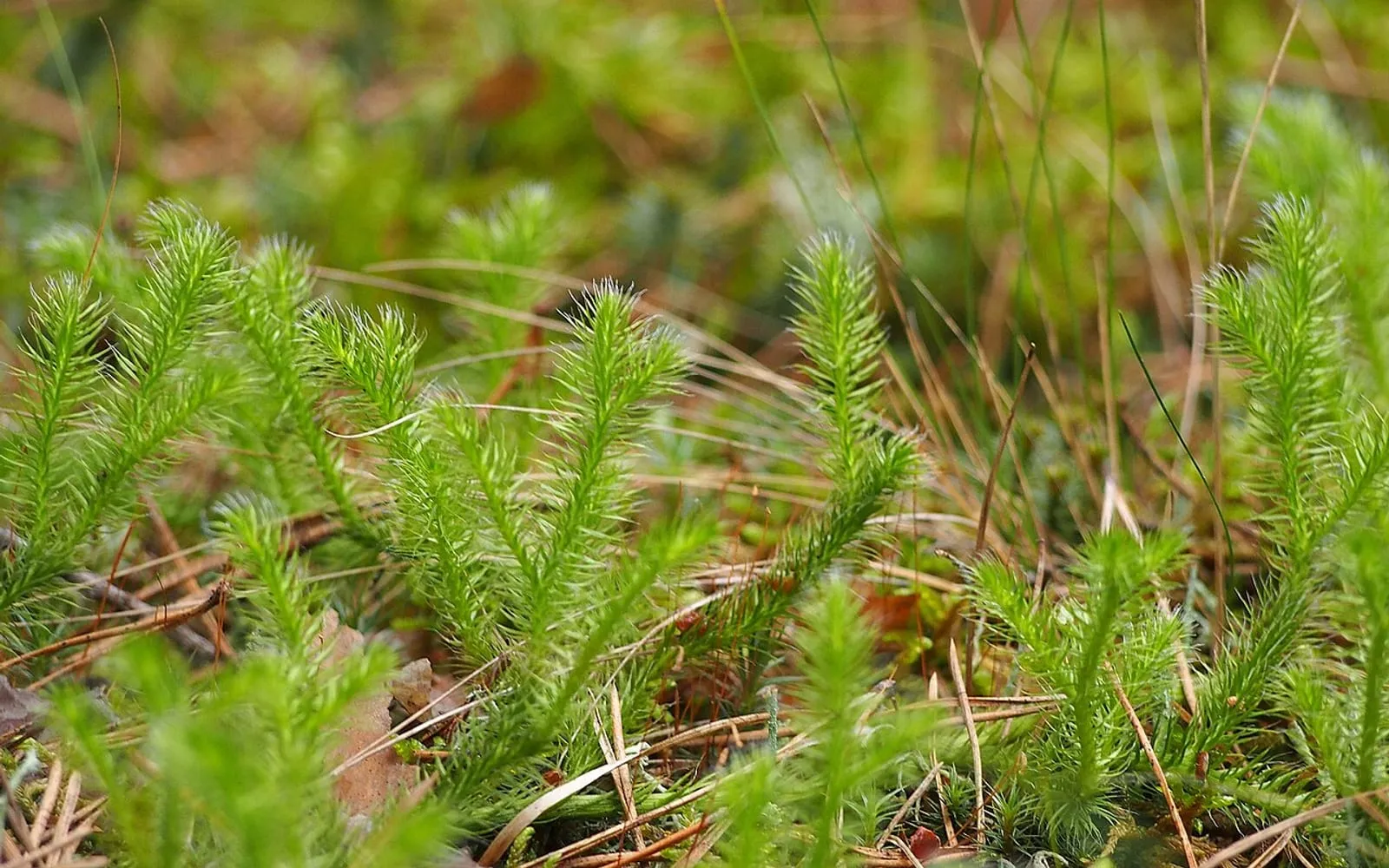
A creeping evergreen lycophyte with long, wiry, horizontal stems that run along or just under the soil surface, sometimes for more than a metre from the original germination point.
Short upright branches rise from the creeping stem at intervals, densely covered in small, narrow, needle-like leaves arranged spirally, giving the whole plant a soft, bristly, almost furry texture.
Reproductive structures called strobili, resembling narrow yellow-green cones, rise on thin stalks above the foliage in summer, usually two or three together, and release the fine spores that made the plant commercially useful for so long.
Growth is exceptionally slow by any garden standard. A germinating spore first produces an underground structure called a gametophyte that lives for several years without producing any visible plant at all, feeding through a partnership with soil fungi before it eventually gives rise to the first tiny sporophyte shoot. A colony visible above ground may represent a decade or more of unseen development below it.
Older stems eventually die at the centre while the growing tips continue outward, so an established colony often forms a widening ring rather than a solid patch.
Where it is from
A circumboreal distribution across the cooler parts of the Northern Hemisphere, including Britain, continental Europe, northern Asia and North America, with scattered populations at high altitude on tropical mountains further south.
It grows on heathland, moorland, open woodland and mountain grassland, almost always on acidic, nutrient-poor soil that has not been ploughed, fertilised or otherwise disturbed for a very long time.
That preference for undisturbed ground is central to understanding why it resists cultivation. The soil fungus its roots depend on takes years to establish a working relationship with the plant, and both partners are easily damaged by digging, by soil improvement, or by the addition of fertiliser that would help almost any other garden plant.
The species has declined across parts of its range through habitat loss, land improvement and, historically, commercial spore collection for industrial use, though it remains locally common on suitable unimproved heath and moorland.
How it grows
This is not, in practice, a plant most gardeners plant. The advice that follows applies to encouraging an existing colony on suitable ground rather than establishing a new one from a nursery pot, since transplanted material fails far more often than it succeeds.
Where a colony already exists on your land, leave the ground it occupies undisturbed. Do not dig around it, add fertiliser, lime the soil, or improve drainage, all of which disrupt the acidic, low-nutrient, fungally active conditions the plant depends on.
Avoid mowing or grazing the area heavily during the summer months when the strobili are producing spores, since repeated cutting prevents the plant completing its reproductive cycle.
If attempting to establish it from spore, which is a slow and specialist undertaking, sow onto sterile, acidic, low-nutrient compost and expect years rather than months before any visible sporophyte appears, if one appears at all.
Resist the temptation to feed it, water it heavily, or otherwise treat it like an ordinary garden perennial. Every intervention that helps a typical plant tends to work against this one.
Through the seasons
Spring brings little visible change. Growth is so slow that seasonal differences are subtle compared with almost any other plant in a garden.
Summer is when the strobili appear and mature, releasing spores toward the end of the season. This is the period to avoid cutting or disturbing the ground where a colony grows.
Autumn sees the foliage remain much as it was through summer, since this is an evergreen species with no dramatic seasonal dieback.
Winter the plant sits fully hardy and largely unaffected by cold, holding its foliage through frost and snow without protection.
Care difficulty
Difficult, despite needing little once established.
The difficulty is almost entirely in establishment rather than ongoing care. A wild colony left alone on suitable acidic, undisturbed ground persists for decades with no attention. A piece dug up and moved to a garden border, by contrast, rarely survives the loss of its soil fungus and the disturbance to its roots.
Feeding, watering heavily, or planting it into rich garden soil all work against it rather than for it, which runs counter to instinct for most gardeners used to helping a struggling plant along.
Patience and restraint, rather than active intervention, are what this species rewards.
Watering
Keep the ground lightly and consistently damp rather than either dry or waterlogged, matching the conditions of damp heathland rather than a conventional border.
Avoid heavy watering, which can waterlog the acidic, free-draining soil this species depends on and disturb the delicate fungal network in the root zone.
Rainfall is usually sufficient on suitable heath or moorland ground in a temperate climate, and supplementary watering is rarely needed or advised.
Never let the ground dry out completely for an extended period, since the shallow surface-running stems have little capacity to draw on deeper moisture reserves.
Warning signs, diseases and pests
A colony that fails to spread, or slowly shrinks, over several years most often reflects a change in the soil, whether from added fertiliser, disturbance, lime application, or increased competition from more vigorous neighbouring plants, rather than a pest or disease.
Transplanted material that browns and dies within weeks or months of moving has almost certainly lost the soil fungus its roots depend on. There is no reliable fix once this has happened, which is why leaving existing colonies undisturbed matters more than anything else with this species.
Encroaching bracken, gorse or coarse grass can outcompete and shade out a colony over time on ground that is becoming more fertile or less actively grazed.
No significant insect pest or disease is documented for this species in cultivation, which fits a plant so rarely grown in a conventional garden setting.
Growing environment
Full sun to light shade, matching the open heath and moorland conditions this species grows in naturally.
Acidic, nutrient-poor, sandy or peaty soil that stays lightly damp without becoming waterlogged, and that has not been recently limed, fertilised or deeply disturbed.
Fully hardy against cold across virtually its entire range, with winter protection never required.
It suits a naturalistic heathland or moorland garden feature far better than a conventional border, and works best where an existing colony is protected and left alone rather than planted from scratch.
Avoid any position where garden improvement, whether feeding, liming or cultivation, might reach the root zone even indirectly through runoff or soil mixing.
Feeding
None. This is a plant of poor, low-nutrient soil, and feeding it disrupts the balance it depends on rather than helping it grow.
Avoid any fertiliser, including slow-release or organic mulches, anywhere near an established colony.
If soil in the surrounding area is fertilised for other planting, keep a generous buffer zone around any clubmoss colony to limit nutrient runoff reaching its roots.
There is no growing season during which feeding this species is appropriate.
Troubleshooting
I have this growing wild on my land. What should I do? Very little. Leave the ground undisturbed, avoid fertiliser or liming nearby, and avoid heavy cutting through summer while the strobili are producing spores.
Can I dig up a piece and move it to my garden? It is best not to try. Transplanted material very rarely survives, since it depends on a soil fungus and undisturbed root conditions that are almost impossible to recreate by moving a piece of stem.
Is it a fern or a moss? Neither. It is a lycophyte, from a lineage older than both the ferns and the true mosses, with its own distinct reproductive structures and life cycle.
What were the spores used for historically? As a flash powder in early photography, and to coat pills, suppositories and rubber gloves to stop them sticking together, uses that lasted well into the twentieth century before synthetic alternatives replaced them.
Is it dangerous to touch or handle? The plant contains alkaloids that make eating it a bad idea in quantity, but ordinary handling carries no established hazard, and it is not listed as a harmful garden plant.
Why does it take so long to establish from spore? The gametophyte stage lives underground for years, feeding through a fungal partnership, before it produces the first visible above-ground growth. A visible plant may represent a decade of prior unseen development.
Will it survive a hard winter? Easily. Cold is never the factor that limits this species in cultivation. The soil and its fungal partner are what decide whether it survives at all.