
Houseplant
Living Stones
Lithops optica
Also known as Lithops optica, Optica Rubra
How to grow Lithops optica, a windowed living stone from Namibia with translucent lobes and white flowers, and how to time its watering.
At a glance
- Difficulty
- Difficult
- Water
- Only at set points in its yearly cycle; none during leaf-renewal or summer dormancy
- Light
- Full sun to very bright light
- Temperature
- Warm; keep above about 7 deg C
- Humidity
- Low
- Hardiness
- USDA 10-11, RHS H1c, hardy to 6 C
- Type
- Evergreen dwarf succulent, one leaf pair a year
- Height
- Each body 1.5 to 3 cm across
- Native to
- Namibia
A dwarf living stone from the coastal Namib desert of Namibia, buried among pale quartz gravel and drawing on sea fog in a land of almost no rain. It needs very strong light and a sharply drained, mineral mix, and keeps a strict cycle of summer rest, autumn flowering and winter-to-spring leaf-renewal. Tenderer than most living stones, it is safest above about 7 deg C and rots at once if watered against its cycle.
Hardiness zones describe winter cold alone. Summer heat, humidity, rainfall and the length of the growing season decide as much, so treat the range as the outer limit rather than as a recommendation.
Not known to be toxic
Lithops, one of the mesemb or living-stone group, is not listed as toxic by the ASPCA or the RHS, and no harmful compound is recorded in the genus. Its tiny stone-like bodies are unlikely to interest a pet, and a bitten one would be unlikely to cause more than a brief, mild stomach upset.
Sources: ASPCA toxic and non-toxic plants, RHS potentially harmful garden plants
About
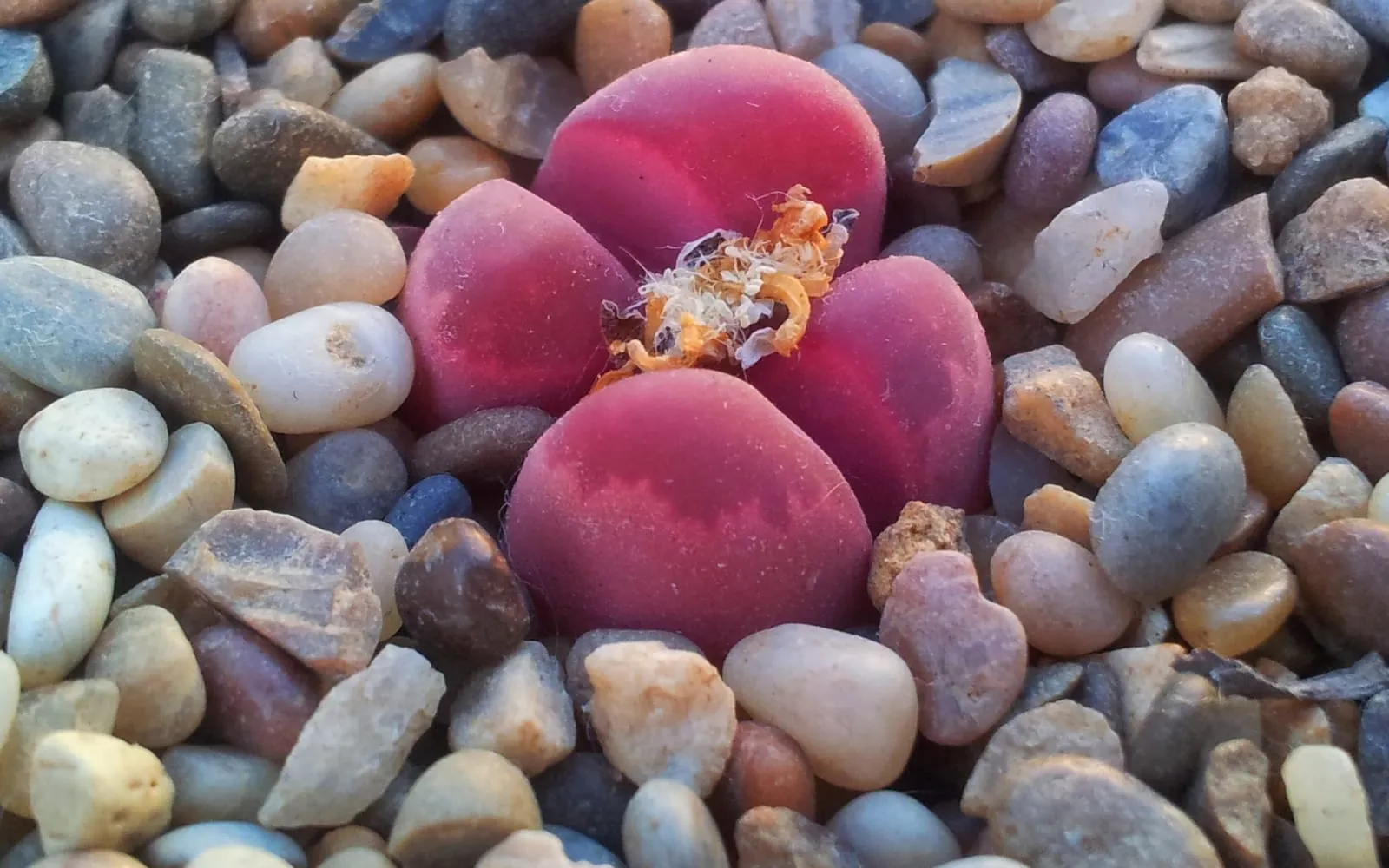
Lithops optica has two rounded, translucent lobes just above the gravel and keeps the rest of the body buried. Split by a deep cleft, the paired leaves are grey-green with a bluish, glassy top. The Rubra form turns the whole body a rich purplish-red, so a pot of it can look like a scatter of coloured pebbles. Its clear-windowed tops let light reach the buried tissue while most of the plant stays below the surface.
It comes from the fog-belt of the coastal Namib desert, one of the driest places on earth, where what little moisture it gets often comes as sea mist instead of rain. That makes it the most demanding of the common living stones to keep. It is tenderer than the brown inland kinds, and even less forgiving of badly timed watering. Its white autumn flowers open from the cleft.
Like all Lithops it follows a strict yearly cycle of summer rest, autumn growth and flowering, and a winter-to-spring renewal in which a fresh leaf pair forms inside the old and dries it to a husk. Watering it while that renewal is under way is fatal. Grow it in a mineral mix, in very strong light, and water only at the right point in the cycle.
Appearance and character
Each body is a pair of fused leaves with rounded, gently domed lobes, one and a half to three centimetres across, divided by a deep central cleft, and topped with a smooth, translucent, glassy window.
The ordinary form is grey-green with a bluish bloom, while the Rubra form is flushed a deep purplish-red over the whole body.
It grows as a single body or slowly clusters into a small clump of a few heads, staying low and buried-looking, with much of the plant below the gravel.
Its flower is white, opening from the cleft in autumn on a mature plant. It is large for the small body and contrasts clearly with the coloured lobes.
Where it is from
Lithops optica grows in the coastal Namib desert of Namibia, buried among pale quartz gravel in a fog-belt where rain is almost unknown and much of the plant’s water comes from sea mist. It endures extreme drought, strong light and cool coastal nights.
Give it very strong light, an almost purely mineral and sharply drained mix, and water only at the right points in its cycle, with a complete rest through summer and through leaf-renewal. It is tenderer to cold and even less tolerant of wet than the inland species.
How it grows
It follows the strict living-stone cycle: a summer rest, autumn growth and white flowers, then a winter-to-spring renewal as a new leaf pair swells inside the old and uses it up. The stage of that cycle determines whether you can water it.
Grow it in an extremely free-draining, mineral, gritty mix, top-dressed with pale gravel, in a deep-ish pot for its taproot. Water sparingly in autumn while it grows and flowers, and only lightly in spring once the old leaves have fully dried; give none in summer or during renewal.
Give it the strongest light you can, warmth above about 7 deg C, and dry, airy conditions. As a fog-desert plant it is especially quick to rot if watered while cool or dormant, so keep it dry when unsure.
Propagate from seed, or by dividing a clustered plant once it has several heads.
Through the seasons
Autumn is the growing and flowering season, when the white flower opens from the cleft. Water sparingly when the mix is dry and the body is plump and active.
Winter is when the new leaf pair starts to form inside the old. Keep it bright and dry, watering little or not at all.
Spring is when the old lobes shrivel to a husk as the new pair emerges. Withhold water until the old body has dried away, then give only a little.
Summer is complete dormancy in the heat. Give no water at all until autumn.
Care difficulty
Difficult, and the most exacting of the common living stones. Coming from a fog desert with almost no rain, it is especially prone to rot from ill-timed water and tenderer to cold than the inland kinds. It must be watered only at the right stages, resting dry through summer and leaf-renewal. Learn the timing, give it very strong light and a mineral mix, and avoid watering when it is inactive.
Watering
Water only when the plant is in active autumn growth, and always let the mineral mix dry out fully first. Give a little in spring only once the old leaf pair has completely dried to a husk.
Give no water through summer dormancy, nor while the new leaves are using up the old ones over winter and spring, since watering then bursts or rots the plant. As a fog-desert species it is quicker to rot than most, so when unsure, leave it dry.
Warning signs, diseases and pests
A body that bursts, splits or goes soft and translucent has been overwatered, usually in dormancy or during renewal. Withhold water and follow the cycle strictly.
A body that greens up and grows tall and soft, losing its markings or its red colour, has too little light. Move it into full sun; the next leaf pair grows firm and coloured again.
Root mealybugs hide among the roots and are easily missed. Check the roots when repotting and treat with dilute alcohol or a suitable insecticide.
Growing environment
Very strong light, ideally full sun, keeps the body firm, low and well coloured, and is essential for the red of the Rubra form. In poor light it grows tall, soft and green and loses its markings. Give it the strongest light you can.
Warmth above about 7 deg C and dry, airy conditions suit it, and being tender it needs a little more warmth than the inland living stones. It needs low humidity and extremely sharp, mineral drainage.
Grow it in an almost purely mineral, gritty mix in a deep-ish pot, top-dressed with pale gravel, in the brightest spot you have. Time the watering to its cycle above all.
Feeding
Feed little or not at all. At most, give a single very dilute, low-nitrogen feed in the autumn growing spell. Rich feeding leaves the body soft and prone to bursting.
Give nothing in dormancy or during renewal. A mineral mix and correct timing matter far more than any feed.
Troubleshooting
The body has burst or gone soft. Overwatering, usually in dormancy or during leaf-renewal. Withhold water and follow the cycle, watering only in active autumn growth.
It has greened up, grown tall and lost its colour. Too little light. Move it into full sun; the next leaf pair grows firm and well coloured, and the Rubra red returns.
When do I water it? Sparingly in autumn while it grows and flowers, and a little in spring only after the old leaves have fully dried. Give none through summer dormancy or leaf-renewal.
How is it different from the brown living stones? It comes from a coastal fog desert, is tenderer and even more rot-prone, and has translucent, rounded lobes with white flowers, while Lithops aucampiae is a browner, inland, yellow-flowered kind. Both keep the same strict cycle.
Is it safe around pets? Yes. Lithops is not listed as toxic, and the bodies are tiny and stone-like, so they are unlikely to interest most cats or dogs.
Living Stones problem guides
Not sure what is wrong? See the common houseplant pests guide.