
Houseplant
Living Stone
Lithops karasmontana
Also known as Karas Mountains living stone
How to grow living stones as a houseplant. Their camouflage as pebbles, the annual leaf-splitting cycle, and why watering at the wrong time can kill them.
At a glance
- Difficulty
- Difficult
- Water
- Very infrequent, following a strict seasonal pattern
- Light
- Very bright light, several hours of direct sun
- Temperature
- 10-30 deg C, avoid below 5 deg C
- Hardiness
- USDA 9-11, RHS H1c, hardy to 5 C
- Type
- Evergreen perennial succulent
- Height
- 2-3 cm tall
- Native to
- Namibia, South Africa
Tender to frost and grown as a houseplant across almost the entire temperate world. It follows a strict annual cycle tied to its native winter-rainfall region, with a real summer dormancy and a watering pattern that runs opposite to many other succulents; getting the timing wrong is the leading cause of failure with this species, far more than temperature alone.
Hardiness zones describe winter cold alone. Summer heat, humidity, rainfall and the length of the growing season decide as much, so treat the range as the outer limit rather than as a recommendation.
Not known to be toxic
Living stone has no toxicity listing from the RHS or the ASPCA and is considered safe around pets and children. There is no documented history of poisoning associated with this species.
Source: RHS
About
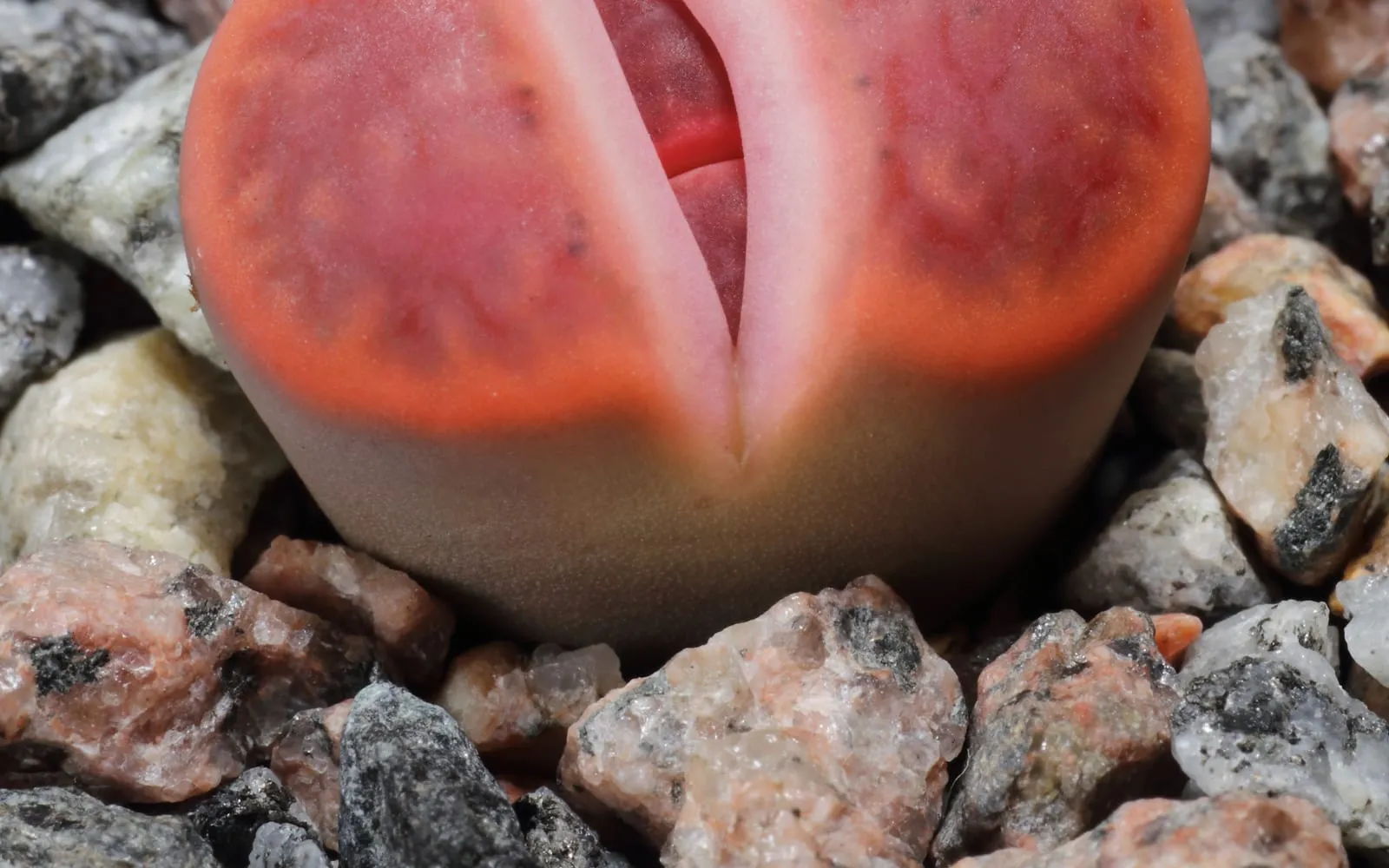
Living stones are among the most extraordinary camouflaged plants grown as houseplants, each one consisting of just a single pair of thick, fused leaves that closely mimic the colour and texture of the stones and gravel they grow among in the wild, an adaptation thought to protect them from grazing animals in their exposed, largely shelterless native habitat. A narrow fissure between the two leaves is the only obvious clue that the “stone” in front of you is a living plant rather than an actual pebble.
Growing them well depends on following a strict annual cycle, tied closely to the plant’s native winter-rainfall climate, that runs counter to how most other succulents are watered; a grower who treats a living stone like an ordinary succulent, watering whenever the compost feels dry, is one of the most common ways this species is accidentally killed.
Appearance and character
A single pair of thick, fused leaves forms a compact, rounded body that sits mostly at or just below the soil surface, patterned and coloured to closely resemble surrounding stone or gravel, with colours and markings varying much between individual plants and populations. A narrow slit or fissure runs across the top between the two leaves, through which a new leaf pair, and eventually a solitary daisy-like flower, emerges.
Each year, a new pair of leaves grows from within the fissure, drawing on the water and nutrients stored in the old pair, which gradually shrivels and is eventually shed once the new leaves have fully taken over, a process that can look alarming to a new grower unfamiliar with the cycle but is entirely normal.
Where it is from
Extremely arid, stony ground in Namibia and South Africa, in a region where most rain falls in a defined season and a long dry period follows, with the plant’s body mimicking the surrounding rock closely enough to avoid most grazing pressure.
That native winter-rainfall pattern is the source of the plant’s unusual cultivation cycle: active growth and flowering happen mainly in autumn, followed by a period of using stored reserves through winter into spring, and a real dormancy through summer when the plant should receive little to no water at all.
How it grows
Each plant produces one new pair of leaves per year from within the central fissure, growing at the expense of the previous pair, which shrivels and dries as its stored water and nutrients are drawn down to support the new growth. This leaf-replacement cycle, rather than continuous growth, is the defining feature of how this species develops over time.
Watering during the wrong phase of this cycle, particularly while the old leaf pair is still present and drawing down its reserves, is one of the most common causes of a plant splitting unnaturally, rotting, or producing two full pairs of leaves at once rather than one pair fully replacing the other.
Through the seasons
Spring the new leaf pair continues developing at the expense of the old, shrivelling pair; watering should remain minimal during this transition.
Summer the plant enters real dormancy. Water not at all, or only in the most minimal, occasional amount if the plant shows signs of excessive shrivelling beyond the normal old-leaf loss.
Autumn growth resumes and flowering typically occurs, with a single daisy-like flower emerging from the fissure on a mature plant. Begin watering again as active growth restarts.
Winter continue watering sparingly as the new leaf pair develops fully and the old pair finishes shrivelling and is shed.
Care difficulty
Difficult, specifically because of how easy it is to misjudge the watering cycle. The plant itself is otherwise undemanding, but that one factor, watering at the correct point in an annual cycle that runs opposite to many other succulents, requires real attention and patience to get right.
Watering
Follow the plant’s own cycle rather than a fixed schedule: minimal to no water during summer dormancy, a resumption of watering in autumn as new growth and flowering begin, and continued sparing watering through winter and spring as the new leaf pair develops and the old pair shrivels away. Watering while the old leaf pair is still present and plump is one of the more common mistakes and can cause the plant to split unnaturally or rot.
Warning signs, diseases and pests
This species has few pests specific to it, though mealybug can occasionally settle in the central fissure. The greater risk by far is watering-related: rot from moisture given at the wrong point in the cycle, or excessive shrivelling from too little water during the active growth phase, both of which are managed by paying close attention to where the plant is in its annual cycle rather than by any pest treatment.
A plant that has produced two full pairs of leaves without the old pair fully shrivelling and being replaced has usually been watered too much or too early, and correcting the watering pattern going forward, rather than any direct intervention, is the appropriate response.
Growing environment
Very bright light with several hours of direct sun is essential; this is one of the more light-demanding common succulents, and insufficient light produces stretched, unnaturally elongated growth that loses the plant’s characteristic low, stone-like profile. Extremely free-draining, mineral compost is equally important, mirroring the harsh, stony ground this species grows in naturally.
Feeding
None needed. This species is adapted to extremely poor, mineral soil, and fertiliser is unnecessary and can encourage unnaturally soft, overgrown growth that departs from the compact, stone-like form the plant is valued for.
Troubleshooting
The plant has produced two full leaf pairs at once instead of one replacing the other. This usually indicates watering too much or too early in the cycle. Hold back on water and let the situation settle, adjusting the timing of future watering to follow the plant’s dormancy more closely.
The old leaf pair looks shrivelled and unattractive. This is completely normal as the new pair develops within the fissure at its expense. Resist the urge to water in response to this appearance, since watering at this stage is a common mistake.
Growth looks stretched and elongated rather than low and compact. Almost always insufficient light. Move the plant to the brightest spot available, ideally with direct sun for several hours a day.
You are unsure which point in the cycle your plant has reached. Observe rather than intervene: a plant with a plump, healthy- looking current leaf pair and no active new growth visible in the fissure is likely in or approaching its summer dormancy and needs little to no water regardless of how dry the compost feels.
Living Stone problem guides
Not sure what is wrong? See the common houseplant pests guide.