
Houseplant
Aucamp's Living Stone
Lithops aucampiae
Also known as Lithops aucampiae, Living Stone
How to grow Lithops aucampiae, a brown-red living stone with stone-mimicking paired leaves, yellow flowers and once-a-year leaf renewal.
At a glance
- Difficulty
- Moderate
- Water
- Only at set points in its yearly cycle; none during leaf-renewal or summer dormancy
- Light
- Full sun to very bright light
- Temperature
- Warm; keep above about 5 deg C
- Humidity
- Low
- Hardiness
- USDA 9-11, RHS H2, hardy to 4 C
- Type
- Evergreen dwarf succulent, one leaf pair a year
- Height
- Each body 2 to 4 cm across
- Native to
- South Africa
A stone-mimicking dwarf succulent from the hot, dry interior of South Africa, wedged among quartz and ironstone pebbles under fierce sun. It needs strong light and an almost purely mineral, sharply drained mix, and follows a strict cycle of summer rest, autumn flowering and spring leaf-renewal. It has little frost tolerance, is safest above about 5 deg C, and rots at once if watered at the wrong time.
Hardiness zones describe winter cold alone. Summer heat, humidity, rainfall and the length of the growing season decide as much, so treat the range as the outer limit rather than as a recommendation.
Not known to be toxic
Lithops, one of the mesemb or living-stone group, is not listed as toxic by the ASPCA or the RHS, and no harmful compound is recorded in the genus. The bodies are small and stone-like, so a pet is unlikely to notice them. A bitten plant would be unlikely to cause more than a brief, mild stomach upset.
Sources: ASPCA toxic and non-toxic plants, RHS potentially harmful garden plants
About
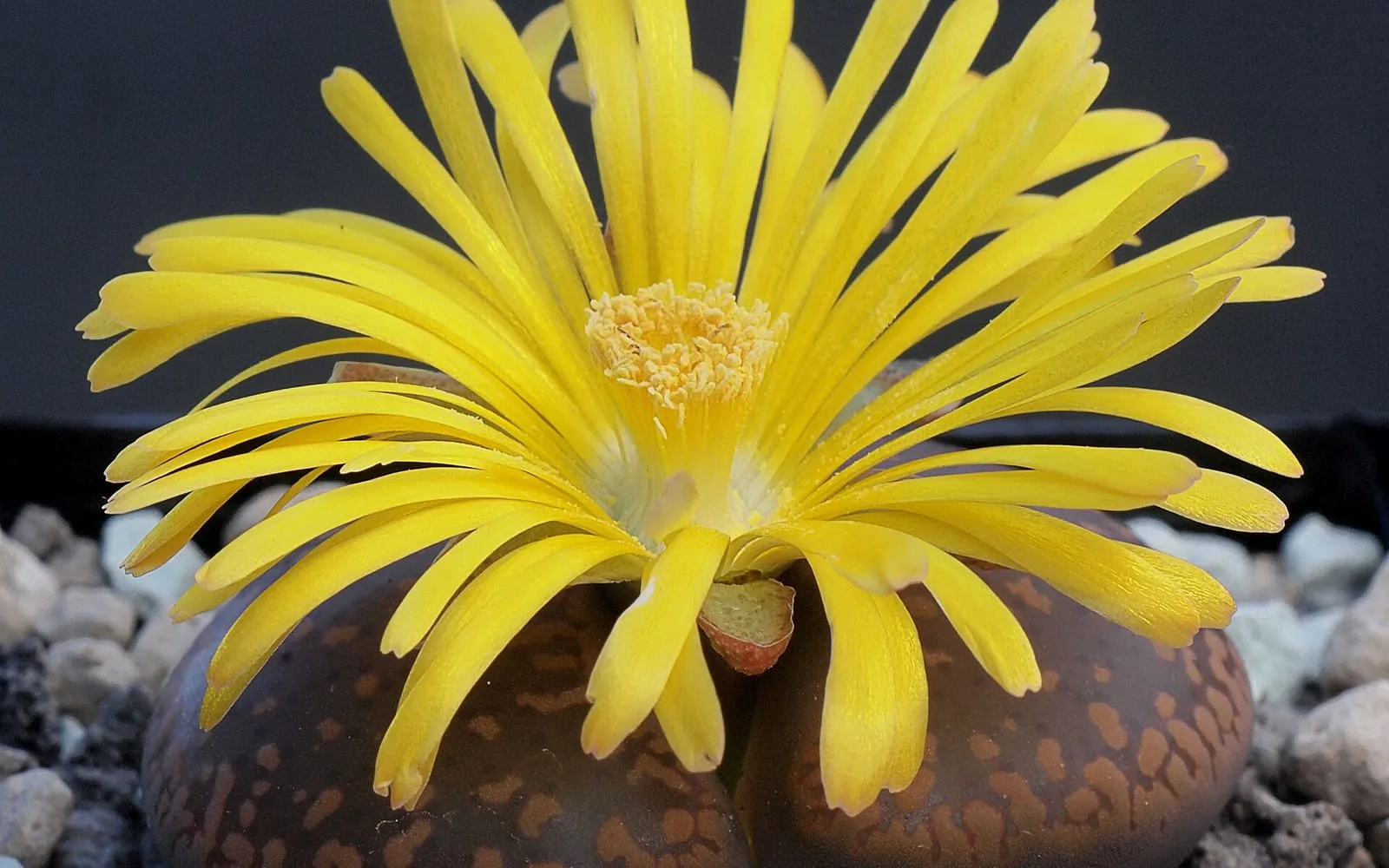
Lithops aucampiae is a small succulent that looks like a pebble. Each body is a single pair of fused leaves, swollen into a rounded stone-shape a few centimetres across. Its flat top is mottled brown to reddish-brown, patterned to match the ironstone gravel it grows among, and split across the middle by a fissure. In the wild, that stone-like shape helps protect it from being eaten.
It is one of the easier living stones to grow, brownish and forgiving, but like all Lithops it follows a strict calendar. Watering it at the wrong point in that calendar is the main way to kill it. Through summer it rests. In autumn it grows and, on a mature plant, opens a large yellow daisy flower from the fissure. Over winter and into spring a new leaf pair forms inside the old one, using the moisture from the old body until it becomes a papery husk. It must not be watered while that renewal is happening, or the old leaves will not shrivel and the plant will rot or burst.
Grown in a gritty, almost soil-free mix, in the strongest light you can give it, and watered only at the right points in its cycle, it can live for years. The main skill is timing the watering. Its cousin the button plant keeps a similar mesemb rhythm, but this plant’s leaf-renewal cycle is the key thing to learn.
Appearance and character
Each body is a pair of fused, swollen leaves forming a rounded, truncated stone, two to four centimetres across, with a flat or slightly domed top split by a central fissure.
The top is mottled and patterned in brown to reddish-brown, a translucent window that lets light down into the buried body, and coloured to blend with the stony ground.
It grows as a single body or, with age, a small cluster of a few heads, staying low and stone-like instead of forming any stem or spread.
Its flower is a large yellow daisy, opening from the fissure in autumn on a mature plant. It is large for the small body, often scented, and followed by seed.
Where it is from
Lithops aucampiae grows in the hot, dry interior of South Africa, among quartz and ironstone pebbles on exposed, sun-baked flats. It mimics the surrounding stones and survives fierce heat and long drought. It is a plant of extreme aridity and strong light.
Those conditions explain its care. Give it the strongest light you can and an almost purely mineral, sharply drained mix. Water only at set points in the year, and keep it completely dry through the summer heat and the spring leaf-renewal. As one of the browner, tougher living stones it tolerates a little more than the fog-desert kinds, but rich soil, shade or badly timed watering can still kill it.
How it grows
Its year runs in a strict cycle. It rests through the heat of summer, grows and flowers in autumn, then over winter and spring forms a new leaf pair inside the old one, which shrivels to a husk. Learn this cycle before watering, because safe watering depends entirely on the stage the plant is in.
Grow it in an extremely free-draining, mineral, gritty mix, top-dressed with stony gravel, in a deep-ish pot to suit its long taproot. Water in autumn when it is growing and flowering, and lightly in spring only after the old leaves have fully dried away; give none in summer or during leaf-renewal.
Give it the strongest light you can, warmth above about 5 deg C, and dry, airy conditions. In too little light the body grows tall and soft and loses its markings.
Propagate from seed, or by dividing a clustered plant, though seed is the usual route.
Through the seasons
Autumn is the main growing and flowering season. Water when the mix is dry and the plant is plump and active. Mature plants can open a yellow flower from the fissure.
Winter is when the new leaf pair begins to form inside the old. Keep it bright and dry, watering little or not at all as renewal starts.
Spring is when the old leaves shrivel to a husk as the new pair emerges. Give no water until the old body has dried away completely, then a little to settle the new pair.
Summer is complete dormancy in the heat. Give no water at all until autumn.
Care difficulty
Moderate, and entirely a matter of timing. The plant itself is tough and long-lived, but it must be watered only at the right stages of its cycle, resting dry through summer and through the spring leaf-renewal. Water it at the wrong time and it bursts, rots or fails to shed its old leaves. Learn the calendar, give it strong light and a mineral mix, and it is manageable.
Watering
Water only while the plant is in active growth, which for aucampiae means chiefly autumn, and let the mineral mix dry right through between drinks. A light spring watering is allowed, but not until the old leaf pair has shrunk to a dry, papery husk, and then only enough to settle the fresh body.
Give no water at all through the summer dormancy, nor while the new leaves are using up the old ones in winter and early spring, since watering then stops the old leaves shrivelling and rots or bursts the plant. When in doubt, do not water.
Warning signs, diseases and pests
A body that splits, bursts or turns soft and glassy has usually been watered while inactive, nearly always during the summer dormancy or the spring renewal. Stop watering at once and return to the cycle, giving nothing until autumn growth resumes.
An old leaf pair that will not shrivel, while a new one forms, means the plant has been watered too soon in spring; stop watering and let the old body dry away.
Mealybugs and root mealybugs hide at the base and down among the roots. Turn the plant out at repotting, inspect the taproot, and wipe or drench pests with dilute alcohol or a suitable insecticide.
Growing environment
Full sun, or the brightest light you can find, keeps the body firm and low and keeps its brown-and-red patterning sharp. In poor light it grows tall, soft and pale, loses the stony markings and often fails to open its autumn flower. Indoors, give it as much direct light as you can.
Warmth above about 5 deg C and dry, airy conditions suit it, matching its arid home. It needs low humidity and extremely sharp, mineral drainage, and dislikes any stagnant damp.
Grow it in an almost purely mineral, gritty mix in a deep-ish pot, top-dressed with gravel, in the brightest spot you have. Match the watering to its cycle above all.
Feeding
Feed little or not at all. At most, give a single very dilute, low-nitrogen feed in the autumn growing spell. Rich feeding produces soft, swollen bodies that split and rot.
Give nothing in dormancy or during leaf-renewal. A mineral mix and correct watering matter far more than feeding.
Troubleshooting
The body has split or burst. Overwatering, usually during dormancy or leaf-renewal. Withhold water and follow the cycle, watering only in active autumn growth.
The old leaves will not shrivel while a new pair forms. It has been watered too soon in spring. Stop watering and let the old body dry away to a husk before giving any more.
When exactly do I water? Main watering is in autumn, while the body is plump and the yellow flower is out. Add a little in spring once the old leaves have dried away, and give nothing at all through the summer rest or while the new pair is forming.
The body has grown tall and lost its markings. Too little light. Move it into full sun; the markings return on the next leaf pair.
Is it safe around pets? Yes. Lithops is not listed as toxic, and the small stone-like bodies are unlikely to interest most cats or dogs.
Aucamp's Living Stone problem guides
Not sure what is wrong? See the common houseplant pests guide.