
Outdoor plant
Russian vine
Fallopia baldschuanica
Also known as Mile-a-minute plant, Bukhara fleeceflower, Silver lace vine
How to grow Russian vine, Fallopia baldschuanica. The mile-a-minute plant, what it will and will not do to a building, and how to get rid of one.
At a glance
- Difficulty
- Easy
- Water
- Never once established
- Light
- Full sun to partial shade
- Temperature
- Fully hardy, to about -30 deg C
- Hardiness
- USDA 4-9, RHS H6, hardy to -30 C
- Type
- Deciduous twining climber, long lived and extremely vigorous
- Height
- 12-15 m
- Native to
- Central Asia, from Tajikistan and Afghanistan into western China
- Best month
- August in the Northern Hemisphere, February in the Southern Hemisphere
Growth is the whole point and the whole problem, at several metres a year through cold, drought, pollution and poor soil. It is a close relative of Japanese knotweed and the two can hybridise, though Russian vine spreads by seed and top growth rather than by the rhizome that makes knotweed a legal and structural problem. It has naturalised across Europe and North America.
Hardiness zones describe winter cold alone. Summer heat, humidity, rainfall and the length of the growing season decide as much, so treat the range as the outer limit rather than as a recommendation.
Every month named in this guide is for the temperate Northern Hemisphere. If you garden in the Southern Hemisphere, shift each one by six months, so August becomes February. Closer to the equator the wet and dry seasons matter more than the calendar, and the shift stops being a useful guide.
Not known to be toxic
Russian vine is not listed by the RHS as a potentially harmful garden plant and is not recorded by the ASPCA as toxic to cats, dogs or horses. No part of it is a recognised poisoning hazard. Like other members of the knotweed family it contains oxalic acid in the leaves and stems, in the same way as rhubarb leaves and sorrel, so eating a large quantity would cause stomach upset, and nobody does. Where a plant is unlisted by both sources rather than positively assessed, read that as no hazard recorded rather than a hazard ruled out. The real hazard from this plant is structural and legal rather than medical. It is closely related to Japanese knotweed, Reynoutria japonica, which is subject to legal controls in Britain, and Russian vine is not covered by those provisions and remains legal to grow and sell. Plant material and soil from either should never be fly-tipped. The damage a Russian vine does to gutters, roofs and neighbouring gardens is the thing to weigh before planting one.
Sources: RHS potentially harmful garden plants, ASPCA toxic and non-toxic plants
About
Russian vine is sold as the answer to an ugly view and becomes a bigger problem than the view was.
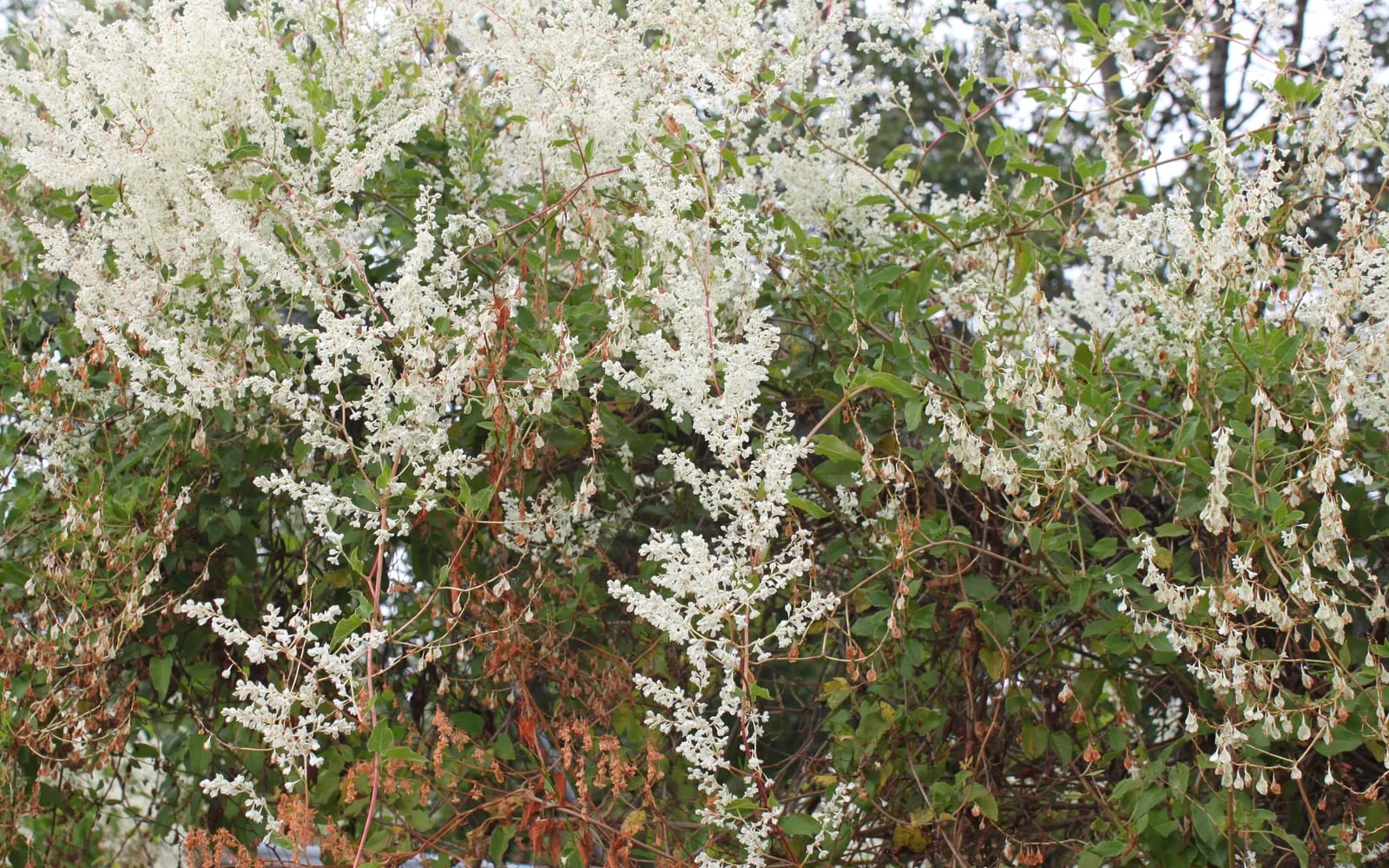
It grows 3 to 6 m in a single season, reaches 12 m or more, and covers a garage, a fence, a shed or an oil tank within two years. In August and September it carries foaming panicles of tiny creamy-white flowers over the whole surface, which is a good display.
Then it keeps going. Into the gutters, under the tiles, over the fence into the neighbour’s garden, up and over any shrub or small tree within reach, and through the hedge. It produces a metre of new growth a month in summer and a mass of dead stems inside the canopy that no amount of tidying reaches.
Removing an established one is a serious job. The root system regenerates from fragments, the top growth is a woody tangle, and it takes repeated cutting over two or three seasons to exhaust it.
None of that makes it a bad plant, and it makes it a plant with one correct use. Where you have a large ugly structure, poor soil, no time and no neighbours close by, nothing covers ground faster or more cheaply.
Anywhere else, a Clematis montana, a rambling rose or a Virginia creeper does the job with a fraction of the trouble.
Appearance and character
A deciduous woody climber reaching 12 to 15 m, twining and extremely vigorous.
Leaves are heart-shaped to arrow-shaped, 4 to 10 cm long, pointed, mid-green, and held alternately along the stem.
Stems are slender, twining, reddish when young and woody at the base, and they form a dense interwoven mass in which the older growth dies and stays.
Flowers open from July to October in large loose panicles 10 to 20 cm long, made of many tiny creamy-white or pink-tinged flowers, foaming over the whole surface of the plant.
The flowering is prolific and long, and it is the best thing about the plant.
Fruits are small three-sided nutlets in papery wings, and it sets little viable seed in Britain.
Growth rate is the defining characteristic, at 3 to 6 m in a season on an established plant.
The stems have swollen joints, which is the knotweed family signature.
Where it is from
Central Asia, from Tajikistan and Afghanistan east into western China, growing on rocky slopes and among scrub.
Baldschuanica refers to Baljuan in Tajikistan, where it was collected.
It reached Britain in 1894 and was widely planted through the twentieth century as a quick screen.
It is in the knotweed family alongside Japanese knotweed, and the two are close enough to hybridise, which has been recorded in Britain.
Japanese knotweed, Reynoutria japonica, is a separate plant subject to legal controls in Britain, and Russian vine carries none of those restrictions. The two are readily told apart, since knotweed is an upright non-climbing plant with bamboo-like stems and Russian vine is a twining climber.
It naturalises in Britain along railways, on waste ground and in hedgerows, spreading mostly by fragments and by discarded garden waste rather than by seed.
The taxonomy has moved about, and the plant appears in books and on labels as Polygonum baldschuanicum, Fallopia baldschuanica and Bilderdykia baldschuanica.
How it grows
Think carefully before planting one at all, and consider Clematis montana, a rambling rose, Virginia creeper or a fast hedge instead.
Plant in autumn or spring in any soil, in sun or partial shade. It grows on rubble, builders’ waste, dry poor ground and thin soil without complaint.
Give it a structure it can smother rather than a wall to decorate. A garage, a large shed, an oil tank, a chain-link fence, a concrete panel wall or an ugly outbuilding are the right jobs for it.
Provide wires or a framework, since it twines rather than clinging.
Keep it well away from the house, and specifically away from the eaves, the gutters and the roof.
Keep it away from trees, shrubs and hedges. It smothers whatever it climbs.
Keep it away from a boundary unless the neighbour is agreeable, since it will go over the fence.
Do not feed it and do not water it after the first year.
Cut it back hard every winter. Take it right back to the main framework in late winter, and expect to do a second cut in midsummer as well. It flowers on the current season’s growth, so hard cutting costs nothing.
Cut out the dead stems that accumulate inside the canopy, which is the tedious part of the job.
Renovate by cutting everything to 60 cm in late winter. It regrows within a season.
To remove one, cut all the top growth off, dig out as much root as you can, and then cut every regrowing shoot as it appears through the following two or three seasons until the root exhausts itself. A glyphosate treatment applied to the cut stumps or to actively growing regrowth in late summer speeds it considerably, following the label. Do not compost the material and do not fly-tip it.
Through the seasons
Winter is bare and shows the tangle of stems, and this is when to cut it hard back.
Spring breaks into leaf in April and starts the season’s growth, which is fast from the outset.
Summer grows a metre a month, often needs a midsummer cut, and starts flowering in July.
Autumn is the peak of the flowering, foaming white through September and into October.
Care difficulty
Easy to grow, difficult to control and hard to remove.
Nothing kills it. It tolerates any soil, drought, cold, wind, pollution, shade and being cut to the ground.
The entire skill is restraint. Cutting it back hard twice a year keeps it usable, and one season of neglect puts it in the gutters and over the fence.
Removing an established plant takes two or three seasons of persistent cutting.
Watering
Water through the first summer after planting.
Established Russian vine needs no watering in a temperate climate and grows through drought without slowing much.
Do not mulch or improve the soil for it. Poor conditions are the only thing that moderates its growth at all.
Warning signs, diseases and pests
Growth in the gutters, under the tiles or in the roof space is the standard problem and the reason to keep it away from a house. Cut it back twice a year and keep the top well clear of the eaves.
A tree, shrub or hedge dying under a blanket of it is smothering. Cut the vine away at the base and unpick the top growth once it dies.
A mass of dead brown stems inside the living canopy is normal and needs clearing out during the winter cut.
Shoots appearing over the boundary fence is normal behaviour rather than a fault, and it is worth speaking to the neighbour before it becomes a dispute.
Regrowth after removal is the root system regenerating. Keep cutting every shoot as it appears until it exhausts itself.
Pests and diseases are almost non-existent, which is part of the problem.
Being mistaken for Japanese knotweed is common. Russian vine twines and climbs, knotweed grows as upright bamboo-like canes and does not climb.
Growing environment
Full sun to partial shade. It grows in both and flowers better in sun.
Any soil, including poor dry ground, rubble and building waste. Do not improve it.
Fully hardy, tolerant of pollution, wind, drought and coastal conditions.
Allow 10 m or more and provide a substantial framework. This is not a plant for a small garden.
It suits a large ugly structure, a garage, an oil tank, a chain-link fence, a concrete wall, a derelict outbuilding or a big open boundary well away from anything else.
Do not plant it on a house, near a roof, next to a tree or shrub, in a small garden, or against a shared boundary without asking.
Consider the alternatives seriously. Clematis montana covers a large area with spring flowers and stops, a rambling rose such as ‘Rambling Rector’ or ‘Kiftsgate’ does the same job with better flowers, and Virginia creeper gives autumn colour. All three are far easier to live with.
Its wildlife value is real. The late flowers feed bees, hoverflies and wasps heavily through August and September when much else has finished, and the dense growth gives good nesting cover.
Feeding
None, and feeding it is a mistake.
It grows several metres a year on rubble. Adding fertiliser produces more growth to cut off and nothing else.
Skip the mulch as well.
Poor dry soil is the only thing that slows it down.
Troubleshooting
How fast does it grow? Three to six metres in a season once established, and about a metre a month at the height of summer. The nickname is close to the truth.
Will it damage my house? It twines rather than clinging, so it does not grip masonry the way ivy or Virginia creeper does. It gets into gutters, under tiles and into roof spaces, and that is where the damage happens. Keep it well away from the eaves.
How do I get rid of one? Cut off all the top growth, dig out as much root as you can, and then cut every regrowing shoot as it appears for two or three seasons until the root exhausts itself. Treating the cut stumps or the regrowth with glyphosate in late summer speeds it up considerably.
Is it Japanese knotweed? No. Japanese knotweed is Reynoutria japonica, an upright non-climbing plant with bamboo-like canes, and it is subject to legal controls. Russian vine is a twining climber and carries no legal restrictions.
When do I prune it? Hard in late winter, back to the main framework, and again in midsummer if it is running. It flowers on the current season’s growth, so hard cutting costs no flowers.
Should I plant one? Only for a large ugly structure in a big garden with no close neighbours. For anything else, Clematis montana, a rambling rose or Virginia creeper does the job with far less trouble.
It is smothering my apple tree. Cut the vine through at the base and leave the top growth to die before unpicking it. Then keep cutting the regrowth.
It has come over from next door. Speak to the neighbour. Cut back what is on your side, and be aware that the roots and the shoots will keep coming until the parent plant is dealt with.