
Outdoor plant
Wood anemone
Anemone nemorosa
Also known as Windflower, Thimbleweed, Smell fox
How to grow wood anemone, Anemone nemorosa. The ancient woodland indicator, why it spreads a few feet per century, and planting it in the green.
At a glance
- Difficulty
- Moderate
- Water
- Rarely, and it wants soil that stays cool in summer
- Light
- Full sun in spring under bare trees, and shade in summer
- Temperature
- Fully hardy, to about -25 deg C
- Hardiness
- USDA 4-8, RHS H6, hardy to -25 C
- Type
- Rhizomatous perennial, very long lived and dormant from early summer
- Height
- 10-20 cm
- Native to
- Europe, and native throughout Britain
- Best month
- April in the Northern Hemisphere, October in the Southern Hemisphere
It is a spring ephemeral, up and gone before the tree canopy closes, so it needs woodland conditions and a summer of dry shade rather than watering. Seed set is poor and the rhizome creeps at roughly two metres a century, which is why a large drift indicates old woodland and why a new planting takes years to look like anything.
Hardiness zones describe winter cold alone. Summer heat, humidity, rainfall and the length of the growing season decide as much, so treat the range as the outer limit rather than as a recommendation.
Every month named in this guide is for the temperate Northern Hemisphere. If you garden in the Southern Hemisphere, shift each one by six months, so April becomes October. Closer to the equator the wet and dry seasons matter more than the calendar, and the shift stops being a useful guide.
Toxic if eaten
- Do not eat
- All parts, and the fresh sap most of all
- Harm from
- Handling it and eating it
- Affects
- People, cats, dogs and horses
Wood anemone contains protoanemonin, released when the tissue is crushed or chewed, which is the irritant compound found across Ranunculaceae including buttercup, clematis and hellebore. Contact with the fresh sap causes redness, itching and blistering, and the old name smell fox records the acrid smell of the crushed plant. Eating any part causes burning and ulceration of the mouth, salivation, vomiting, abdominal pain and diarrhoea. The taste is acrid enough that most animals stop after a mouthful, which limits serious poisoning, and livestock have been affected where large quantities were grazed. The ASPCA lists Anemone as toxic to cats, dogs and horses, and the RHS lists it as harmful if eaten and as a skin irritant. Protoanemonin breaks down on drying, so dried plant material is far less irritant than fresh. Wear gloves when handling the rhizomes, and treat ingestion by a child or an animal as a call to a doctor or vet.
Sources: RHS potentially harmful garden plants, ASPCA toxic and non-toxic plants
About
Wood anemone spreads at around two metres per century, which makes a big drift of it one of the best indicators of ancient woodland in Britain.
Where you find a wood carpeted in it in April, the woodland has probably been there continuously since at least 1600. The rhizomes creep a few centimetres a year and the seed rarely sets viable offspring in temperate conditions, so a large colony represents a very long stretch of undisturbed ground.
In a garden that slowness is the whole story. A dozen rhizomes planted in a shady corner will be a small patch in ten years and a proper drift in thirty, and there is no way to hurry it.
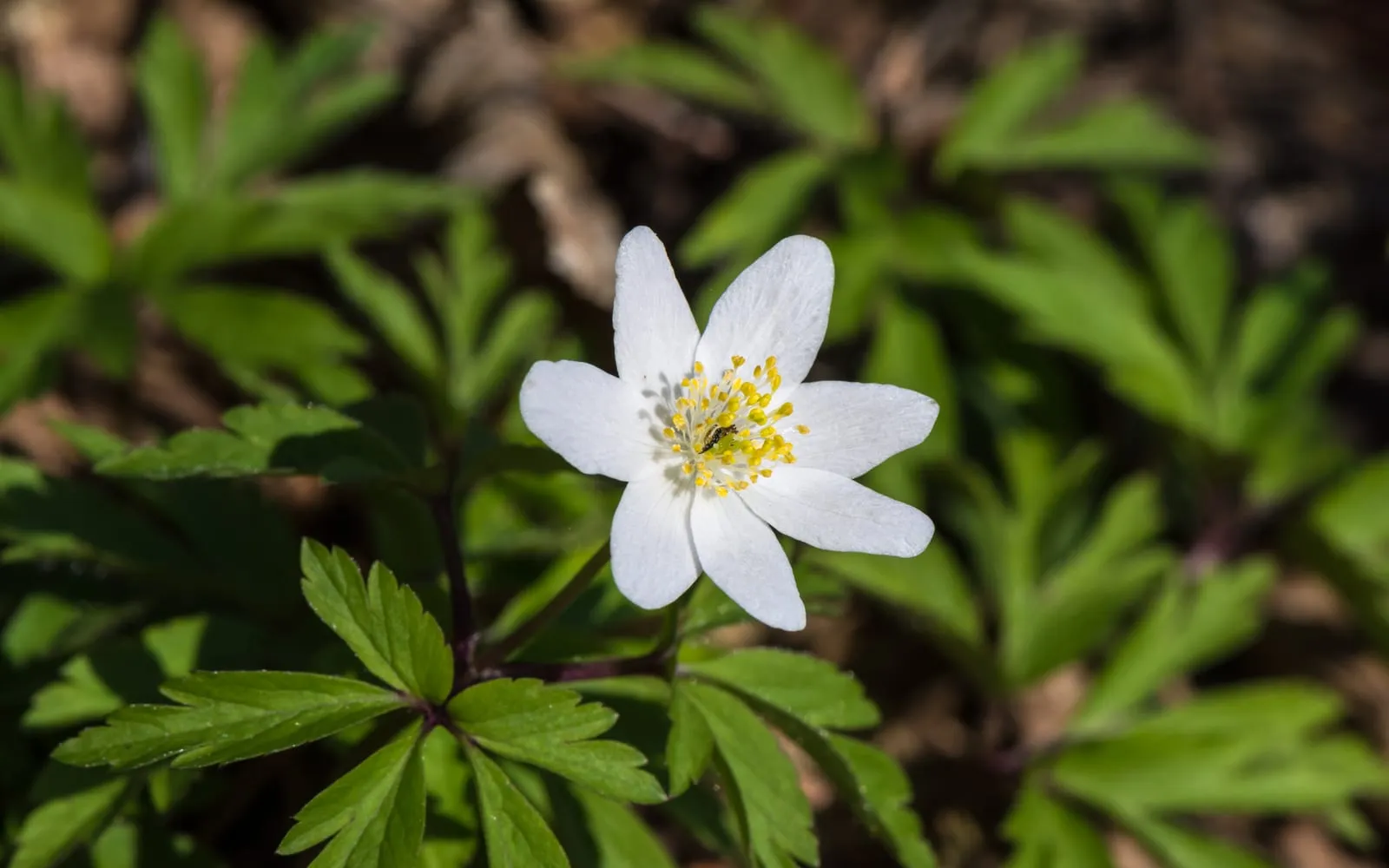
The flowers are worth waiting for. Single white stars 2 to 4 cm across, often flushed pink or purple on the reverse, held just above a ruff of divided leaves, opening in the sun and closing at night and in rain.
It is dormant by June. The whole plant dies back and disappears, which makes it ideal under deciduous trees and shrubs where summer growth would be shaded out anyway.
Dry rhizomes bought in autumn establish poorly, in the same way as winter aconite, and buying plants in the green is far more reliable.
Appearance and character
A rhizomatous perennial reaching 10 to 20 cm, in growth from March to May and fully dormant from early summer.
Leaves are divided into three stalked segments, each further cut and toothed, mid-green and slightly glossy, held in a whorl of three below each flower.
Flowers open from March to May, 2 to 4 cm across, with six to eight white petal-like sepals, often flushed pink, mauve or purple on the outside, around a boss of yellow-white stamens.
Each stem carries a single flower.
The flowers open in sun and close at night and in dull weather, and they turn to follow the light.
There is no scent worth the name, and the crushed foliage has an acrid smell, which is what smell fox records.
Rhizomes are thin, brown, brittle and creeping, running horizontally just below the surface.
Named cultivars extend the range considerably. ‘Robinsoniana’ is pale lavender-blue, ‘Vestal’ is a white double, ‘Allenii’ is deeper blue, and ‘Bracteata Pleniflora’ is a green and white double.
Anemone ranunculoides is the yellow woodland species and Anemone x lipsiensis is the pale yellow hybrid between the two.
Where it is from
Europe, and native throughout Britain and Ireland.
It grows in deciduous woodland, in hedge banks, on shaded roadside verges and in old meadows in the north, always on ground that has not been cultivated.
Its status as an ancient woodland indicator follows from its slowness. Rhizome spread is around 2 m per century and seed set is poor, so a large colony takes centuries to build and is destroyed by ploughing.
Colonies in hedge banks and open fields are often relics marking woodland that has been cleared, so it can mark old woodland in a landscape.
The flowers have no nectar and produce pollen only, and they are visited by early bees, hoverflies and beetles.
Windflower comes through Greek, from anemos for wind, and the usual explanations involve the flower opening in the wind or the seed being wind-dispersed.
It belongs to Ranunculaceae alongside buttercup, clematis, hellebore and monkshood, which accounts for the irritant sap.
How it grows
Buy plants in the green in spring if you can, which establishes far more reliably than dry rhizomes. Specialist nurseries sell it alongside snowdrops and winter aconite.
Plant dry rhizomes in autumn if that is what you have, soaking them for a few hours first, and expect losses.
Plant 3 to 5 cm deep and horizontal, spacing them 8 to 10 cm apart in groups.
Choose a position under deciduous trees or shrubs, which gives spring sun through bare branches and summer shade.
Moist humus-rich woodland soil is what it wants, with plenty of leaf mould, and it grows on both acid and mildly alkaline ground.
Avoid anywhere that bakes dry in summer and anywhere that waterlogs in winter.
Mulch with leaf mould in autumn, which is what the plant lives on in the wild.
Do not dig or fork the ground around a colony. The rhizomes sit shallow and break easily.
Leave the foliage to die back naturally in May and June, and do not cut or mow it while green.
Be patient. A colony takes many years to build and there is no way to speed it up.
Divide an established clump in the green immediately after flowering, or in late summer when dormant, lifting sections of rhizome and replanting straight away without letting them dry.
Keep vigorous neighbours off it. Wood anemone is easily smothered by anything strong growing in the same ground.
Wear gloves when handling the rhizomes, since the sap irritates skin.
Through the seasons
Winter is dormant with no growth above ground, and this is when dry rhizomes are planted.
Spring is the season. Leaves and flowers appear from March, flowering peaks in April, and this is when to buy and plant in the green.
Summer the foliage yellows and dies back through May and June, and the plant disappears completely.
Autumn is dormant, and this is the time to mulch with leaf mould and to divide.
Care difficulty
Moderate, and the difficulty is establishment and patience rather than upkeep.
Dry rhizomes are unreliable, which is the main reason attempts fail, and buying in the green solves it.
Once established in the right position it is permanent and needs nothing at all, spreading slowly and outliving everybody who plants it.
The position has to be right. Spring light, summer shade, leaf mould and soil that neither bakes nor floods are what it wants, and it will not compromise on the summer moisture.
Watering
None needed once established.
The requirement is soil that stays cool and slightly moist through the summer rather than watering, which is what a deciduous canopy and a leaf mould mulch provide.
Water new plantings in a dry spring while the foliage is green.
Avoid watering during summer dormancy.
Avoid waterlogged ground, where the rhizomes rot.
Warning signs, diseases and pests
Rhizomes planted in autumn that never appear is the standard problem, caused by them drying out before sale. Buy in the green instead.
A colony that dwindles is usually a position that bakes in summer, ground that is being dug, or vigorous neighbours smothering it.
Foliage yellowing in May is normal die-back rather than a problem.
Powdery white coating on the leaves in spring is powdery mildew and is uncommon.
Smut and rust both occur occasionally, showing as dark or orange pustules. Remove affected plants.
No spread after several years is normal. Wood anemone is one of the slowest spreading plants in cultivation.
Slugs occasionally graze the emerging shoots.
Growing environment
Spring sun with summer shade, which is what a deciduous tree or shrub provides. Under a large deciduous tree, in a shrub border, at a woodland edge or on a north-facing bank all work.
Moist, humus-rich soil with plenty of leaf mould, on acid or mildly alkaline ground.
Fully hardy to about -25 deg C.
Allow 8 to 10 cm between rhizomes and plant in generous groups, since the effect depends on the drift.
It suits a woodland garden, the base of a deciduous tree, a shrub border, a shaded bank or a naturalised planting in grass that is not cut until June.
Grow it with the plants that share the season and the conditions. Snowdrop, winter aconite, primrose, bluebell, lesser celandine, hellebore and Cyclamen hederifolium all fit, and between them they cover January to May.
Keep vigorous ground cover away from it.
Its wildlife value is modest and real. The flowers offer pollen to early bees, hoverflies and beetles in April, and it produces no nectar.
Choose ‘Robinsoniana’ for lavender-blue, ‘Allenii’ for a deeper blue, and ‘Vestal’ for a white double, all of which are as easy as the species.
Feeding
None needed.
Mulch with leaf mould in autumn, which is what it lives on in a wood and is all it wants.
Avoid fertiliser, which does nothing useful for a woodland rhizome and encourages the neighbours that smother it.
Avoid mushroom compost and heavy manures.
A colony that fails to thrive has a position or a moisture problem rather than a nutrient one.
Troubleshooting
I planted rhizomes and nothing came up. The usual result with dry rhizomes, which desiccate before sale. Soak them before planting, and buy plants in the green in spring instead, which is far more reliable.
How fast does it spread? Around 2 m per century in the wild, which is why it indicates ancient woodland. A garden colony builds over decades and there is no way to hurry it.
Where should I plant it? Under deciduous trees or shrubs, in moist leafy soil, where it gets spring sun through bare branches and summer shade. Avoid anywhere that bakes.
When can I divide it? In the green immediately after flowering, or in late summer when dormant. Lift sections of rhizome and replant straight away without letting them dry.
It disappeared in June. Normal. Wood anemone is dormant from early summer and the whole plant dies back. It reappears in March.
Will it grow in grass? Yes, under deciduous trees, provided the grass is not cut until the foliage has died back in June.
Is it poisonous? Yes. All parts contain protoanemonin, which blisters skin and causes burning and vomiting if eaten. Wear gloves when handling the rhizomes.
What should I plant with it? Snowdrop, winter aconite, primrose, bluebell and hellebore, which want the same woodland conditions. Keep anything vigorous away, since it is easily smothered.
Which cultivar should I choose? ‘Robinsoniana’ for lavender-blue and ‘Allenii’ for a deeper blue are the best known, and both grow as readily as the plain white species.