
Outdoor plant
Peruvian Lily
Alstroemeria aurea
Also known as Golden alstroemeria, Lily of the Incas
How to grow Peruvian lily, Alstroemeria aurea. Deep planting to protect the tuberous roots, why you pull stems instead of cut them, and the twisted leaves that identify it.
At a glance
- Difficulty
- Moderate
- Water
- Regularly through spring and summer, less once dormant
- Light
- Full sun to light shade, better with some afternoon shade in a hot summer
- Temperature
- Root-hardy where the tubers are planted deep and mulched
- Hardiness
- USDA 7-10, RHS H4, hardy to -10 C
- Type
- Tuberous perennial, spreading by fleshy roots
- Height
- 60-100 cm
- Native to
- The Andes of Chile and Argentina
The hardiest of the cultivated Peruvian lilies, and the zone number depends almost entirely on how deep the tuberous roots sit. Planted 15 cm down and mulched for the first winter or two, the root system survives cold that would kill top growth, since the tubers regenerate fresh shoots the following spring. Shallow planting or a wet, poorly drained winter kills it more often than the cold itself.
Hardiness zones describe winter cold alone. Summer heat, humidity, rainfall and the length of the growing season decide as much, so treat the range as the outer limit rather than as a recommendation.
Harmful if eaten
- Do not eat
- Sap in the stems, leaves and flowers
- Harm from
- Eating it and handling it
- Affects
- People, cats and dogs
Sources disagree on the severity here, and both are worth knowing. The ASPCA does not list Alstroemeria as toxic to cats, dogs or horses. The Pet Poison Helpline lists it as mildly toxic, and florists have long recognised Alstroemeria as one of the plants most likely to cause contact dermatitis among people who handle it professionally, alongside tulips and, more famously, chrysanthemums. The compound responsible is tulipalin A, the same allergen found in tulips, present in the sap of the stems, leaves and flowers. A pet that chews the foliage is more likely to get an upset stomach and mild drooling than anything serious, and a person cutting large quantities for arrangements over years is more at risk of developing a skin sensitivity than a gardener growing a few clumps in a border. Wear gloves if you cut it regularly and your skin reacts, and keep cut stems out of reach of a cat inclined to chew vase flowers.
Sources: RHS potentially harmful garden plants, ASPCA toxic and non-toxic plants
About
Cut flower growers rate a Peruvian lily stem for how long it lasts in a vase instead of how it looks on the day of cutting, and Alstroemeria aurea is one of the longest lasting cut flowers grown anywhere, holding for two to three weeks with nothing more than a change of water. The commercial cut flower trade in the genus is built on exactly that trait, which comes from an unusual piece of plant mechanics instead of any special treatment.
Harvesting method matters. Cutting a stem with secateurs leaves a wound and the plant treats it as damage. Pulling a stem sharply upward and outward, so it comes away cleanly from the underground crown, triggers the plant to send up a fresh replacement stem from the same point, and the harvested stem itself lasts noticeably longer once cut this way instead of snipped.
The species name refers to the golden-orange flowers instead of anything about the plant’s structure, and it is generally considered the hardiest member of a genus otherwise associated with greenhouse and florist trade plants that will not survive a cold winter outdoors.
Appearance and character
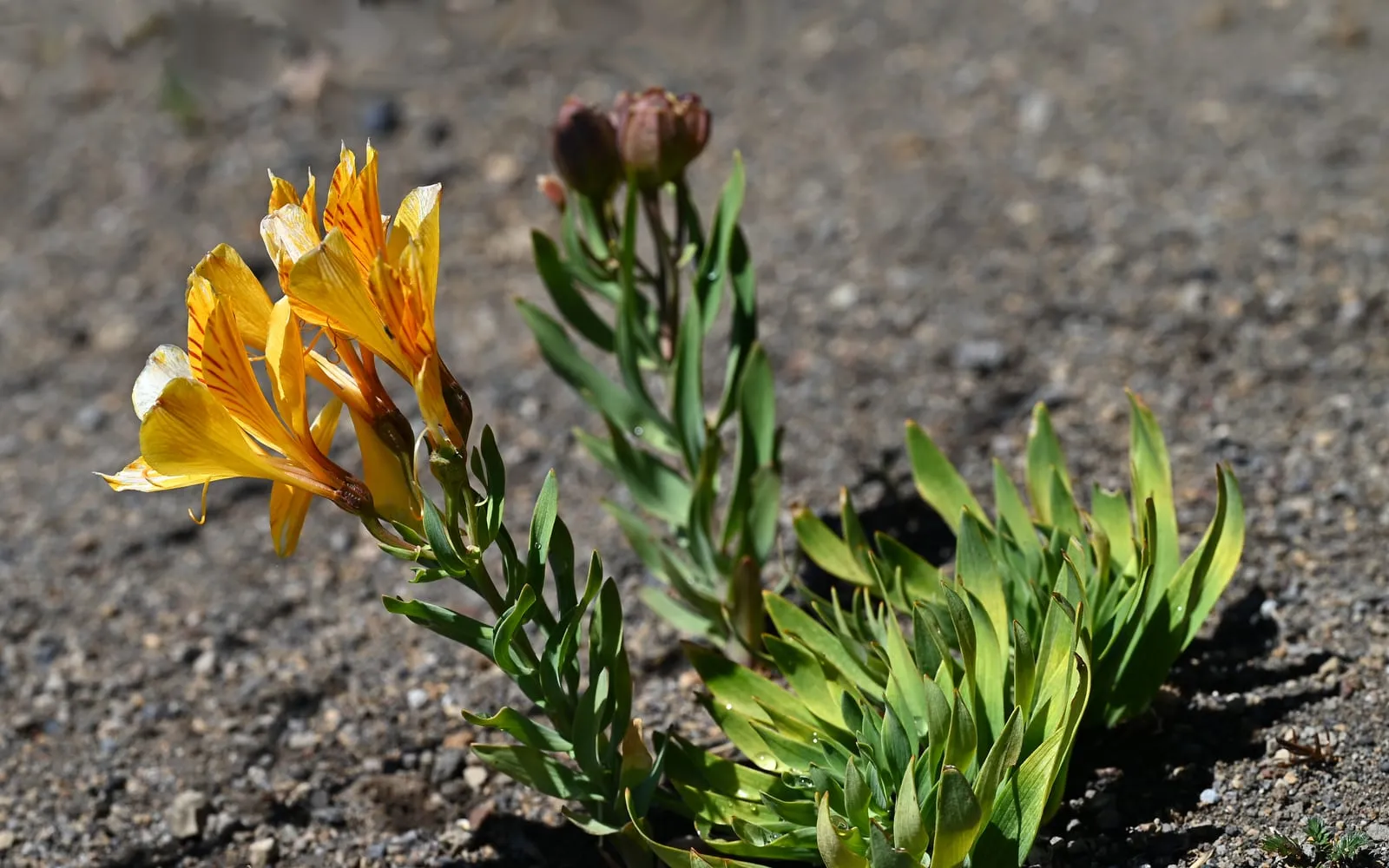
Slender, wiry, unbranched stems rise 60 cm to 1 m from an underground network of fleshy, pale, finger-like roots, each stem topped with a loose cluster of three to six trumpet-shaped flowers.
The flowers are orange to golden yellow, each of the six petals marked with darker streaks and flecks towards the throat, a pattern that guides pollinating insects towards the nectar and gives every Alstroemeria flower its distinctive freckled look regardless of the base colour.
The most reliable identifying feature has nothing to do with the flower. Alstroemeria leaves are resupinate: each leaf twists through 180 degrees at the point where it joins the stem, so what should be the underside of the leaf faces upwards and what should be the upper surface faces the ground. No other common garden plant does this as its ordinary habit, and it is visible on close inspection of any leaf, on any stem, at any time of year the plant is in growth.
Underground, the plant grows as a spreading mass of fleshy storage roots radiating from a central crown, closer in structure to a dahlia’s tuber cluster than to a single tuber or a bulb. This structure lets an established clump expand steadily outward year on year.
Where it is from
The Andes of Chile and Argentina, where the genus as a whole ranges from coastal scrub up to alpine grassland at considerable altitude. Alstroemeria aurea itself grows through temperate forest margins and open grassland in southern Chile and adjoining Argentina, a region with cooler, wetter summers than most of the genus experiences further north.
That cooler native range explains why this particular species tolerates a proper winter where most cultivated Alstroemeria hybrids need greenhouse protection. Its relatives from further north in the Andes, and the many modern florist hybrids bred from crosses across the genus, are far more tender and are usually grown as summer bedding or under glass outside mild coastal gardens.
The genus commemorates the Swedish botanist Baron Claus von Alstroemer, a student of Linnaeus who collected seed in Spain in the 1750s, from plants that had themselves arrived from South America with returning trade ships.
How it grows
A tuberous perennial that spreads by underground roots instead of by seed alone, forming an expanding clump over several years from a single planting.
Plant from a pot instead of as a bare root wherever possible, since the fleshy roots resent disturbance and a plant lifted and moved bare-rooted often grows poorly for a full season before settling. If a bare-root piece is all that is available, handle the roots as little as possible and plant it without delay.
Plant deep: 15 cm to the top of the root mass, deeper than almost anything else in this collection of bulbs, corms and tubers. Depth protects the crown through a hard winter, since the growing points sit well below frost penetration even where the surface freezes solid. Shallow planting is the most common reason a hardy Alstroemeria fails to return.
Growth begins in spring as a flush of new shoots, reaching flowering height by early to midsummer and continuing to produce fresh stems over several weeks if spent flowers are removed by pulling instead of cutting.
Established clumps benefit from being left alone. Division is possible in spring but the fleshy roots are brittle and slow to recover, so divide only when a clump has become obviously congested, and expect a light flowering year while the divided pieces re-establish.
Through the seasons
Spring brings the new flush of shoots from the crown, visible from March or April depending on the season, growing quickly once the soil warms.
Summer is the main flowering period, from June through into September in a good year, with fresh stems continuing to appear if spent ones are pulled not left to set seed.
Autumn sees growth slow and the top growth begin to die back after the first cold snap. Cut the dead stems to ground level once they have browned off, leaving the crown undisturbed below.
Winter is spent entirely underground. A mulch of bark or compost applied after the first hard frost, particularly for the first two winters after planting, insulates the crown while the roots establish themselves at depth.
Care difficulty
Moderate. The plant needs very little once it is settled, and the difficulty is concentrated almost entirely at planting time.
Get the depth right, plant from a pot without breaking up the root system, and choose a spot with reliable drainage, since the fleshy roots that make it hardy against cold are the same roots that rot in waterlogged winter ground. Past that first season, an established clump needs little regular care and increases in size and flower count year on year.
The other thing to know before planting is that Alstroemeria spreads when conditions suit it. Given good conditions it moves steadily outward from the original clump, which is a virtue in a wild or naturalistic border and a nuisance in a tightly planned one.
Watering
Water regularly through spring and summer to keep the soil consistently moist, particularly while the clump is establishing in its first year. Alstroemeria’s leafy top growth transpires readily in a hot spell and wilts quickly if the soil dries out completely.
Reduce watering once the top growth begins to die back in autumn, and stop almost entirely over winter, since the dormant roots sitting in cold wet soil are more vulnerable to rot than to the cold itself.
Mulching after watering helps retain moisture through summer and suppresses the weeds that compete with a young clump before it has filled its space.
Warning signs, diseases and pests
Slugs and snails target the soft new shoots as they emerge in spring, and can set an establishing clump back significantly in its first year or two before the stems toughen. Protect emerging growth with the usual physical barriers and remove slugs by hand on damp evenings.
Yellowing leaves and stems that collapse at the base, with the plant failing to return strongly the following spring, point to root rot from poorly drained or waterlogged soil. There is no cure once rot sets in; the fix is prevention, by improving drainage before replanting or moving the clump to a better-drained spot.
Contact dermatitis from handling the sap affects some people, usually after repeated handling instead of a single brush against the foliage, and shows as redness and itching on exposed skin. Wearing gloves for regular cutting avoids it entirely.
A clump that stops flowering well after several strong years is usually overcrowded. Lift and divide in spring, replanting smaller pieces at the full 15 cm depth, and accept a lighter flowering season while they settle.
Spread beyond the intended planting area is the other common complaint, not a disease. A barrier sunk into the soil around the planting area, or removing unwanted shoots as they appear each spring, keeps a vigorous clump within bounds.
Growing environment
Full sun suits it in a cool or temperate climate; in a hot summer, light afternoon shade keeps the flowers from fading fast and reduces stress on the plant generally.
Soil should hold moisture without becoming waterlogged. Work plenty of organic matter into the planting hole before setting the roots in, both to improve drainage on heavy ground and to hold moisture on anything sandy.
Shelter from strong wind helps, since the wiry flowering stems can be blown around and broken in an exposed position, though the plant itself does not need staking under normal conditions.
Give a young clump 40 to 50 cm of room to spread into over the following few years, more if the site suits it particularly well and growth is vigorous.
A container works for a smaller garden or a colder site where the winter protection of a greenhouse or cold frame is useful, though the roots still need depth, so choose a pot at least 30 cm deep instead of a shallow one.
Feeding
Feed monthly through the growing season with a balanced liquid feed, from when the spring shoots are a few centimetres tall through to late summer.
A slow-release granular feed worked into the soil surface in spring is an easier alternative to monthly liquid feeding and suits a clump that has been established for several years and needs maintaining instead of being pushed into softer growth.
Stop feeding by early autumn as growth slows, so the plant is not encouraged into soft new growth right before the cold arrives.
Troubleshooting
Planted it and it never came back the following spring. Almost always planted too shallow, or lost to waterlogging over winter. Check the depth next time: 15 cm to the top of the root mass, in ground that drains.
How do I get the flowers to last in a vase? Pull the stem sharply rather than cutting it with secateurs. A pulled stem lasts noticeably longer, both in the vase and as encouragement for the plant to send up a replacement.
How do I know I have an Alstroemeria and not something similar? Check a leaf closely. It should be twisted through 180 degrees where it joins the stem, so the surface facing you is technically the underside. No other common garden plant does this.
It has spread much further than I planted it. That is normal vigorous growth not a problem. Remove unwanted shoots each spring, or sink a root barrier around the planting area if it needs containing.
Yellow, collapsing stems and it is not returning well. Root rot from waterlogged soil. Improve the drainage before replanting, since there is no treatment for roots that have already rotted.
My skin reacts after handling it. Contact dermatitis from the sap, caused by the same compound found in tulips. Wear gloves for cutting and deadheading if this affects you.
Is it safe around pets? The ASPCA does not list it as toxic, while the Pet Poison Helpline rates it mildly toxic. Either way, expect mild stomach upset instead of an emergency if a pet chews it, and keep cut stems out of reach of a cat that likes to nibble vase flowers.