
Outdoor plant
Chinese Silver Grass
Miscanthus sinensis
Also known as Eulalia grass, Japanese silver grass
How to grow Chinese silver grass, Miscanthus sinensis, as an ornamental border grass. Its tall autumn plumes, and why some cultivars self-seed more than others.
At a glance
- Difficulty
- Easy
- Water
- Regular watering while establishing, drought-tolerant once mature
- Light
- Full sun
- Hardiness
- USDA 4-9, RHS H7, hardy to -30 C
- Type
- Hardy deciduous perennial grass
- Height
- 1.5-3 m
- Native to
- East Asia
Fully hardy through cold winters, dying back to a dormant crown each year. It flowers most reliably given a reasonably long, warm growing season, and in cooler climates or short summers may produce foliage without the tall autumn plumes that many gardeners grow it for, though the clump itself remains hardy regardless.
Hardiness zones describe winter cold alone. Summer heat, humidity, rainfall and the length of the growing season decide as much, so treat the range as the outer limit rather than as a recommendation.
Not known to be toxic
Chinese silver grass has no toxicity listing from the RHS or the ASPCA and is considered safe around pets and children. The leaf blades have finely serrated edges that can cause a minor skin cut on contact, a mechanical rather than toxic hazard worth a moment's care when handling the clump.
Source: RHS
About
Chinese silver grass is one of the most widely planted large ornamental grasses, grown for its tall, arching clumps of narrow foliage and, on many forms, feathery, silvery-pink plumes that rise above the leaves in late summer and persist attractively well into winter. Breeders have developed an enormous range of cultivars from the wild species, varying in height, leaf width, variegation and flowering time, which is part of why this single species covers such a wide range of garden roles, from a tall screening hedge to a much more compact border specimen.
In parts of North America it has escaped cultivation and become invasive in some regions, self-seeding into natural areas from older, more fertile seed strains, which has led plant breeders to develop increasingly sterile or low-seeding cultivars specifically to reduce this risk; checking a cultivar’s seeding behaviour is worthwhile before planting in an area where this is a known concern.
Appearance and character
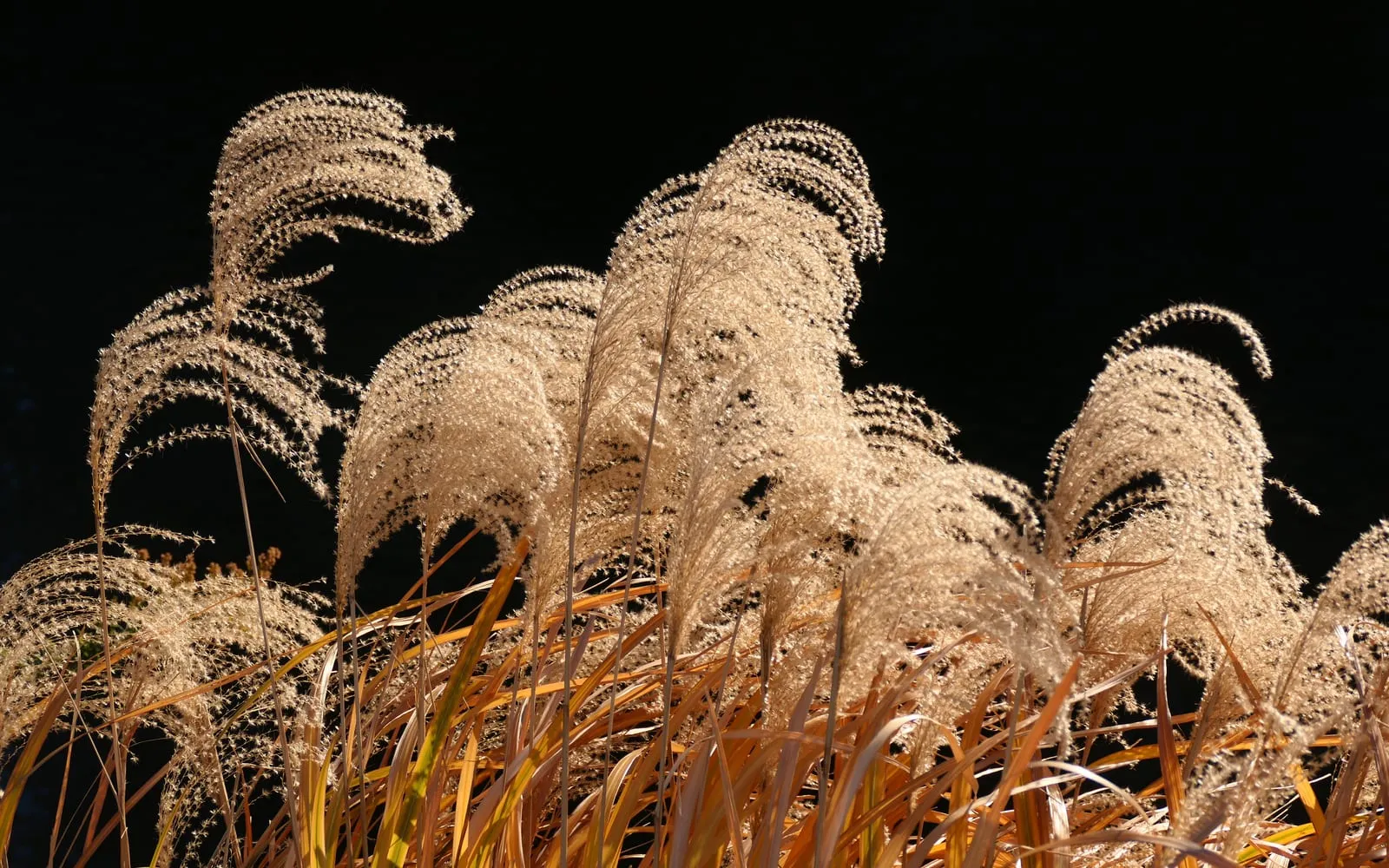
Long, narrow, arching leaves, often with a pale midrib stripe, form a substantial clump that can reach well over head height in some cultivars by late summer. Flower plumes emerge above the foliage from late summer into autumn, opening a coppery pink or silver before fading to a pale, feathery cream that remains attractive on the plant through much of winter, catching low autumn and winter light more than most perennials manage.
Cultivars vary much: some carry horizontal gold banding across the leaf, others a fine white leaf margin, and flowering time and plume colour both differ enough between named varieties that choosing a specific cultivar rather than the unnamed species is worthwhile for a garden with a particular look in mind.
Where it is from
Grassland, hillsides and open woodland margins across East Asia, including Japan, China and Korea, in a climate with warm, often humid summers and cold winters, broadly similar to much of the temperate world where it is now grown.
That East Asian origin, with a reasonably long warm season, is why flowering performance varies so much by climate in cultivation: gardens with a shorter or cooler summer than the plant’s native range often see strong foliage growth with plumes appearing late or sparsely, if at all, in a particularly cool year.
How it grows
A hardy perennial that dies back to a dormant crown each winter and regrows vigorously each spring, expanding gradually into a wider clump over successive years. Growth accelerates through summer, with the tallest foliage and, given enough warmth, flower plumes developing from late summer onward.
Older clumps can develop a dead, hollow centre after some years, a common pattern in large ornamental grasses, and are usually rejuvenated by lifting and dividing the clump, discarding the exhausted centre and replanting vigorous sections from the outer edge.
Through the seasons
Spring cut back the previous year’s dead foliage before new growth emerges, then watch for the fresh shoots that follow quickly once temperatures rise.
Summer is the main growing season, with foliage reaching close to full height. Water during any extended dry spell, particularly on a recently planted clump.
Autumn flower plumes open on most cultivars, adding height and movement to the border into the colder months.
Winter the dried foliage and plumes are usually left standing for their winter interest and the shelter they offer wildlife, cut back only at the start of the following spring.
Care difficulty
Easy. Once established, this is a low-maintenance, reliably hardy grass that needs little beyond an annual cut-back and, for larger cultivars, enough space to reach their eventual size without crowding neighbouring plants.
Watering
Regular watering supports strong establishment in the first year or two after planting. Once its root system is developed, this species tolerates real drought reasonably well, needing supplemental watering only during an extended dry spell in summer.
Warning signs, diseases and pests
This is an unusually trouble-free grass in most gardens, with rust disease the main issue occasionally reported, showing as orange-brown pustules on the leaves, generally more a cosmetic concern than a serious threat to the plant’s survival.
A clump with a dead, hollow or sparse centre, still growing vigorously around its outer edge, has aged past the point where the centre can be sustained, a normal pattern in large grasses rather than a disease; lifting and dividing in spring, discarding the dead centre, restores a fuller, more even clump.
Little to no flowering despite healthy foliage most often reflects a shorter or cooler growing season than the plant’s native range provides, particularly for cultivars bred for a longer summer than the local climate offers.
Growing environment
Full sun gives the best growth and the most reliable flowering. Ordinary garden soil suits it well, ideally moisture-retentive but free draining, and this species tolerates a fairly wide range of soil types without much complaint.
Feeding
A balanced granular feed applied once in spring as growth resumes is generally sufficient. This is not a particularly hungry plant, and established clumps in reasonable garden soil often perform well with minimal supplemental feeding.
Troubleshooting
The centre of an established clump has died out. This is normal ageing in a large grass. Lift and divide the clump in spring, discarding the dead centre and replanting vigorous outer sections.
Little to no flowering despite good foliage growth. Usually a reflection of a shorter or cooler growing season than the cultivar expects. Foliage remains attractive regardless, and a warmer summer may bring stronger flowering.
Orange-brown pustules have appeared on the leaves. This is rust disease, usually a cosmetic rather than a serious problem. Improving air circulation around a crowded clump can help reduce its recurrence.
You are concerned about self-seeding in a sensitive natural area. Choose a cultivar specifically bred for sterility or low seed production, and check regional guidance, since seeding behaviour varies widely between named varieties of this species.
You are choosing where to site a tall cultivar in the garden. Allow generous space from the outset, since many popular forms reach well over two metres at maturity and can shade or crowd smaller neighbouring plants if placed too close, an easy mistake to make when a young, newly planted clump still looks modest.