
Outdoor plant
Yellow Pitcher Plant
Sarracenia flava
Also known as Yellow Trumpet Pitcher, Trumpet Pitcher Plant
How to grow Sarracenia flava, the tallest of the American pitcher plants, whose nectar contains a narcotic alkaloid also found in hemlock.
At a glance
- Difficulty
- Moderate
- Water
- Stand the pot in 2-4 cm of rainwater throughout the growing season
- Light
- Full sun for most of the day
- Temperature
- Grows best 15-32 deg C; wants a cool winter rest rather than deep freezing
- Humidity
- Ordinary outdoor humidity
- Hardiness
- USDA 6-9, RHS H3, hardy to -5 C
- Type
- Hardy herbaceous perennial
- Height
- 60-100 cm
- Native to
- North America
Native to the coastal plain from Virginia to Florida and west into Alabama, where winters are cool rather than harsh. The USDA range looks generous next to the RHS rating, and the gap is mostly about wet British winters rather than cold ones: a mulched crown handles a brief hard frost, but weeks of cold, sodden compost rots the rhizome long before frost alone would kill it. In anything colder than a mild maritime climate, grow it in an unheated greenhouse or cold frame over winter with reduced water.
Hardiness zones describe winter cold alone. Summer heat, humidity, rainfall and the length of the growing season decide as much, so treat the range as the outer limit rather than as a recommendation.
Not known to be toxic
Yellow pitcher plant has no toxicity listing from the RHS or the ASPCA for people or pets. Its nectar contains coniine, the same alkaloid found in hemlock, but in quantities aimed at intoxicating insects rather than anything that poses a risk to a person or a cat brushing past the flower or leaves. There is no documented case of it harming a pet.
Source: RHS
About
Sarracenia flava is the tallest of the North American pitcher plants, capable of throwing up trumpets a metre high from a rhizome that barely breaks the surface of the peat. It grows across the wet pine savannas of the southeastern coastal plain, and where conditions suit it, it forms stands dense enough to dominate the ground beneath the pines.
Its trap works on a principle unusual among carnivorous plants: it drugs its prey. The nectar around the rim and down inside the throat of each pitcher contains coniine, the alkaloid that makes hemlock deadly to a grazing animal, and in an insect it acts as a narcotic. A fly or wasp that lingers over the nectar becomes uncoordinated, stumbles rather than flies, and is far more likely to slip over the waxy internal zone and fall to its death than one that fed briefly and left. Researchers have measured enough coniine in the nectar to paralyse a fire ant outright.
The flower carries its own oddity. It is a large, showy, lemon-yellow bloom held well clear of the pitchers on a bare stalk, and it smells unpleasant, a scent often compared to cat urine, which draws the flies that pollinate it rather than repelling them.
Appearance and character
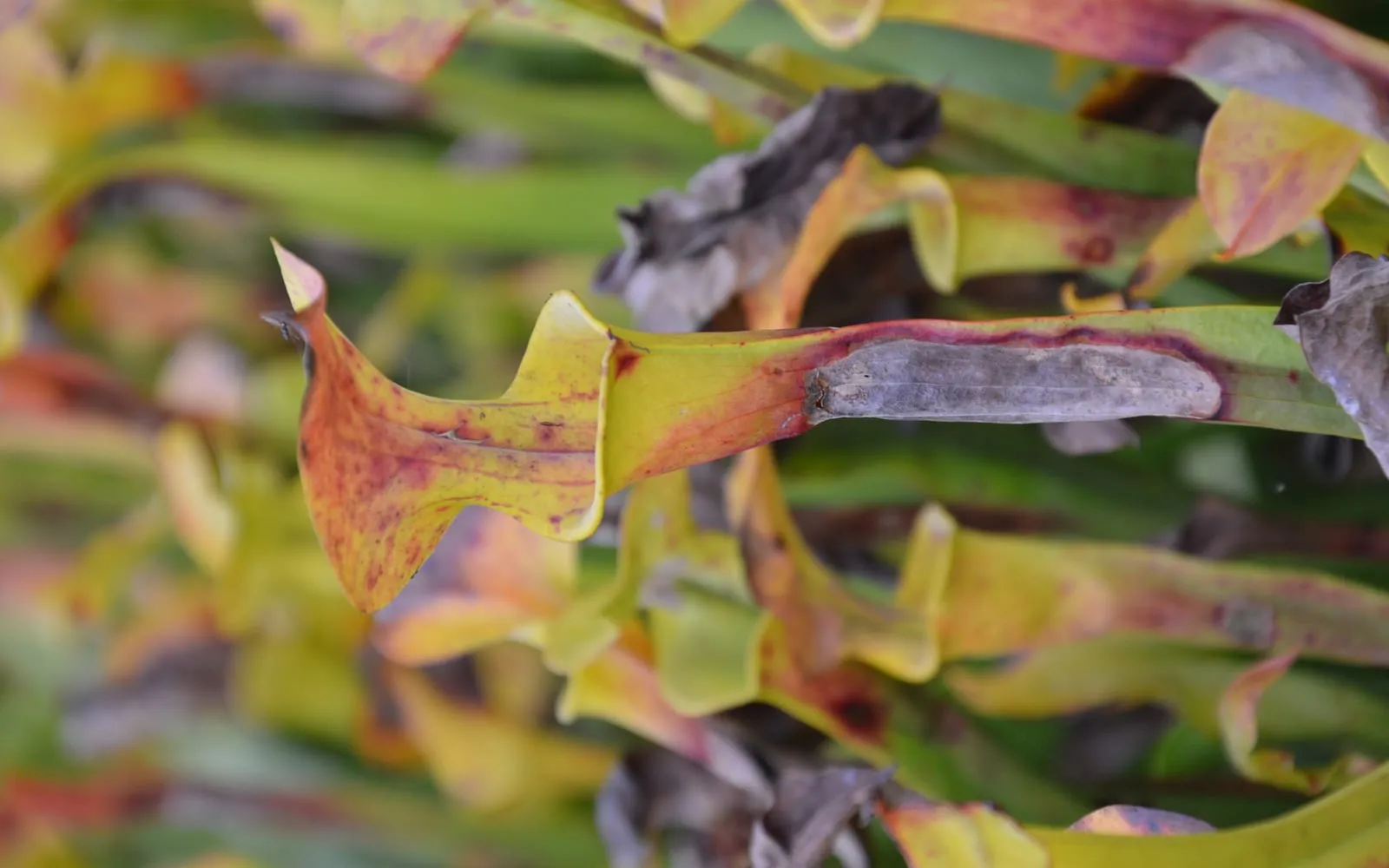
Each pitcher is a narrow, upright trumpet, pale yellow-green through most of its length with a deep red-veined throat and a broad, wavy-edged lid, called an operculum, that arches over the opening without sealing it. Younger pitchers in spring tend to be more heavily flushed with red than the taller, plainer ones that follow in summer.
Unlike the ground-hugging purple pitcher plant, this species holds its traps fully upright, and a mature clump reads as a fan of pale trumpets rather than a low rosette. In autumn, some populations produce a second, shorter flush of pitchers with distinctly narrower hoods, thought to catch a different mix of prey than the tall summer growth.
Despite the narcotic reputation of its nectar, ground-dwelling ants make up more than half of its prey, alongside flying insects such as flies and wasps that fall for the drugged nectar trail up near the rim.
Where it is from
Wet, sunny pine savannas and seepage bogs along the coastal plain from southeastern Virginia down through the Carolinas and Georgia into Florida and the Florida panhandle into Alabama. These sites burn periodically in the wild, and fire clears the woody competition that would otherwise shade the plant out, keeping the ground open and sunny in a way an unmanaged garden bog has to replicate by hand, through cutting back encroaching growth rather than fire.
The soil is sandy, acidic and almost entirely without available nitrogen or phosphorus, kept permanently damp by a high water table rather than by standing water. That combination, full sun with wet but not waterlogged roots, is the one to aim for in cultivation.
How it grows
Growth starts with the flower, which typically opens before the first pitchers of the season have fully unfurled, avoiding pollen contamination from the plant’s own traps. Pitchers then rise through spring, reaching full height by early summer and persisting for most of a year before browning off and being cut back.
The rhizome branches slowly at the surface, and an old clump can carry a dozen or more growth points, each capable of being separated into its own plant. Division in early spring, before the flush of new pitchers, is the usual way to increase it; from seed, expect three to four years before a seedling pitchers at anything like full size.
The plant produces no obvious digestive movement of its own. Fluid pooled in the base of the pitcher, together with the plant’s own enzymes and a resident community of bacteria, breaks down trapped insects over days to weeks.
Through the seasons
Spring opens with the flower, a solitary yellow bloom on a tall bare stalk that can appear before the winter’s old pitchers have finished dying back. New pitchers follow soon after and climb quickly towards their full height.
Summer is when the plant is at its tallest and most active, catching the bulk of its prey as flying insects are drawn to the narcotic nectar. Keep it in full sun with the roots permanently damp.
Autumn brings a second, often shorter flush of pitchers in warmer parts of its range, along with the start of dieback in the oldest summer growth. Cut away pitchers only once they have fully browned, since living tissue keeps feeding the rhizome even after it has stopped catching insects.
Winter calls for a cool rest rather than a hard freeze. In mild climates, leave it outdoors with the water tray kept lower than in summer. Anywhere colder than USDA zone 7 or so, move the pot into an unheated greenhouse, porch or cold frame, since prolonged freezing that a purple pitcher plant shrugs off can kill this species’ rhizome outright.
Care difficulty
Moderate, and the difficulty is more about winter than summer. It wants full sun, wet and mineral-free roots, and no fertiliser through the growing season, all of which are straightforward to provide. Where it gets tricky is protecting the crown through a winter colder than its native range without denying it the cool rest it still needs to flower well the following spring.
Watering
Stand the pot in 2 to 4 cm of rainwater or distilled water throughout spring, summer and autumn, and never let the compost dry out while the plant is in active growth. Reduce the depth of water in winter so the compost stays damp rather than saturated, particularly where the plant is being overwintered somewhere sheltered rather than outdoors.
Tap water, mineral water and softened water are all unsuitable long term. The dissolved salts they carry build up in the peat mix over a season or two and damage the fine roots well before any visible symptom appears above ground.
Warning signs, diseases and pests
Botrytis takes hold on dead or dying pitcher tissue in humid, still conditions, showing as a grey fuzzy coating. Cut away and dispose of affected pitchers and open the plant up to more airflow rather than reaching for a fungicide first.
Aphids sometimes cluster on new pitchers as they unfurl, when the tissue is softest. A hard spray of water usually dislodges a light infestation, and established outdoor plants often attract enough ladybirds and lacewing larvae on their own to keep numbers down without any intervention.
Scale insects appear as small, flattened brown discs stuck to the outside of older pitchers. Scrape them off by hand or with a soft brush, and repeat over a few weeks to catch any that were missed the first time.
Pitchers that come up thin, short and pale, well below the plant’s usual size, are the clearest sign the rhizome did not get enough winter rest the year before, rather than a disease.
Growing environment
Full sun for most of the day is essential; a shaded plant produces short, weak pitchers and rarely flowers well. Outdoors it suits a bog garden, pond margin with a liner, or a large glazed pot with no drainage and a topped-up water reservoir.
It tolerates summer heat readily, provided the roots stay wet, and needs a cool but not necessarily freezing winter, as described under hardiness. Ordinary outdoor humidity is fine. Plant it in a low-nutrient mix of peat-free sphagnum and perlite or sand, never in ordinary compost or anything carrying fertiliser.
Feeding
None, in the conventional sense. The plant meets its nitrogen and phosphorus needs from insects lured in by its narcotic nectar and drowned in the pitcher fluid, and adding fertiliser to the soil or spraying it on the leaves damages the roots rather than helping the plant grow.
An outdoor planting in full sun rarely needs supplementing. A plant kept somewhere with few insects can be offered a small dead insect or a freeze-dried bloodworm dropped into a pitcher once or twice a month at most.
Troubleshooting
Pitchers are tall but pale, with little of the usual red veining. Not enough direct sun. Move the plant somewhere it gets several hours of full sun daily.
The rhizome rotted over winter. Almost always waterlogging combined with cold rather than cold on its own. Overwinter in a sheltered spot with the compost damp rather than saturated.
No flower appeared this spring. Common in young divisions and seedlings, which can take several years to reach flowering size. An established plant that skips flowering usually had an interrupted or too-warm winter rest the year before.
Insects are lingering around the pitcher rim rather than falling in. Expected behaviour, not a fault. The narcotic nectar works by degrees, and some insects feed and leave before it takes full effect.
The pitchers have gone from mostly upright to leaning and floppy. Usually windburn or overcrowding rather than disease. Stake tall pitchers in an exposed spot, or divide a congested clump.
White crust is building up on the compost or pot rim. A sign that mineral-bearing water has been used. Flush thoroughly with rainwater and use only rainwater or distilled water afterwards.
Is the nectar dangerous to touch or to pets that sniff at it? No. The coniine content is aimed at insects and present in amounts far too small to threaten a person or a curious cat or dog, though it is still sensible practice to keep any garden plant out of a pet’s reach as routine.