
Outdoor plant
Japanese knotweed
Reynoutria japonica
Also known as Fallopia japonica, Polygonum cuspidatum, Donkey rhubarb
How to recognise Reynoutria japonica, tell it from its lookalikes, treat it over several seasons, and the legal duties that come with having it on your land.
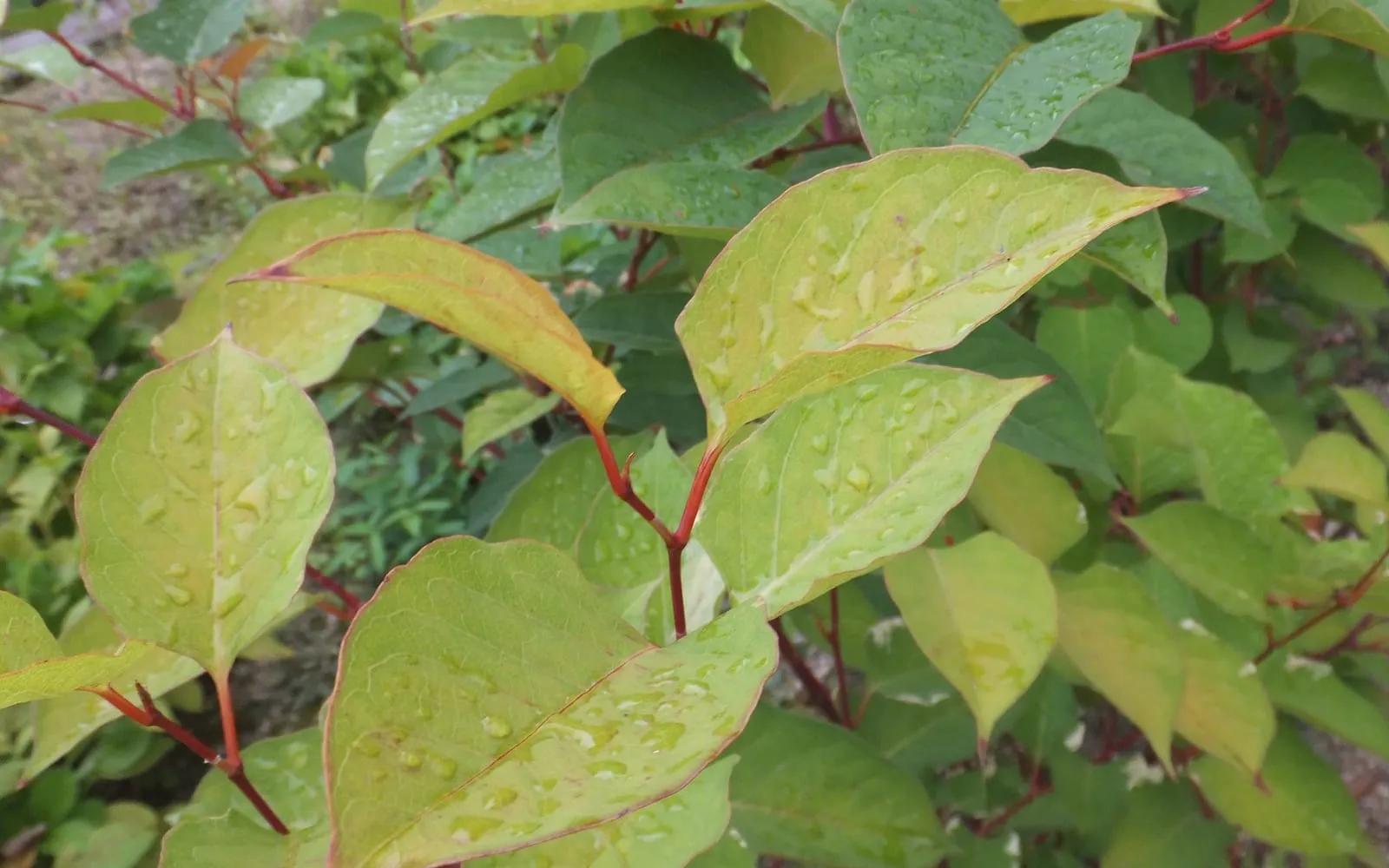
At a glance
- Difficulty
- Difficult
- Water
- Never water it. This is a plant to eradicate rather than grow
- Light
- Full sun to partial shade
- Temperature
- Fully hardy, and the canes die back to the ground each winter
- Hardiness
- USDA 4-9, RHS H7, hardy to -30 C
- Type
- Herbaceous perennial from a deep woody rhizome, effectively permanent
- Height
- 2-3 m in a single season
- Native to
- Japan, Korea and northern China
- Best month
- June in the Northern Hemisphere, December in the Southern Hemisphere
It colonises raw volcanic ash in Japan, so nothing a garden offers is difficult, and it regrows from a rhizome fragment weighing under a gram. What changes at a border is the law. Britain is unusual in attaching civil liability and mortgage consequences to it, and the practical effect is that a sale can fall through. Across North America it is a listed noxious weed in many states and provinces, prohibited from sale, and the duty is a control obligation rather than a liability to a neighbour.
Hardiness zones describe winter cold alone. Summer heat, humidity, rainfall and the length of the growing season decide as much, so treat the range as the outer limit rather than as a recommendation.
Every month named in this guide is for the temperate Northern Hemisphere. If you garden in the Southern Hemisphere, shift each one by six months, so June becomes December. Closer to the equator the wet and dry seasons matter more than the calendar, and the shift stops being a useful guide.
Edible, with limits
- Safe to eat
- The young spring shoots, cooked, in the same way as rhubarb
- Do not eat
- Nothing seriously toxic, though the whole plant is high in oxalic acid
- Harm from
- Eating it
- Affects
- People
Japanese knotweed is a legal and structural problem rather than a poisonous one. It is not listed by the ASPCA as toxic to cats, dogs or horses, and it is not in the RHS list of potentially harmful garden plants. The young spring shoots are eaten in Japan under the name itadori and taste much like rhubarb, which is unsurprising since both belong to the same family and both are high in oxalic acid. That oxalic acid is the only real dietary caution, and anyone prone to kidney stones should treat it as they would rhubarb stalks. Eating it is a poor idea in Britain for two other reasons that matter more than the chemistry. Cutting shoots creates fragments, and a piece of rhizome or stem weighing less than a gram can start a new colony, so harvesting risks spreading the very thing you want gone. Many stands have also been sprayed with glyphosate, sometimes for years, and there is no way to tell by looking. The serious hazards are legal and financial, and they differ by country. In Britain, knotweed is listed on Schedule 9 of the Wildlife and Countryside Act 1981, making it an offence to plant it or cause it to grow in the wild, cut canes and contaminated soil are controlled waste under the Environmental Protection Act 1990, and courts have found landowners liable in private nuisance where it encroaches onto neighbouring land. Across the United States and Canada it is a listed noxious weed in many states and provinces and prohibited from sale, and the obligation there is to control it rather than a liability to a neighbour.
Sources: RHS potentially harmful garden plants, ASPCA toxic and non-toxic plants
About
Every Japanese knotweed plant in Britain is, as far as anyone can tell, part of the same organism. A single female clone was introduced in the nineteenth century and it has never had a male partner here, so it has spread entirely by fragments of itself for nearly two centuries. That makes the British population one of the largest clonal organisms on earth.
It arrived through the front door. Philipp von Siebold sent it from Japan to Leiden, and by the 1850s British nurseries were selling it as an ornamental with handsome foliage and useful vigour. The Royal Horticultural Society gave it a gold medal.
Now it grows 2 to 3 m in a season from a rhizome that runs 3 m deep and 7 m sideways, it costs the UK economy an estimated quarter of a billion pounds a year, and it complicates house sales. This guide is about recognising it and getting rid of it.
Appearance and character
A herbaceous perennial forming dense stands of hollow canes, dying back to the ground each winter and regrowing to 2 to 3 m by midsummer.
Stems are the clearest identifier. Hollow, jointed like bamboo, green with distinctive purple or red speckles, and dying to hollow orange-brown canes that stand through the winter.
Leaves are shield-shaped or spade-shaped, up to 14 cm long, with a pointed tip and, critically, a flat straight base where the leaf meets the stalk. Most lookalikes have a rounded or heart-shaped base.
The arrangement is the second key feature. Leaves come off the stem alternately in a clear zig-zag, one on each side in turn, rather than in opposite pairs.
Flowers open in late August and September as loose sprays of tiny creamy-white blooms in the leaf axils, and bees work them heavily.
Spring shoots are unmistakable in March and April, red or purple asparagus-like spears pushing through the ground, often through tarmac and paving, unfurling into rolled red-veined leaves.
The rhizome is the real plant. Woody, thick, dark brown outside and bright orange inside when snapped, which is a useful confirmation, and it snaps crisply like a carrot.
Common lookalikes catch people out constantly. Russian vine and bindweed both have heart-shaped leaves with a notched base. Himalayan honeysuckle and dogwood carry leaves in opposite pairs rather than alternately. Bamboo has narrow strap leaves and persistent woody canes. Broadleaved dock, houttuynia and lilac seedlings are all reported as knotweed regularly. Where a sale or a legal question depends on it, get a professional identification rather than relying on a photograph.
Where it is from
Japan, Korea and northern China, where it grows on volcanic slopes and in ash fields as a pioneer species colonising bare ground after eruptions.
That origin explains everything about its behaviour. A plant adapted to establishing on raw volcanic ash will grow in rubble, made ground, ash and clinker, and it regenerates from fragments because the volcanic habit rewards it.
In Japan it is kept in check by around 180 insect species and 40 fungi, none of which came with it. It is a well-behaved plant at home.
Von Siebold shipped it to the Netherlands around 1850, and a single specimen sent to Kew is thought to be the ancestor of most of the British population.
It escaped from gardens into railway embankments, riverbanks and waste ground, and it now occurs in almost every 10 km square in Britain.
Because there is no male plant, it does not set viable seed here. Every new stand comes from a fragment of rhizome or stem that has been moved, usually in soil, garden waste or fly-tipped material.
How it grows
The rhizome is what you are dealing with, and everything above ground is a symptom.
Rhizomes reach 3 m deep and extend up to 7 m from the visible canes, which is why the stand is always larger than it looks.
A fragment weighing 0.7 g, smaller than a fingernail, can produce a new plant. This is the single most important fact about controlling it.
Canes emerge in March and April and reach full height by June, growing up to 10 cm a day at the peak.
Do not dig it, strim it, or put it in the compost. Digging and cutting both create fragments, strimming flings them, and a compost heap or green bin spreads it to wherever that waste goes. This is where most new infestations come from.
Herbicide is the practical treatment. Glyphosate applied to the foliage in late summer, from July to September, is standard, because the plant is drawing resources down into the rhizome at that point and carries the herbicide with them. Spring application kills the top growth and leaves the rhizome alive.
Expect three to five years of repeat treatment. A stand that shows no growth for one season is dormant rather than dead, and treatment stops only after several clear years.
Excavation and removal to a licensed landfill is the fast option and it is expensive, and it is what developers use where a site must be cleared to a deadline.
Professional treatment with an insurance-backed guarantee is what mortgage lenders usually want to see, so a management plan from a qualified contractor is worth having before a sale rather than after.
Cut canes, rhizome and any soil containing it are controlled waste and must go to a licensed facility with the correct documentation.
Through the seasons
Spring brings the red asparagus-like shoots in March and April, growing extremely fast. This is the easiest time to spot a stand and the wrong time to spray.
Summer is full growth, with dense canes at 2 to 3 m by June and the leaves at their most recognisable.
Late summer is the treatment window. Glyphosate applied from July to September, while the plant is moving resources into the rhizome, is what reaches the root system.
Winter leaves hollow orange-brown canes standing over bare ground. The stand is easy to identify at this stage and there is nothing green to treat.
Care difficulty
Difficult, and it is one of the few garden problems where doing the wrong thing makes it considerably worse.
Fragment regeneration is the reason. Digging, strimming and moving soil all multiply the problem rather than reducing it.
Time is the other reason. Three to five years of treatment is normal, and there is no single application that solves it.
The legal position adds a layer that most weeds do not have. In Britain a landowner can be liable to a neighbour and the waste is regulated, and in much of North America it is a listed noxious weed that has to be controlled.
Professional treatment is the right answer for most people, particularly where a property sale is involved, because the insurance-backed guarantee is what a lender wants.
Watering
There is nothing to water. Everything here is about removal.
The plant tolerates drought, waterlogging, salt, poor soil and shade, and no change to the growing conditions will weaken it.
Repeated cutting over many years does eventually exhaust a stand, and it takes far longer than herbicide and produces fragments in the meantime.
Warning signs, diseases and pests
Damage to buildings is the reputation rather than the reality. Knotweed exploits existing cracks in drains, walls and hard surfaces rather than creating them, and the RICS guidance was revised in 2022 to reflect that the risk to sound structures had been overstated. It is still a serious problem for drains, boundary walls, patios and tarmac, and it still affects lending.
Encroachment onto neighbouring land is the liability to take seriously. Courts have found landowners liable in private nuisance where knotweed spreads across a boundary and reduces the neighbour’s enjoyment of their property, so knowing about a stand and doing nothing is a poor position.
Regrowth after a quiet season is normal rather than a sign of failure. Rhizome can lie dormant for years and then resprout, which is why treatment programmes run for several seasons after the last visible growth.
New stands appearing elsewhere in a garden usually mean soil or waste has been moved. Trace where the material went.
Misidentification runs both ways. People panic over bindweed and dogwood, and people miss real knotweed among other rough growth. Check the flat leaf base, the alternate zig-zag arrangement, the speckled hollow stems and the orange rhizome interior.
Bamboo is increasingly mistaken for it and causes its own problems, spreading aggressively by rhizome without any of the legal baggage.
Growing environment
Knowing where it establishes helps you look in the right places.
Railway embankments, riverbanks, roadside verges and the sites of demolished buildings are the classic locations, all places where soil has been moved.
Old garden boundaries, allotment edges and fly-tipping spots are common in residential areas.
It grows in full sun and partial shade, on any soil, including rubble, ash, clay and sand, and at any pH.
Watercourses spread it, since fragments break off and root downstream.
Check boundaries and back lanes in spring, when the red shoots are distinctive, and in late summer, when the stands are at full height.
Feeding
Nothing here needs feeding. The relevant point is that restoring dense competitive planting after a stand has been cleared helps to keep it from returning.
Leaving bare soil after treatment invites regrowth and makes it harder to see.
Grass or dense ground cover over a treated area allows any regrowth to be spotted against a uniform background.
Troubleshooting
How do I know it is knotweed? Look for shield-shaped leaves with a flat straight base, arranged alternately in a zig-zag along hollow stems speckled with purple. Snap a rhizome and it should be bright orange inside. Where money or a sale depends on it, pay for a professional identification.
Can I dig it out? Not effectively. A fragment of 0.7 g regrows, and digging creates hundreds of them. Full excavation to a licensed landfill works and is expensive.
When should I spray it? Late summer, from July to September, when the plant is moving resources into the rhizome and carries the glyphosate down with them. Spring spraying kills only the top growth.
How long will it take? Three to five years of repeat treatment, with monitoring afterwards. A season without growth means dormancy rather than death.
Can I put it in the green bin? No. Canes, rhizome and contaminated soil are controlled waste under the Environmental Protection Act 1990 and must go to a licensed facility.
Is it illegal to have it? In Britain, having it is not an offence, though planting it or causing it to grow in the wild is, under Schedule 9 of the Wildlife and Countryside Act 1981, and you can be liable to a neighbour if it spreads onto their land. Many American states and Canadian provinces list it as a noxious weed and require control.
Will it stop me selling my house? In Britain it complicates things rather than preventing them, and this is a mostly British problem rather than a general one. Most lenders want a professional treatment plan with an insurance-backed guarantee, so arrange that before marketing the property.
My neighbour has it and it is coming under the fence. Tell them in writing, keep a record, and take photographs. Encroachment causing loss of amenity has been held to be an actionable nuisance.