
Edible
Giant Bamboo
Dendrocalamus giganteus
Also known as Dragon Bamboo
How to grow giant bamboo, Dendrocalamus giganteus. Shoots that push up thirty centimetres in a day, why raw shoots must be boiled to break down their cyanide compounds, and the clumping habit that keeps it from running like other bamboos.
At a glance
- Difficulty
- Difficult
- Water
- Generously and constantly through the growing season
- Light
- Full sun
- Temperature
- Keep well above 5 deg C; damaged by any real frost
- Humidity
- High. It suffers in dry heated air
- Hardiness
- USDA 9b-11, RHS H2, hardy to -3 C
- Type
- Evergreen clump-forming tropical bamboo
- Height
- 20-30 m, with culms up to 30 cm across
- Native to
- Southeast Asia
A lowland tropical and subtropical bamboo that needs sustained heat, a long wet season and heavy rainfall to reach anything near its full size, growing best where the temperature barely drops year round. Established clumps take an occasional brush of light frost, but the new season's shoots, which are what most of the culm's eventual girth depends on, are killed outright by any real cold.
Hardiness zones describe winter cold alone. Summer heat, humidity, rainfall and the length of the growing season decide as much, so treat the range as the outer limit rather than as a recommendation.
Edible, with limits
- Safe to eat
- Young shoots, boiled or otherwise cooked before eating
- Do not eat
- Raw shoots
- Harm from
- Eating it
- Affects
- People
Giant bamboo is grown across Southeast Asia partly for its young shoots, among the largest of any edible bamboo and a genuine vegetable crop rather than a curiosity. Raw shoots contain cyanogenic compounds that release cyanide when the plant tissue is damaged, the same chemistry found in raw cassava and bitter almonds, and they must be peeled and boiled before eating, which breaks the compounds down and removes the bitterness along with the risk. Properly cooked shoots are eaten widely and are not documented as harmful. True bamboos are grasses rather than the unrelated Dracaena often sold as lucky bamboo, and neither the RHS harmful plants index nor the ASPCA toxic plant index lists true bamboo foliage, cane or root as a hazard to people or pets.
Sources: RHS potentially harmful garden plants, ASPCA toxic and non-toxic plants
About
Giant bamboo is among the largest bamboo species grown anywhere, capable of putting up canes over 20 m tall and 25 cm or more across in a single growing season under the right conditions. It clumps rather than runs, so a mature stand is a dense, self-contained mass of enormous canes rather than a spreading thicket that colonises everything around it.
It is grown for timber, for construction and for its young shoots, which are harvested and cooked as a vegetable across much of its native range. Outside consistently tropical or warm subtropical conditions, it is grown mainly as a large ornamental or a glasshouse specimen, since it never approaches its full size without sustained heat and rainfall.
Appearance and character
New shoots emerge from the base of the clump covered in dark, papery, hair-fringed sheaths, and where growing conditions are good they can push up thirty centimetres or more in a single day, among the fastest growth rates recorded in any plant.
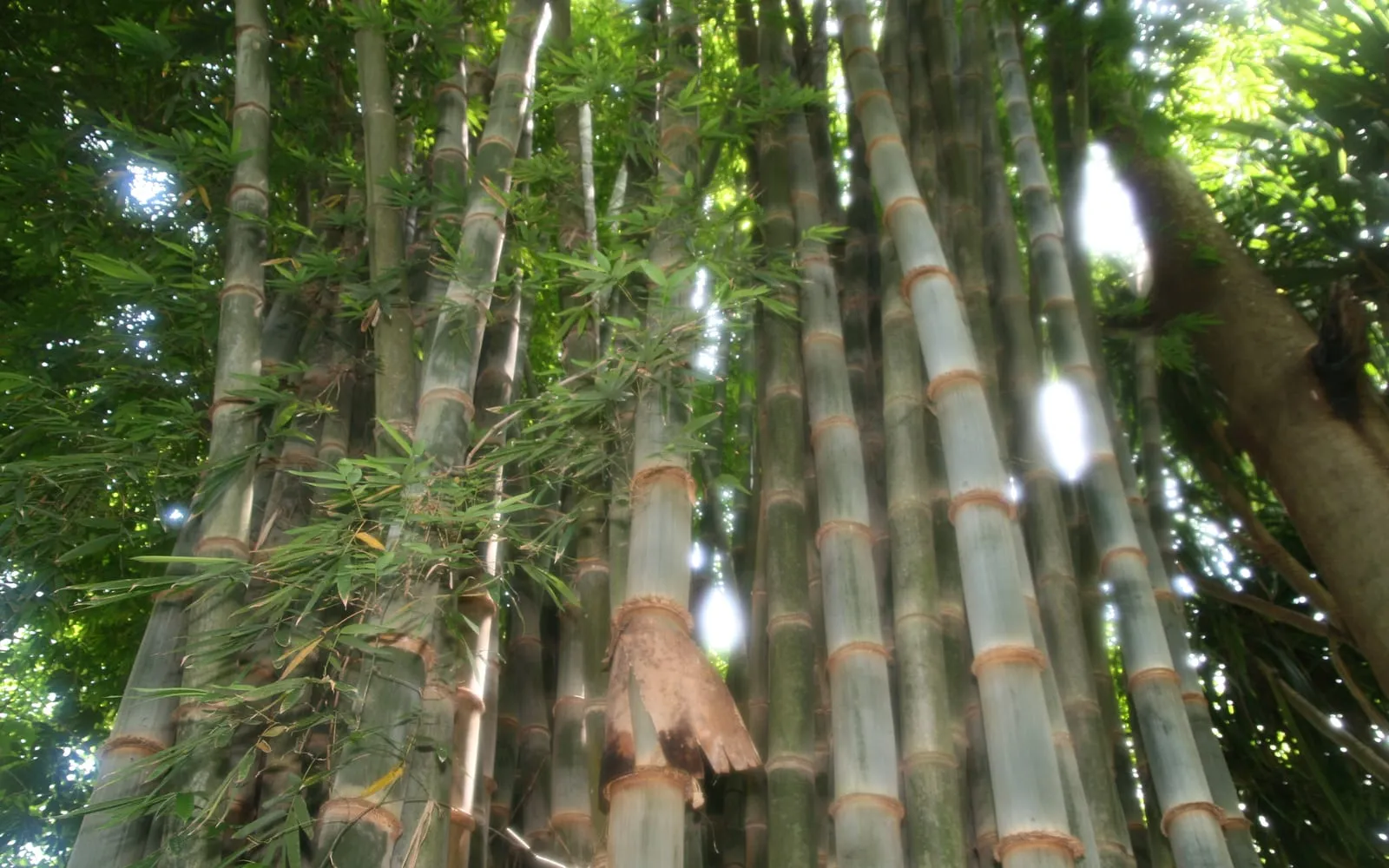
Mature culms are a pale blue-green when young, ageing to a duller yellow-green, upright at the base of the clump and arching outward towards the top under their own considerable weight. The culm walls are thick, which is what makes them valuable for construction, and the nodes along each cane are pronounced, ringed swellings that mark where side branches emerge higher up the stem.
Leaves are relatively small for a plant of this scale, borne in clusters on the upper branches, and give a mature clump a light, feathery canopy high above a trunk-like base that can look more like a stand of small trees than a grass.
Where it is from
Dendrocalamus giganteus is native to Myanmar, Thailand and neighbouring parts of Southeast Asia, and is now cultivated widely across the tropics and subtropics of Asia, including southern China and India, well beyond its original range.
It grows naturally in lowland tropical forest and river valleys with high year-round rainfall and consistent heat, conditions that let a clump put on the enormous seasonal growth its size depends on. Its native range has no real dry season by temperate standards and no cold season at all, which explains both how quickly it can grow and how little tolerance it has for either drought or frost.
How it grows
Plant in deep, fertile, moisture-retentive soil in full sun, in a position with plenty of room, since a mature clump eventually occupies a footprint several metres across and needs an equivalent amount of space overhead for its arching canes.
Give it consistent water and warmth from the outset. Unlike many ornamental bamboos, this species has almost no drought tolerance and a young plant that dries out during its main growing period is set back badly rather than merely slowed.
Propagate from culm cuttings, offsets divided from an established clump, or, less commonly, from seed, which this species produces only irregularly since bamboo generally flowers just once every several decades before dying back. Division of an existing clump is the most reliable route to a new plant for most growers.
Outside a consistently tropical climate, it is usually grown in a large container or a heated glasshouse rather than in open ground, since the size a specimen can reach under glass is a fraction of what it achieves in the tropics but is still often the largest plant most temperate growers will ever house.
Through the seasons
The wet season, where the climate provides one, drives the main flush of new shoots and the fastest growth, with established culms capable of reaching their full height within a single such season.
The dry season slows growth considerably, and in cultivation outside the tropics this period corresponds to the coolest months, when watering is reduced but never stopped altogether.
Shoot emergence happens at the base of the clump, usually timed to the start of the main growing season, and this is when new canes reach their final diameter, since a bamboo culm does not thicken further once it has finished its initial growth spurt.
A cold spell, in any climate cool enough to produce one, can damage or kill young shoots outright even where the established clump survives largely unharmed.
Care difficulty
Difficult, and mostly because of scale rather than any inherent fussiness. Enough warmth, water and feeding keep the plant alive without much trouble. Almost no garden outside the true tropics can give it the space, heat and rainfall it needs to reach anything like its natural size, and a plant grown well below its potential is still a large one to accommodate.
Watering and feeding both need to be generous and sustained through the growing season, since a plant capable of this much growth in a short period draws heavily on both.
Watering
Water generously and often through the growing season, keeping the root zone consistently moist rather than allowing it to dry out between waterings, since this species has essentially no built-in tolerance for drought.
Reduce watering somewhat during any cooler or slower period, but do not let the soil dry out completely even then, since the deep, moisture-loving root system this bamboo relies on has no dormant strategy for coping with prolonged dryness the way a temperate grass does.
Warning signs, diseases and pests
Scale insects cluster on the culms and around the branch nodes, appearing as small, immobile brown bumps that sap the plant’s vigour over time. Horticultural oil applied directly to the affected areas is the standard treatment.
Aphids colonise new shoots and soft foliage, distorting growth and fouling it with sticky honeydew. A strong jet of water or an insecticidal soap deals with light infestations before they spread further.
Sooty mould follows an infestation of aphids or scale, growing as a black, powdery coating on the honeydew they leave behind. Treating the insect responsible clears the mould as a consequence.
Root rot develops where the deep root system this plant relies on sits in poorly drained ground rather than moist, free-draining soil. Good drainage at planting time is essential given how much water this species otherwise needs.
Growing environment
Full sun and real warmth are both essential. Growth slows sharply below around 15 deg C and stops altogether well before frost, which damages or kills the plant outright depending on severity and how established the clump is.
High humidity suits it best, mirroring the wet tropical air of its native range, and it performs poorly in a dry, centrally heated indoor environment even where temperature alone would otherwise be adequate.
Deep, fertile, moisture-retentive soil supports the scale of growth this species is capable of. Poor or shallow soil produces a smaller, weaker clump regardless of how much water and feed are applied above ground.
Space is the final and often limiting factor. A mature clump needs several metres of room in every direction, both for the canes themselves and for the extensive root mass that supports them.
Feeding
Feed generously through the growing season with a high-nitrogen fertiliser or well-rotted manure, applied monthly, since a plant capable of putting on this much growth in a matter of months draws heavily on soil nutrients to do it.
Reduce or stop feeding during any period of slower growth, whether that is a genuine dry season or, in cultivation outside the tropics, a cooler part of the year.
A mulch of well-rotted organic matter around the base of the clump supplies additional fertility over time and helps the root zone hold the moisture this species constantly needs.
Troubleshooting
My plant has never grown anywhere near as large as I expected. Almost always a matter of warmth, water or space rather than anything wrong with the plant. This species reaches its full size only in sustained tropical heat with heavy year-round rainfall, and a specimen grown in a container or a cooler climate will always be a fraction of what it achieves in those conditions.
Can I really eat the shoots, and how? Yes, once cooked. Harvest young shoots as they emerge from the base, peel away the tough outer sheaths, and boil the tender core for at least twenty minutes before eating it in any dish that calls for bamboo shoot. Never eat a raw shoot straight from the clump.
New shoots blackened and died after a cold snap. Frost or a hard chill, even a brief one. Established canes often survive a light frost that kills the current season’s emerging shoots outright, so a damaged crop of new growth does not necessarily mean the whole clump has been lost.
Is this the same bamboo used for garden canes and screening? No. Most garden bamboo sold for screening is a much smaller species suited to a normal garden. Giant bamboo is grown at a different scale entirely and needs tropical or near-tropical conditions to be worth planting for its size at all.
Will it spread and take over like some bamboos do? No, not in the invasive, far-running sense some bamboo species are known for. This is a clumping species that expands slowly outward from its base rather than sending runners through the surrounding garden, though a mature clump still eventually needs several metres of space to itself.