
Outdoor plant
Woolly Foxglove
Digitalis lanata
Also known as Grecian foxglove, Digitalis lanata
How to recognise Digitalis lanata, the foxglove behind digoxin. Cream flowers with a big white lip, why this species supplies the drug, and the same danger as every foxglove.
At a glance
- Difficulty
- Easy
- Water
- Never plant it where a child would pick the flowers
- Light
- Full sun to light shade
- Temperature
- Hardy, to about minus 20 deg C
- Hardiness
- USDA 4-8, RHS H6, hardy to -20 C
- Type
- Biennial or short-lived perennial
- Height
- 60-100 cm
- Native to
- the Balkans, the Danube basin, Turkey
Sharp drainage and full sun suit it better than they suit common foxglove, and it is shorter-lived, often behaving as a biennial. Cold does not trouble it. This is the species digoxin is extracted from, and the whole plant is dangerous, with the gap between a dose and an overdose narrower than for almost any other medicinal herb.
Hardiness zones describe winter cold alone. Summer heat, humidity, rainfall and the length of the growing season decide as much, so treat the range as the outer limit rather than as a recommendation.
Poisonous if eaten
- Do not eat
- Every part, and the leaves most of all
- Harm from
- Eating it
- Affects
- People, cats, dogs and horses
Every foxglove is dangerous and this one is more concentrated than the common purple foxglove. Digitalis lanata contains lanatoside C and digoxin itself, and it is the commercial source of digoxin worldwide, which is to say the plant in a border and the drug in a hospital are the same chemistry. The ASPCA lists foxglove as toxic to dogs, cats and horses, describing cardiac arrhythmias, vomiting and death, and its entry covers the genus through the common species rather than this one specifically. Cardiac glycosides interfere with the heart's electrical conduction, and poisoning produces nausea and vomiting, abdominal pain, visual disturbance with yellow-green haloes, confusion, and a slow or irregular pulse that can progress to cardiac arrest. The margin between an effective dose and a dangerous one is narrow, which is why digoxin is monitored by blood test in clinical use. Poisoning has followed leaves being mistaken for comfrey or borage and brewed as tea. Any suspected ingestion is a medical emergency. Get emergency care at once, take a piece of the plant, and do not wait for symptoms.
Sources: ASPCA, Foxglove, RHS potentially harmful garden plants, ASPCA toxic and non-toxic plants
About
The digoxin in a hospital pharmacy comes from this plant. William Withering established the medical use of the common purple foxglove in 1785, and the pharmaceutical industry that followed settled on Digitalis lanata instead, because its glycoside content is higher and the extraction is cleaner. Most digoxin manufactured today is made from woolly foxglove grown as a crop, largely in the Netherlands and eastern Europe.
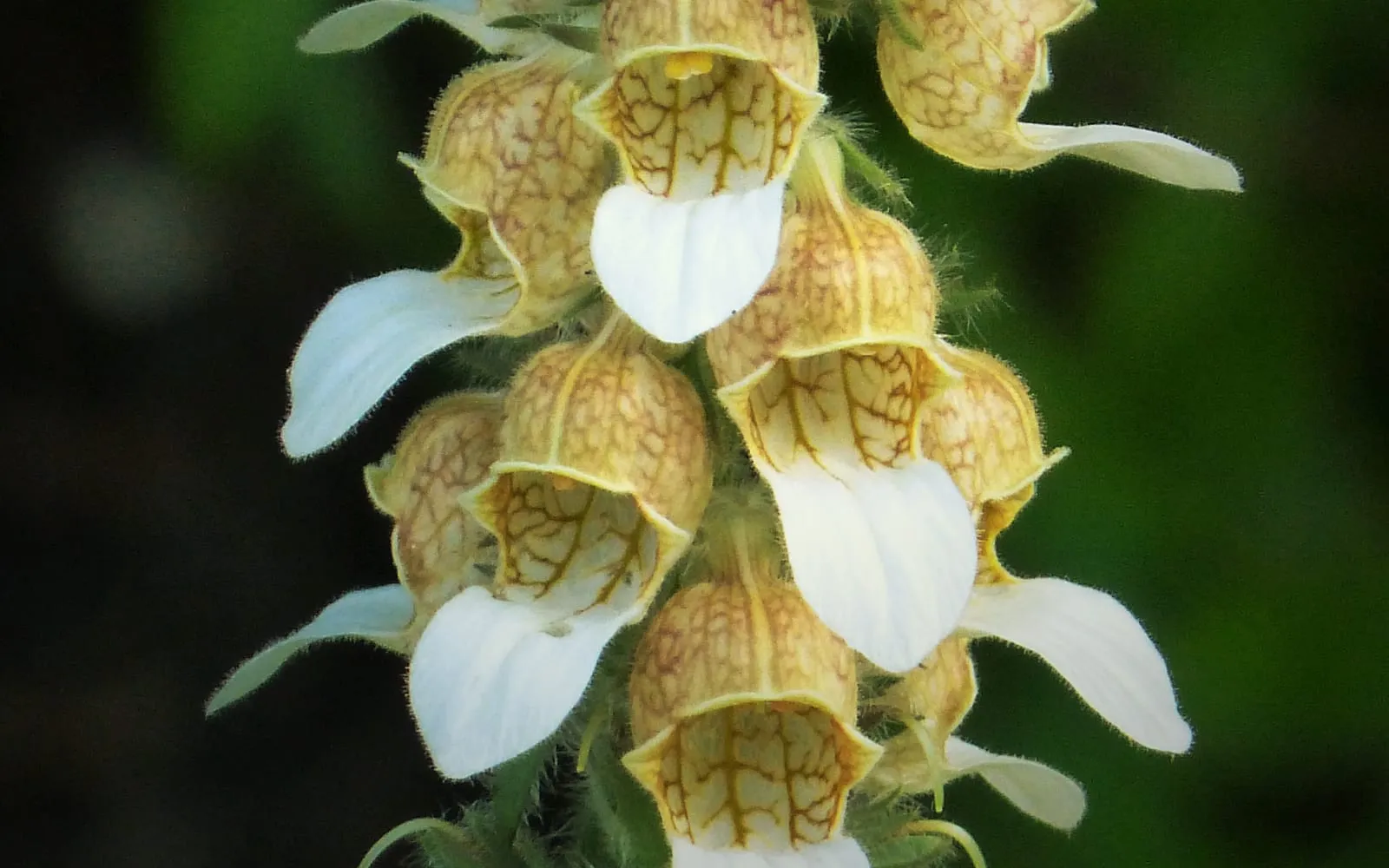
The plant is a native of the Balkans and the Danube basin rather than of Britain, and it is grown in physic gardens, in some borders and, occasionally, escaping. It is more compact and stiffer than the wild foxglove, with a dense one-sided spike of cream flowers netted in brown and a conspicuous white lower lip.
Anyone who has read about digoxin in connection with the common foxglove has been reading about this plant without being told its name. The hazard is the same as any foxglove’s and the concentration is higher.
Appearance and character
The first year produces a flat rosette of narrow lance-shaped leaves 10 to 25 cm long, deep green, smooth-edged, with a prominent midrib. That rosette is the stage most easily mistaken for a harmless plant.
The second year sends up a stout unbranched spike 60 cm to a metre tall, densely packed with flowers, and the stem and calyces carry a covering of soft woolly hairs which is what gives the species its name.
The flowers set it apart from the common foxglove at a glance. Each is 2 to 3 cm long, pale cream to fawn, netted with fine brown-purple veins, with a large projecting white lower lip that hangs below the tube like a tongue. They are packed tightly around the spike rather than hanging on one side.
Where it is from
Digitalis lanata is native to south-eastern Europe, through the Balkans, Hungary, Romania and into Turkey, growing on dry stony hillsides, in open scrub and on grassy banks with free drainage.
It is grown as a field crop for digoxin extraction, chiefly in the Netherlands and in eastern Europe, harvested as leaf. That crop is the source of most of the world’s supply of the drug.
It has naturalised in parts of North America, and in Minnesota it is listed as a noxious weed, having spread on roadsides and prairie from garden plantings. In Britain it appears as an occasional escape rather than as an established plant.
How it grows
The plant is biennial in most conditions and can behave as a short-lived perennial. Seed germinates in summer or autumn, the rosette overwinters, the spike rises the following June, and the plant usually dies after setting seed.
Seed is produced in very large quantities in dry capsules and is fine enough to be moved by wind and on boots and machinery, which is how the plant spread in North America.
It prefers dry stony ground and free drainage and is more drought tolerant than the common foxglove, which is a woodland plant of moist acid soil.
Through the seasons
Rosettes sit through the winter as flat clusters of narrow leaves, unremarkable and easy to overlook among other plants.
The spike rises in June and flowers through July, with the flowers opening from the bottom upward. Bees work them heavily and the plant is a good nectar source.
Capsules ripen from August and shed fine seed through the autumn. Deadheading before that is the only maintenance worth doing, and it is what stops the plant seeding itself across a garden.
Care difficulty
The plant is easy to grow, which is not the same as being a good idea. It is hardy, drought tolerant, seeds freely and needs nothing.
The decision is about siting. Flowers on a metre-tall spike at eye level for a small child, on a plant more concentrated than the common foxglove, argue against a position beside a path or a play area.
Anyone growing it should deadhead before seed sheds and wear gloves when handling it. Wash your hands afterwards, as with any foxglove.
Watering
Never plant it where a child would pick the flowers. That is the substance of this section.
The plant is drought tolerant and grows on dry stony ground. It needs no watering in a temperate climate once established.
What it does not tolerate is winter wet, which rots the crown. Free drainage is the one cultural requirement.
Warning signs, diseases and pests
The warning signs are about people. A foxglove in seed near a path, a vegetable bed or a place children play is a job to do rather than a thing to watch.
The specific confusion to guard against is with comfrey and borage. Foxglove rosette leaves are narrow, smooth-edged and hairless in this species, where comfrey’s are broader and bristly, and people have been poisoned brewing the wrong rosette as tea.
Slugs graze the overwintering rosette and crown rot takes plants in wet winter soil. Neither matters much next to the plant’s own hazard.
Growing environment
Full sun to light shade on free-draining soil. It prefers dry stony ground and tolerates poor soil well.
Hardiness is adequate to about minus 20 deg C. Winter wet kills more plants than cold does, as with most dry-hillside species.
It self-seeds prolifically on open ground and much less in a closed planting, so a gravel garden will give more seedlings than a border.
Feeding
None. The plant grows on thin stony soil in the wild and needs nothing in a garden.
Feeding produces a larger plant with more seed, which is not an improvement.
If the soil is heavy, grit is the amendment worth making, since drainage is what the plant needs.
Troubleshooting
How is it different from the common foxglove? Digitalis purpurea has hanging pink-purple bells on a one-sided spike and broad soft hairy leaves. Digitalis lanata has cream flowers netted with brown, a large white lower lip, narrow smooth leaves and a woolly flower stem.
Is this really where digoxin comes from? Yes. Most digoxin manufactured today is extracted from Digitalis lanata grown as a field crop, because its glycoside content is higher than the common foxglove’s.
Someone has eaten it. What do I do? Get emergency care immediately, take a piece of the plant with you, and do not wait for symptoms. Cardiac glycoside poisoning affects the heart and is treatable when treatment starts early.
Is it safe to have in the garden? It is as safe as any foxglove, which is to say it is fine in a border where nobody eats it and a poor choice beside a path in a garden with small children. Deadhead before it seeds.
Can it be confused with comfrey? The first-year rosette can, and people have been poisoned brewing it as tea. Foxglove leaves here are narrow and smooth; comfrey leaves are broader and rough with bristles.
Will it take over? It seeds prolifically on open ground. Deadheading before the capsules ripen prevents that entirely.
Do I need gloves? Wear them for pruning and deadheading, and wash your hands afterwards. The risk is from ingestion rather than from touch, and the habit is still worth having.