
Outdoor plant
Lords-And-Ladies
Arum maculatum
Also known as Cuckoo pint, Wild arum, Jack in the pulpit, Snakeshead
How to identify lords and ladies, Arum maculatum. The orange berry spike children eat, the burning mouth it causes, and how to tell it from wild garlic in spring.
At a glance
- Difficulty
- Easy
- Water
- None needed, since it is a wild plant of shaded ground
- Light
- Partial to full shade
- Temperature
- Fully hardy, and in leaf through winter
- Hardiness
- USDA 6-9, RHS H6, hardy to -20 C
- Type
- Perennial, dying back in summer and regrowing from a tuber
- Height
- 30-50 cm
- Native to
- Europe including Britain, in woodland and shaded hedge banks
- Best month
- September in the Northern Hemisphere, March in the Southern Hemisphere
Deep shade and heavy soil suit it, and the leaves appear in winter and die back by midsummer, so it occupies the ground when nothing else is using it. The berries are the hazard. They ripen to bright orange-red on a bare stalk at the height of a small child and are one of the commonest causes of plant poisoning enquiries. It has naturalised through the American Pacific north-west, where it is becoming a woodland problem.
Hardiness zones describe winter cold alone. Summer heat, humidity, rainfall and the length of the growing season decide as much, so treat the range as the outer limit rather than as a recommendation.
Every month named in this guide is for the temperate Northern Hemisphere. If you garden in the Southern Hemisphere, shift each one by six months, so September becomes March. Closer to the equator the wet and dry seasons matter more than the calendar, and the shift stops being a useful guide.
Poisonous if eaten
- Do not eat
- Every part, and the ripe berries most of all
- Harm from
- Eating it, handling it and sap in the eyes
- Affects
- People, cats and dogs
Lords and ladies is one of the commonest causes of plant poisoning enquiries involving children, because the berries are bright orange-red, clustered at knee height and look like sweets. Every part of the plant contains needle-like calcium oxalate crystals held in specialised cells that fire on contact, along with other irritant compounds. Chewing any part produces immediate intense burning of the lips, mouth, tongue and throat, with swelling, drooling and difficulty swallowing. That burning is the plant's own protection and it is the reason serious poisoning is uncommon, since almost nobody swallows a second mouthful. Where a significant quantity is swallowed, swelling of the airway is the danger, along with vomiting and stomach pain. Contact with sap can irritate skin and cause painful inflammation if rubbed into the eye. Treat any ingestion by a child as needing medical advice, give cold milk or water to sip and do not induce vomiting. Get emergency help if there is any difficulty breathing or swallowing. The ASPCA lists Arum maculatum as toxic to cats and dogs for the same reason, and the presentation is drooling, pawing at the mouth and vomiting.
Sources: ASPCA toxic and non-toxic plants, RHS potentially harmful garden plants
About
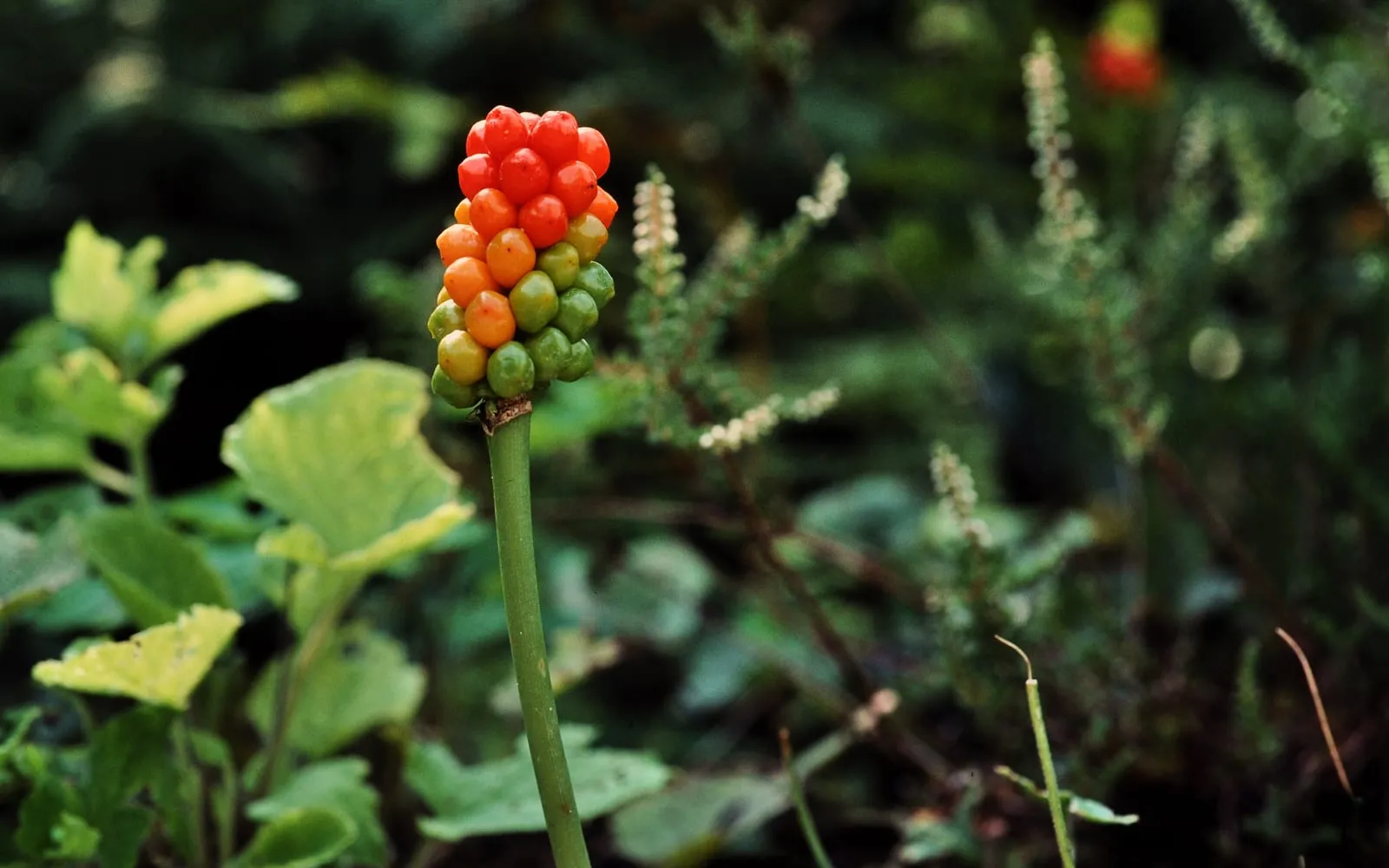
The spike of orange-red berries standing on a bare stalk in a hedge bottom in September is the plant most often photographed by an anxious parent.
Lords and ladies is native, extremely common, and grows in exactly the places children play. Woodland edges, shaded hedge banks, churchyards, garden borders under trees.
The berries are the problem. They are glossy, bright, held at knee height on a leafless stalk, and they look edible in a way that almost nothing else at that season does.
The plant defends itself effectively. A mouthful burns immediately and violently, which is why serious poisoning is rare despite how often it is tasted. That does not make it harmless, and a child who has chewed one needs advice.
It is also a plant with an extraordinary flower. In spring it produces a pale hood wrapped around a purple-brown spike that generates its own heat and smells of dung, trapping midges overnight to pollinate it.
Appearance and character
A perennial growing from a tuber, with a life cycle out of step with almost everything around it.
Leaves appear from late winter, often in January or February, and are the first fresh green in a hedge bottom. They are arrow-shaped or spear-shaped with two backward-pointing lobes, glossy and dark green, 10 to 25 cm long, often marked with irregular dark purple-black blotches.
The flower appears in April and May. A pale green or yellowish hood, the spathe, wraps around a poker-shaped purple-brown spike, the spadix. The whole structure is 15 to 25 cm tall and smells faintly of decay.
The leaves die back and vanish completely by midsummer, leaving no trace.
Berries follow in August and September on a bare stalk 15 to 30 cm tall, packed in a dense cylindrical spike. They ripen from green through yellow and orange to brilliant scarlet, and are 5 to 8 mm across.
This bare-stalk-of-berries stage with no leaves anywhere is the thing people find and fail to identify, because the plant that made it has already disappeared.
Where it is from
Europe including Britain, where it is native and common throughout England and Wales and more local in Scotland.
It grows in deciduous woodland, along shaded hedge banks, in churchyards, on woodland edges and in shaded garden borders, favouring moist humus-rich soil and doing particularly well on chalk and clay.
Its winter leaf and early summer die-back are an adaptation to woodland. The plant does its growing while the tree canopy is bare and shuts down when the wood closes over.
The name cuckoo pint is old and bawdy, referring to the shape of the spadix, and lords and ladies has the same origin. The plant carries dozens of regional names in Britain, more than almost any other wild plant.
The related Italian lords and ladies, Arum italicum, is grown in gardens for its marbled winter foliage and is similarly toxic. It seeds about freely.
How it grows
This is not a plant to introduce, and the species is worth tolerating in a wild corner where children do not play.
It grows from a tuber that sits several centimetres down and spreads slowly into a colony, and it also seeds where birds take the berries.
To remove it, dig the tuber out. Pulling the leaves off achieves nothing, since the tuber regrows immediately.
Dig in autumn or winter when the plant is visible, going deep enough to get the whole tuber. Fragments left behind will regrow.
Wear gloves. The sap irritates skin, and rubbing an eye afterwards is painful.
In a garden with small children, cut the berry spikes off in August before they ripen and colour. Bag them rather than composting them.
Arum italicum in a border needs the same discipline, since it seeds prolifically and the marbled foliage sold as an ornamental produces the same berries.
Through the seasons
Winter is when the leaves appear, from January, giving glossy arrow-shaped green in an otherwise bare hedge bottom. This is the time to dig tubers out.
Spring brings the hooded flower in April and May, and the leaves are at their fullest. This is also when confusion with wild garlic arises.
Summer sees the leaves yellow and vanish entirely by July, leaving bare ground.
Autumn is the berry stage, from August into October, on a leafless stalk. Cut them off where children have access.
Care difficulty
Identification is easy at every stage once you know what to look for.
The plant needs no care and is difficult to remove permanently, since the tuber sits deep and any fragment regrows.
The real difficulty is the timing mismatch. The berries appear when the leaves have gone, so the two halves of the plant are never visible together, and people who know the leaves do not recognise the berries.
Watering
Not applicable. It is a wild woodland plant and looks after itself.
It indicates moist, shaded, humus-rich ground, often on chalk or clay.
Warning signs, diseases and pests
The warnings here concern people and animals rather than the plant, which is untroubled by pests.
A child has eaten a berry. Get medical advice. Give cold milk or water to sip, wipe out any plant material still in the mouth, and do not induce vomiting. The burning is immediate and severe and usually stops any further eating. Get emergency help if there is any swelling of the lips or tongue, drooling with difficulty swallowing, or any trouble breathing.
Sap on skin causes redness and irritation. Wash it off with soap and water.
Sap in the eye causes intense pain and inflammation. Irrigate with clean water for fifteen minutes and get medical advice the same day.
A dog or cat has chewed it. Expect drooling, pawing at the mouth, vomiting and reluctance to eat. Ring a vet. Airway swelling is the thing to watch for.
Livestock rarely eat it because of the burning, and it is not a significant pasture problem.
Growing environment
Partial to full shade, in moist humus-rich soil, and it is entirely self-sufficient.
Look for it in woodland, hedge banks, churchyards, under garden hedges and in shady borders, particularly on chalk and clay.
In a wildlife garden it is worth leaving. The flower is pollinated by an unusual mechanism, and the berries are eaten by blackbirds and thrushes without harm.
In a garden used by toddlers, the berries are the reason to act. Cutting the spikes before they colour in August removes the hazard without digging the plant out.
Where it is in a border and unwanted, dig the tubers in winter and expect to repeat it.
Feeding
Not applicable. It needs nothing and responds to rich woodland soil by spreading more freely.
Troubleshooting
A child has eaten the orange berries. Get medical advice. Give cold milk or water to sip, clear the mouth, do not make them sick. Get emergency help if there is swelling or any difficulty breathing or swallowing.
Is this wild garlic? No, and this is the confusion that matters in spring. Wild garlic has broad flat leaves that smell strongly of garlic when crushed and rise singly from the ground on their own stalks. Lords and ladies has arrow-shaped leaves with two backward-pointing lobes, no smell, and often dark blotches. Crush a leaf. If it does not smell of garlic, it is not wild garlic.
What is the spike of berries with no leaves? That is lords and ladies in autumn. The leaves die back in July, so the berries stand on a bare stalk with nothing else attached, which is why so few people recognise it.
How do I get rid of it? Dig the tuber out in winter when the leaves are visible. Removing the leaves alone does nothing.
I have small children. Should I remove it? Cutting the berry spikes off in August before they colour is quicker and more effective than trying to dig out a colony, and it removes the actual hazard.
My dog ate one. Ring a vet. Expect drooling, pawing at the mouth and vomiting, and watch for any swelling that affects breathing.
Is the garden one with marbled leaves the same? Arum italicum is a close relative grown for winter foliage and is equally toxic, with the same berries. Treat it the same way.
Why does the flower smell? It heats itself and produces a dung-like smell to attract midges, which it traps overnight to carry pollen. The whole apparatus is one of the odder things in the British flora.