
Outdoor plant
Barren Strawberry
Waldsteinia ternata
Also known as Siberian Barren Strawberry, Siberian Waldsteinia
How to grow barren strawberry, Waldsteinia ternata, a tough shade groundcover with strawberry-like leaves and yellow flowers but no edible fruit.
At a glance
- Difficulty
- Easy
- Water
- Regularly for the first year, then occasional in drought
- Light
- Partial shade to full sun
- Temperature
- Fully hardy, to about -20 deg C
- Hardiness
- USDA 4-9, RHS H6, hardy to -20 C
- Type
- Hardy semi-evergreen perennial
- Height
- 10-15 cm
- Native to
- Central and eastern Europe, temperate Asia
Cold is no obstacle to this plant across most of the temperate world. What the zone number leaves out is how well it tolerates root competition and dry shade under trees once it has had a season to settle, which is a bigger factor in whether it thrives than winter temperature ever is.
Hardiness zones describe winter cold alone. Summer heat, humidity, rainfall and the length of the growing season decide as much, so treat the range as the outer limit rather than as a recommendation.
Not known to be toxic
Waldsteinia ternata is not listed among the RHS potentially harmful garden plants, and no toxicity to people or animals is recorded by the ASPCA or by university extension plant profiles. Its fruit is described as inedible, small and dry rather than as harmful, which is a different thing from toxic and is the reason for the plant's common name. Treat it as safe groundcover for a garden with children or pets, on the same footing as its close relatives in the strawberry and cinquefoil group.
Sources: NC State Extension Gardener Plant Toolbox (Waldsteinia ternata), RHS potentially harmful garden plants
About
Barren strawberry looks, at a glance, like an ordinary strawberry plant that has forgotten to fruit. The leaves are the same three-lobed shape, the flowers open the same bright yellow, and the whole plant runs across the ground the same way. What never follows is fruit worth eating, and that gap between appearance and reward is built into the plant’s name.
The reason is structural rather than a failure of pollination. In a true strawberry, the fleshy red fruit most people eat is the swollen flower receptacle, studded on its surface with the real botanical fruits, the tiny dry achenes. Waldsteinia never swells its receptacle that way, so its flowers set only those small, dry, seed-like fruits, and they stay hard rather than becoming worth eating.
What it does offer is a tough, adaptable groundcover that holds its strawberry-like leaves through most of the winter and copes with root competition and shade better than the true strawberry does. That is the trade a gardener makes by choosing it.
Appearance and character
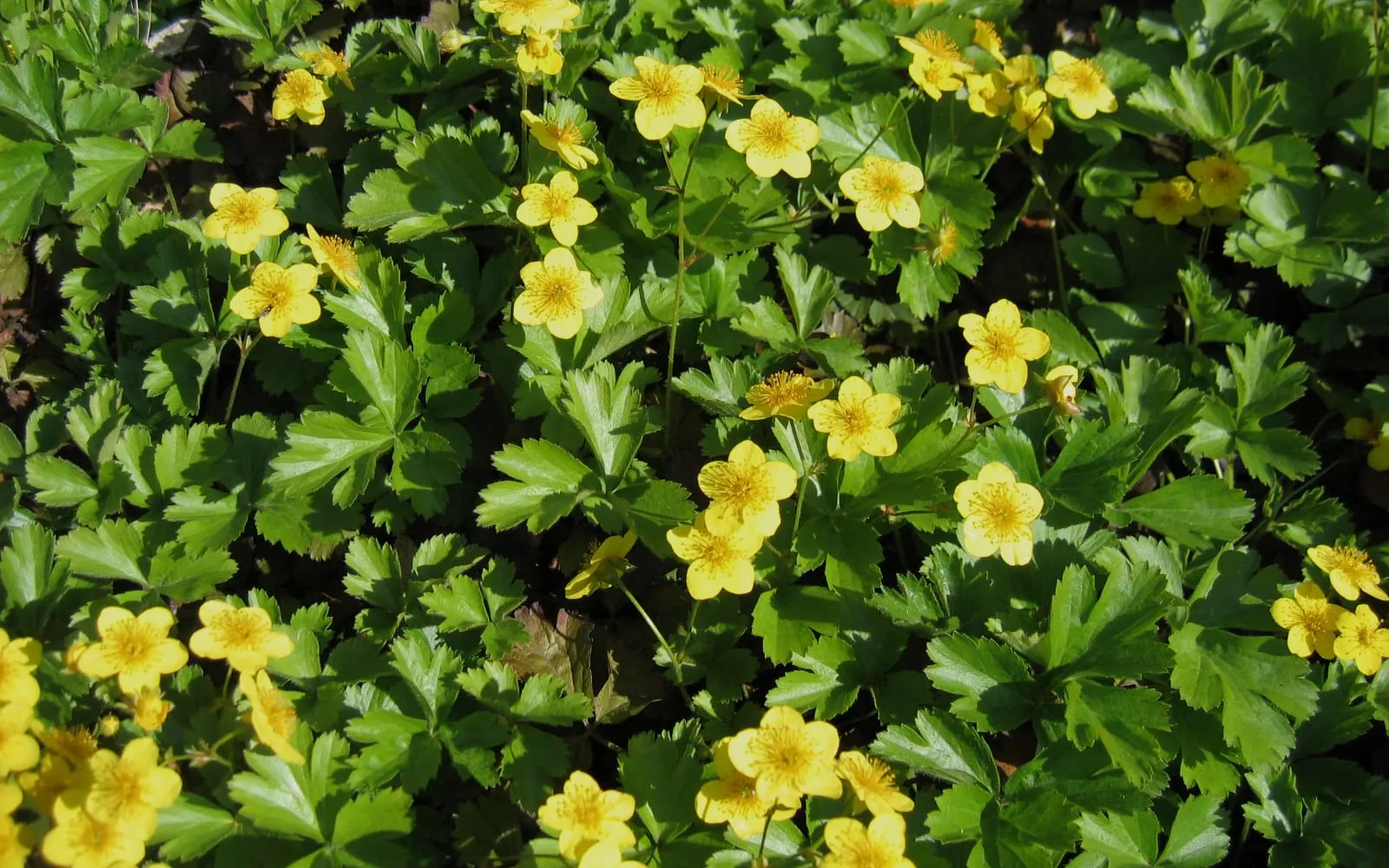
Leaves are trifoliate, divided into three toothed, dark green leaflets on a short stalk, closely resembling a wild strawberry leaf at a casual glance and giving the plant most of its visual identity outside the brief flowering period.
Flowers are bright yellow, five-petalled, 1.5 to 2 cm across, held singly or a few together on short stems above the foliage in April and May, similar in shape to a cinquefoil flower, which is a close botanical relation.
The foliage is semi-evergreen, staying green through a mild winter and often taking on bronze or reddish tints in cold weather before fresh green growth replaces it in spring.
Growth forms a low, dense, even mat rather than a scattering of individual clumps, and a well-established planting knits together tightly enough to suppress most weed germination underneath it.
Where it is from
Waldsteinia ternata is native across central and eastern Europe and into temperate Asia, including Siberia, growing in woodland and at woodland margins in soil enriched by leaf litter.
The genus is named after Franz de Paula Adam von Waldstein, an Austrian botanist and count of the late eighteenth century, and ternata refers to the three-part, trifoliate leaf that gives the plant its strawberry-like look.
A related North American native, Waldsteinia fragarioides, grows wild across eastern woodland from Ontario south into the Appalachians and is sometimes offered as a regional alternative in North American gardens, though Waldsteinia ternata remains the species most widely sold and grown for groundcover.
It reached cultivation as a reliable, low-maintenance filler for the difficult ground under trees and shrubs, a role it has held for decades without needing much promotion, since it does the job with very little drama.
How it grows
Spread comes from short rhizomes and above-ground runners extending from the parent crown, rooting at intervals and producing new rosettes that gradually knit into a continuous mat. The pace is moderate rather than fast, closer to a clump-forming perennial slowly widening than to a vigorous runner racing across open ground.
Plant divisions or young plants 25 to 30 cm apart for reasonably full cover within two to three seasons. Establishment is quickest in soil with some organic matter and consistent moisture, and noticeably slower in dry shade under mature trees, though it still succeeds there over a longer timescale.
Division of an established clump is straightforward. Lift a rooted section with a spade or hand fork in spring or autumn and replant it immediately with a thorough watering in.
Through the seasons
Spring brings the flowering display through April and into May, alongside the year’s main flush of new leaf growth and runner extension.
Summer is quieter, with the plant holding its mat through warmer weather and needing watering only in a prolonged dry spell, particularly where it is competing with tree roots for moisture.
Autumn is a good second window for planting or dividing an established clump, letting the pieces settle in before winter. Fallen leaves can be left in place as a light mulch rather than raked off, since the plant tolerates them better than many evergreen groundcovers do.
Winter sees the semi-evergreen foliage persist through mild spells, often taking on a bronze tint in cold weather, with the whole plant dying back only in the harshest conditions before returning reliably in spring.
Care difficulty
Easy, and notably tolerant of the conditions that trouble many groundcover perennials, including dry shade and competition from tree roots. A newly planted patch establishes with ordinary care and then needs very little for years afterward.
The main task, where one exists, is occasional division of an old, congested clump to keep growth vigorous, which is optional rather than necessary on most plantings.
It takes a wider range of light conditions than many flowering groundcovers, performing respectably from full sun through to fairly deep shade, which makes it a useful choice for a bed that gets mixed light through the day.
Watering
Water regularly through the first growing season after planting, while roots and runners are still establishing and before the mat has built up enough coverage to conserve its own soil moisture.
An established planting tolerates short dry spells reasonably well, particularly in soil with decent organic content, though a prolonged drought in a hot, exposed position will show as dulled or wilting foliage.
Dry shade under a mature tree is the position most likely to need supplementary watering in a dry summer, since the tree canopy intercepts much of the rainfall that would otherwise reach the roots.
Warning signs, diseases and pests
Slugs and snails graze young leaves, mostly affecting new plantings before the mat has bulked up enough to shrug off the damage.
Leaf spot appears as small dark blotches after extended wet weather and is generally cosmetic on an established, well-spaced planting, resolving once drier conditions return.
Powdery mildew can develop in a crowded, poorly ventilated patch, more often in a dry season with still air than in a wet one. Thinning an overcrowded clump improves airflow and reduces the risk.
Vine weevil grubs occasionally feed on the roots, mainly where the plant is grown in a container rather than open ground, where the damage is usually more noticeable and more damaging.
Growing environment
Partial shade suits it particularly well, and it also tolerates full sun with adequate moisture or fairly deep shade with reduced flowering, giving it a wider usable range of light than many flowering perennials offer.
Soil should ideally be moist and humus-rich, though the plant adapts well to average garden soil and, once established, to dry shade under trees, which is where it earns its keep most clearly.
It is not particular about pH, growing well across acid to neutral soils, and it takes underplanting beneath shrubs and small trees without complaint, which is one of its principal garden uses.
Feeding
A light balanced feed in spring, or a mulch of leaf mould, supports steady growth on average or poor soil, though an established planting on reasonable ground needs very little additional feeding.
Avoid heavy or repeated fertiliser applications, which push soft, lush growth more prone to mildew than the plant’s normal, moderate pace of growth.
Where it is used under trees, a mulch does more good than a fertiliser application, both feeding the soil lightly and helping to retain the moisture that dry shade otherwise takes away.
Troubleshooting
It looks exactly like a strawberry but never fruits properly. That is normal. The small, dry fruit it does produce is not the fleshy fruit a true strawberry makes, and no amount of feeding or better pollination will change that. Grow it for the foliage and flowers, not for fruit.
Growth has been slow under a large tree. Dry shade and root competition both slow this plant down, though it usually succeeds there eventually with consistent watering through the first year or two after planting.
The leaves have gone reddish-bronze in winter. Normal seasonal colour change on the semi-evergreen foliage, not a sign of stress, and it reverts to green with the spring flush.
Small dark spots have appeared on the leaves. Leaf spot after wet weather, usually cosmetic on an established planting. Remove badly affected leaves if it bothers you, and expect it to clear as conditions dry.
Can I mow or trim it like a lawn? It is not built for regular mowing or foot traffic the way turf is, and cutting it back hard is better done occasionally with shears if the mat becomes untidy rather than treated as routine maintenance.
It has stopped flowering as freely as it used to. Deepening shade, as a nearby tree or shrub grows and casts more cover than it did when the plant was first established, is a common cause. Consider whether the light conditions have changed since planting.
White powder has appeared on some leaves. Powdery mildew, usually in a crowded or dry, still position. Thin the clump for better airflow, and water during dry spells to reduce plant stress.