
Outdoor plant
Cretan Bryony
Bryonia cretica
Also known as Red Bryony, Mediterranean Bryony
What Cretan bryony is, Bryonia cretica, a red-berried wild climber of the cucumber family with a poisonous root, and how to control it.
At a glance
- Difficulty
- Easy
- Water
- None; a wild plant that needs no watering
- Light
- Full sun to partial shade
- Temperature
- Hardy; the top growth dies back in winter
- Hardiness
- USDA 6-9, RHS H5, hardy to -15 C
- Type
- Herbaceous perennial climber from a swollen root
- Height
- 2 to 4 m of annual growth
- Native to
- The Mediterranean
A plant of the warm, dry Mediterranean, hardy enough that its top growth dies down in winter and regrows from the root in spring. It suits hot, dry summers and free-draining ground far better than cold, wet clay. The red-berried bryony of British hedgerows belongs to this same broad group and is a little hardier, coping with cooler, damper conditions.
Hardiness zones describe winter cold alone. Summer heat, humidity, rainfall and the length of the growing season decide as much, so treat the range as the outer limit rather than as a recommendation.
Poisonous if eaten
- Do not eat
- Every part, and the root and berries most of all
- Harm from
- Eating it and handling it
- Affects
- People, cats, dogs and horses
Cretan bryony is poisonous throughout, with the swollen root and the ripe red berries the most dangerous parts. Like the rest of its family it contains bitter cucurbitacins, and the root is a drastic purgative that has poisoned people and grazing animals. The bright red berries are the main hazard in a garden, because their colour draws a child to pick and eat them, and only a small number can cause severe sickness. The sap can also irritate and blister skin. Treat any swallowing of the berries or root as a medical emergency, and handle the plant in gloves.
Sources: RHS potentially harmful garden plants, ASPCA toxic and non-toxic plants
About
Cretan bryony is a wild Mediterranean climber of the cucumber family, and like white bryony it is a plant to recognise and control instead of to grow. It climbs through scrub and hedges on tendrils, dies back each winter, and regrows from a fleshy root underground.
It is the red-berried bryony, which is the quickest way to separate it from its white-berried relative. The broad group it belongs to also includes the red bryony of British hedges, which is the only member of the cucumber family native to Britain, so a British reader who finds a wild cucurbit scrambling through a hedge has almost certainly found this kind.
Every part is poisonous, and the scarlet berries are the danger a gardener is most likely to meet, since their colour can tempt a child to pick and eat them.
Appearance and character
Leaves are palmately lobed with five main lobes, rough to the touch, mid green, and vine-like or ivy-like in outline, set alternately along the stems.
Tendrils coil from beside the leaves and grip any support, hauling the annual stems up through hedges and shrubs to a few metres in a season.
Flowers are small, pale greenish white with five lobes, borne through summer. The plant is usually dioecious, meaning male and female flowers grow on separate plants, so only the female plants carry berries.
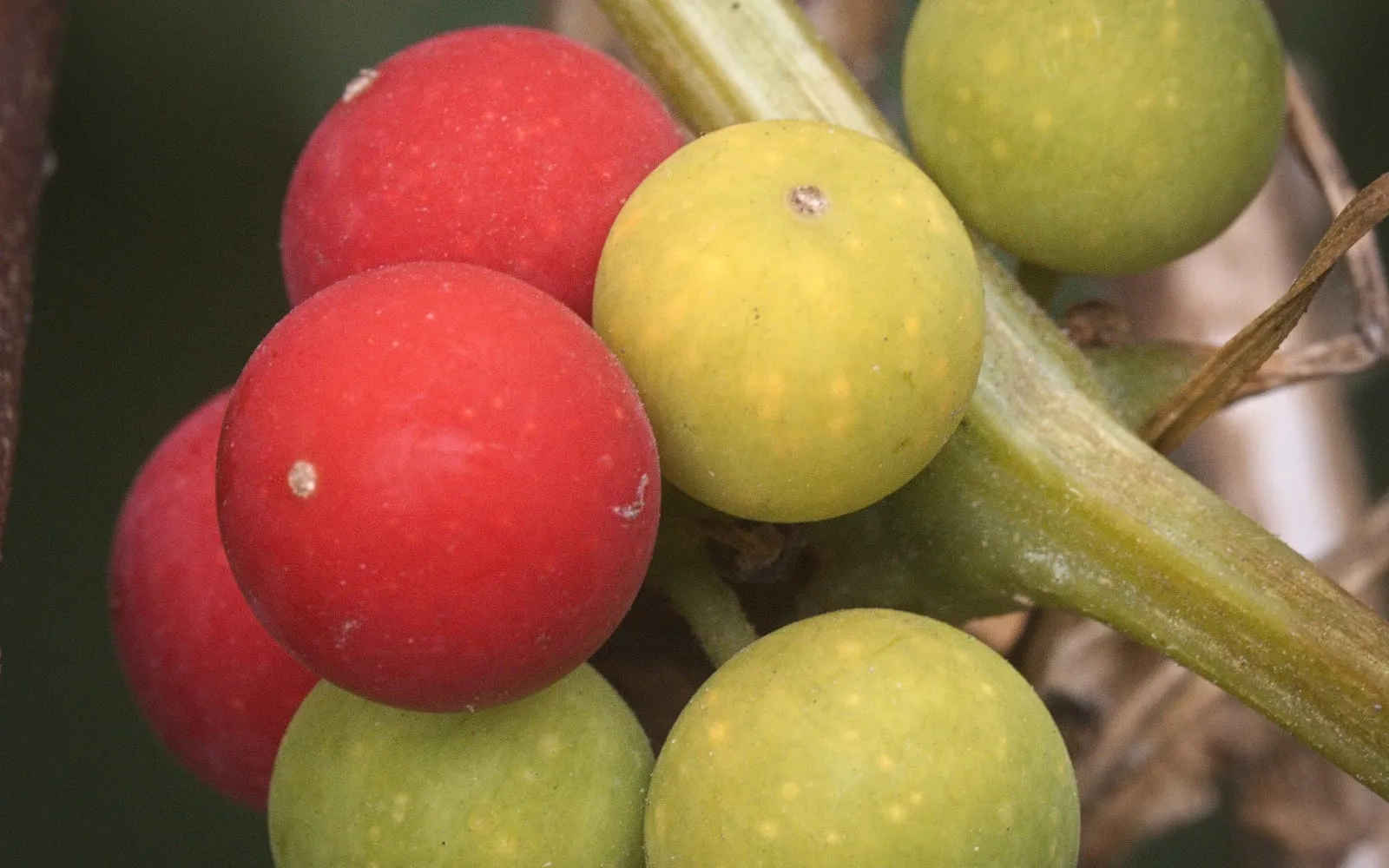
Berries ripen from green to a glossy red, each with a few seeds, held in small clusters along the female stems. The red colour is the plant’s clearest field mark and its main hazard.
The root is a large, pale, fleshy structure that persists and enlarges year by year, producing vigorous spring regrowth and storing much of the plant’s poison.
Where it is from
Bryonia cretica grows around the Mediterranean, on dry hillsides, in scrub, hedges and rough ground, in the hot dry summers and mild winters of that region. It is adapted to free-draining ground and strong sun.
The closely related red bryony extends the group north and west into cooler, damper country, including Britain, where it climbs through hedgerows and is the sole native cucurbit. Both share the same climbing habit, poisonous root and red berries, and the same status as plants to manage instead of cultivate.
How it grows
Shoots emerge from the root in spring and climb quickly through the warming months, using tendrils to reach up through whatever supports them. An established root sends up strong growth each year.
Flowering and fruiting run through summer, the female plants setting red berries that ripen towards autumn. The top growth then dies back with the cold, leaving the root alive below ground to start again the next spring.
The persistent root and bird-sown seed make it hard to shift once established. Removing the visible stems does nothing lasting while the root remains, so control means getting the root out.
There is no reason to plant it. Where it appears, treat it as a weed and remove it while young.
Through the seasons
Spring brings rapid climbing growth from the root, the point at which a young plant is easiest to trace and dig out.
Summer brings dense foliage, flowering, and the first green berries on female plants as the growth smothers its support.
Autumn ripens the red berries, after which birds carry the seed away. Clear the berries beforehand where you can.
Winter kills the top growth entirely, leaving no sign above ground while the root remains alive. This is why the plant is often overlooked until spring.
Care difficulty
No cultivation is involved, since it grows readily and unwanted on its own. The difficulty is removal. The deep, fleshy root regenerates from pieces left in the ground, and fresh plants arrive as bird-dropped seed, so clearing it reliably takes more than one attempt and more than one season.
Watering
None is needed. This is a drought-adapted Mediterranean perennial that stores water in its root and survives without help. Managing it never involves watering, only removing it.
Warning signs, diseases and pests
If a child or anyone else has eaten the red berries or the root, treat it as a medical emergency. The berries are the likeliest thing to be eaten and a small quantity can cause serious illness. Do not wait for symptoms to appear.
The plant has few troubles of its own, being a hardy wild species. The main issues are poisoning risk and its smothering growth.
It poisons grazing animals, so keep it away from livestock and paddocks. Wear gloves when pulling or digging it, since the sap can inflame and blister the skin.
As a weed it climbs over and shades out shrubs and hedge plants, weakening them, and a heavy tangle of stems can bend and break thin growth.
Growing environment
It grows in full sun to partial shade on free-draining soils, thriving in the warm, dry conditions of its Mediterranean home and in the disturbed ground of hedges, banks and scrub. Sharp drainage and heat suit it.
It climbs on any nearby support, from hedges to fences to other plants, and sprawls along the ground where nothing offers a hold.
No feeding, shelter or soil improvement is wanted, because the aim is to discourage instead of encourage it. The useful decision is how to clear it.
Feeding
Do not feed it. Extra fertility only makes a wild climber grow more strongly, and the rich soil of a cultivated border already suits it well enough. That is a further reason to remove any plant early, before it takes hold among plants you value.
Troubleshooting
Someone has eaten the berries. Treat it as an emergency and seek help immediately. The red berries are seriously poisonous and dangerous in small amounts, especially to a child.
Which bryony is this, red or white? Look at the berries. Red berries and, in most plants, separate male and female individuals point to Cretan or red bryony. Black berries and both sexes on one plant point to white bryony. Both are poisonous climbers of the cucumber family.
Is this a wild cucumber or grape? No. It is a poisonous relative of the cucumber, not a food plant, so never eat any part of it however vine-like it looks.
How do I remove it? Dig out the whole root in gloves, tracing the stem down to it, and expect to repeat the job, since it regrows from root fragments and reseeds from berries. Cutting the top alone will not clear it.
Why does it keep coming back after I pull it? Because the living root remains below ground and regrows, and birds bring in fresh seed from berries elsewhere. Dig out the whole root and clear berries before they ripen.