
Outdoor plant
Lady's mantle
Alchemilla mollis
Also known as Alchemilla, Garden lady's mantle
How to grow Alchemilla mollis. The leaves that hold water like mercury, cutting back for a second flush, and staying ahead of the seedlings it scatters everywhere.
At a glance
- Difficulty
- Easy
- Water
- Rarely once established
- Light
- Full sun to partial shade
- Temperature
- Very hardy, to -25 deg C
- Hardiness
- USDA 3-8, RHS H7, hardy to -35 C
- Type
- Herbaceous perennial, clump-forming and long-lived
- Height
- 40-50 cm in flower
- Native to
- The Carpathians, the Caucasus and eastern Turkey
- Best month
- June in the Northern Hemisphere, December in the Southern Hemisphere
Cold, poor soil, drought and shade are all taken without complaint. Seeding is the only real issue, since it produces enormous quantities and the seedlings appear in every crack, so cutting the whole plant back straight after flowering both prevents that and produces a fresh mound of leaves. It has naturalised through north-east North America and parts of New Zealand.
Hardiness zones describe winter cold alone. Summer heat, humidity, rainfall and the length of the growing season decide as much, so treat the range as the outer limit rather than as a recommendation.
Every month named in this guide is for the temperate Northern Hemisphere. If you garden in the Southern Hemisphere, shift each one by six months, so June becomes December. Closer to the equator the wet and dry seasons matter more than the calendar, and the shift stops being a useful guide.
Not known to be toxic
- Safe to eat
- The young leaves, in small quantity as a salad leaf or a tea
Non-toxic. The ASPCA does not list Alchemilla among plants harmful to cats, dogs or horses, and the RHS does not include it in its list of potentially harmful garden plants. Lady's mantle has a long history of use as a herbal tea and the young leaves are occasionally added to salads, which is a reasonable thing to do in small quantity though the flavour is astringent and unremarkable. The plant is high in tannins, which is the basis of its traditional use for wounds and for what herbals coyly called women's complaints, and that is also why a large quantity would be unpleasant rather than dangerous. The genus name comes from the Arabic al-kimiya, alchemy, because medieval alchemists collected the drops of water that gather on the leaves and regarded them as unusually pure. Those droplets are guttation water pushed out through pores at the leaf margin rather than dew, and they are harmless. This is one of the safer plants to have in a garden used by children and animals.
Sources: ASPCA toxic and non-toxic plants, RHS potentially harmful garden plants
About
Rain is what this plant is for. The leaves are covered in fine hairs that water will not wet, so a shower leaves each one holding a bead of mercury-bright liquid in its centre, and a whole clump after rain is the best thing in the garden that morning.
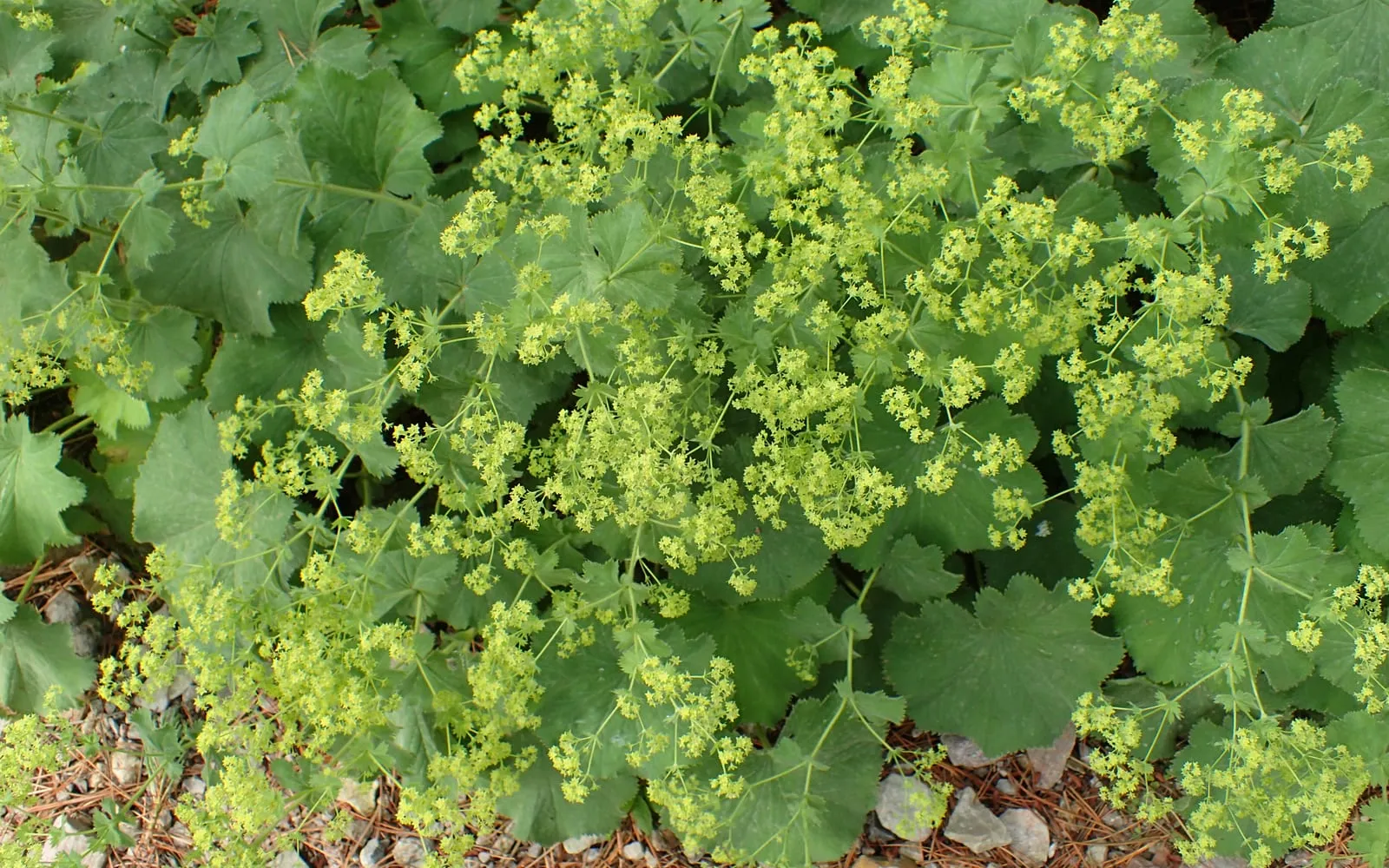
The flowers do the other half of the work. A froth of tiny lime-green stars in June that goes with everything, softens every edge it is planted against, and lasts for weeks.
The catch is the seed. Lady’s mantle scatters itself into gravel, paving joints, the crowns of other plants and every gap in a border, and a garden that has had it for five years has it everywhere. Cutting the whole plant down as the flowers fade solves that and gives a fresh mound of leaves at the same time.
Appearance and character
A clump-forming herbaceous perennial, 40 to 50 cm tall in flower and rather wider, forming a low dome of foliage.
Leaves are the plant’s signature. Rounded, 5 to 15 cm across, softly hairy, grey-green, and pleated into nine or eleven shallow lobes with finely toothed edges, so each one looks like a folded fan.
Water beads on the surface because of the hairs, and the plant also pushes out its own droplets overnight through pores at the leaf margin, so the beads are often there on a dry morning.
Flowers open in June and July in loose airy sprays of tiny lime-green to yellowish stars, each about 3 mm across, held just above the leaves.
The flowers have no petals. What look like them are sepals, which is unusual and is part of why the colour is so peculiarly green.
The whole plant dies back to a woody crown in winter and reappears in April.
Alchemilla alpina is the smaller relative, 15 cm tall with silver-edged leaves, and it suits a rock garden or a trough.
Where it is from
The Carpathian mountains, the Caucasus and the mountains of eastern Turkey, where it grows in damp meadows, on grassy slopes and along stream sides.
Britain has its own native lady’s mantles, a complicated group of around a dozen microspecies in the Alchemilla vulgaris aggregate, most of them smaller and less showy. The garden plant is the Turkish and Caucasian species and it was introduced in the 1870s.
Its mountain meadow habitat explains the toughness. Full exposure, cold winters, poor soil and grazing are all part of the deal, and nothing a temperate garden does will trouble it.
The plant reproduces apomictically, meaning it sets viable seed without fertilisation, so every seedling is a clone of the parent. That is why the seedlings all look identical and why there are so many of them.
Its long medicinal history gave it the alchemists’ name and a place in every monastery garden in Europe.
How it grows
Plant at any time from autumn to spring into almost any soil that is not waterlogged. It grows on clay, on chalk, in sun and in shade.
Space plants 45 cm apart. A single clump fills that within two years.
Cut the whole plant to the ground as the flowers begin to brown, usually mid to late July. This does three things at once. It stops the seed, it removes the tired flopping foliage, and it produces a fresh mound of clean leaves within three weeks that lasts until the frosts.
Deadheading alone is not enough if you want to control the seeding, since the plant sets seed as the flowers fade rather than after.
Pull out unwanted seedlings while they are small. A one-year seedling comes up with a tug and a three-year-old needs a spade.
Divide in spring or autumn every few years to make more plants, though seedlings supply all anyone could want.
Cut the old foliage away in late winter if you left it standing.
Cut stems dry well and hold their colour, which is why florists use them.
Through the seasons
Winter is dormancy. The plant is a woody crown at ground level. Clear the old leaves in late winter.
Spring brings the pleated leaves through in April. Nothing else is needed beyond watching for slugs.
Early summer is the display. Flowers open in June and hold for four or five weeks, and the leaves are at their best after rain.
Midsummer is the cut-back. Shear the whole plant to the ground in July, before the seed sets, and it regrows a fresh mound.
Care difficulty
Easy, and among the toughest perennials sold. It survives drought, cold, clay, chalk, shade and neglect.
Self-seeding is the only real management task, and the July cut-back handles it.
The plant collapses open in the middle after flowering if left uncut, which looks tired for the rest of the season. The same cut-back fixes that too.
Mildew appears in a dry summer and disappears with the cut-back.
Nothing here needs feeding, staking, spraying or winter protection.
Watering
Established plants need no watering except in a long drought.
Water new plantings through their first summer.
A dry summer produces smaller leaves, earlier collapse and powdery mildew. Cutting the plant back and watering once produces a fresh flush.
The plant tolerates dry shade better than most perennials, which makes it useful under shrubs.
Avoid waterlogged ground in winter.
Warning signs, diseases and pests
Seedlings everywhere is the characteristic problem and the reason some gardeners refuse to grow it. The plant sets seed as the flowers fade, and the seedlings come up in gravel, in paving joints and inside the crowns of neighbouring plants. Cut the entire plant to the ground in July before the seed ripens. Pull strays while small.
Collapsing open in the middle after flowering is normal and looks poor. Shear the whole clump to the ground and it regrows clean within three weeks.
Powdery mildew coats the leaves in white in a dry summer. The cut-back removes it.
Slugs graze the emerging leaves in April and the damage is cosmetic.
Yellowing lower leaves in midsummer usually means the plant is dry or has finished flowering and wants cutting back.
Very little else affects it. Lady’s mantle is close to disease-free.
Growing environment
Full sun to partial shade. It flowers more heavily in sun and copes with surprisingly deep shade.
Almost any soil that drains, including heavy clay and thin chalk. It has no pH preference.
Path edges, the front of a border, gravel and the base of a wall are the classic positions, where the leaves soften a hard line.
Under shrubs and in dry shade it earns its place as ground cover.
Avoid a rock garden or anywhere near small choice plants, which the seedlings will swamp.
It is excellent on a slope or at the top of a retaining wall, where the flowers can be seen from below.
No shelter or staking is needed.
Feeding
Lady’s mantle needs no feeding on ordinary soil.
A mulch of garden compost in spring is enough on poor ground.
Avoid rich feeding, which produces soft floppy growth.
A plant that has been cut back in July benefits from a watering rather than a feed.
Division every four or five years keeps a clump vigorous, though it rarely declines.
Troubleshooting
Seedlings are coming up all over the garden. Cut the whole plant to the ground in July as the flowers begin to brown, before the seed sets. Deadheading alone is too late.
It has flopped open in the middle. Normal after flowering. Shear the entire clump to ground level and a fresh mound of leaves appears within three weeks.
What are the water droplets on the leaves? Partly rain held by the fine hairs, and partly guttation, where the plant pushes water out through pores at the leaf edge overnight. Medieval alchemists collected it, which is where the name comes from.
White powder on the leaves. Powdery mildew from a dry summer. Cut the plant back and it regrows clean.
Will it grow in dry shade? Yes, better than most perennials. Flowering is lighter than in sun.
Can I use it as a cut flower? Yes, and it dries well while keeping its green colour, which is why florists use so much of it.
Is it edible? The young leaves are used in small quantity in salads and as a tea. The flavour is astringent and not worth much, and the plant is harmless.
How do I get more plants? You will not need to. If you do, divide in spring or lift a seedling.