
Outdoor plant
Oriental poppy
Papaver orientale
Also known as Perennial poppy
How to grow oriental poppy, Papaver orientale. Huge silk flowers in May, what to do with the gap it leaves in July, and propagating from root cuttings.
At a glance
- Difficulty
- Easy
- Water
- Rarely once established
- Light
- Full sun, and it flops and rots in shade
- Temperature
- Extremely hardy, and it needs a cold winter
- Hardiness
- USDA 3-7, RHS H7, hardy to -35 C
- Type
- Herbaceous perennial, long lived and dying back completely in midsummer
- Height
- 60-100 cm
- Native to
- The Caucasus, north-eastern Turkey and northern Iran
- Best month
- May in the Northern Hemisphere, November in the Southern Hemisphere
It dies back completely after flowering and leaves a gap in the border by midsummer, which is normal and not a sign of failure, so plant something later beside it to fill the hole. Free drainage matters more than cold, and the fleshy roots rot in wet winter ground. It regrows from root fragments, which makes it hard to move cleanly and easy to propagate.
Hardiness zones describe winter cold alone. Summer heat, humidity, rainfall and the length of the growing season decide as much, so treat the range as the outer limit rather than as a recommendation.
Every month named in this guide is for the temperate Northern Hemisphere. If you garden in the Southern Hemisphere, shift each one by six months, so May becomes November. Closer to the equator the wet and dry seasons matter more than the calendar, and the shift stops being a useful guide.
Toxic if eaten
- Do not eat
- All parts, and the milky sap most of all
- Harm from
- Eating it and handling it
- Affects
- People, cats, dogs and horses
Oriental poppy contains alkaloids in its milky white sap, principally thebaine and related compounds rather than the morphine of the opium poppy. Thebaine is not a sedative in the way morphine is, and in quantity it causes convulsions rather than drowsiness. The ASPCA lists Papaver species as toxic to cats, dogs and horses, and eating any part causes salivation, vomiting, lethargy or agitation, and in larger amounts breathing difficulty. The RHS lists poppy as harmful if eaten and as a skin irritant. The sap irritates skin and is worth washing off, and it can cause a rash in sensitive people, so wear gloves when cutting the foliage down. Human poisoning from a garden plant is rare and the usual outcome of chewing a leaf is an unpleasant taste and a stomach upset, so treat it as a reason to keep an eye on a toddler rather than an emergency. Growing Papaver orientale carries no legal restriction, and it is not the plant opium comes from.
Sources: RHS potentially harmful garden plants, ASPCA toxic and non-toxic plants
About
Oriental poppy gives ten days of the most extravagant flower in a temperate border and then leaves a hole for the rest of the summer.
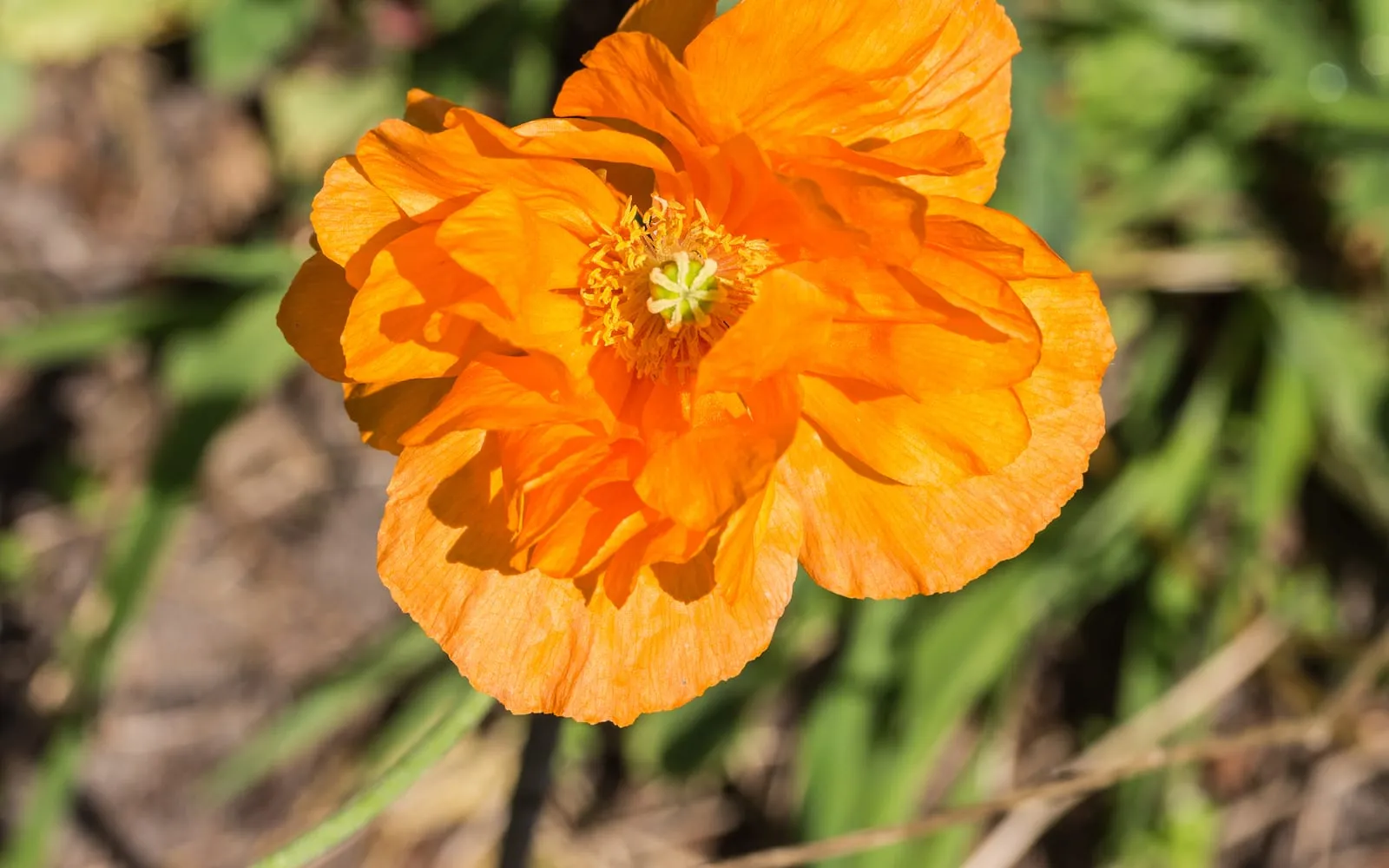
The flowers are enormous, up to 15 cm across, in crumpled tissue-paper petals that look like they have just been unpacked, with a boss of black stamens around a green seed capsule. Scarlet is the classic, and the range now runs through orange, salmon, plum, pink and white, many with a black blotch at the base of each petal.
By July the foliage yellows and collapses and the plant goes fully dormant, leaving a gap of half a metre in the middle of the summer border. This is normal rather than a problem, and the whole art of growing it is planning for that gap.
The standard solution is to plant something that expands later in front of or beside it. Hardy geranium, nepeta, aster, gypsophila or a late-emerging perennial all fill the space while the poppy sleeps.
It is one of the longest-lived perennials in a garden, sitting in the same spot for decades on free-draining soil. Moving it is the one thing it objects to, and every root fragment left in the ground comes up again.
Appearance and character
A herbaceous perennial reaching 60 to 100 cm in flower, forming a coarse clump that dies back completely by midsummer and often reappears with fresh leaves in autumn.
Leaves are large, deeply cut into toothed lobes, and covered in stiff bristly hairs that give the whole plant a grey-green rough appearance.
Flower buds are nodding and hairy, held on tall stems, and they lift and split as the flower opens.
Flowers open in late May and June, 10 to 15 cm across, with four to six broad crumpled petals, most with a dark blotch at the base, around a ring of blue-black stamens and a flat-topped green capsule.
Colour runs from the scarlet of the species through orange, salmon, apricot, soft pink, plum and white. ‘Patty’s Plum’ is a dusky plum, ‘Perry’s White’ is white with a black centre, and ‘Beauty of Livermere’ is deep blood red.
Seed capsules are the pepper-pot type, drying to a hard grey-brown case that scatters seed through pores below the rim, and they are worth keeping for winter arrangements.
Every part carries a milky white sap that bleeds from any cut.
Where it is from
The Caucasus, north-eastern Turkey and northern Iran, growing on stony mountain slopes and in alpine meadows.
That habitat sets the requirements exactly. Full sun, deep free-draining stony soil, a cold winter, and a hot dry summer during which the plant is dormant.
Its dormancy is an adaptation to that dry summer rather than a fault, which is worth knowing when it disappears in July.
It reached Britain in the eighteenth century and the modern range of colours largely dates from the work of Amos Perry, an English nurseryman who raised many named cultivars in the early twentieth century.
Papaver orientale is closely related to Papaver bracteatum, and the two have been crossed extensively, which is where several of the darker and larger-flowered cultivars come from.
Thebaine, the main alkaloid, takes its name from Thebes and is used industrially as a starting material for painkillers, extracted from Papaver bracteatum rather than from garden plants.
It is unrelated to the annual field poppy of European cornfields, which is Papaver rhoeas.
How it grows
Plant in autumn or spring into deep, free-draining soil in full sun.
Sharp drainage is the requirement that matters. Oriental poppy rots in heavy wet clay, and adding grit or planting on a slight ridge solves it.
Avoid shade, where it grows lax, flops and flowers poorly.
Space plants 45 to 60 cm apart and think about what will fill the gap in July before you plant.
Plan for the summer dormancy. Plant something beside it that expands later, such as hardy geranium, nepeta, gypsophila, aster or a late-emerging perennial, so the gap closes on its own.
Support the flower stems with a ring or twiggy sticks in an exposed position, since the heads are heavy and rain flattens them.
Cut the whole plant to the ground once the foliage yellows in July. This tidies the gap and often triggers a fresh rosette of leaves in autumn that sits through the winter.
Leave the seed heads if you want them, cutting the foliage and keeping the stems.
Leave the plant alone once established. It is long-lived and resents disturbance.
Divide only if you must, in autumn, and expect every root fragment left behind to come up as a new plant.
Propagate from root cuttings in autumn or winter, which is the reliable method. Lift a plant, cut thick roots into 5 cm lengths, and set them upright in gritty compost with the top end level with the surface.
Do not feed it heavily. Rich soil gives soft growth that flops.
Deadhead after flowering unless you want the seed heads, since seedlings do not come true to the named cultivars.
Through the seasons
Winter often shows a low rosette of hairy leaves through mild weather, and the plant needs a cold winter to perform.
Spring grows fast from March, and the buds form in May.
Summer flowers for ten days to a fortnight in late May and June, then the foliage yellows and the plant goes dormant through July.
Autumn is when it often throws a fresh rosette of leaves, and it is the season for root cuttings and for any dividing.
Care difficulty
Easy, with one design problem rather than a cultivation problem.
It is extremely hardy, long-lived, drought-tolerant once established, unattractive to slugs, and needs no feeding.
The requirements are full sun and free drainage. Given both it looks after itself for decades.
The difficulty is the gap it leaves from July, which is solved at the planting stage rather than by anything you do to the plant.
Watering
Water through the first summer after planting.
Established oriental poppy needs no watering in a temperate climate and tolerates drought well, which follows from a plant that is dormant through the dry season in the wild.
Avoid watering it in July when it is dying back, which does nothing useful.
Free drainage in winter matters far more than summer water. Waterlogged cold clay is what kills it.
Skip a heavy compost mulch over the crown and use grit if you want to mulch at all.
Warning signs, diseases and pests
Foliage yellowing and collapsing in July is normal summer dormancy rather than disease. Cut it to the ground.
The plant failing to reappear in spring after a wet winter is crown rot from waterlogged soil. Add grit and plant on a ridge on heavy ground.
Grey-purple furry patches on the undersides of the leaves in a wet spring, with yellow blotches above, is downy mildew. Remove affected leaves, improve air movement, and avoid overhead watering.
Flowers flattened after rain is the weight of the heads. Support them with a ring before they open.
Lax floppy growth with few flowers is shade or over-feeding.
New poppies appearing where you dug an old one out is root fragments regenerating, which is normal and hard to prevent.
Seedlings that flower in the wrong colour are exactly that, since named cultivars do not come true from seed. Deadhead to stop it.
Aphids on the buds and stems feed a great many predators and rarely need action.
Growing environment
Full sun. It needs it for upright growth as much as for flowering.
Deep, free-draining soil, and stony or gravelly ground suits it. Improve heavy clay with grit or plant on a raised ridge.
Extremely hardy, and it needs a proper cold winter, so it does less well in a very mild sheltered garden.
Allow 45 to 60 cm per plant, and plan for the gap it leaves.
It suits a herbaceous border, a cottage garden, a gravel garden or a sunny bank.
Grow it with plants that expand in July. Hardy geranium, nepeta, gypsophila, aster, Anemone x hybrida and ornamental grasses all fill the space while it sleeps.
Its wildlife value is concentrated and brief. Bees work the flowers heavily for the pollen during their short season, and the plant offers nothing for the rest of the year.
Choose ‘Beauty of Livermere’ for deep red, ‘Patty’s Plum’ for dusky purple, ‘Perry’s White’ for white with a black eye, and ‘Karine’ for a soft pink at a lower height.
Feeding
None needed on reasonable soil.
Mulch with grit or a light compost dressing in spring, keeping it clear of the crown.
Avoid rich feeding and fresh manure, which produce soft floppy growth with fewer flowers.
A plant flopping and flowering badly is short of sun rather than short of nutrients.
Troubleshooting
It has died back completely in July. Normal. Oriental poppy goes dormant through the summer, which is an adaptation to a dry season in the wild. Cut the yellowing foliage to the ground and expect fresh leaves in autumn.
What do I plant to fill the gap? Something that expands later. Hardy geranium, nepeta, gypsophila, aster or a late-emerging perennial all close the space while the poppy is asleep.
It did not come back in spring. Crown rot from wet winter soil. Add grit, improve drainage and plant on a slight ridge on heavy clay.
The flowers were flattened by the rain. The heads are heavy. Put a support ring in place before they open in an exposed position.
Can I move it? You can in autumn, and it will sulk, and every root fragment left in the old spot will grow into a new plant. It is better left alone.
How do I propagate it? From root cuttings in autumn or winter. Cut thick roots into 5 cm lengths and set them upright in gritty compost with the top level with the surface.
Seedlings came up in the wrong colour. Named cultivars do not come true from seed. Deadhead after flowering if you want to stop it.
Is it the opium poppy? No. The opium poppy is Papaver somniferum, an annual with smooth blue-grey leaves. Oriental poppy is a hairy perennial and contains thebaine rather than morphine.
Is the sap dangerous? It irritates skin and causes a rash in sensitive people, so wear gloves when cutting the foliage down and wash it off.