
Outdoor plant
Gladiolus
Gladiolus communis
Also known as Sword lily, Corn flag
How to grow gladiolus, Gladiolus communis. Planting a true corm, succession planting for weeks of spikes, and when to lift and store it over a cold winter.
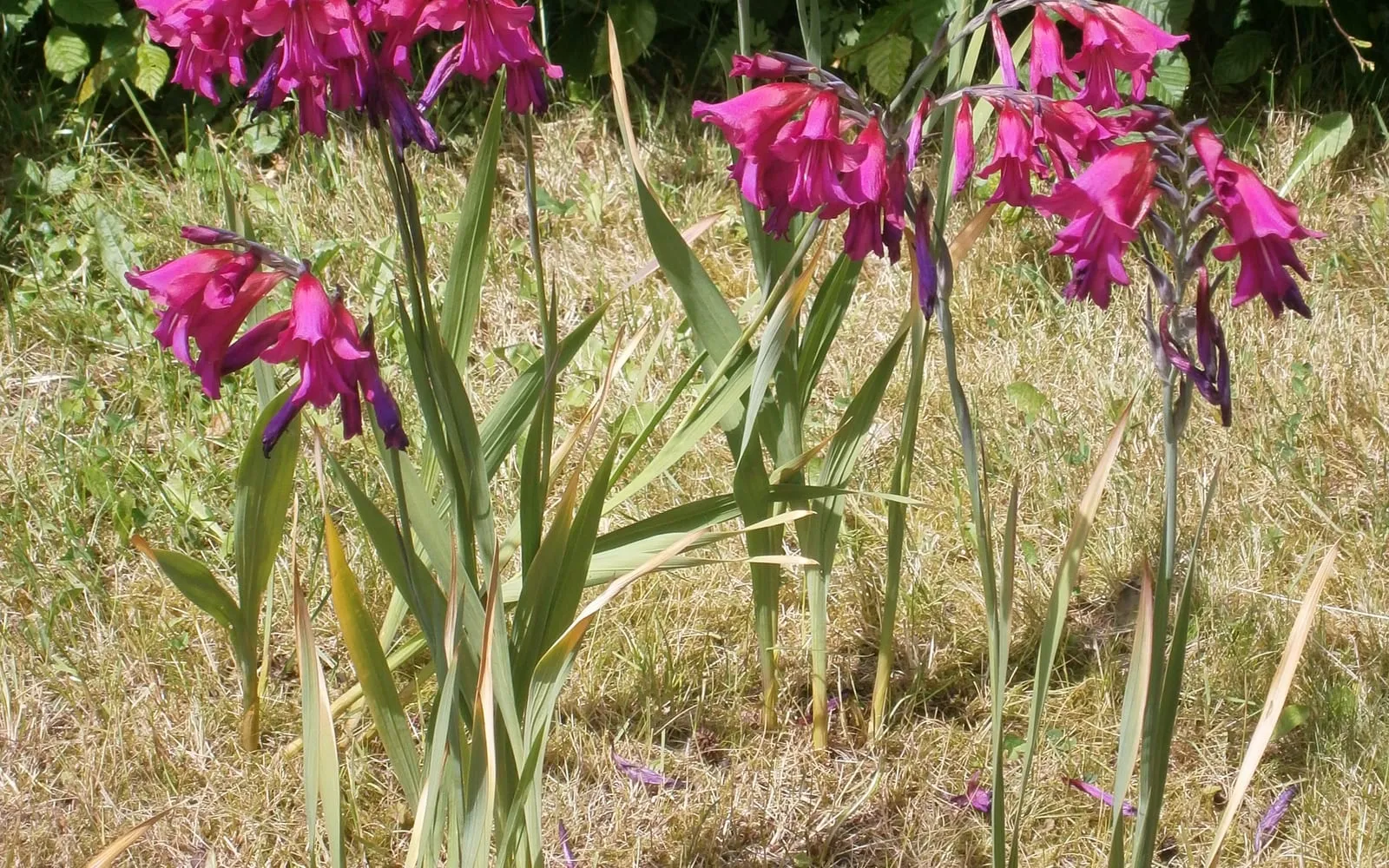
At a glance
- Difficulty
- Easy
- Water
- Regularly through active growth, especially as the spike develops
- Light
- Full sun
- Temperature
- Frost tender at the corm in most gardens below zone 7
- Hardiness
- USDA 6-9, RHS H4, hardy to -10 C
- Type
- Cormous perennial
- Height
- 60-120 cm
- Native to
- The Mediterranean and southwest Asia
Zone 6-9 covers the subspecies byzantinus, which is markedly hardier than most gladiolus grown for cut flowers and can stay in the ground year round with a winter mulch in a sheltered spot. Where winters go consistently below about -10 deg C, or where the ground stays wet and cold instead of drying out, the safer course is the traditional one: lift the corm each autumn, dry it, and store it somewhere frost-free until spring.
Hardiness zones describe winter cold alone. Summer heat, humidity, rainfall and the length of the growing season decide as much, so treat the range as the outer limit rather than as a recommendation.
Toxic to pets if eaten
- Do not eat
- The corm above all, with milder effects from leaves and flowers
- Harm from
- Eating it
- Affects
- Cats, dogs and horses
The ASPCA lists gladiolus as toxic to cats, dogs and horses, though the specific toxic principle has not been identified and the plant appears to act mainly as a gastrointestinal irritant. Eating any part causes salivation, vomiting and diarrhoea, and a large ingestion, most likely from a stored corm a dog has got into, can cause lethargy and an unsteady gait as well. The corm carries by far the highest concentration and is the part responsible for the more serious reported cases, which is worth knowing because dried corms are commonly stored indoors or in a garage over winter in an open box a dog can reach. There is no listing for humans on the RHS harmful plants page, and gladiolus is not generally regarded as a risk to people, though eating any quantity of the corm would upset a stomach the same way it does a pet's.
Sources: ASPCA (Gladiola), RHS potentially harmful garden plants
About
A row of gladiolus spikes makes a strong vertical line in a border, each stem carrying a dozen or more funnel-shaped flowers arranged up one side only, all facing the same direction. That one-sided arrangement, botanically called secund, makes a cut gladiolus spike especially useful in an arrangement: every flower faces outward from the vase instead of competing for space.
Underground sits a true corm, a solid swollen stem base that is different in structure from a layered bulb. The corm a gladiolus is planted from is used up over the course of the growing season and replaced with a new one that forms on top of it, as a crocus does. The same mechanism produces a scatter of tiny cormlets around the base of the new corm each year.
The genus name comes from the Latin gladius, a sword, describing the shape of the leaves instead of anything about the flower, and the common name sword lily is a direct translation of the same idea.
Appearance and character
Fans of stiff, sword-shaped leaves rise from the corm, three to six per fan, with the flower spike emerging from the centre and rising well clear of the foliage.
Flowers open from the base of the spike upward over one to two weeks, funnel-shaped and six-petalled, in colours running from magenta and purple through the pinks and whites depending on the variety, with Gladiolus communis itself and its widely grown subspecies byzantinus both typically a deep magenta-purple.
A single corm typically produces one main spike per season, occasionally two, and each flower on the spike lasts only a few days before fading, though the succession of buds up the stem keeps a spike looking fresh for a week or more.
The corm itself is flattened and rounded, wrapped in papery fibrous tunics, sitting on a flat base plate from which the roots grow. Cut one open and it shows solid tissue throughout instead of the fleshy layers of a true bulb, which is the structural difference that separates a corm from a bulb.
Where it is from
The Mediterranean basin and southwest Asia, growing wild in grassland, scrub and cultivated ground from Iberia and North Africa across to the Levant. Gladiolus communis subsp. byzantinus, the form most widely grown as a garden hardy perennial, is associated particularly with the eastern Mediterranean and reached British gardens in the sixteenth century, well before the showier South African species that gave rise to the large- flowered summer hybrids most people picture when they hear the name.
Mediterranean grassland is winter-wet and summer-dry, and communis flowers in late spring before the summer drought arrives, going dormant through the hottest months exactly as the ground it grows in dries out. This pattern makes the species and its subspecies hardier than most gladiolus, since the corm is adapted to sit through a cold, wet winter that a summer-growing South African relative never experiences in the wild.
How it grows
A cormous perennial, replacing its corm annually and multiplying by cormlets that form around the base of the new one, like a crocus on a larger scale.
Plant corms 10 to 15 cm deep and 10 to 15 cm apart, pointed end upward, in well-worked soil with grit added if drainage is at all doubtful. Deeper planting than the minimum gives better anchorage for the tall flower spike and some protection against frost where the corm is being left in the ground over winter.
For a long run of cut flowers instead of one crowded flush, plant a batch every two weeks from mid-spring through early summer. Succession planting spreads flowering across most of the summer instead of concentrating it into a fortnight. This is the usual approach when growing gladiolus for cutting rather than purely for border display.
Stake taller varieties individually or support a block planting with string run between canes at two heights, since a spike heavy with open flowers catches wind like a sail and snaps at the base if unsupported.
Where the corm is lifted for winter, do so about six weeks after flowering finishes, once the foliage has yellowed, cutting the top growth back to a few centimetres and drying the corms somewhere airy for a couple of weeks before storing.
Through the seasons
Spring is planting time for corms grown as summer bedding, from mid spring once the soil has warmed and the frost risk has passed, continued in successive batches into early summer for cut flowers.
Summer brings the leaf fans up and, roughly ten to twelve weeks after planting, the flower spikes. This is also when established hardy clumps of byzantinus flower, considerably earlier than the summer-planted hybrids, typically in late spring to early summer.
Autumn is lifting season where the corms are not being left in the ground. Lift about six weeks after flowering finishes and the foliage has yellowed, dry thoroughly, and remove the old shrivelled corm from beneath the new one before storing.
Winter is either dry storage in a frost-free shed or garage at around 5 to 10 deg C for corms that have been lifted, or, for hardy byzantinus in a sheltered spot in zone 7 and warmer, a mulched dormancy in the ground.
Care difficulty
Easy. Planting depth and spacing are straightforward, the plant is untroubled by most ordinary garden conditions, and the main jobs, staking tall spikes and lifting tender corms before a hard frost, are simple tasks that just need doing at the right point in the calendar.
The one thing that catches people out is treating a summer-planted hybrid gladiolus as if it were as hardy as byzantinus. The larger-flowered hybrids commonly sold for cutting descend mostly from South African species and do not reliably survive a cold, wet winter in the ground outside the mildest gardens, whatever the label on the packet implies about the species name.
Watering
Water regularly once growth is underway, particularly as the flower spike develops, since a gladiolus growing fast in summer heat with dry roots produces a shorter spike with fewer, smaller flowers.
A deep weekly soak in dry weather serves the plant better than light daily watering, which encourages roots to stay near the surface instead of reaching down to where the corm needs support.
Reduce watering once flowering finishes and stop altogether as the foliage begins to yellow, allowing the corm to dry down naturally before lifting or before winter dormancy.
Warning signs, diseases and pests
Thrips are the most persistent problem, tiny insects that rasp at the buds and open flowers, leaving streaked, distorted petals and a silvery scarring on the leaves. They thrive in hot dry weather and overwinter on stored corms, so an infestation often reappears the following year from corms that looked clean at lifting. Dust stored corms with an appropriate insecticide before storage if thrips have been a recurring problem, and keep the growing area weeded, since thrips breed readily on many common weeds.
Corm rot, showing as soft brown patches and a corm that fails to sprout, follows either waterlogged soil during growth or corms stored damp rather than properly dried first. Discard any soft or discoloured corm at lifting instead of storing it alongside healthy ones, since rot spreads in storage.
Aphids cluster on buds and young growth, weakening the plant and spreading viral disease between corms.
Botrytis, a grey fungal mould, appears on flowers and leaves in a cool wet summer, particularly where plants are crowded with poor air movement between them. Space plantings generously and remove affected material promptly.
A spike that fails to open properly, staying tightly closed or opening only partially, usually points to a cold snap or a dry spell during bud development not disease.
Growing environment
Full sun, and as much of it as the site allows. Gladiolus grown in shade produce weak, leaning growth and flower poorly.
Fertile, free-draining soil worked deeply before planting gives the roots room to establish and reduces the risk of corm rot. Dig in organic matter the season before planting on poor or very light soil.
Shelter from strong wind reduces the need for staking and protects the tall spikes from being snapped, though full sun should not be sacrificed for shelter if the two are in tension.
Space corms 10 to 15 cm apart in blocks or rows for the strongest visual effect, and consider a cutting bed separate from the main border if growing primarily for cut flowers, since a border full of gaps after cutting looks worse than a dedicated row grown for that purpose.
Feeding
Feed with a balanced fertiliser at planting time to support the initial leaf growth, then switch to a high-potash feed such as tomato food fortnightly from around the six-leaf stage until the flowers open.
Avoid heavy nitrogen once the spike is forming, since it produces soft leafy growth at the expense of flower size and stem strength.
Stop feeding once flowering finishes, whether the corm is being lifted or left in the ground, so the plant can enter dormancy instead of being pushed into new growth right before autumn.
Troubleshooting
How deep should I plant the corms? 10 to 15 cm deep, pointed end upward, in soil that has been worked and, if needed, improved with grit for drainage.
I want flowers all summer, not just for two weeks. Plant in batches every two weeks from mid spring into early summer. Each batch flowers roughly ten to twelve weeks after planting.
The spikes keep snapping in the wind. Stake individually, or run string between canes at two heights for a block planting, before the spikes reach full height instead of after.
Do I need to lift the corms every year? Only where winters go reliably below about -10 deg C or the ground stays wet through winter. Gladiolus communis subsp. byzantinus in particular can be left in the ground in a sheltered spot in milder zones with a winter mulch.
The buds and flowers are streaked and distorted. Thrips. They thrive in hot dry weather and overwinter on stored corms, so treat stored corms if this recurs each year.
Corms went soft and mouldy in storage. They were not dried thoroughly enough before storing, or a diseased corm was stored alongside healthy ones. Dry corms fully for a couple of weeks in an airy spot before boxing them up, and discard anything soft at lifting.
Is it dangerous to my dog? The ASPCA lists gladiolus as toxic to cats, dogs and horses, with the corm carrying by far the highest concentration. Keep stored corms somewhere a pet cannot reach, since a box in a garage or shed is the kind of place a curious dog investigates.