
Outdoor plant
Claret Cup Cactus
Echinocereus triglochidiatus
Also known as King Cup Cactus, Mojave Mound Cactus, Hedgehog Cactus
How to grow claret cup cactus, Echinocereus triglochidiatus. It survives cold that kills most cacti yet rots in wet winter soil, and its scarlet flowers are built for hummingbird rather than bee pollination.
At a glance
- Difficulty
- Easy
- Water
- Thoroughly through the growing season, then almost not at all in winter
- Light
- Full sun
- Temperature
- Extremely cold-hardy in dry soil; damaged far more easily by wet cold than by cold alone
- Hardiness
- USDA 5-9, RHS H5, hardy to -20 C
- Type
- Evergreen perennial cactus, clump-forming
- Height
- 20-30 cm tall, clumps spreading to 1 m or more across over years
- Native to
- the southwestern United States, Mexico
Grows wild up to around 3,000 m in the Rocky Mountains and Colorado Plateau, where winter temperatures fall well below what most cacti can survive, so cold itself is not the limiting factor for this species the way it is for almost every other cactus grown in a garden. Cold and wet together kill it. Dry, frozen soil around the roots does little lasting harm, while the same cold reaching roots sitting in damp ground is usually fatal.
Hardiness zones describe winter cold alone. Summer heat, humidity, rainfall and the length of the growing season decide as much, so treat the range as the outer limit rather than as a recommendation.
Not known to be toxic
- Safe to eat
- The ripe fruit is edible and was traditionally gathered and eaten by Indigenous peoples across its range
Echinocereus triglochidiatus carries no recorded toxic compounds and does not appear on the RHS or ASPCA lists of harmful plants. Its small red fruit is sweet and edible once the spines are removed, and it has long been gathered as a wild food across the plant's native range. The real hazard is entirely mechanical rather than chemical: the stems carry sharp spines capable of a painful puncture wound, and that risk applies equally to curious pets and to anyone weeding or handling the plant carelessly.
Sources: RHS potentially harmful garden plants, ASPCA toxic and non-toxic plants
About
Claret cup cactus forms low, dense mounds of many upright, spiny stems, building over years into a clump that can hold a hundred stems or more and spread wider than it is tall. Its main appeal is the flowers: brilliant scarlet, cup-shaped blooms that open across the whole mound in late spring and draw hummingbirds from a considerable distance.
Unlike most cacti grown outdoors, cold is not the main challenge with this species. Wild populations survive harsh mountain winters at real altitude, and the plant is one of the hardiest cacti available for a temperate garden provided the drainage is sharp enough to keep its roots dry through the coldest months.
Appearance and character
Each stem is cylindrical and ribbed, typically 10 to 20 cm tall and a few centimetres thick, covered in clusters of spines that vary considerably between populations, from long and conspicuous to sparse and almost bristly depending on the form. Stems branch from the base over time, gradually building the dense clump the species is known for rather than growing as a single specimen.
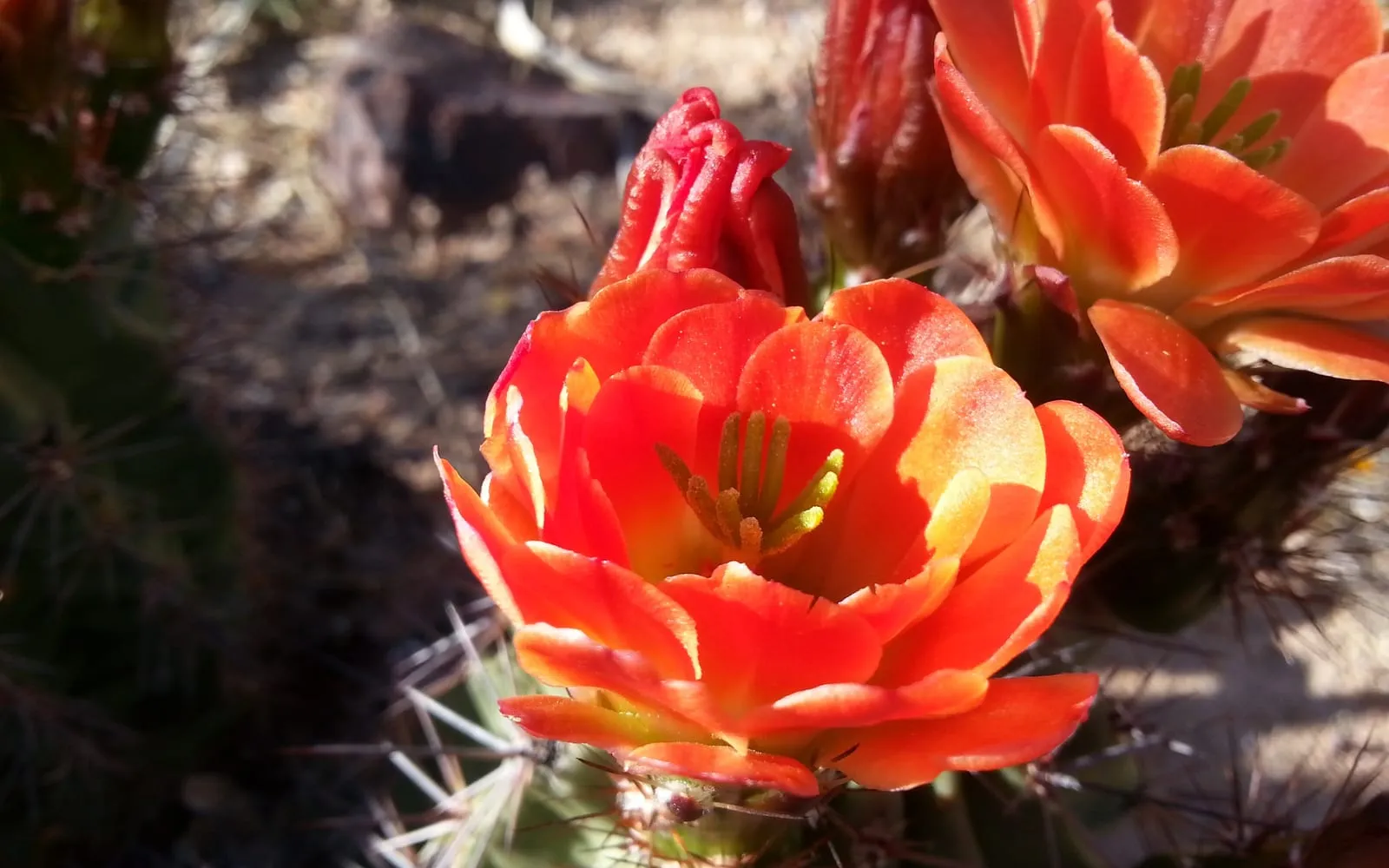
Flowers open in late spring, an intense scarlet to deep claret red that gives the plant its name, cup-shaped and several centimetres across, appearing in numbers across an established clump rather than singly. They stay open for several days at a stretch, longer than many cactus flowers, and their colour and shape are specifically suited to pollination by hummingbirds rather than the bees and moths that visit most cactus flowers.
Small, round, red fruit follows flowering on a pollinated stem, edible once the spines have been removed and traditionally gathered as a wild food by Indigenous communities across the plant’s range.
Where it is from
Echinocereus triglochidiatus grows across the southwestern United States and into northern Mexico, from low desert country in Arizona and Texas up into high, rocky terrain in Colorado, Utah and New Mexico, reaching elevations of around 3,000 m in parts of the Rocky Mountains. That range spans markedly different climates, and it is the high- elevation populations that give the species its exceptional cold tolerance, adapted to mountain winters far harsher than anything most cactus species encounter.
Across that whole range, the soil shares one trait: it drains fast. Rocky, gravelly slopes shed water quickly after rain or snowmelt, so the roots rarely sit in damp ground for long even where winter precipitation is significant, which is the condition a garden needs to replicate more than any particular temperature.
How it grows
Plant it in full sun, in soil amended heavily with grit, gravel or coarse sand if the native ground is not already sharply draining; a raised bed or rock garden setting suits it particularly well, both for drainage and for showing off the clump as it develops.
Avoid organic-rich compost or heavy clay, both of which hold far more moisture around the roots than this cactus can tolerate through a cold, wet winter. A poor, mineral, low-fertility soil is closer to what it grows in naturally than anything enriched for typical garden plants.
Established clumps need very little attention beyond an occasional check that surrounding plants have not grown in and shaded them out, since full sun is important for both flowering and keeping growth compact rather than stretched.
Propagation is straightforward from stem cuttings taken from an established clump, left to callus for a few days before being potted into a dry, gritty mix, or from seed, which is slower but produces a wider range of spine forms.
Through the seasons
Spring brings the main flush of growth and, towards late spring, the scarlet flowers that are the main reason to grow this species.
Summer is steady growth after flowering, with watering scaled to rainfall and heat rather than a fixed schedule.
Autumn calls for a gradual reduction in watering as growth slows, preparing the roots for a dry winter.
Winter is spent almost completely dry. In a climate with wet winters, overhead rain cover or a raised, sharply draining position matters more during this season than at any other point in the year.
Care difficulty
Easy, and one of the more forgiving hardy cacti available once drainage is sorted out at planting time. It needs no winter protection from cold in the way many other cacti do, no regular feeding, and very little watering beyond what a dry climate’s rainfall provides. The one condition that has to be right from the start is drainage: a claret cup cactus planted in ordinary garden soil that holds winter moisture is far more likely to fail from rot than from the cold itself, however low the temperature drops.
Watering
Water thoroughly through spring and summer whenever the soil has fully dried out, mimicking the pattern of infrequent but heavy desert rain rather than light, frequent watering.
Through autumn and winter, water rarely if at all, particularly in a climate where winter brings rain or snow on top of cold; in that situation, the plant’s own drought tolerance is more useful than any watering a gardener could add, and additional moisture only raises the risk of rot.
Warning signs, diseases and pests
Root rot is by far the most common problem, following soil that has held moisture through a cold spell rather than draining away. A stem that turns soft, discoloured or collapses at the base is the best sign. Cut away affected tissue where the clump allows it, improve drainage before replanting, and reduce watering going forward.
Mealybug can establish in the crowded base of a dense, mature clump, where individual stems are hard to inspect closely. A strong jet of water or a cotton bud dipped in alcohol treats a light infestation; horticultural soap suits a heavier one.
Scale insects show as small, flat, brownish bumps on older stems, usually towards the base of the clump. Treat the same way as mealybug.
Vine weevil larvae feed on the roots below ground, and damage often shows only once a stem or section of the clump looks weak or collapses without an obvious external cause. A biological nematode drench applied to the soil in late summer is the standard treatment where the pest is suspected.
Growing environment
Full sun is essential for compact growth and reliable flowering; a plant in shade stretches, flowers poorly if at all, and is more prone to rot in the reduced airflow shade often brings.
Sharp, mineral drainage matters more for this species than for almost any other factor, including the cold it is otherwise so well adapted to. A raised bed, a rock garden or a slope all help shed excess water faster than flat, amended ground.
Low humidity and dry air suit it well, and this is not a species that benefits from misting or a humid microclimate the way some houseplants do.
Feeding
Feed occasionally through spring and summer with a low-nitrogen fertiliser formulated for cacti and succulents, diluted to the strength the product recommends.
Little feeding is needed overall, and a plant grown in poor, mineral soil, closer to its native ground, often flowers just as well with no feeding at all as one on a regular programme.
Troubleshooting
A stem in my clump has gone soft and discoloured at the base. Root rot, almost always from soil that stayed wet through a cold spell. Cut away the affected stem if it can be removed without disturbing the rest of the clump, and improve drainage at the site before the next winter.
It has never flowered even though it looks healthy. Usually insufficient sun. This species needs strong, direct light for reliable flowering, and a plant in any real shade may grow perfectly well without ever producing the scarlet blooms it is grown for.
Can I grow this in a cold climate with wet winters? Yes, with the right site preparation. Plant on a slope, in a raised bed, or under an overhang that keeps winter rain off the crown, since the cold itself is rarely the problem; wet roots in cold soil are.
The clump has grown very dense and some inner stems look weak. This is normal in an old, crowded clump, where the innermost stems receive less light and air than those around the edge. Thinning out a few older or weaker stems from the centre improves airflow and reduces the risk of rot taking hold there.
Is it safe to plant this near a path where people or pets might brush against it? Only with some care. The spines can inflict a sharply painful puncture wound, so this suits a bed set back from regular foot traffic better than the immediate edge of a path, regardless of the plant’s total lack of chemical toxicity.