
Outdoor plant
Fishhook Barrel Cactus
Ferocactus wislizeni
Also known as Candy barrel cactus, Arizona barrel cactus
How to grow fishhook barrel cactus outdoors. Its ribbed barrel shape, hooked spines, and why it leans south as it ages.
At a glance
- Difficulty
- Easy
- Water
- Occasional deep watering in summer, almost none in winter
- Light
- Full sun
- Temperature
- Tolerates brief hard frost once established
- Hardiness
- USDA 8-11, RHS H4, hardy to -12 C
- Type
- Evergreen perennial cactus
- Height
- 0.5-2 m
- Native to
- Southwestern United States, Northern Mexico
Reasonably cold-tolerant for a barrel cactus, surviving brief hard frost given dry soil and good drainage, since the combination of cold and wet roots is what threatens this species most rather than cold alone. It needs long, hot, dry summers to grow and flower well, and performs poorly in a consistently cool or humid climate regardless of winter temperature.
Hardiness zones describe winter cold alone. Summer heat, humidity, rainfall and the length of the growing season decide as much, so treat the range as the outer limit rather than as a recommendation.
Not known to be toxic
Fishhook barrel cactus has no toxicity listing from the RHS or the ASPCA and poses no known chemical hazard to pets or people. The substantial hooked spines that give the species its common name are a serious mechanical hazard, capable of causing deep puncture wounds that can be awkward to remove given their hooked tip, and should be handled with thick gloves and long tools rather than bare hands.
Source: RHS
About
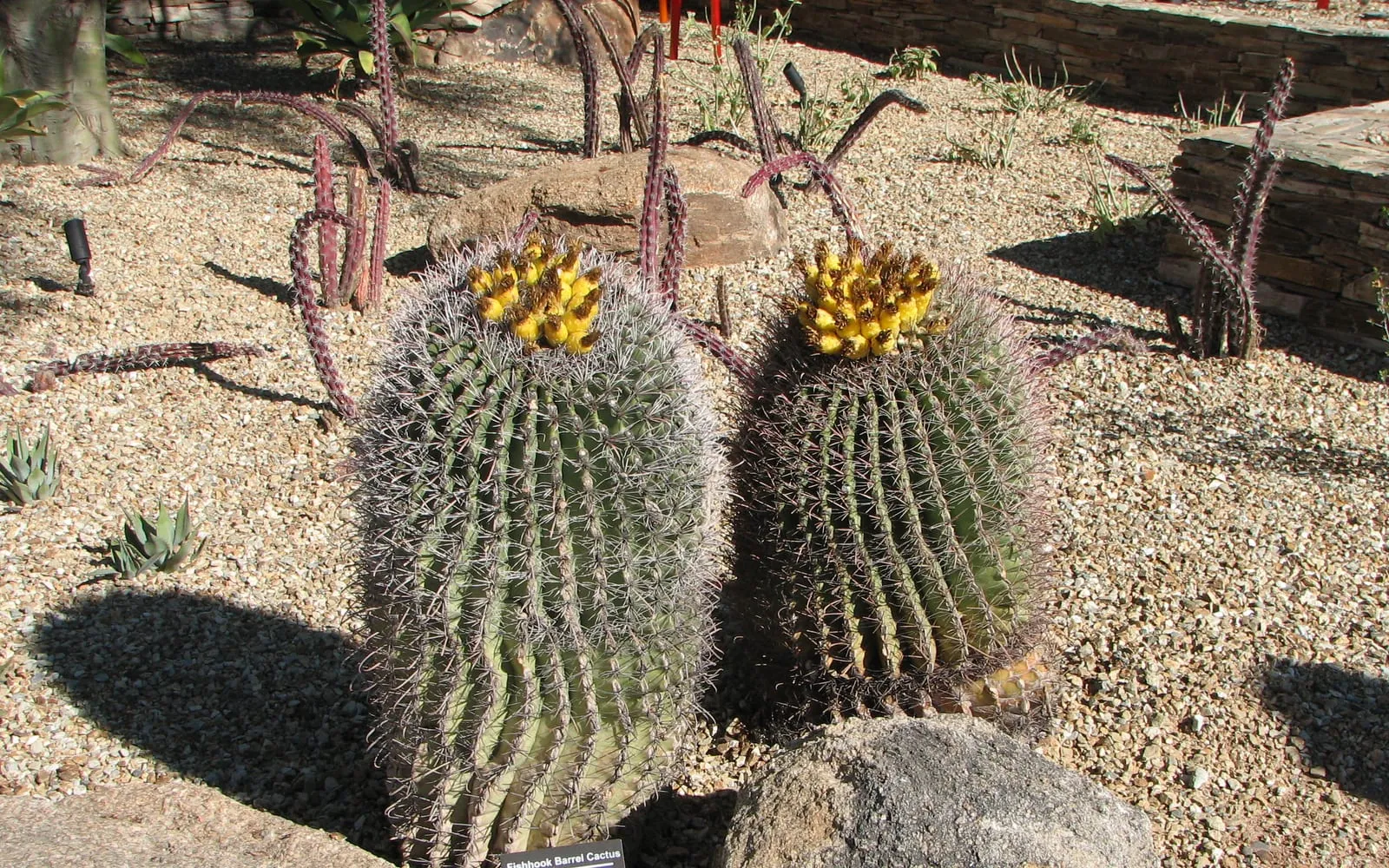
The fishhook barrel cactus is one of the most recognisable desert cacti, forming a solitary, ribbed, barrel-shaped stem armed with strong, distinctly hooked spines that give the species its common name and make it easy to identify even from a distance. Older plants develop a noticeable lean toward the south, a well-documented phenomenon caused by the south-facing side of the stem growing more slowly than the shaded north-facing side in the northern hemisphere, which has earned it the folk nickname compass cactus in parts of its native range.
It is a long-lived, slow-growing species, and old specimens found in the wild are often many decades old, their considerable girth and height a result of sustained, patient growth over a very long lifespan.
Appearance and character
A solitary, ribbed, cylindrical to barrel-shaped stem, typically with twenty or more pronounced vertical ribs, has clusters of substantial spines at each areole, the central ones distinctly hooked at the tip and often a striking red, yellow or grey depending on the individual plant. Young plants are more rounded, gradually elongating into a taller, more cylindrical barrel shape as they age.
Flowers appear in a ring around the crown of the stem in summer, typically orange, yellow or red, followed by yellow, barrel-shaped fruit that persist on the plant for some time after ripening, a useful identification feature since old dried fruit often remain visible on the crown well into the following season.
Where it is from
Rocky slopes, desert flats and grassland across the southwestern United States and northern Mexico, in one of the hottest and driest climates any widely cultivated cactus comes from, with intense summer heat and minimal, highly seasonal rainfall.
That extreme desert origin explains both its considerable drought tolerance and its need for a hot, dry summer to grow and flower well; a cool, damp temperate summer, even without frost, rarely lets this species perform at its best.
How it grows
An evergreen cactus growing slowly and steadily from the tip of its single stem, gradually increasing in both height and girth over many years. Growth is markedly slower than many other cacti, and a specimen reaching a metre or more in height represents a considerable number of years of accumulated, patient growth.
The well-documented southward lean that develops in older plants, caused by uneven growth rates between the sun-facing and shaded sides of the stem, becomes more pronounced with age and is a normal, expected feature of a mature specimen rather than a sign of stress.
Through the seasons
Spring growth resumes as temperatures rise.
Summer is the main growing and flowering season, with a ring of flowers appearing around the crown in hot, dry weather. Water occasionally during unusually extended dry, hot spells.
Autumn fruit ripens to yellow around the crown and growth slows as temperatures drop.
Winter established plants tolerate real cold provided the soil stays dry; withhold water almost entirely through this period.
Care difficulty
Easy, provided sharp drainage and strong sun are both available. This species is slow-growing and largely self-sufficient once established, asking for very little beyond the desert-like conditions it evolved for and tolerating real neglect far better than overwatering.
Watering
Occasional deep watering during hot, dry summer weather supports steady if slow growth. Withhold water almost entirely through winter, since cold, wet soil is a serious threat to this species even though it tolerates cold air reasonably well on its own.
Warning signs, diseases and pests
Scale insects and mealybug occasionally colonise the crown or the grooves between ribs, and respond to careful manual removal or a horticultural oil treatment for heavier infestations. Root rot from overwatering or poor drainage is the most serious threat this species typically faces, showing as a soft, discoloured base and, in advanced cases, a stem that becomes unstable and can topple.
A stem that has stopped growing and looks shrivelled, rather than firm and plump, usually indicates prolonged drought beyond what even this drought-tolerant species can shrug off, and a deep watering, followed by the normal dry regime, typically restores it over the following weeks.
Growing environment
Full sun is essential; this species performs poorly in any meaningful shade and needs strong, direct light to grow and flower well. Sharply free-draining, gritty or rocky soil is equally important, and this is not a species that tolerates heavy clay or poorly drained garden soil regardless of how much sun it receives.
Feeding
A low-nitrogen cactus fertiliser, applied once during the growing season, is generally enough for this slow-growing species. Many established plants in reasonably mineral soil need no supplemental feeding at all, and heavy feeding risks producing soft, weak growth uncharacteristic of the species.
Troubleshooting
The stem is soft, discoloured and unstable at the base. Suspect root rot from overwatering or poor drainage. Improve drainage significantly and reduce watering, removing any clearly rotten tissue if the plant can be saved.
The plant looks shrivelled rather than firm. Usually prolonged drought beyond what this tolerant species can handle without water. Give it a deep watering and return to the normal sparing regime once it has recovered.
The stem has developed a pronounced lean. This is the well-documented southward lean common in older barrel cacti, caused by uneven growth between the sunny and shaded sides of the stem, and is a normal feature of a mature plant rather than a problem.
A puncture wound from a hooked spine will not come out cleanly. The hooked tip can catch in skin or clothing. Work the spine out slowly in the direction it entered rather than pulling straight back, and clean the wound afterward as you would any puncture injury.
You want to move an established specimen to a new spot. A large plant is heavy and well armed, so wrap it in several layers of thick fabric or old carpet before lifting rather than relying on gloves alone, and dig a wide enough root ball to avoid unnecessary root loss, since this slow-growing species takes a long time to recover from a badly damaged root system.