
Houseplant
Ponytail palm
Beaucarnea recurvata
Also known as Elephant's foot, Bottle palm, Beaucarnea
How to grow ponytail palm, Beaucarnea recurvata. The swollen base that stores water, why it needs watering monthly rather than weekly, and its slow growth.
At a glance
- Difficulty
- Easy
- Water
- Every three to four weeks in summer and every six to eight in winter
- Light
- Bright light including several hours of direct sun
- Temperature
- 18 to 26 deg C in growth, and it tolerates down to 7 deg C
- Hardiness
- USDA 9-11, RHS H1c, hardy to 7 C
- Type
- Evergreen perennial, extremely long lived and very slow growing
- Height
- 1-1.8 m indoors, and 6 m in the wild
- Native to
- Eastern Mexico, in the semi-desert of Veracruz and Tamaulipas
- Best month
- February in the Northern Hemisphere, August in the Southern Hemisphere
Semi-desert eastern Mexico, and neither a palm nor a plant that wants palm treatment. The swollen base stores months of water, so it survives neglect and dies of routine. Outdoors year round in USDA 9 and warmer.
Hardiness zones describe winter cold alone. Summer heat, humidity, rainfall and the length of the growing season decide as much, so treat the range as the outer limit rather than as a recommendation.
Every month named in this guide is for the temperate Northern Hemisphere. If you garden in the Southern Hemisphere, shift each one by six months, so February becomes August. Closer to the equator the wet and dry seasons matter more than the calendar, and the shift stops being a useful guide.
Not known to be toxic
Ponytail palm is one of the few large architectural houseplants that is positively assessed as safe. The ASPCA lists Beaucarnea recurvata as non-toxic to cats, dogs and horses, and it is not listed by the RHS as a potentially harmful garden plant. No part of it is a recognised poisoning hazard. That makes it a useful choice for a household with animals, where most of the alternatives at a similar scale, including dracaena, yucca, dieffenbachia and the aroids, are all toxic. The only physical caution is mechanical. The leaves are long, tough and finely serrated along the edges, and drawing a hand along one can produce a shallow cut, and the leaf tips are fine enough to be worth keeping away from a small child's eyes. A cat that chews the leaves may vomit from the fibre rather than from any toxin. Where a plant is positively assessed as non-toxic rather than merely unlisted, as this one is, the position is as clear as it gets.
Sources: RHS potentially harmful garden plants, ASPCA toxic and non-toxic plants
About
The ponytail palm is not a palm, and treating it like one is how it gets killed.
It is a succulent, related to asparagus and agave rather than to any palm, and the swollen bulbous base is a water store. In the semi-desert of eastern Mexico where it grows, that base holds enough water to carry the plant through months of drought.
Indoors that means it wants watering every three or four weeks in summer and every six to eight in winter, and the compost should dry out completely in between. Watering it weekly, as you would a fern or a fig, rots the base within a season.
Beyond that it is one of the easiest houseplants there is. It tolerates dry air, low humidity, central heating, being forgotten on holiday and a good deal of neglect, and it lives for decades.
It is also extremely slow. A plant grows a few centimetres a year indoors, so buy it at the size you want it rather than expecting it to fill a corner.
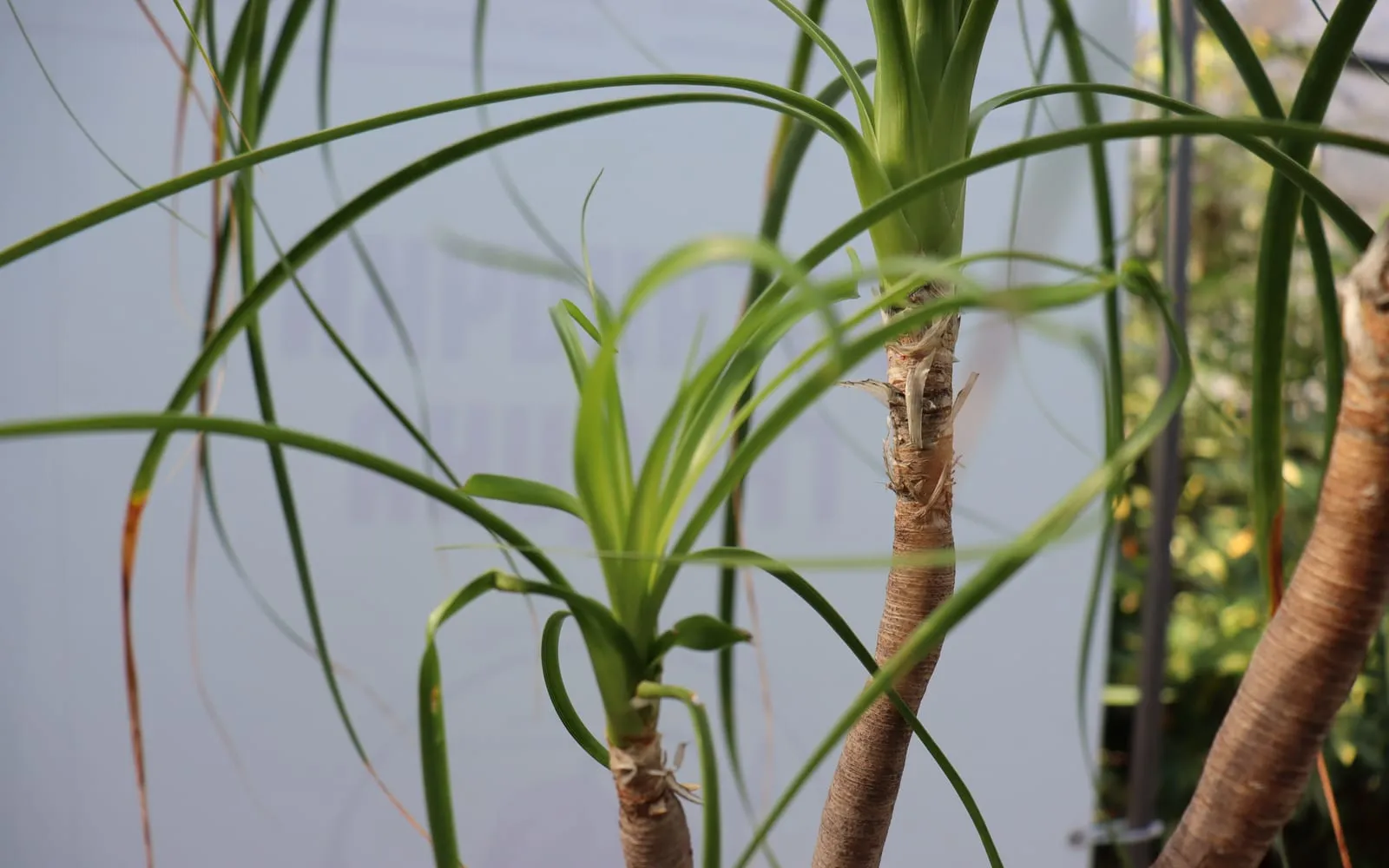
The trunk gives it its character. Grey-brown, corky, cracked and swollen at the base like an elephant’s foot, topped by a fountain of long arching leaves that curl at the ends.
Appearance and character
An evergreen succulent reaching 1 to 1.8 m indoors after many years, and up to 6 m in the wild.
The base is the plant’s signature. A swollen bulbous caudex, grey-brown, corky and cracked, which stores water and widens with age.
The trunk above it is slender and gradually thickening, usually single but sometimes branching after damage to the growing point.
Leaves are long, narrow and strap-shaped, 60 cm to 1.8 m, leathery, mid-green, arching out and downwards from the top of the trunk and curling at the tips.
Leaf edges are finely serrated and rough to the touch.
The rosette of leaves at the top gives the ponytail appearance.
Flowers are produced only on very old plants in the wild, in large creamy panicles, and never indoors.
Growth is very slow, a few centimetres a year in a pot.
Old lower leaves brown and die from the tips and are shed, which is normal.
Where it is from
Eastern Mexico, in the semi-desert states of Veracruz, Tamaulipas and San Luis Potosi, growing on dry rocky hillsides.
Its habitat has hot dry conditions with long periods without rain, which is what the swollen water-storing base is for.
It is in Asparagaceae, the same family as asparagus, agave, yucca and dracaena, and it is not related to palms at all despite the common names.
The genus was formerly placed in Nolina, and older books and some labels still use that name.
Wild populations are threatened by habitat loss and collection, and the species is listed on CITES Appendix II, which regulates international trade. Plants on general sale are nursery propagated.
It reached European cultivation in the nineteenth century and became a mass-market houseplant in the late twentieth.
Elephant’s foot is the older common name and describes the base accurately.
How it grows
Grow it in bright light, including several hours of direct sun. A south or west-facing windowsill suits it, and it tolerates less light at the cost of even slower growth.
Use a gritty free-draining cactus or succulent compost, or a loam-based compost with at least a third added grit.
Pot it into a container only slightly larger than the base, and no deeper than the plant was growing. Ponytail palms flower and grow better slightly pot-bound, and a large pot holds too much wet compost.
Use a pot with generous drainage holes and stand it on feet.
Water thoroughly, then let the compost dry out completely. Every three to four weeks in summer and every six to eight weeks from October to March is a realistic rhythm, and check with a finger rather than working to a calendar.
Water the compost rather than pouring into the crown of leaves, where water sitting causes rot.
Never let it stand in a saucer of water.
Feed weakly every six to eight weeks from April to September with a balanced or cactus feed, and not at all in winter.
Keep it above 7 deg C. It tolerates cool conditions better than most houseplants and dislikes cold combined with wet.
Wipe the leaves occasionally, since dust builds up on the long straps.
Trim brown leaf tips with scissors, following the natural taper of the leaf rather than cutting straight across.
Remove dead lower leaves by pulling them away cleanly.
Repot every three or four years at most, in spring. It grows slowly and dislikes disturbance, and top-dressing is often better than repotting.
Stand it outside in a sheltered sunny spot through July and August in a warm summer, hardening it off gradually and bringing it in before the nights turn cold.
Propagate from offsets that occasionally appear at the base, removing them in spring with a piece of root attached. Seed is slow and cuttings do not work.
Through the seasons
Winter is a rest period. Water every six to eight weeks at most, stop feeding, and keep it in the brightest position available.
Spring starts into growth from March, and this is repotting season and when feeding resumes.
Summer is the main growth period, watering every three to four weeks and feeding every six to eight.
Autumn slows down, and this is the point to stop feeding and reduce watering.
Care difficulty
Easy, and among the most forgiving houseplants available, provided the watering is right.
It tolerates dry air, central heating, low humidity, bright sun, being forgotten for a month and a wide temperature range.
The single failure mode is overwatering. Almost every ponytail palm that dies has been watered on a weekly schedule, and the swollen base goes soft and rots from the inside.
Slow growth is the other thing to accept rather than fix. Buy it at the size you want.
Watering
Water thoroughly so it runs through, then let the compost dry out completely before watering again.
Every three to four weeks in summer and every six to eight from October to March is realistic in a heated house, and the compost rather than the calendar should decide.
Push a finger well into the compost and water only when it is dry all the way down.
Never let it stand in water, and empty the saucer after watering.
Water the compost rather than the crown, since water sitting in the rosette causes rot.
The swollen base should feel firm. A base that gives to gentle pressure is rotting and is usually past saving.
Underwatering shows as wrinkling and shrivelling of the base, which recovers quickly when watered.
Warning signs, diseases and pests
A soft or squashy swollen base is rot from overwatering, which is the commonest way the plant is killed and is usually fatal by the time it is noticed. Stop watering, tip the plant out, cut away any soft tissue, and repot into dry gritty compost.
Yellowing leaves and a general decline is usually overwatering rather than anything else.
A wrinkled shrunken base is underwatering, which is easily corrected. Water thoroughly and it plumps up within a week or two.
Brown crisp leaf tips are largely unavoidable and cosmetic, caused by dry air and by the sheer length of the leaves. Trim them with scissors following the natural taper.
Whole lower leaves browning and dying is normal shedding of old foliage.
Fine mottling with faint webbing is red spider mite, which thrives in dry indoor air. Wipe the leaves and use a biological control.
White cottony masses in the leaf bases is mealybug. Wipe them off with a cotton bud dipped in alcohol.
No visible growth for a year is normal. It is a very slow plant.
Leaves flopping and pale is usually insufficient light.
Growing environment
Bright light including several hours of direct sun. A south or west-facing window is ideal, and it survives in less light and grows even more slowly.
A gritty free-draining cactus compost, in a pot only slightly larger than the base with generous drainage.
18 to 26 deg C in the growing season, tolerating down to 7 deg C in winter, which is cooler than most houseplants accept.
Low humidity is fine. This is one of the few houseplants that is happy in dry centrally heated air, and it needs no misting or pebble tray.
Allow the leaf spread, which is considerable on a mature plant and reaches well over a metre.
It suits a bright living room, a hallway with a window, a conservatory, a south-facing windowsill or a sunny office.
Grow it with the other dry-loving plants that want the same treatment. Cacti, succulents, aloe, agave, sansevieria and haworthia all share the light and the sparing watering, and grouping them means one watering routine.
The ASPCA lists it as non-toxic to cats, dogs and horses, which makes it one of the few large architectural houseplants that is safe in a household with animals.
Feeding
Feed weakly every six to eight weeks from April to September with a balanced houseplant feed at half strength, or a cactus feed.
Do not feed from October to March.
Do not overfeed. The plant grows slowly and extra fertiliser does not speed it up, and it can scorch the roots.
Top-dress with fresh gritty compost each spring rather than repotting, since it dislikes disturbance and grows better slightly pot-bound.
Repot fully only every three or four years.
Troubleshooting
How often should I water it? Every three to four weeks in summer and every six to eight in winter, letting the compost dry out completely in between. This is the single most important thing about the plant.
Is it a palm? No. It is a succulent in the asparagus family, related to agave and yucca. The swollen base is a water store, which is why it needs so little watering.
The base has gone soft. Rot from overwatering, and usually fatal by the time it is noticed. Tip it out, cut away all soft tissue, and repot into dry gritty compost, and expect the worst.
The base has gone wrinkled. Underwatering, which is easily fixed. Water it thoroughly and the base plumps up within a week or two.
The leaf tips are brown. Largely unavoidable and cosmetic, from dry air and the length of the leaves. Trim them with scissors following the natural taper rather than cutting straight across.
It has not grown at all this year. Normal. Ponytail palms grow a few centimetres a year indoors. Buy one at the size you want rather than waiting for it.
What pot should it be in? One only slightly larger than the base. A big pot holds too much wet compost and the plant grows better slightly pot-bound. Repot only every three or four years.
Is it safe for cats and dogs? Yes. The ASPCA lists it as non-toxic to cats, dogs and horses, which is unusual for a large architectural houseplant.
Can it go outside in summer? Yes, in a sheltered sunny spot through July and August in a warm summer. Harden it off gradually and bring it in before the nights turn cold.
Ponytail palm problem guides
Not sure what is wrong? See the common houseplant pests guide.